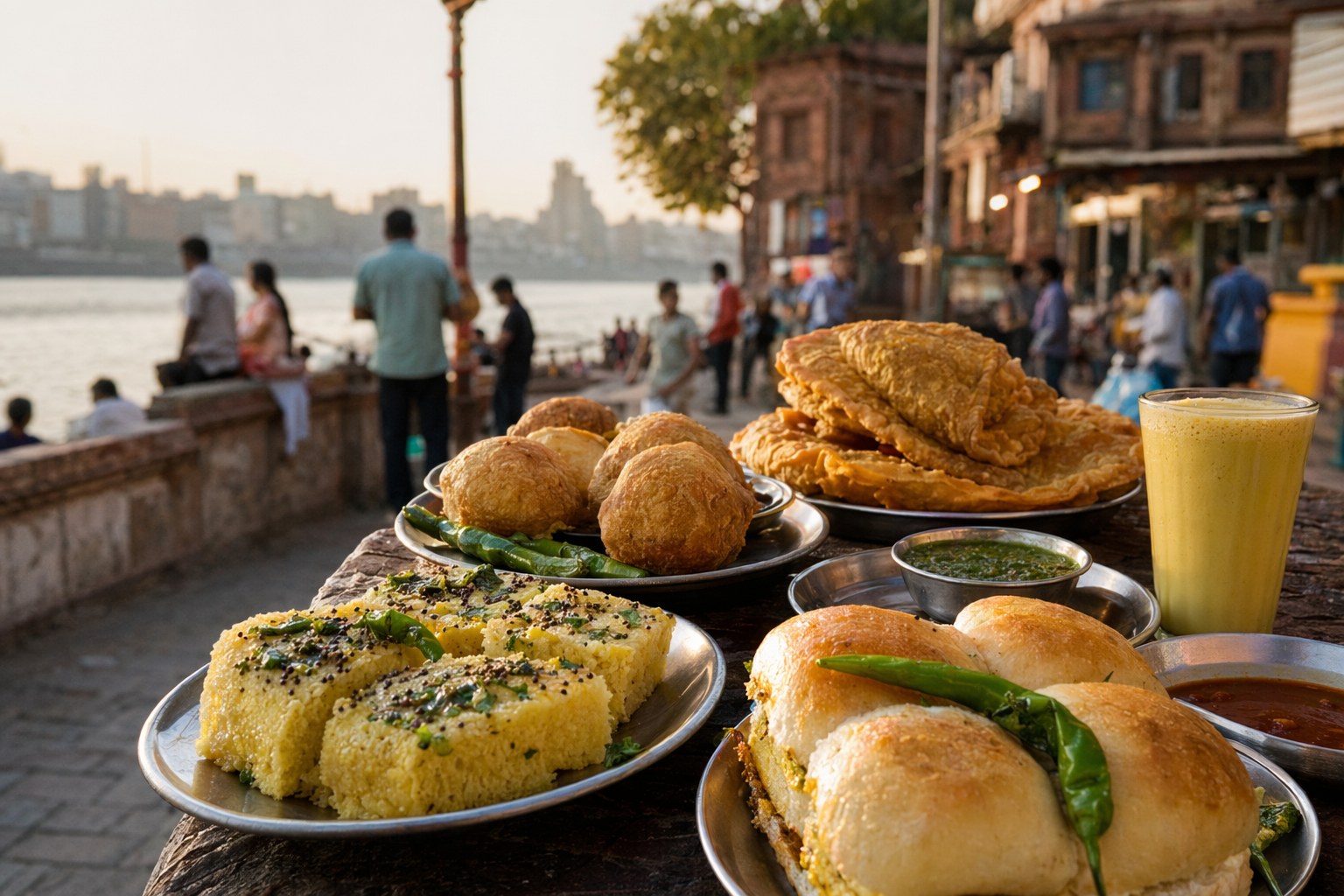
A hungry day in Surat, timed by appetite not by a clock
#Surat is one of those cities that doesn’t gently invite you to eat. It sort of grabs your wrist, drags you toward a steaming counter, and says, “Bas, try this first.” I came in thinking I’d do a neat little food walk, maybe tick off locho, ghari, some farsan, cold coco, done. Very organised, very traveler-with-a-plan. By 9:30 in the morning, I had chutney on my shirt, a half-empty paper plate in one hand, and a local uncle explaining why I had eaten the “wrong” locho first. So yeah, this is not a polished museum-guide itinerary. This is my one-day Surat food itinerary, built from walking too much, eating too fast, asking too many questions, and learning that Suratis take snacks more seriously than some people take weddings.
The beautiful thing about Surat is that it works for a one-day food trip. The city is busy, yes, and traffic can be a bit of a mood killer around office hours, but the actual eating is easy if you cluster things properly. Morning farsan in the older or central parts, a slow wander through markets and river-side pockets, a proper thali or Surti lunch, sweets in the afternoon, then Dumas-side bhajiya or a street-food dinner depending on your stamina. And please don’t come here counting calories. I mean, you can, but why would you do that to yourself?
Quick one-day Surat food schedule, if you’re the planning type
#| Time | What to eat | Where to aim for | My tiny warning |
|---|---|---|---|
| 7:30 AM | Locho, khaman, sev khamani, chai | Central Surat, Nanpura, Athwa, old farsan shops | Go early, the good stuff tastes better fresh |
| 9:30 AM | Surti breakfast round two, maybe jalebi-fafda | Local snack shops near markets | Share plates or you’ll crash before lunch |
| 11:00 AM | Market walk and light bites | Chowk Bazaar, old city lanes, Tapi-side stops | Carry water, and don’t block shopfronts for photos |
| 1:00 PM | Gujarati thali or Surti lunch | City restaurants, family dining spots | Ask for less ghee if you need, but honestly... good luck |
| 3:30 PM | Ghari, nankhatai, khari biscuits | Sweet shops in old and central areas | Buy ghari late if you’re carrying it home |
| 5:00 PM | Cold coco or fresh lime soda | Busy dairy/cold drink counters | Choose high-turnover places, always |
| 6:30 PM | Dumas bhajiya or evening street snacks | Dumas Road, beach-side stalls, busy snack lanes | Weekends get crowded, like properly crowded |
| 8:30 PM | Egg ghotala, pav bhaji, Chinese bhel, or light dinner | Ghod Dod Road, Piplod, Adajan, street-food clusters | If catching a train, don’t be heroic with spice |
7:30 AM - Start with locho, because Surat basically insists
#If you eat only one thing in Surat, make it locho. I know people say that about every city’s signature dish, but locho really does feel like Surat in edible form. It’s soft, messy, steamed, slightly lumpy, and usually served with oil, sev, green chutney, maybe garlic chutney, onions if you want, and that wonderful Gujarati confidence that says breakfast should absolutely include snacks. The name itself comes from the idea of something going a bit wrong, a “locho” or mess-up, and honestly that makes me love it more. It’s like a kitchen accident that became more famous than the intended dish.
I had my first plate standing near a counter where everyone seemed to know what they were doing except me. The vendor moved fast, the chutney was slapped on with zero hesitation, and the sev landed like golden rain. One bite and it was soft, tangy, spicy, oily in a good way, and somehow comforting. Not elegant. Never elegant. That’s the whole point. There are well-known locho places around Surat, and you’ll hear names from locals depending on which neighborhood they swear by, but my advice is simple: pick a busy farsan shop in the morning, where trays are turning over fast. Freshness matters more than a famous board sometimes.
- Order locho first, then decide if you still have space for khaman or sev khamani.
- Ask for chutney on the side if you’re not used to sharp green chilli. I learned this after pretending to be brave and then quietly suffering.
- Stand and eat if everyone else is standing. Surat breakfasts are not always sit-down poetry, sometimes they’re a delicious traffic jam.
9:00 AM - Khaman, sev khamani, and the dangerous logic of “just one more plate”
#After locho, you may think you should stop. That is sensible. It is also not very Surti. The next thing I’d do is try khaman or sev khamani. Khaman is that soft, spongy, chickpea-flour snack that people outside Gujarat often mix up with dhokla. In Surat, you’ll find versions that are sweet, tangy, spicy, and ridiculously easy to keep eating. Sev khamani is more crumbly, more snacky, and usually topped with sev, pomegranate sometimes, coriander, coconut, and a little squeeze of lime. It has this wet-dry texture thing going on that sounds odd until you taste it.
This is where traveling for food gets funny, because you start telling yourself stories. “I walked from the hotel, so I deserve this.” “It’s just steamed.” “I’ll eat a light lunch.” Lies. Sweet little lies. But I would still do it again. Morning in Surat has a particular smell, like frying oil, wet roads, incense from someone’s doorway, and chai boiling somewhere close. You’ll see office-goers, students, aunties buying farsan for home, delivery boys balancing parcels. It’s not a tourist performance. People are actually eating this stuff as part of life, and that makes it better.
A short wander before you eat again, please
#By now, you should walk. Not because of wellness or whatever, but because your stomach will send you a formal complaint if you don’t. Head toward the older parts of the city if you like markets. Chowk Bazaar and nearby lanes can be chaotic, but in the best way, with textiles, utensils, little snack shops, old buildings peeking out between signboards, and scooters appearing from angles that should not exist. Surat’s identity as a textile and diamond city is everywhere, but food keeps interrupting the view. You go to look at fabrics and end up buying khari biscuits. This happened to me. Twice.
11:00 AM - Old city nibbles, chai, and watching Surat move
#Late morning is not for a heavy meal, unless you are built differently than me. I like using this time for a slow food-travel wander. Get chai. Maybe a small packet of roasted snacks, or a khari biscuit from a bakery, or nankhatai if you see it looking fresh and crumbly. Surat has these bakery and farsan traditions that don’t always get the same attention as locho, but they’re part of the city’s everyday eating. A hot cup of chai with a salty, flaky khari biscuit while standing beside a shop counter can be as memorable as a famous restaurant meal. I know that sounds dramatic. I stand by it.
If you are near the Tapi river side or old colonial-era pockets like the area around the old fort, take a small detour. I won’t pretend Surat is a slow romantic walking city in the usual postcard sense. It’s commercial, loud, practical, sometimes dusty, and a little impatient. But that’s what I liked. Food here doesn’t feel separated from work and travel. People are eating between errands, between deals, between trains, between family visits. The city moves, and snacks move with it.
My rule in Surat became very simple: if a place has a crowd, a steaming tray, and at least one person arguing about chutney, it’s probably worth stopping.
1:00 PM - Lunch should be Gujarati, but don’t sleep on the Surti touches
#For lunch, I’d pick a Gujarati thali or a proper local family restaurant rather than more street snacks, because your body needs something that resembles a meal. A thali in Surat can bring the usual comforting parade: rotli, puri, dal, kadhi, shaak, farsan, rice, pickle, papad, maybe something sweet. The Surti style often leans into that Gujarati balance of sweet, salty, sour, spicy, and rich, all fighting and hugging at the same time. Some travelers find Gujarati food too sweet. I get it, kinda. But in Surat, when the kadhi is warm and the shaak is seasoned right and there’s a little pickle cutting through, it just makes sense.
If you’re visiting in winter, ask around for ponk. Ponk is tender green jowar, usually associated with the cooler months, and Surat is one of the places where people genuinely get excited about it. It can be served with sev, chutneys, lemon, and other crunchy bits. I once tried it sitting in a car because the place was too crowded and honestly it was perfect, little green kernels spilling everywhere while my friend kept saying “don’t waste, don’t waste.” Winter is also when you might hear more about undhiyu or ubadiyu-style preparations, those earthy, slow-cooked vegetable situations that make you feel like someone’s grandmother has taken over your afternoon.
But if it’s not winter, don’t force it. This is one mistake food travelers make, me included. We read about a seasonal dish and then demand it in May like fools. Eat what the city is eating that day. Ask the server what is good right now. Not what is famous, what is good. There’s a difference, and locals always know.
3:30 PM - Ghari time, aka the sweet that does not apologize
#Ghari is Surat’s famous sweet, and it is not shy. It’s rich, dense, often made with mawa, ghee, sugar, nuts, and fillings like pistachio, almond, or kesar. Traditionally, ghari is strongly linked with Chandi Padvo, the day after Sharad Purnima, when people in Surat buy and eat it in big quantities. But you’ll find it through the year in sweet shops, especially the established ones. I love ghari, but I also respect it. This is not a sweet you casually eat three of and then go jogging. One piece with tea or after a walk is enough for most humans.
I bought ghari in the afternoon thinking I’d take it home and share it like a responsible person. Then I ate one in the hotel room “just to check quality.” Then another half because the first one was too cold. This is how it starts. If you’re traveling onward, buy from a reputed shop and ask how long it will keep, because heat and rich dairy sweets are not best friends. If sweets are your souvenir weakness, this guide on Travel-Friendly Indian Sweets: What to Pack, Skip, and Eat First is actually useful, especially for deciding what to eat fresh in Surat and what can survive a train or flight without becoming a tragic box of melted regret.
What else to pick up with ghari
#- Nankhatai, if it smells buttery and fresh. It travels better than many wet sweets.
- Khari biscuits for chai later, though they crumble like they have personal issues.
- Dry farsan, but ask what is made today. Fresh stock makes a difference.
- Maybe not too much mawa-based mithai if you’re roaming all evening in warm weather. I hate being the boring person, but still.
5:00 PM - Cold coco, but use your traveler brain
#By late afternoon, Surat gets snacky again. This is the hour when cold coco starts looking like the best idea ever. If you haven’t had it, think chilled chocolate milk, thicker and more dessert-like, often served from busy dairy or cold drink counters. It can be wonderfully refreshing after a day of farsan, walking, traffic fumes, and your own questionable decisions. I had mine at a place where the queue moved fast and the glasses were being filled constantly, which is exactly the kind of place I prefer for chilled dairy drinks.
Small hygiene rant, sorry but not sorry: with anything cold, creamy, icy, or blended, choose a vendor with high turnover. Watch if the glasses are clean, see if the drink is stored cold, and avoid places where the container looks like it has been waiting since the last monsoon. Same logic applies to juices and smoothies when traveling. I’ve written before about how I decide when to buy chilled drinks on the road, and this piece on Smoothies While Traveling: When to Buy One, Skip It, or Grab Bottled Instead fits the cold-coco situation pretty well. I’m not saying be paranoid. Just don’t let chocolate feelings destroy your evening.
6:30 PM - Dumas bhajiya and the sea-breeze snack fantasy
#If you have the time and energy, go toward Dumas in the evening. Dumas Beach is not the prettiest beach you’ll ever see, and depending on tide, crowds, and weather, it can feel more like a snack fair near the sea than a beach escape. But that’s exactly why I like it. The drive out gives you a break from the dense city, and once you reach the area, the smell of frying bhajiya starts doing emotional work. Bhajiya near Dumas, hot and crisp, with chutney and that slightly salty air, hits different.
You’ll see stalls selling various fried things, corn, chaat, tea, and the general Indian evening-snack universe. I got a mixed bhajiya plate and burned my tongue because patience is not my gift. There was one potato slice, crisp-edged and soft inside, that I still think about. Was it objectively the best bhajiya of my life? Maybe not. Was it perfect in that moment, standing there with wind messing up my hair and families walking past with paper plates? Absolutely. Food travel is half taste and half timing. Sometimes the location seasons the food.
If you skip Dumas, stay in the city and snack smarter
#Not everyone wants to spend evening time driving out, especially if you have a train or limited transport. In that case, stick around Ghod Dod Road, Piplod, Adajan, or any busy street-food pocket recommended by your hotel or local friends. Surat has plenty of pav bhaji, chaat, sandwiches, frankies, Indo-Chinese snacks, and the kind of fusion food that purists complain about while secretly eating. I had a cheesy street sandwich once that was completely unreasonable. Too much butter, too much cheese, too much everything. I judged it for five seconds and then finished it.
8:30 PM - Dinner depends on your exit plan, and your stomach’s honesty
#Dinner in Surat is tricky after a whole food day, because your brain will still want egg ghotala, pav bhaji, dosa, Chinese bhel, or another round of farsan, while your stomach is quietly packing its bags. If you’re staying overnight, go enjoy yourself. Pick a busy street-food stretch or a casual restaurant and order one or two things to share. Egg lovers should look for local egg preparations like ghotala or spicy egg bhurji-style plates with pav. Surat does eggs with serious late-night energy, and even if you’re not usually an egg-for-dinner person, it can be a fun change.
But if you’re leaving by overnight train, please don’t be me from five years ago, ordering the spiciest thing before boarding and then pretending everything was fine. It was not fine. Keep dinner lighter, pack something sensible, and avoid risky dairy or too much fried stuff right before travel. This guide on Dinner Before an Overnight Train in India: What to Eat, Pack, and Avoid is the sort of practical advice I wish I had followed before learning the hard way. Surat Railway Station is busy, and the last thing you want is a stomach rebellion when you’re sharing a berth with strangers and one tiny bottle of water.
How to move around without wasting your whole food day
#Surat is not impossible to navigate, but don’t underestimate distances and traffic. Auto-rickshaws, app cabs, and local help from hotel staff can save you a lot of time. If you’re doing old-city breakfast and market wandering, do that together. Don’t bounce from Dumas to Chowk Bazaar to Adajan to Nanpura like a confused pinball. You’ll spend more time in traffic than eating, which is just sad. I usually plan Surat like this: morning in central or old areas, lunch not too far from where I already am, afternoon sweets nearby, evening either Dumas or a modern street-food zone, not both unless I’ve got a driver and the patience of a saint.
- Start early. Surat snacks taste best when the trays are fresh and the city is just waking up.
- Carry cash in smaller notes. Many places take digital payment, but small cash still saves awkward moments.
- Share everything. One plate each sounds fun until the fourth stop, then nobody is laughing.
- Ask locals specific questions, like “where do you eat locho near here?” not “best food in Surat?” The second question starts debates.
My honest favorites, and the things I’d do differently next time
#My favorite bite of the day was still the morning locho. Not because it was fancy, but because it was the most Surat thing I ate, messy and warm and full of personality. Ghari was the thing I most wanted to carry home, though I’d buy it later next time instead of walking around with a sweet box like it was a newborn baby. Cold coco was the biggest relief. Dumas bhajiya was the most atmospheric. The thali was the best reset between snack attacks. See, I can’t pick one. That’s the problem with Surat.
What would I do differently? I’d bring one extra person just to share more dishes. Solo food travel is romantic until you realise you can’t order six snacks without consequences. I’d also spend more time asking about seasonal foods, especially ponk in winter. And I’d leave space for random discoveries, because some of the best Surat bites are not on lists. They’re the things your rickshaw driver points at, or the shop your cousin’s friend’s aunt insists is better than the famous one, or the counter you only notice because ten people are waiting with that very serious snack face.
Final Surat food thoughts, from one overfed traveler to another
#A one-day Surat food itinerary is not about finishing a checklist. It’s about catching the rhythm of the city: steamed breakfast, market wandering, sweet shopping, cold drinks, fried evening snacks, and dinner that may or may not be a good idea depending on how ambitious you got earlier. Surat doesn’t do delicate little tasting portions. It feeds you like it means it. And if you let the day unfold a bit, without trying to control every bite, the city becomes ridiculously fun.
So go hungry, wear comfortable shoes, don’t be too proud to share plates, and keep a little empty space in your bag for sweets. Also keep a little empty space in your plan, because Surat will fill it, probably with something fried. If you’re into these messy, delicious food-travel rambles, I keep finding myself browsing more stories and ideas on AllBlogs.in when I’m planning the next edible adventure.