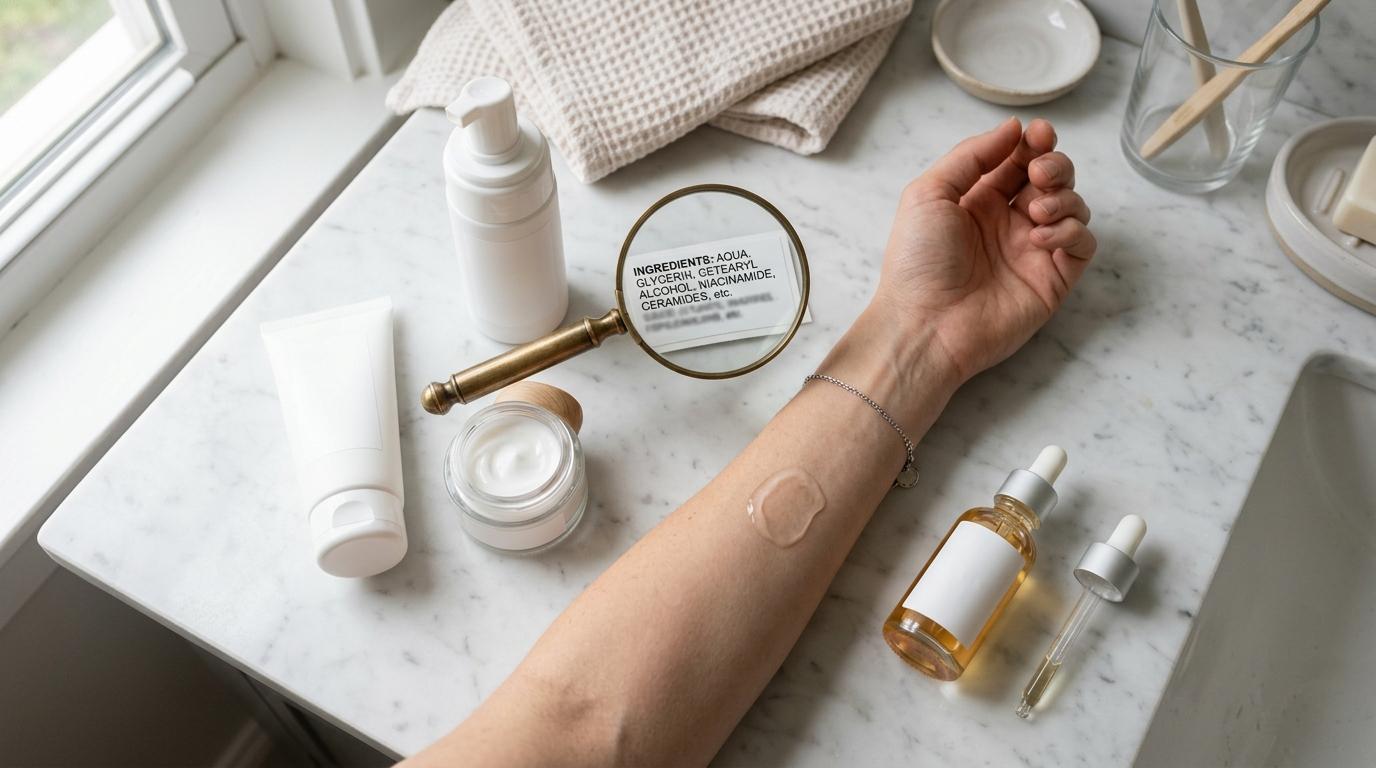
To patch test skincare products, apply a small amount to a clean, discreet area of skin, like your inner forearm, twice a day for 7 to 10 days. Use the product the same way you normally would. If it is a leave-on moisturiser or serum, leave it on. If it is a cleanser, rinse it off as directed.
If you notice burning, swelling, a rash, intense itching, blistering, or redness that keeps getting worse, stop using it and gently wash it off.
That is the short version. But the smarter skincare decision usually starts before the product ever touches your skin.
Because skincare labels can be a lot.
One bottle says “dermatologist-tested.” Another says “hypoallergenic.” A serum promises a “clean” formula. A foundation says “non-comedogenic.” It all sounds reassuring, especially when the packaging is pretty and the reviews are glowing. But those words do not always mean what we assume they mean.
This guide will help you read skincare labels with more confidence, understand common claims like hypoallergenic, non-comedogenic, and fragrance-free, and patch test sunscreen, moisturiser, cleanser, serum, or makeup before using it all over your face.
Quick answer: what should you do before trying new skincare?
#Before putting a new product straight onto your face, do two things:
- Read the label properly. Look for fragrance, active ingredients, directions, warnings, and claims like non-comedogenic, hypoallergenic, or fragrance-free.
- Patch test first. Apply a small amount to one discreet area for 7 to 10 days and watch for burning, swelling, rash, bumps, redness, itching, or blistering.
And if your skin reacts, stop. Not “maybe I’ll try it one more time.” Not “maybe my skin is purging.” Not “but it was expensive.” Just stop, wash it off gently, and give your skin a break.
Why skincare labels can be so confusing
#Skincare labels are part useful information, part marketing.
The ingredient list, directions, and warning section are the bits you really want to pay attention to. The big claims on the front of the bottle can be helpful sometimes, but they can also be vague.
For example, the FDA says cosmetic products and ingredients generally do not need premarket approval before they are sold, except in certain cases such as color additives. The FDA also says there is no federal standard for the word hypoallergenic.
In normal-person language, that means a brand can call a product hypoallergenic, but it does not guarantee your skin will be fine with it.
That does not mean every label claim is useless. It just means you should treat those claims as clues, not promises.
Skincare label terms: what they actually mean
#What to check on a skincare label before buying
#You do not need to become a cosmetic chemist. You just need to slow down for a minute and look at a few practical things.
1. What the product is actually for
#Start with the obvious question: what is this product supposed to do?
A cleanser should cleanse. A moisturiser should help support hydration. A sunscreen should be used as directed for sun protection. A serum may contain more targeted ingredients, so it deserves a closer look.
If the label is packed with dramatic promises but does not clearly explain how to use the product, that is a reason to pause. Good skincare does not need to sound like a miracle.
2. Directions for use
#The directions matter more than people think.
Some products are meant to stay on your skin. Some are meant to be rinsed off. Some are for daytime only. Some tell you to avoid the eye area. Sunscreen, especially, should be used according to the label directions.
Patch testing should follow the same logic.
If you are testing a leave-on moisturiser, serum, sunscreen, or foundation, leave it on. If you are testing a cleanser, apply it briefly and rinse it off, because that is how the product is meant to be used.
3. Fragrance and scent claims
#If your skin gets irritated easily, fragrance is worth checking.
Fragrance-free is usually a clearer label than “unscented,” especially if you already know scented products bother your skin. But fragrance-free still does not mean “impossible to react to.” It simply means there is no added fragrance for scent. Your skin may still dislike another ingredient in the formula.
4. Strong or active ingredients
#Some products are more active than others, especially products marketed for acne, brightening, dark spots, exfoliation, texture, or anti-ageing.
Be careful with the idea that tingling means a product is “working.” Sometimes tingling is just your skin politely asking, “What are we doing?”
A mild unfamiliar feeling can happen with some products. But burning, swelling, intense itching, or a rash is not something to push through.
5. The full ingredient list
#The first few ingredients usually make up a large part of the formula, but ingredients lower down can still matter. This is especially true if you are sensitive to a particular preservative, fragrance ingredient, dye, essential oil, or botanical extract.
If you have reacted to skincare before, it can help to keep a simple note on your phone with:
- The product name
- What happened
- How quickly the reaction appeared
- Any ingredients you suspect
It is not glamorous, but it can be surprisingly useful, especially if you ever need to speak with a dermatologist.
Why you should patch test skincare products
#Even a product with thousands of five-star reviews can irritate your skin.
Even a gentle-looking moisturiser can cause a rash.
Even a non-comedogenic foundation can break you out.
That does not mean your skin is “bad” or the product is automatically terrible. It just means skin is personal. What works beautifully for one person can be a disaster for someone else.
The American Academy of Dermatology recommends testing skin care products before using them routinely. A home patch test is a simple way to see whether your skin shows obvious signs of irritation or an allergic-type reaction before you use the product more widely.
A home patch test is not perfect. It will not predict every breakout, and it is not the same as medical allergy testing from a dermatologist. But it can help you catch many obvious problems while they are still limited to a small patch of skin.
That is much better than discovering your face hates something after you have applied it everywhere.
Step-by-step checklist: how to patch test skincare products
#Use this cautious approach when trying a new cleanser, moisturiser, sunscreen, serum, or makeup product.
- Test one product at a time. Do not start a whole new routine at once. If your skin reacts, you will have no idea which product caused it.
- Choose a clear test area. The inner forearm or the bend of the elbow usually works well. The skin should be clean, dry, and free from cuts, rash, sunburn, or irritation.
- Apply a small amount. You only need a small amount on the same spot each time. No need to cover a large area.
- Use it the way it is meant to be used. If it is a leave-on product, leave it on. If it is a wash-off product, rinse it off as directed.
- Repeat twice a day. Apply the product to the same test spot twice daily, unless the product directions say otherwise.
- Continue for 7 to 10 days. Some reactions show up quickly. Others take repeated use. A longer test gives your skin more time to tell you if something is wrong.
- Watch the area closely. Look for burning, swelling, redness, raised bumps, itching, rash, blistering, or tenderness.
- Stop if your skin reacts. Gently wash the product off and do not keep testing it.
- If everything looks normal, introduce it slowly. If there is no reaction after 7 to 10 days, you can try using the product more normally. For face products, it can still be smart to start on a small facial area before applying it everywhere.
Where should you patch test a face product?
#For a first test, the inner forearm or the bend of the elbow is practical. It is easy to see, easy to wash, and easy to cover if needed.
If that area stays calm for 7 to 10 days but you are still unsure, try a small amount near your jawline before using it across your whole face. This can be especially useful for makeup, moisturiser, sunscreen, or anything you plan to wear for several hours.
One important note: arm skin and face skin are not exactly the same. Passing a patch test does not guarantee you will never break out or feel irritated on your face. It just lowers the chance of a bigger, more obvious reaction.
What reactions mean you should stop?
#Stop using the product and gently wash the area if you notice:
- Strong burning
- Burning that does not settle
- Swelling
- A rash
- Intense itching
- Raised bumps
- Blistering
- Redness that keeps getting worse
- Pain or unusual tenderness
Do not keep applying the product to “build tolerance.” That can make things worse.
This guide is not medical advice or a treatment plan. It is a safety-first way to decide whether a product deserves a place in your routine.
When should you ask a dermatologist?
#Speak with a dermatologist or qualified medical professional if:
- A rash continues after you stop using the product
- Swelling, burning, or itching feels severe
- The reaction spreads beyond the test area
- You keep reacting to different skincare or makeup products
- You are not sure whether a product is safe for your skin history
A dermatologist can help you work out what may be causing the reaction. Try not to diagnose yourself using only product labels, TikTok comments, or review sections.
How to patch test different product types
#Sunscreen
#Patch test sunscreen like any other leave-on product. Apply it to the test area and leave it on as directed.
If your skin reacts, stop using that sunscreen.
Also, do not make DIY sunscreen or rely on homemade mixtures for sun protection. Sunscreen should be used according to the product label.
Moisturiser
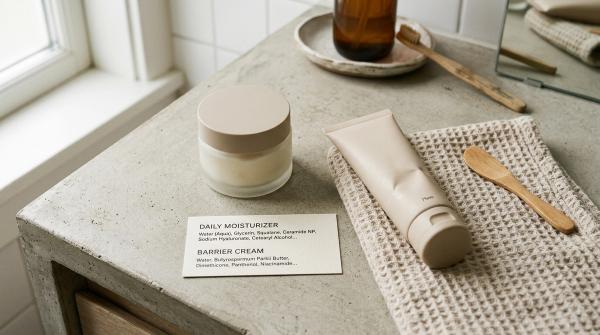
#Apply a small amount to the test area twice daily. Since moisturiser is usually a leave-on product, let it stay on unless irritation appears.
If it causes burning, swelling, rash, or intense itching, wash it off and stop using it.
Cleanser
#A cleanser is a wash-off product, so do not leave it sitting on your skin all day.
Apply it to the test area, rinse it off as directed, and repeat during the test period.
Serum
#Serums can be a little trickier because some contain more active ingredients. Patch test carefully, and avoid layering several new serums at the same time.
If a serum burns, causes swelling, or leaves a rash, stop using it.
Makeup
#Foundation, concealer, primer, blush, bronzer, and other makeup can contain pigments, preservatives, fragrance, oils, and other ingredients that may irritate some people’s skin.
Patch test leave-on makeup the same way you would patch test a moisturiser.
A simple rule for buying skincare online
#Before you add a new product to your basket, ask yourself:
- Do I understand what this product is for?
- Do the directions make sense?
- Is the product relying on vague buzzwords?
- Does it contain fragrance, if I usually avoid fragrance?
- Am I buying this because it suits my skin, or because it is trending?
- Am I willing to patch test it for 7 to 10 days before using it properly?
That last question is a good reality check. If a product feels too urgent to test, the hype may be doing the shopping for you.
Beginner-friendly routine advice
#If you bought several new products, slow down.
Do not start a new cleanser, serum, moisturiser, sunscreen, and foundation on the same day. If your skin becomes red, itchy, bumpy, or irritated, you will not know what caused it.
A calmer approach looks like this:
- Patch test one product.
- Introduce it slowly.
- Wait before adding the next new product.
- Keep notes if your skin reacts.
It is not exciting. It does not make for a dramatic skincare haul. But most skin prefers boring consistency over sudden experiments.
Source-aware notes
#This guide uses conservative wording from dermatology and regulator sources: patch testing is a precaution, not a diagnosis; cosmetic label terms are not guarantees; and persistent or severe reactions should be discussed with a qualified dermatologist.