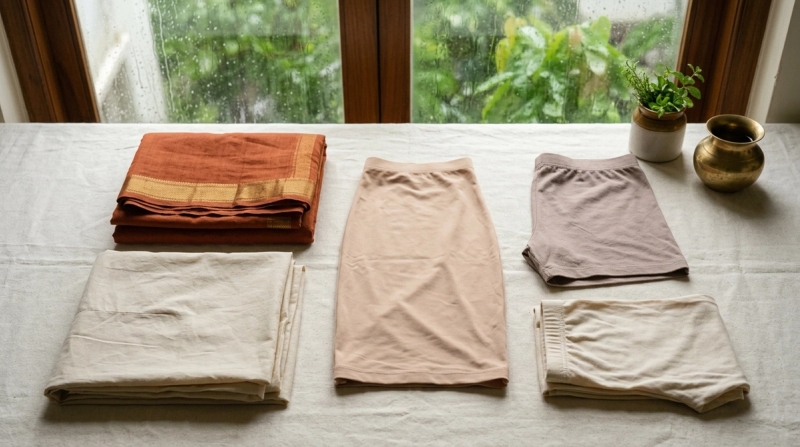
Quick answer: In humid weather, wear a breathable petticoat for everyday comfort and pleat support, saree shapewear for a smoother base under sheer or clingy sarees, and anti-chafing shorts if thigh rubbing is your main problem. Leggings or slip shorts can work for casual and modern drapes. Avoid very tight shapewear for long hours, and stop wearing it if you feel numbness, pain, rash, swelling or irritation.
What you wear under a saree in humid weather can honestly decide how your whole day goes.
You may love the saree, the blouse may fit perfectly, the pleats may look neat in the mirror — and then one metro ride, one sudden rain splash or one long wedding queue later, everything starts feeling sticky, tight or uncomfortable.
That is the thing about humidity. It changes the rules.
A saree underlayer that feels fine at home can feel completely different when you are walking fast, sitting for hours, climbing stairs, travelling, sweating or dealing with monsoon dampness. So the choice between a petticoat, saree shapewear, anti-chafing shorts or leggings is not just about the look. It is about comfort, movement and how your body feels through the day.
In general:
- A breathable petticoat is great for airflow, comfort and strong pleat support.
- Saree shapewear gives a smoother base under sheer, flowy or clingy sarees.
- Anti-chafing shorts help if thigh rubbing is your main issue in the heat.
- Leggings or slip shorts can work for casual sarees, travel and modern drapes.
There is no one perfect answer for every saree. A cotton office saree, a chiffon travel saree, an organza wedding saree and a heavy silk family-function saree may all need different underlayers.
So let’s break it down in a simple, realistic way.
Quick Decision Table: Petticoat vs Shapewear vs Shorts vs Leggings
#Option 1: The Breathable Petticoat
#The petticoat is still the classic saree underlayer for a reason. It gives the saree something to sit on, keeps the pleats in place and offers coverage without clinging too much to the body.
And in humid weather, that little bit of breathing space really helps.
If you are choosing between a saree petticoat and shapewear for a regular day, the petticoat often wins on comfort. It is especially good with cotton sarees, linen sarees, handloom sarees and heavier silks because these fabrics usually need proper pleat support and a secure tuck.
A slightly loose, A-line petticoat allows more air to move around your legs. That may sound like a small thing, but on a sweaty day, it makes a big difference.
When a petticoat works best
#Choose a petticoat if:
- You are wearing an opaque saree.
- Your saree is cotton, linen, handloom or silk.
- You need strong pleat support.
- You will be walking, sitting, commuting or climbing stairs.
- You do not like compression around your waist, hips or thighs.
- You want something simple and budget-friendly.
- Your saree is heavy and needs secure tucking.
For office, college, daily errands and family visits, a soft cotton or poplin petticoat is often the easiest choice. It is familiar, breathable and easy to adjust if the saree starts feeling uncomfortable during the day.
Where petticoats can feel annoying
#Most petticoat problems come from the waistband.
A thick drawstring can dig into your waist, especially when your skin is sweaty. The knot can create a bump under thin sarees. If you tie it too tight, sitting after lunch can feel like a punishment.
Then there is the monsoon problem. A thick cotton petticoat can take ages to dry if the hem gets wet from rainwater or road splash. You may not notice it at first, but walking around with a damp underlayer is uncomfortable and can irritate the skin.
Petticoats can also add bulk under very light sarees like chiffon, georgette, satin-finish fabrics or organza. If the fabric is stiff or thick, the saree may not fall as smoothly as you want.
What to look for in a humid-weather petticoat
#Look for:
- Lightweight cotton, poplin cotton or another breathable fabric.
- An A-line or slightly flared shape for easy walking.
- A soft, flat waistband instead of a thick rope-like drawstring.
- A side slit or enough flare around the legs.
- A length that does not drag in rainwater.
- A colour that does not show through your saree.
- Fabric that feels soft against sweaty skin.
If you like petticoats but hate the waist pressure, try one with a flat waistband. It sounds like a tiny change, but it can make the whole saree feel more comfortable.
Option 2: Saree Shapewear
#Saree shapewear is a fitted, stretchy underlayer that many people wear instead of a traditional petticoat. It usually has a wider waistband and a tapered or mermaid-style shape.
The main reason people love it is the finish. It gives the saree a smoother fall, reduces bulk and removes the visible drawstring knot that can show under thinner fabrics.
It works especially well under chiffon, georgette, satin, lightweight crepe and some organza sarees. Basically, if your saree is sheer, flowy or clingy, shapewear can make the drape look cleaner.
When saree shapewear works best
#Choose saree shapewear if:
- Your saree is sheer, light or clingy.
- You want a smooth base without a drawstring knot.
- You are dressing for a wedding, reception, party or special event.
- You want the pleats to stay neat for photos.
- Your saree fabric shows every bump and fold underneath.
- You prefer a more streamlined silhouette.
Good saree shapewear can also dry faster than a thick cotton petticoat, depending on the fabric. That can be useful during monsoon if you get splashed or caught in light rain.
Where shapewear can go wrong
#Shapewear is not always the magical comfort solution it is advertised to be.
In humid weather, thick synthetic shapewear can trap heat and sweat. If the waistband is too tight, it may feel fine for the first hour and then become unbearable after sitting, eating or travelling.
Movement is another thing to check. Some saree shapewear is too narrow around the knees, which makes walking fast, climbing stairs or getting into a cab awkward. If there is no slit, flare or enough stretch, you may feel like your steps have suddenly become half their normal size.
And honestly, no saree look is worth feeling trapped for hours.
Safety note before wearing shapewear
#Do not wear tight saree shapewear all day in humid weather just because it makes the saree look smoother.
It should not cause:
- Numbness
- Pain
- Rashes
- Swelling
- Skin irritation
- Difficulty breathing
- Deep marks on the skin
- Trouble sitting or walking normally
If any of these happen, remove it and stop wearing it.
You should be able to breathe, sit, walk, climb stairs and eat comfortably. A smooth saree fall is nice, but comfort and safety matter more.
What to look for in saree shapewear
#Look for:
- Soft, stretchable fabric.
- A wide waistband that supports without digging in.
- Some moisture control or quick-drying quality, if possible.
- A side slit, flare or enough stretch for movement.
- A size that does not roll down, pinch or squeeze.
- A length that works with your saree and footwear.
- Fabric that does not feel rough when you sweat.
One important tip: do not size down for extra compression. In humid weather, that usually backfires. You may get a slightly more “snatched” look for a few minutes, but you will pay for it once the heat, sweat and sitting begin.
Option 3: Anti-Chafing Shorts
#Anti-chafing shorts, also called slip shorts, are not always meant to replace a petticoat. Their main job is much simpler: they stop your thighs from rubbing together.
And for many saree wearers, this is the real problem in humid weather.
Sweat plus walking plus friction can make your inner thighs sore, red or irritated. Even if the saree itself is comfortable, chafing can ruin the whole experience. Anti-chafing shorts create a soft layer between the thighs so the skin does not rub directly.
When anti-chafing shorts work best
#Choose anti-chafing shorts if:
- Your thighs rub when you walk.
- You have a long commute.
- You travel by train, bus, metro or on foot.
- You sweat a lot in humid weather.
- You are wearing a saree for many hours.
- You want extra comfort under a petticoat.
- You often get irritation during weddings, office days or travel.
Anti-chafing shorts work especially well under a breathable petticoat. That combination gives you airflow, pleat support and protection from friction. For hot and humid days, it is a very practical setup.
Can you wear only anti-chafing shorts under a saree?
#Sometimes, yes. But not always.
Anti-chafing shorts alone may work under a casual saree, a pre-stitched saree or a modern relaxed drape, especially if the saree is not sheer and the waistband can hold the pleats.
But for a regular saree drape, they may not give enough structure. They may not hold pleats securely, especially if the saree is heavy. They also may not offer enough coverage under transparent or very light fabrics.
So for most traditional drapes, anti-chafing shorts are better as an extra comfort layer, not the main underlayer.
What to look for in anti-chafing shorts
#Look for:
- Lightweight, breathable fabric.
- A smooth waistband that does not roll down.
- Mid-thigh length, or the length that works for your body.
- No thick seams that show through the saree.
- Quick-drying fabric for monsoon days.
- A snug fit that is not tight.
- Soft fabric that does not irritate sweaty skin.
If you are already wearing fitted saree shapewear, avoid adding shorts unless you really need them. Too many tight layers in humidity can feel hot, heavy and irritating.
Option 4: Leggings or Slip Shorts
#Leggings, cycling shorts, structured pants and slip shorts are sometimes used instead of a petticoat, especially with modern saree drapes.
This can work nicely for pant-style sarees, dhoti-style drapes, pre-stitched sarees, travel looks and casual lightweight sarees. They are also useful when you want more freedom to walk, sit or move around without worrying too much about the saree opening.
In windy or rainy weather, leggings or pants can also make you feel more secure.
When leggings or slip shorts work best
#Choose leggings or slip shorts if:
- Your saree is lightweight.
- You are wearing a modern, pant-style or dhoti-style drape.
- You need easy movement for travel.
- You do not need the traditional flared saree shape.
- The waistband can hold the pleats properly.
- You are going for a casual or fusion look.
- You want extra coverage in wind or rain.
Where leggings and slip shorts struggle
#Regular leggings are not designed to hold saree pleats. If the saree is heavy, the waistband may fold, sag or shift. That can get annoying very quickly.
Cotton leggings can also hold sweat, which is not ideal in humid weather. They may feel comfortable at first, but after a few hours, they can become damp and clingy.
Slip shorts are comfortable, but they do not always give enough structure for a normal saree drape. And if your saree is sheer, always check the opacity in natural light before leaving the house. Indoor lighting can be very misleading.
How to Choose by Occasion
#For office wear
#For office, a breathable petticoat is usually the safest and most comfortable choice, especially with cotton, linen, handloom or opaque sarees.
It gives you proper pleat support, enough airflow and freedom to sit, walk and commute without feeling squeezed. You can also adjust it easily if needed.
If you wear chiffon, georgette or lightweight sarees to work, light saree shapewear can work too. Just make sure it is not restrictive. You need to sit through meetings, walk around, eat lunch and maybe commute in heat. Comfort should matter more than a super-fitted shape.
If thigh rubbing bothers you during your commute, wear anti-chafing shorts under your petticoat.
For weddings and receptions
#For sheer, embellished, flowy or photo-heavy sarees, saree shapewear can give a cleaner base than a bulky petticoat. It can make the saree fall better and help the pleats look neater.
But do not wear new shapewear directly to an event without testing it first.
Try it at home. Walk around. Sit down. Climb stairs. Bend a little. Take normal steps. If it feels restrictive in 10 minutes, it will not feel better after 5 hours of ceremonies, food, photos and dancing.
For heavy silk sarees, a sturdy petticoat may still be the better option. Heavy sarees need strong support, especially when the pleats are thick.
For college and everyday errands
#For college, errands and everyday wear, comfort comes first.
A lightweight cotton petticoat is usually enough for daily sarees. If you deal with thigh chafing, add anti-chafing shorts. For relaxed or casual drapes, slip shorts may also work.
Avoid anything too tight if you will be walking around campus, sitting for long classes, travelling in heat or climbing stairs. Your saree should not need fixing every 15 minutes.
For travel
#For travel, think about movement, sweating and drying time.
If you are wearing a regular saree drape, anti-chafing shorts under a light petticoat can be very useful. You get support plus comfort while walking or sitting for long hours.
For modern drapes, leggings, structured pants or slip shorts may be easier than a traditional petticoat. They allow better movement and can feel more secure during flights, trains, road trips or sightseeing.
Avoid long, heavy cotton underlayers that can get wet and stay damp. Also avoid tight shapewear for long journeys because travel is already uncomfortable enough.
Humidity and Monsoon Comfort Tips
#1. Choose breathable fabrics first
#In humid weather, fabric matters a lot.
Cotton, poplin cotton, lightweight modal blends and thin quick-drying fabrics are usually more comfortable than thick, shiny or heavy fabrics that trap heat.
A breathable petticoat is a good choice, but check the thickness. Very heavy cotton can still feel hot and may take forever to dry in monsoon weather.
2. Be careful with the waistband
#The waistband can make or break the whole outfit.
A tight drawstring can cut into your waist. A rolling elastic band can irritate your skin. A bulky knot can show through thin sarees. A hard waistband can feel worse once you start sweating.
A flat, soft, secure waistband is usually the most comfortable option.
If you are wearing shapewear, do not size down. If you are wearing a petticoat, tie it firmly enough to hold the pleats, but not so tight that sitting becomes uncomfortable.
3. Test walking, stairs and sitting
#Do not judge your saree underlayer only while standing in front of a mirror.
A saree can look perfect while you are standing still and still feel terrible once you start moving.
Before wearing it out, try:
- Walking fast
- Climbing stairs
- Sitting on a chair
- Sitting in a car or cab
- Bending slightly to adjust footwear
- Taking normal-length steps
- Sitting after eating
- Turning and moving naturally
If your knees feel restricted, the waistband digs in, or the saree pulls strangely, change the underlayer before you leave.
4. Think about rain splash
#During monsoon, the lower hem gets wet very easily.
Thick cotton petticoats can stay damp for hours. Lighter synthetic or blended fabrics may dry faster, but they should still feel breathable and soft on your skin.
Also check the length. If your underlayer is too long, it can collect rainwater, mud and street splash. That is uncomfortable and unhygienic.
5. Match the underlayer to the saree weight
#This is the simplest rule:
A heavy silk saree needs a strong base.A light chiffon saree needs a smooth base.A daily cotton saree needs a breathable base.A travel saree needs easy movement.A monsoon saree needs something that will not stay wet forever.
Do not force one underlayer to work with every saree you own. It may work sometimes, but it will annoy you on other days.
Related AllBlogs Reads
#If you want to build this topic into a practical outfit cluster, add internal links to these existing AllBlogs guides where relevant:
- Anti-Chafing Shorts vs Balm vs Powder: What Should You Buy?
- Cotton vs Modal vs Bamboo Innerwear: Best Fabric for Humid Weather
- Monsoon Wedding Guest Packing List India: Clothes, Shoes, Gifts
- Best Fabrics for Monsoon Office Wear in India
Final Verdict: What Should You Wear?
#There is no single best thing to wear under a saree in humid weather.
Choose a breathable petticoat if you want airflow, comfort and strong pleat support for everyday sarees.
Choose saree shapewear if you want a smooth base under sheer, clingy or dressy sarees, but avoid tight compression for long hours.
Choose anti-chafing shorts if thigh rubbing is your biggest discomfort in heat and humidity.
Choose leggings or slip shorts for lightweight sarees, travel, casual looks or modern drapes where traditional pleat support is not the main concern.
The best saree underlayer is the one that lets you move, sit, climb stairs, commute, handle humidity and enjoy your day without constantly adjusting your drape.