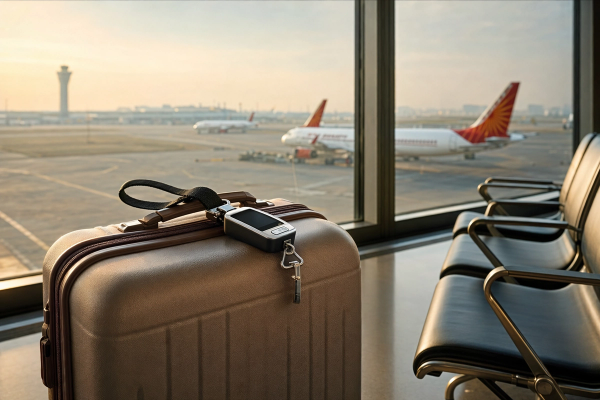
If you’ve ever stood in an Indian airport security line with your backpack half open, laptop in one tray, belt in another, passport in your teeth basically... then yeah, you already know how chaos begins. Now add one innocent-looking power bank to that scene. Suddenly everybody acts like you’re carrying some mysterious device from a spy movie. I’m writing this because I’ve gone through this on international flights from India more than once, and trust me, power bank rules are one of those small travel things that can mess up your whole trip if you ignore them.
The annoying part is, a lot of people still think, "arre charger hi toh hai," and toss it into check-in baggage. Big mistake. I saw a guy at Delhi airport almost lose his expensive 20,000 mAh power bank because he had packed it inside his suitcase. Security pulled the bag aside, opened it, and then the whole family started arguing about whose idea it was. Flight almost boarding, stress full on. So let’s just make this simple and real - if you’re flying international from India, especially from airports like Delhi, Mumbai, Bengaluru, Hyderabad, Chennai, Kochi, Kolkata, you need to know the battery rules before reaching the terminal.
The one rule you really, really should not forget
#Power banks are not allowed in checked baggage on most airlines. Full stop. They must go in your cabin baggage, not the suitcase you hand over at check-in. This is because power banks use lithium-ion batteries, and those can overheat or catch fire in rare situations. In the cabin, if something goes wrong, crew can respond. In the aircraft hold... well, that’s exactly what airlines and regulators don’t want.
This isn’t just some random airline tantrum either. Airlines flying out of India generally follow DGCA safety practice along with IATA-style lithium battery restrictions. Across most carriers, spare lithium batteries and power banks are treated as carry-on only items. That includes Air India, IndiGo on international sectors, Vistara back when many people flew it, Akasa on applicable routes, and foreign airlines departing India too. Sometimes wording changes a bit, but the basic rule stays the same.
If you pack your power bank in check-in luggage, best case they remove it. Worst case your bag gets delayed, opened, flagged, and your airport mood is ruined before the trip even starts.
How much power bank capacity is allowed on international flights from India?
#Okay, this is where people get confused because brands print capacity in mAh, but airline rules often talk in Wh, meaning watt-hours. Most passengers from India are carrying power banks labelled 10,000 mAh, 20,000 mAh, sometimes 30,000 mAh if they’re travelling long-haul and pretending they’ll work productively on the plane. I’ve done that too, no judgement.
The most commonly accepted limit is up to 100 Wh without needing special airline approval. From 100 Wh to 160 Wh, some airlines may allow it only with prior approval, but honestly for normal travellers this category is messy and not worth testing unless you absolutely know your airline’s written rule. Anything above 160 Wh is generally not permitted for passenger carriage.
| Power bank label | Approx. watt-hours | Usually allowed? | Notes |
|---|---|---|---|
| 5,000 mAh | Around 18.5 Wh | Yes | Fine in cabin baggage |
| 10,000 mAh | Around 37 Wh | Yes | Most common and no issue usually |
| 20,000 mAh | Around 74 Wh | Yes | Generally allowed in cabin |
| 26,800 mAh | Around 99 Wh | Usually yes | This is close to the common limit |
| 30,000 mAh | Often above 100 Wh depending on voltage | Maybe not | Check exact Wh on label and airline policy |
| 50,000 mAh | Often well above limit | No in most cases | Don’t carry unless some very specific approval exists |
Quick trick if watt-hours aren’t clearly written: Wh = mAh × voltage ÷ 1000. Most power banks use a nominal voltage around 3.7V. So a 20,000 mAh power bank is usually about 74 Wh. That’s why 20,000 mAh models are usually okay, and many 30,000 mAh ones become risky depending on actual rated voltage and label info.
What security staff in India usually checks in real life
#Now the practical bit. In real life, CISF or airport security staff usually look for three things. One, is the power bank in cabin luggage. Two, does it look damaged, swollen, leaking, or weirdly taped up. Three, is the rating visible. That last one matters more than people think. If your power bank is scratched beyond recognition and the mAh or Wh marking is gone, security may ask questions or stop it. I’ve seen this happen with old white-label gadgets bought from local markets years ago.
At Bengaluru once, my bag was pulled aside because I had two power banks, one 10,000 and one 20,000, plus loose charging cables making a mini snake nest in the scanner. Nothing dramatic happened, but they asked me to remove both and show the printed details. Since branding and capacity were clearly visible, done in two minutes. The guy behind me had a no-brand chunky battery pack with no label. That took much longer. Moral of the story - don’t carry mystery electronics and expect smiles.
How many power banks can you carry?
#This depends on airline policy, and this is where people get lazy and say "sab chalta hai". Sometimes yes, until it doesn’t. Many airlines allow a reasonable number of personal-use batteries or power banks under the usual watt-hour limit, but they may still restrict quantity. Some carriers are okay with two, some with more if within limits, some want terminals protected. For a normal international trip from India, I’d say carry one good quality power bank, or max two if you genuinely need them. More than that starts looking commercial or suspicious for no reason.
- Keep power banks in your cabin backpack, not buried deep in checked suitcase
- Try to carry models with the capacity printed clearly on the body
- Avoid cracked, swollen, overheating or very old units
- Use branded or at least BIS-compliant products if possible
- Don’t charge the power bank if airline crew specifically tells you not to during flight
Can you use or charge a power bank during the flight?
#This one’s a bit airline-specific now, and rules have become stricter in some places after cabin safety concerns over lithium batteries. On many flights, carrying the power bank is fine but using it actively, especially charging devices from it during certain phases or stowing it improperly, may be discouraged or restricted. A few airlines globally have become stricter about in-flight use after overheating incidents. So don’t assume because you boarded with it, you can do whatever you want.
Personally, I keep mine in the seat pocket or backpack under the seat if I need it, never charging under a blanket or stuffed between clothes. Sounds obvious but people actually do that. If cabin crew says no usage, just follow it. Not worth arguing 35,000 feet in the air because your phone is at 22 percent.
Airport-by-airport vibe in India - yes, it does feel different
#Maybe this is just me, but different Indian airports have slightly different security vibes. Delhi and Mumbai are usually efficient but stricter when something looks unclear on the scan. Bengaluru is tech-traveller central, so they’ve seen every gadget known to mankind, but they still stop unlabeled batteries. Hyderabad felt smooth the last time I travelled, though the line was long. Kochi and Chennai were straightforward too, but international departures anywhere can suddenly become extra alert depending on traffic and security conditions that day.
So if you’re starting your trip from a metro airport and connecting via Dubai, Singapore, Doha, Kuala Lumpur, London, whatever - don’t just think about Indian rules. Think about transit airport screening too. Some airports abroad rescan cabin luggage and can be even stricter about loose batteries, oversized power banks, and odd accessories. Basically, if your setup looks neat and legitimate, life is easier.
What kind of power bank is best for international travel from India?
#Honestly, for most people, 10,000 mAh or 20,000 mAh is the sweet spot. That’s enough for long airport waits, layovers, delayed boarding, no charging points at gate, useless charging sockets on old aircraft seats, and the classic roaming-drains-battery-faster situation. I used to carry a huge one thinking bigger is better. Not true always. Bigger means heavier, more questions, and maybe crossing airline limits.
If you’re travelling from India to Europe, Southeast Asia, the Middle East, or even US/Canada with one stop, a 20,000 mAh branded power bank usually does the job nicely. Just check airline restrictions before departure. Look for features like short-circuit protection, overcharge protection, USB-C output, and visible certification marks. Cheap roadside or random online deals are tempting, I know, but this is one thing I don’t like to gamble with. A fake power bank is bad enough. A fake one at airport security... headache.
A small thing nobody tells first-time international travellers
#Keep the power bank easy to remove. That’s it. Such a tiny hack, but it saves time. Don’t pack it under socks, passport pouch, medicine strips, and half your house. Put it in an outer compartment. Some security lanes ask you to remove electronics separately, some don’t, some are inconsistent. If it’s accessible, you won’t panic and start repacking your whole bag while ten irritated people wait behind you.
Also, if you’re carrying camera batteries, vape devices, laptop battery packs, or portable Wi-Fi hotspots with batteries, remember these can also fall under lithium battery rules. People focus only on power banks and forget the rest. I’ve seen travellers very carefully carry the power bank in hand baggage and then toss spare camera batteries loosely into check-in. Same problem, different gadget.
International travel planning from India - where this fits into the bigger picture
#Power bank rules sound like a tiny topic, but they’re part of a larger thing Indian travellers are dealing with now - airports are busier, screenings are more layered, and airlines are less patient about non-compliance. Add self check-in kiosks, baggage scanners, immigration queues, gate changes, and occasional random checks, and you really don’t want avoidable issues. These days I reach at least 3 to 4 hours early for international departures from major Indian airports, especially during holiday season, long weekends, school vacations, and year-end rush. Overkill? Maybe. But missing a flight because your bag got flagged for battery nonsense would be painful yaar.
And btw, if you’re staying near the airport the previous night because of an early departure, most airport hotels in Delhi Aerocity, Mumbai International Airport area, Bengaluru near Devanahalli, and Hyderabad airport zone range quite a bit in price. Budget rooms can start around Rs 2,000 to Rs 4,000 if booked early, mid-range often sits around Rs 4,500 to Rs 8,000, and premium airport hotels go much higher. I mention this because a rested traveller packs smarter than a sleepy one. Very scientific, according to me.
What about seasons, delays, and other very Indian travel realities?
#If you’re flying out during monsoon, winter fog season in North India, or peak summer holiday periods, keep your phone charged because delays happen. A lot. This is where the power bank becomes less of a luxury and more of a survival tool. During foggy winter departures from Delhi, I’ve sat around watching boarding times shift like cricket scores. In those moments, a legal, properly packed power bank is gold.
For long-haul travel, especially to colder countries, carry charging cables in cabin too and not checked luggage. Sounds basic but after a red-eye and one missed connection, your phone, earbuds, maybe smartwatch all die together and then even airport Wi-Fi login becomes a task. I learned this the dumb way. Not my proudest travel moment.
My simple checklist before leaving home
#- Check the airline website, not just Instagram reels or random comments
- Confirm the power bank capacity is under the common allowed range, ideally under 100 Wh
- Pack it only in cabin baggage
- Make sure the label is readable
- Don’t carry damaged or duplicate-looking junk units
- If carrying more than one, keep them separated and easy to inspect
- Take charging cable, but don’t wrap it around the power bank like a bomb prop from a B-grade movie
Final thoughts - the rule is simple, but people still get it wrong
#So yeah, the short version is this: on international flights from India, power banks go in cabin baggage, not check-in, and most normal-sized ones under 100 Wh are usually allowed. But the real-world version is slightly more nuanced - airline policy matters, transit airport rules matter, visible labelling matters, and how sensibly you pack matters too. It’s one of those boring travel rules that suddenly becomes super important when security stops your bag.
I know this isn’t the glamorous side of travel. It’s not beaches, cafes, shopping streets, mountain views and all that. But practical stuff like this saves money, time, and unnecesary stress. And honestly, Indian travellers are travelling more than ever now - solo, with family, for work, for study, for honeymoon, for visa runs, for concerts, for just because life is short - so getting the basics right is half the game.
Anyway, if you’re flying soon, check your bag tonight itself. Don’t wait till airport drama starts. And if you like travel posts that mix actual on-ground experience with useful details, have a look at AllBlogs.in too. I keep finding handy reads there before trips, and sometimes after making mistakes... which, well, also counts as research.