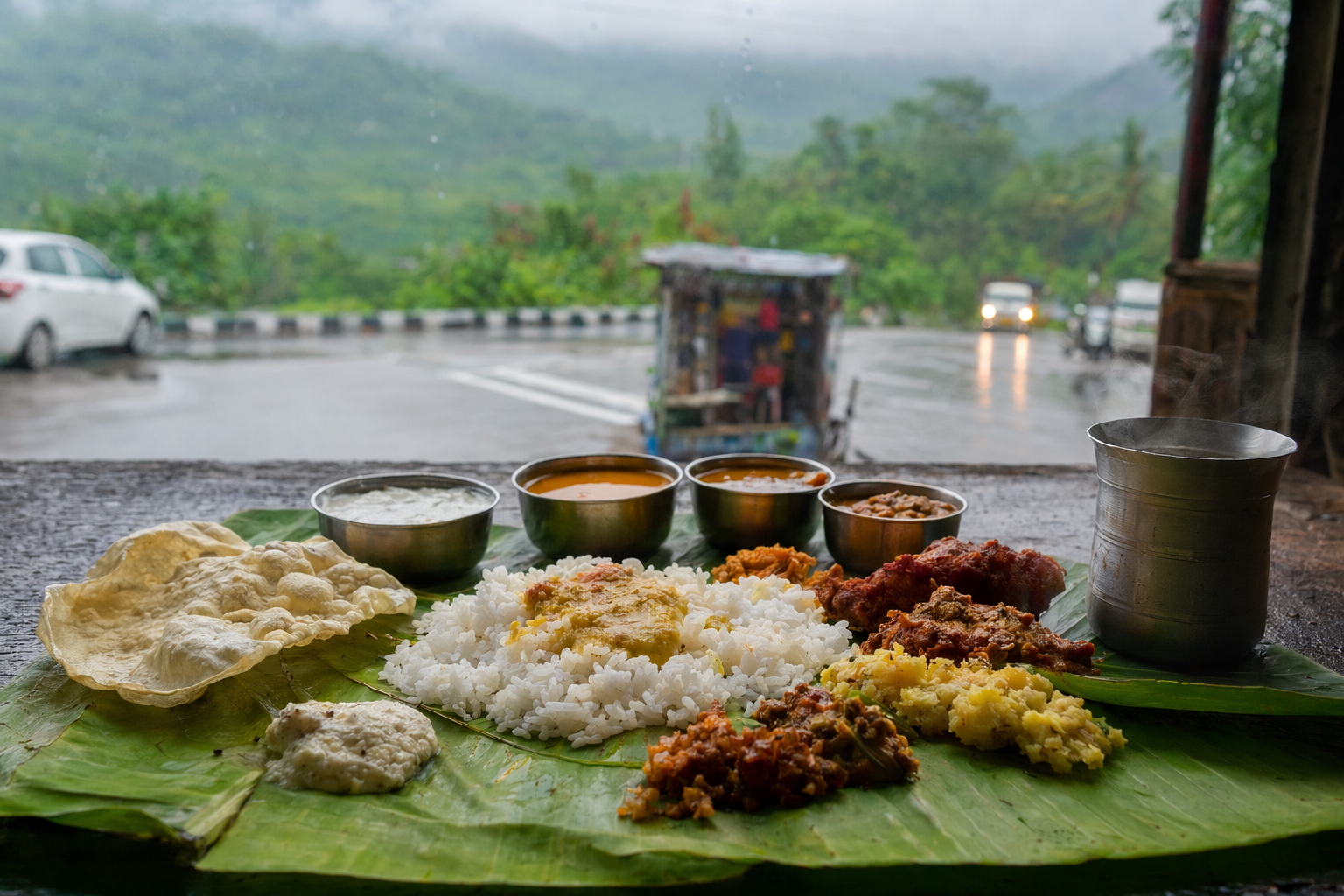
There is a very specific kind of hunger that happens on an Andhra highway in the rain. Not normal hunger, not the bored airport-snack kind. I mean that deep, slightly dramatic, stomach-growling hunger that comes after you’ve been watching grey clouds sit low over paddy fields, windshield wipers doing their tired left-right dance, and every passing truck throwing up a misty splash like it owns the road. That’s when Andhra meals hit different. Rice steaming hot, pappu with ghee, gongura pachadi sharp enough to wake your ancestors, rasam that feels like someone fixed your mood from inside. Honestly, I think rainy highway food in Andhra Pradesh deserves its own travel category. People talk about beaches, temples, hill stations, but me, I remember the meals. The unexpected banana leaf lunches. The filter coffee in steel tumblers. The mirchi bajji eaten while standing under a leaking tin roof somewhere between Vijayawada and Ongole. That’s the stuff.
And before someone says, “But highway food is just highway food,” no. Not in Andhra. A rainy drive through Andhra Pradesh is basically a moving buffet if you know what to look for. On the Hyderabad to Vijayawada run along NH65, you get spicy meals hotels and tiffin stops around Suryapet and Kodad. On NH16, that long coastal stretch from Vijayawada down toward Nellore and Chennai, the food starts leaning into fish curry, prawns, sour pulusu, and those big rice-heavy meals that make you both sleepy and spiritually satisfied. Go north toward Rajahmundry, Kakinada, or Visakhapatnam and suddenly coconut, seafood, Godavari-style cooking, and pesarattu breakfasts enter the chat. Head toward Tirupati or Anantapur, and Rayalaseema spice starts smacking you around lovingly. Rain just makes all of this better. Messier, yes. But better.
Why Rain Makes Andhra Food Taste More Alive
#I don’t know the science, but I have theories. First, rain makes you crave heat. Not just temperature heat, but chilli heat, pepper heat, sour-tangy heat. Andhra food is basically built for this mood. The food already has this punchy personality: red chilli from Guntur, sour tamarind, gongura leaves, garlic, curry leaves crackling in oil, and pickles that do not believe in being polite. Add a rainy highway, some foggy fields, and your clothes smelling faintly of damp car seat, and suddenly a simple dal-rice situation becomes emotional. I’ve had fancy tasting menus in nice cities, all pretty plates and microgreens, but one wet afternoon near Eluru, a meals plate with tomato pappu, avakaya, papad, and curd rice made me happier than most expensive meals ever did.
Also, Andhra meals are practical road food, which sounds boring but isn’t. A proper meals hotel gives you rice, dal, sambar or pulusu, rasam, curry, fry, pachadi, podi, curd, papad, and pickle. Everything is refillable in many old-school places, or at least served generously enough that nobody leaves sad. You can eat with your hand, mix to your own comfort level, slow down for ten minutes, then return to the road feeling like life is under control again. In 2026, food travel has become weirdly obsessed with hyperlocal plates and regional thalis, and Andhra has been doing that forever without making a fuss. The new trend is just people finally noticing what highway regulars already knew.
The Perfect Rainy Highway Andhra Meal, If You Ask Me
#If I had to design the perfect rainy highway lunch, it would start with hot rice. Not lukewarm rice sitting in a sad steel container, I mean actual steam rising when they drop it on your banana leaf or plate. Then a spoon of ghee, because rainy drives are not the time to pretend we are saints. First mix: kandi pappu or tomato pappu, with a little avakaya on the side. Second mix: sambar or a tamarind pulusu, depending on where you are. In coastal Andhra, if there is fish pulusu and the place looks clean and busy, I am ordering it. The sourness with rice on a rainy day is ridiculous, in a good way. Then some dry fry, maybe bendakaya fry, aratikaya fry, potato fry with curry leaves, or a spicy chicken fry if it’s that kind of day.
Then comes the dangerous part: pachadi. Gongura pachadi is my weakness. It’s sour, leafy, spicy, and has that earthy bite that feels so Andhra it should have its own road sign. Allam pachadi, the ginger one, is great when the rain has made the weather a bit chilly. Dosakaya pachadi is more cooling, so I save that for when the spice has bullied me too much. And podi. Please don’t ignore podi. A spoon of kandi podi or karam podi with ghee and rice is one of those simple combinations that makes you wonder why we complicate food so much. End with rasam and curd rice. Always. Rasam clears the highway fog inside your head, and curd rice calms down whatever chilli storm you created in your mouth.
Breakfast Stops: Idli, Pesarattu, Upma, and the First Chai of the Drive
#Rainy Andhra drives should start early, before traffic gets ugly and before everyone in the car starts arguing about playlists. My favorite breakfast stop is the kind of place where the floor is wet because people keep walking in from the rain, the coffee counter is doing nonstop business, and the idlis vanish faster than the staff can bring them out. Andhra idli with peanut chutney is not a small thing. That chutney, slightly coarse, nutty, sometimes with a chilli kick, is perfect road breakfast. Add sambar, add a vada if you’re brave, and you’re good till lunch. If you see pesarattu on the menu, especially in Vijayawada, Rajahmundry, or anywhere in the Godavari belt, don’t overthink it. Green gram dosa, ginger chutney, maybe upma folded inside if it’s MLA pesarattu style. Rain outside. Hot pesarattu inside. Done.
There are famous city places worth detouring for if your route allows. Babai Hotel in Vijayawada is legendary for idli and old-school breakfast energy. Subbayya Gari Hotel, originally from Kakinada, is known for its generous Andhra meals and has become a name people actively plan around. Minerva-style coffee shops in Andhra and Telangana cities are still reliable for tiffins, coffee, and that slightly nostalgic family-restaurant vibe. But on highways, the rule is simple: choose the place with turnover. If the idlis are moving fast, chutney is being refilled, and local families are eating there, you’re probably okay. In rainy weather, I’m extra careful with cold chutneys that have been sitting around. Hot sambar is your friend. Hot anything, basically.
Mirchi Bajji Under a Tin Roof Is a Whole Mood
#I need to talk about mirchi bajji because rainy highways and bajji stalls are a dangerous love story. You’ll see them near bus stops, small towns, toll-side tea stalls, and random junctions where nobody planned to stop but everyone suddenly needs chai. The best ones are made with long green chillies dipped in gram flour batter, fried till golden, slit open, and stuffed or sprinkled with onion, lemon, and masala. Sometimes they serve it with a chutney that looks innocent and absolutely isn’t. You bite into it, rain blowing sideways, tea burning your fingers through a paper cup, and for a few seconds everything is perfect. Then the chilli hits and you start questioning your life choices, but in a proud way.
Punugulu is another rainy-day snack I chase like a fool. Little fried batter balls, crisp outside, soft inside, served with chutney. They are common around Vijayawada and coastal Andhra, though every town does them slightly differently. Onion pakodi, garelu, masala vada, and hot samosas also show up everywhere, but punugulu has that Andhra tiffin-shop soul. Just don’t eat too many if you’re the one driving ghats later. I say this as someone who once ate a heroic amount before a damp Araku road climb and regretted it by curve number twelve.
Coastal Andhra in the Rain: Fish Pulusu, Prawns, and Rice That Never Ends
#If your drive touches the coast or the Godavari districts, your meal priorities should shift. Around Rajahmundry, Bhimavaram, Kakinada, Machilipatnam, and toward Visakhapatnam, seafood becomes more tempting. Fish pulusu is the rainy day king for me. It’s sour with tamarind, red with chilli, oily in that glossy home-style way, and best eaten with heaps of rice. The fish should be soft but not falling apart into sadness. Prawn fry, crab curry, and chepala vepudu can be amazing too, but I’m picky on highways. Busy restaurant, clean smell, quick turnover, and preferably locals eating the same thing. If the place is empty at 1:30 pm and the fish display looks tired, I keep driving.
One of my favorite rainy food memories is near the Godavari side, not in some famous restaurant, just a family-run place where the server kept bringing rice like he was personally offended by empty space on the plate. The fish pulusu was so sour and spicy that my eyes watered, but I couldn’t stop. Outside, the rain had made the road muddy, buses were honking, someone’s kid was crying, and inside I was mixing pulusu into rice with onion pieces and feeling ridiculously lucky. Travel gives you these moments. Not polished, not Instagram-perfect, but the kind you remember years later because your senses recorded everything.
Rayalaseema Roads: When the Spice Gets Serious
#Rayalaseema food is not here to comfort you gently. It grabs your collar. If you are driving toward Tirupati, Kadapa, Kurnool, or Anantapur, expect bolder spice, more meat dishes, ragi sangati, natu kodi pulusu, and fiery chutneys. Ragi sangati with country chicken curry on a rainy day is heavy, earthy, and deeply satisfying, especially if the weather has turned cool. It’s also the kind of meal after which the passenger seat becomes very attractive. So maybe don’t plan a tight schedule after it. I like Rayalaseema meals because they feel rugged, like the landscape. Dry stretches, rocky hills, sudden rain, and then a plate of food that tastes like it has no interest in compromise.
A good order would be ragi sangati, natu kodi pulusu if available, pappu, spicy fry, curd, and maybe a lemon soda after because you’ll need peace. Some restaurants in Hyderabad and Bengaluru made Rayalaseema-style food trendy over the past few years, with places like Kritunga becoming known for spicy Andhra and Rayalaseema dishes, but eating similar flavors closer to the region feels different. Less branded, more direct. In 2026, I notice travelers are asking for “authentic spice” and “regional heat levels” like it’s a badge. Cute. Andhra aunties and highway cooks have been testing people’s spice tolerance long before food reels made it fashionable.
The 2026 Highway Food Scene: EV Stops, QR Menus, Millets, and Still the Same Old Pickle
#Highway eating has changed a lot, even in the last few years. On the bigger routes, especially NH65 and NH16, you now see more organized food plazas, cleaner washrooms than before, EV charging points, digital payment everywhere, and QR-code menus even at places that still serve meals on banana leaves. UPI has made quick stops easier because nobody wants to dig for change with wet hands. EV road trips are becoming more normal, and food stops are adjusting. A charging break naturally becomes a tiffin break, which honestly is the best possible use of waiting time. Some newer highway cafés are adding millet dosas, ragi items, and “regional thali” boards because millets are still riding the post-2023 popularity wave. I’m not mad about it.
But the funny thing is, the soul of the Andhra highway meal hasn’t changed that much. The best places still rely on hot rice, good pappu, strong pickle, and quick service. Food travel trends in 2026 talk about slow travel, local sourcing, culinary road trips, and community-led dining. All nice phrases. But an old meals hotel where the curry changes with the season and the server knows which pickle is too strong for outsiders is already doing that. The innovation is useful, sure. Cleaner rest stops, better toilets, card and UPI payments, live location reviews, all of that helps. Still, the deciding factor remains: does the rasam taste alive?
How I Choose a Rainy Highway Meals Hotel
#I have developed a slightly obsessive method. First, I look at the parking. If there are local cars, buses, or office crowd vehicles, good sign. If only one lonely tourist car is parked and five staff members are staring at the rain, I hesitate. Second, I smell the place when I walk in. Fresh tempering, rice, sambar, coffee, frying snacks, all good. Stale oil smell, damp mop smell, or that weird refrigerator smell, no thanks. Third, I watch what people are eating. If everyone has meals, order meals. If everyone has tiffin, don’t ask for fish curry at 5 pm and then complain. Highway kitchens have rhythms. Respect the rhythm.
- For breakfast, I stick to hot idli, dosa, pesarattu, vada, upma, pongal, and coffee.
- For lunch, I want Andhra meals, pappu, sambar or pulusu, fry, pachadi, pickle, rasam, curd, and papad.
- For snacks, mirchi bajji, punugulu, onion pakodi, roasted corn, or tea if the stall is busy and the oil looks fresh enough.
- For dinner on the road, I go lighter than my heart wants: curd rice, lemon rice, idli, dosa, or a small meals if I’m not driving much further.
What Not to Eat, Even If the Rain Is Making You Reckless
#I hate giving boring advice, but rain changes the food-safety game. Avoid cut fruit sitting open near the road. Avoid chutneys that look like they’ve had a long, emotional day. Avoid seafood at odd hours unless the place is genuinely trusted and busy. Be careful with very oily snacks if the oil is dark and tired. And if you’re driving through ghats, don’t eat like you’re attending a wedding buffet. I learned this the hard way on a misty drive toward Araku, after breakfast became breakfast-plus-snacks-plus-extra-coffee. Beautiful road, terrible stomach confidence. Not my finest travel chapter.
Also, spice plus rain plus long drive can make you thirsty, so keep water in the car. But don’t drink too much right before a stretch with no clean restrooms, because Indian highways love testing your planning skills. I carry wet wipes, a small towel, hand sanitizer, and sometimes banana chips or peanuts for emergencies. Not glamorous, but neither is being stuck between toll plazas with a hungry car full of people who suddenly hate each other.
Best Routes for Andhra Meals in Rainy Weather
#The Hyderabad to Vijayawada route on NH65 is probably the classic rainy food drive for many people. Suryapet and the towns after it have plenty of tiffin and meals options, and by the time you approach Vijayawada, you’re in serious food country. Vijayawada to Rajahmundry and onward toward Visakhapatnam gives you lush fields, canals, seafood temptations, and breakfast stops that make early mornings worthwhile. NH16 toward Ongole and Nellore is great if you like coastal flavors, spicy meals, and the feeling of endless highway rain. The Visakhapatnam to Araku drive is more about scenery, coffee, bamboo chicken in touristy pockets, and hot snacks, though I’d be careful in heavy monsoon because hill roads can get tricky.
Tirupati routes bring a different mood: temple traffic, tiffin stops, strong coffee, and meals that slowly lean Rayalaseema depending on where you are coming from. Around Nellore, don’t miss the chance to try Nellore-style meals or fish curry if you find a good place. Around Guntur, expect chilli confidence. Around Kakinada, Subbayya-style generous meals are famous for a reason, though plan for crowds if it’s a peak day. And in Vijayawada, honestly, I’d happily spend a whole rainy weekend just eating breakfast, meals, sweets, and snacks without pretending I came for anything else.
My Rainy Andhra Highway Food Order, From Morning to Night
#- Start with filter coffee or strong tea before leaving, because rainy roads require emotional support.
- First stop: idli with peanut chutney, or pesarattu with ginger chutney if it’s available and fresh.
- Mid-morning if the rain is dramatic: mirchi bajji or punugulu, shared. Shared is important, otherwise you’ll overdo it.
- Lunch: full Andhra meals with pappu, gongura or mango pickle, podi with ghee, sambar or pulusu, fry, rasam, and curd rice.
- If near the coast: add fish pulusu or prawn fry, but only at a busy, trusted place.
- Evening: tea and something hot, maybe pakodi, maybe corn, maybe just coffee if the lunch was a monster.
- Dinner: keep it simple. Dosa, curd rice, lemon rice, or idli. Your stomach will thank you on the last stretch.
The Meal Is the Memory
#What I love about Andhra highway eating is that it doesn’t separate travel and food. The road is part of the taste. The rain is part of the meal. The sound of trucks, the damp plastic chairs, the waiter shouting “meals one!” into the kitchen, the little steel bowl of rasam that looks harmless until you sip it and suddenly feel restored. It’s not luxury travel, but it is rich in the way that matters to me. You learn a place through its everyday food. Not just restaurant awards or pretty café interiors, but what people actually eat when they’re traveling, working, rushing home, waiting for buses, escaping rain.
A good Andhra meal on a rainy highway doesn’t just fill your stomach. It resets the whole journey.
So if you’re planning a monsoon or post-monsoon drive through Andhra Pradesh, don’t treat meals as an afterthought. Build the trip around them a little. Leave early for tiffin. Stop before you’re starving. Ask locals what’s fresh. Follow the crowd, but not blindly. Respect spice. Respect rain. And when that hot rice arrives with pappu, ghee, pickle, and rasam waiting nearby, put your phone down for a minute. Mix with your hand, take the first bite, and let the highway wait. It’ll still be there after lunch, shining wet and chaotic and beautiful. For more food-travel rambles and route ideas, I keep finding myself browsing AllBlogs.in, especially when I’m hungry and pretending to plan my next drive.