You know that tiny moment of doubt when you open your lunchbox in peak summer and pause for a second?
It looked fine in the morning. It smelled amazing when it was packed. But now it has been sitting in a school bag, office drawer, bus, train, or maybe even a parked car for hours.
And suddenly the question is not just, “Will this taste fresh?”
It is, “Is this still safe to eat?”
Sambar can feel like a “safe” food because it is boiled, salty, spicy, and sour from tamarind. But at the end of the day, it is still a cooked, moist, dal-based dish with vegetables. In Indian summer, that combination needs care.
So, can sambar stay outside in summer? Yes, but only for a short time. If you are not keeping it properly hot or properly cold, the safe window is limited.
This guide covers practical time limits, sambar tiffin safety, how to pack a sambar rice lunchbox, what to do for idli sambar travel, and when it is better to refrigerate or throw the food away.
This is a food safety and storage guide, not a recipe.
Quick answer
#Here is the simple version.
- At normal room temperature, cooked sambar should not be left outside for more than 2 hours.
- In very hot weather, especially above 90°F or around 32°C, follow the 1-hour caution.
- If sambar has been sitting in a warm kitchen, school bag, office drawer, train, bus, or car for too long, reheating does not always make it safe again.
- For lunchboxes, keep sambar either hot in a reliable insulated flask or cold with refrigeration or an ice pack.
- Avoid mixing sambar with rice, idli, dosa, or vada in the morning if it will sit for hours. Pack wet and dry foods separately, then mix when eating.
In short, how long can sambar sit out depends heavily on the heat around it. In summer, especially in India, it is better to be a little strict.
For more lunch packing ideas, you may also want to read about office lunch food safety and no-fridge travel food.
Why sambar spoils in heat
#Sambar is not just spicy water. It usually has cooked dal, vegetables, tamarind, salt, spices, and tempering. That is exactly what makes it comforting and delicious.
But it also means sambar has moisture, nutrients, and cooked ingredients. Bacteria love that combination, especially when the food is warm.
Tamarind gives sambar its sour taste, but it does not make it shelf-stable. Salt and spices may slow some spoilage, but they do not make cooked dal and vegetables safe to keep outside all day.
The danger zone problem
#Food safety guidance often talks about the temperature “danger zone,” which is roughly 40°F to 140°F, or 4°C to 60°C.
This is the range where many harmful bacteria can multiply more easily.
A hot kitchen, school bag, non-AC office, bus, train compartment, or lunchbox kept near a window can keep sambar in this risky temperature range for hours. That is why the usual 2-hour rule becomes more cautious during peak heat.
When the surrounding temperature is above 90°F or 32°C, use the 1-hour caution.
This does not mean sambar magically becomes unsafe the second it crosses 2 hours. Food safety is not that exact. But these limits are useful boundaries. Once you cross them, the risk goes up, and you cannot reliably judge safety by smell alone.
A closed lunchbox can make things worse
#A lunchbox can become its own small, warm, damp space.
If you pour very hot sambar into a regular steel or plastic dabba and close it immediately, steam gets trapped inside. Water droplets form on the lid and sides. The food stays warm and wet, and then the box sits inside a bag with almost no airflow.
That trapped heat and moisture can make food sour or spoil faster.
Sometimes you open the box and it smells fermented. Sometimes it just tastes slightly “off.” And sometimes it may look normal even when it is no longer safe.
That is why packing matters. Fresh sambar can become risky if it is packed badly and kept warm for too long.
For similar lentil-based storage concerns, see cooked dal summer safety.
Safe time limits for sambar
#Let’s make the timing practical.
Freshly cooked sambar at home
#If you have cooked sambar and it is sitting in the kitchen, do not leave it on the stove for the whole day.
At normal room temperature, refrigerate it within 2 hours.
In very hot weather, especially above 90°F or 32°C, try to refrigerate it within 1 hour.
This matters during hot afternoons, power cuts, outdoor meals, non-air-conditioned kitchens, and travel.
If you plan to eat it later, transfer the sambar to shallow containers so it cools faster. Then refrigerate it. Do not leave a large covered vessel sitting on the stove for hours just because the sambar was boiled once.
Sambar packed for lunch
#A normal steel dabba does not keep food safely hot for several hours. It is just a container.
So if you pack sambar at 8 AM and eat it at 1 PM, the food may spend most of that time warm, not hot. That warm middle stage is the problem.
For safer sambar until lunch, choose one of these:
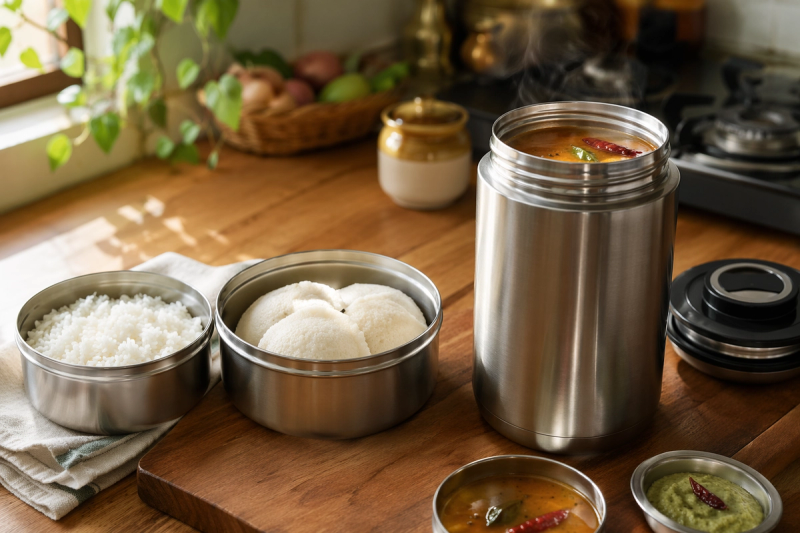
- Keep it hot in a proper insulated flask.
- Keep it cold by cooling it quickly and using a fridge or ice pack.
- Skip carrying sambar if you cannot control the temperature and the weather is very hot.
The risky zone is “lukewarm for hours.” That is where many summer tiffin problems begin.
Sambar during travel
#Travel is trickier because you may not know how hot your food is getting.
A train berth, bus luggage area, car boot, backpack, or bag kept in sunlight can heat up quickly. Even if the weather feels manageable to you, the food inside the container may be much warmer.
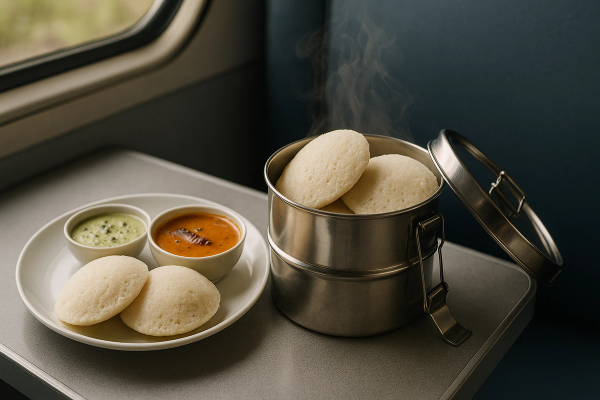
For idli sambar travel, carry sambar only if you can keep it hot in an insulated flask or cold with proper cooling. Otherwise, carry dry items separately and eat sambar fresh when possible.
If the sambar has been sitting in a hot bag for several hours and is only lukewarm when opened, it is safer to throw it away.
Tiffin packing rules for sambar
#Good sambar tiffin safety is mostly about two things: temperature and separation.
You do not need to overthink it, but you do need a basic system.
1. Do not seal steaming sambar in a regular dabba
#If sambar is going into a normal lunchbox and will be refrigerated or packed with an ice pack, let it cool slightly first.
Closing very hot food immediately traps steam. That creates condensation, and the inside of the box becomes damp and warm.
At the same time, do not leave it sitting outside for too long while cooling. Cool it as quickly as practical, close it, and then refrigerate it or pack it with a cold source.
2. Use an insulated flask if there is no fridge
#If your office, school, or travel route has no refrigerator, a good insulated flask is usually the better option for liquid foods like sambar.
Use it properly:
- Fill the flask with boiling water and let it sit for a few minutes.
- Heat the sambar until it is properly hot.
- Empty the hot water from the flask.
- Pour in the hot sambar immediately.
- Close the flask tightly.
- Open it only when you are ready to eat.
The goal is to keep the sambar hot until lunch, not just slightly warm. If your flask leaves food lukewarm by lunchtime, it is not reliable enough for summer safety.
3. Keep wet and dry foods separate
#This is one of the easiest habits that makes a big difference.
Pack sambar separately from:
- rice
- idli
- dosa
- vada
- upma
- poha
- curd-based items
Mix only when you sit down to eat.
This is safer, and honestly, the food tastes better too. Rice does not become mushy, idlis do not turn soggy, and vada does not sit in warm liquid for hours.
For dry-food packing ideas, see cooked poha summer safety.
4. Avoid keeping lunchboxes in hot places
#A lunchbox kept inside a parked car, near a sunny window, or deep inside a school bag on a hot day can heat up fast.
If the food is not kept hot in a flask or cold with an ice pack, the safe time window becomes short.
For children, pack sambar only if lunch is reasonably early and the food can stay safe until then. If the classroom is hot and lunch is late, a dry lunch may be a better option.
5. Clean containers properly
#Old food stuck in lids, rubber rings, flask caps, corners, and gaskets can make spoilage more likely.
Wash containers well, rinse them properly, and dry them fully before packing.
For sambar, pay special attention to flask lids and rubber seals. They often hold smells and tiny bits of food even when they look clean.
Sambar with rice, idli, dosa, and vada
#A sambar rice lunchbox is comforting, filling, and easy to eat. But in summer, mixing sambar and rice in the morning is not the best idea if the box will sit out for hours.
Cooked rice already needs careful handling in warm weather. When you add sambar, you add more moisture, warmth, dal, and vegetables. The rice absorbs the liquid, the whole box becomes dense and humid, and the food can spoil faster.
The safer method is simple:
- Pack rice dry in one container.
- Pack sambar separately in a hot flask or chilled container.
- Mix just before eating.
The same idea applies to idli.
Idli and sambar
#For idli sambar travel, do not soak idlis in sambar before leaving home if they will sit for hours in heat.
Idlis are soft and porous. They absorb liquid quickly. Once soaked, they become one warm, wet food mass, which is not ideal for summer storage.
Pack idlis dry. Pack sambar separately. Combine them when you eat.
Vada, dosa, and other pairings
#Vada soaked in sambar is delicious, but it is not a good choice for long holding in hot weather.
Dosa packed with wet chutney or sambar can also become soggy and spoil faster.
If you are carrying these foods, keep the wet items separate and control the temperature. In summer, convenience should not mean mixing everything early.
Separate packing is safer and usually tastes better too.
How sambar compares with dal, rice, idli, chutney, and curd meals
#Different Indian foods behave differently in summer. Here is a practical comparison.
Sambar vs dal
#Sambar and dal are both cooked lentil-based foods. Both should follow the 2-hour rule, or the 1-hour caution in very hot weather.
Sambar often has more vegetables and liquid than thick dal, so it may feel more delicate in a lunchbox. But the main rule is the same: do not leave cooked lentils sitting warm for hours.
Sambar vs plain rice
#Plain cooked rice may look harmless, but it also needs safe handling in summer.
If cooked rice sits warm for too long, reheating may not fix every safety concern.
When rice is mixed with sambar, the risk increases because the rice becomes wet, warm, and dense. So if you are packing rice and sambar, use separate containers.
Sambar vs idli
#Dry idlis are easier to carry than idlis soaked in sambar.
The problem starts when idlis are packed wet and left warm. For travel, dry idlis with separate sambar are much safer than a pre-soaked box.
Sambar vs coconut chutney
#Coconut chutney is especially delicate in summer. It is moist and often not cooked after grinding, so it can turn sour quickly in heat.
If you carry coconut chutney, use refrigeration or an ice pack. Do not leave it in a warm bag for hours.
Freshly boiled sambar may hold better than coconut chutney if temperature is controlled, but it still cannot sit outside all day.
Sambar vs curd rice
#Curd rice also needs care in summer. It can turn very sour when warm, and curd-based meals should not sit in the heat for long.
If you are carrying curd rice, keep it cold.
For more detail, see curd rice travel safety.
Sambar vs dry rice dishes
#Dry rice dishes usually travel better than wet gravies, as long as they are cooked and packed cleanly.
Still, no cooked food should be left in heat indefinitely.
If there is no fridge, no ice pack, and no insulated flask, a drier lunch is often the safer choice.
When to refrigerate sambar
#Refrigerate sambar as soon as it has cooled enough to store safely. Keep the total time outside within the safe limit.
Use these habits:
- Do not leave a full pot on the stove from morning to night.
- Transfer leftovers to smaller containers so they cool faster.
- Refrigerate within 2 hours at normal room temperature.
- In very hot weather, aim for refrigeration within 1 hour.
- Reheat only the portion you plan to eat.
If sambar has already sat outside too long, refrigeration will not make it safe again.
Cold storage slows further bacterial growth, but it does not undo what may have happened while the food was warm.
When to throw sambar away
#Throw sambar away if:
- it sat out for more than 2 hours at normal room temperature
- it sat out for more than 1 hour in very hot weather
- it was in a warm lunch bag for several hours without insulation or cooling
- it smells sour, fermented, stale, or unpleasant
- it has bubbles, froth, sliminess, mold, or a strange texture
- you are not sure how long it was outside
That last point is important.
If nobody knows whether the pot was left out all afternoon, do not take a chance.
Food waste feels bad, yes. But food poisoning is worse. When in doubt, especially in summer heat, discard it.
Final thoughts
#Sambar can absolutely be part of a safe summer lunch. It just needs a little care.
The main rule is simple: do not let it sit warm for hours.
Follow the 2-hour rule at normal room temperature and the 1-hour caution in very hot weather. For tiffin or travel, keep sambar hot in a reliable insulated flask or cold with refrigeration or ice packs.
And whenever possible, keep rice, idli, dosa, and vada separate until mealtime.
That one small packing habit makes a big difference. You still get your comforting South Indian meal, but with less guesswork and much better summer safety.