If you are flying from India, there is a good chance someone at home has asked, “Take some ghee also, no?”
Maybe it is homemade ghee for a student going abroad. Maybe it is a sealed tin for relatives. Or maybe it is your favourite brand that you simply do not want to miss while travelling.
The good news is: yes, you can usually carry ghee on flights from India. But the rules are not the same for cabin baggage and checked baggage, and that is where most people get confused.
The short answer to can you carry ghee in flight India is this: carry only a tiny, rule-friendly quantity in your cabin bag, and put larger quantities in check-in luggage with very careful leak-proof packing.
Airport security generally treats ghee as a liquid, gel, or semi-liquid, even if it looks solid when you pack it at home. Once you understand that, the rules become much easier to follow.
Quick Answer: Can You Carry Ghee on Flights from India?
#Yes, ghee can usually be carried on flights from India, but you need to follow airport security rules, airline baggage rules, and, if you are travelling abroad, the destination country’s customs rules.
Here is the practical answer:
- Cabin baggage: Ghee is usually treated like a liquid, gel, or semi-liquid. The 100 ml cabin liquid rule applies. Each container should be 100 ml or less and should fit inside the allowed transparent resealable liquids bag.
- Checked baggage: Larger quantities are usually better in check-in luggage, as long as the container is sealed properly and packed so it cannot leak.
- Homemade ghee: Usually possible, but it needs extra-careful packing because it may not have a factory seal or label.
- Sealed packaged ghee: Usually easier to carry and identify, especially for international travel.
- International flights: Always check the food import and customs rules of your destination country. Some countries are strict about dairy, homemade food, and unlabelled food.
- Final decision: Airport security or airline staff can still refuse an item if it is leaking, oversized, poorly packed, or unclear.
If you are carrying more than a very small amount, putting ghee in check-in luggage is usually the safest and simplest option.
Why Ghee Is Treated Like a Liquid or Gel
#This is the part that surprises many people.
At home, ghee may look solid, especially in winter or in an air-conditioned room. It may look more like a block of fat than a liquid. So naturally, many travellers think it should not come under the liquid rule.
But airport security usually looks at it differently.
Ghee can melt, soften, spread, and leak when the temperature changes. Because of that, it is commonly treated as a liquid, gel, or semi-liquid during baggage screening. So for cabin baggage, the same restrictions that apply to liquids, aerosols, and gels can apply to ghee too.
In simple words: even if your ghee looks firm at home, security may still treat it as a liquid or gel at the airport.
That is why a big jar of ghee in cabin baggage can be stopped, even if it looks completely harmless.
Cabin Baggage vs Checked Baggage
#The main thing you need to decide is where to pack the ghee. Cabin baggage and checked baggage have very different rules.
Ghee in Cabin Baggage India
#If you want to carry ghee in cabin baggage India, keep it small and easy to inspect.
For cabin baggage, ghee should follow the 100 ml liquid or gel rule. That means:
- Each container should be 100 ml or less
- The container size matters, not just the amount of ghee inside
- The container should fit inside the permitted transparent resealable liquids bag
- Security staff may ask you to take it out for checking
- Leaking or unlabelled containers may create problems
One common mistake is carrying a 250 ml or 500 ml jar with only a little ghee left in it. That can still be rejected because the container itself is larger than 100 ml.
So if you really need to carry ghee in the cabin, use a small, clean, tightly closed container of 100 ml or less. Keep it with your other liquid items so you can show it easily during security screening.
For most travellers, though, cabin baggage is not the best place for ghee unless the quantity is very small.
Ghee in Check-In Luggage
#For larger quantities, ghee in check-in luggage is usually much more practical.
You can pack sealed tins, jars, or bottles in your checked bag. Here, the main concern is not the 100 ml rule. The main concern is leakage.
Airlines may not have a problem with ghee itself, but leaking food can damage your suitcase, other passengers’ bags, and airport handling equipment. And if ghee leaks into clothes, it is a real headache to clean.
Keep these points in mind:
- Use strong, tightly sealed containers
- Avoid loose or flimsy plastic containers
- Avoid glass if possible, or wrap it extremely well
- Keep the weight within your checked baggage allowance
- Check your airline’s baggage and food item rules before travel
- For international travel, check destination customs rules before packing
Checked baggage is usually better for 500 ml, 1 kg, 2 kg, or larger quantities, but only if the packing is strong and leak-proof.
The 100 ml Liquid and Gel Rule
#If you remember only one thing about carrying ghee in cabin baggage, remember this: the 100 ml rule applies.
For cabin baggage, liquids, aerosols, and gels are restricted. Since ghee is usually treated as a gel or semi-liquid, it comes under this rule even if it looks thick or partly solid.
In simple terms:
- A 100 ml container may be allowed in cabin baggage
- A container larger than 100 ml may be rejected, even if it is only half full
- Multiple small liquid containers usually need to fit in the permitted transparent resealable bag
- The bag should close properly
- Security staff may inspect the item separately
- The final decision rests with airport security
That last point is important. Rules give you the general limit, but airport security staff still have discretion. If the container is leaking, badly packed, suspicious-looking, unlabelled, or hard to identify, they can ask you to remove it.
Also, do not depend on “I carried it last time” as a guarantee. Screening can vary by airport, route, staff judgement, and even the condition of the item on that day.
Homemade vs Sealed Packaged Ghee
#Both homemade and packaged ghee can be carried, but they may be treated a little differently during checks.
Homemade Ghee
#Many Indian families prefer sending homemade ghee, especially for students, children, elderly parents, or relatives abroad. It feels personal, familiar, and let’s be honest, it often tastes better too.
But when you are flying, homemade ghee needs more caution.
Homemade ghee usually has:
- No factory seal
- No printed label
- No ingredient list
- No manufacturing or expiry details
- A higher chance of being packed in a reused jar or bottle
For domestic flights within India, the main concerns are usually leakage and cabin liquid limits. If homemade ghee is packed properly in checked baggage, it is usually more practical than carrying it in the cabin.
For international travel, homemade ghee can be trickier. Customs officers in the destination country may ask what it is. Some countries have strict rules for dairy, animal-origin food, homemade food, or unlabelled food items. Since homemade ghee does not have commercial labelling, it may be harder to explain.
So if you are wondering, can I carry homemade ghee on flight, the safer answer is: yes, you may be able to carry it, especially in checked baggage, but check the airline and destination customs rules first. And if food declaration is required, declare it honestly.
Sealed Packaged Ghee
#Sealed packaged ghee is usually easier to travel with.
It has a few advantages:
- Factory sealing
- Brand name and product name
- Ingredient information
- Batch or manufacturing details
- Usually stronger packaging
For airport screening and customs checks, a sealed retail pack is often easier to identify than an unmarked homemade jar.
That does not mean packaged ghee is automatically allowed everywhere. It still needs to follow cabin liquid rules, checked baggage rules, airline policies, and destination customs rules. But if you are travelling internationally, a sealed and labelled pack is usually the cleaner, safer option.
Leak-Proof Packing Checklist for Ghee
#Ghee leakage is the real problem.
It can melt, seep through the lid, stain clothes, and leave a strong smell inside your suitcase. And once ghee gets into fabric, cleaning it is not fun at all.
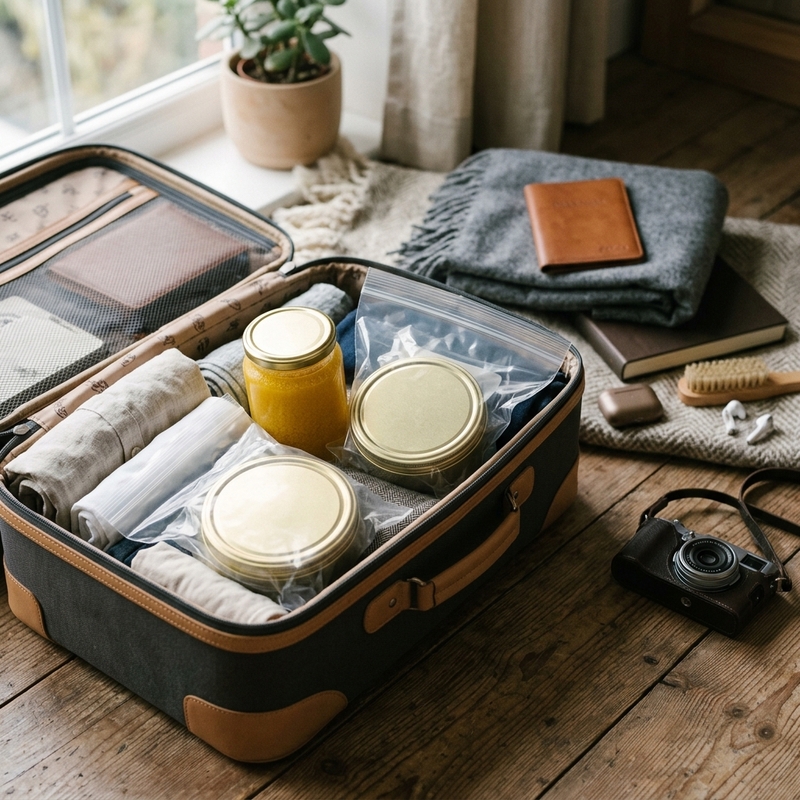
So if you are packing ghee for a flight, use layers. One lid is not enough.
Leak-Proof Packing Checklist
#- Choose a strong containerUse a sturdy tin, jar, or food-grade container with a tight lid. Avoid thin, flimsy plastic containers.
- Do not fill it to the topLeave a little space inside. Temperature and pressure changes can affect packed items, and overfilled containers are more likely to leak.
- Clean the rim before closingIf there is oil or ghee on the rim, the lid may not seal properly. Wipe it clean before tightening.
- Tighten the lid properlyMake sure the lid is firmly closed and not loose.
- Tape the lidWrap strong packing tape around the lid and neck of the container. This helps stop the lid from loosening during baggage handling.
- Use one plastic bagPut the container inside a thick zip-lock or leak-resistant plastic bag. Press out extra air and seal it fully.
- Use a second plastic bagPlace the first bag inside another bag and seal it again. This gives you backup if the first layer fails.
- Wrap it in clothWrap the double-bagged container in an old towel, cotton cloth, or washable clothing.
- Pack it in the centre of the suitcaseKeep it away from suitcase edges, where impact is more likely.
- Keep it away from valuables Do not pack ghee near electronics, documents, books, silk clothes, expensive sarees, formalwear, or gifts that can stain.
- Label homemade ghee If you are carrying homemade ghee, add a simple label saying “Ghee” or “Clarified Butter.” This does not replace customs requirements, but it can make identification easier.
For sealed tins, do not break the factory seal before travel. A sealed tin is easier to pack and easier to explain if someone checks it.
If you are carrying other Indian foods too, the same basic logic applies to wet, oily, or leak-prone items. You may also find these useful: pickle/achar allowed in flights in India and chutney, sauce, dry podi and wet food cabin baggage rules.
Domestic Travel Within India: What to Keep in Mind
#For domestic flights in India, your main concerns are cabin liquid rules, baggage weight, and leakage.
If you are carrying a tiny amount in cabin baggage, follow the 100 ml rule. If you are carrying a larger quantity, checked baggage is usually better.
Before flying domestically:
- Check your airline’s baggage allowance
- Pack ghee in checked luggage if the quantity is more than 100 ml
- Avoid loose jars in handbags or backpacks
- Use double or triple leak protection
- Reach the airport with enough time in case security asks questions
Domestic screening can vary a little from airport to airport. One airport may clear the item quickly, while another may inspect it more carefully. That does not always mean the rule has changed. Sometimes it is simply security discretion.
International Travel: Customs and Food Rules Matter
#International flights need extra care because customs rules come into the picture.
Airport security checks whether the item is safe to carry on the aircraft. Customs checks whether the item is allowed into the destination country. These are two separate things.
When carrying ghee internationally, check:
- Airline baggage rules
- Transit airport rules, if you have a connecting flight
- Destination country customs rules
- Food import restrictions
- Rules for dairy or animal-origin products
- Declaration requirements for food items
Be especially careful with homemade ghee because it may not have commercial labelling. If the destination country requires food declaration, declare it honestly. Not declaring food can create bigger problems than the ghee itself.
A sealed retail pack is usually easier to identify, but it still does not guarantee clearance. Customs rules can change, and officers at the destination have the final say.
If you are unsure, carry a smaller quantity or avoid carrying homemade ghee internationally.
What to Do at Airport Security
#A little preparation can make the security process much smoother.
If Ghee Is in Cabin Baggage
#Before reaching the scanner:
- Make sure the ghee container is 100 ml or less
- Place it inside your transparent resealable liquids bag
- Keep the bag easy to remove
- Do not hide it under clothes or electronics
- Show it calmly if asked
If security says it cannot go through, do not argue. You can politely ask if you are allowed to return to check-in and place it in checked baggage. This may only be possible if check-in is still open and airport procedures allow it.
If that is not possible, you may have to surrender the item.
If Ghee Is in Checked Baggage
#Before handing over your bag:
- Make sure the container is tightly sealed
- Double-bag it
- Pack it in the centre of your suitcase
- Keep it away from valuables
- Stay within baggage weight limits
If airline staff ask what is inside, answer clearly. Say it is ghee or clarified butter. Avoid vague answers like “food item” if they ask specifically.
Common Mistakes to Avoid
#These are the mistakes that usually cause trouble:
- Carrying a large jar of ghee in cabin baggage
- Assuming solid-looking ghee will not count as a liquid or gel
- Using a container larger than 100 ml in the cabin
- Carrying a half-empty large jar in cabin baggage
- Packing homemade ghee in a weak reused bottle
- Not taping the lid
- Not using double plastic bags
- Packing ghee next to clothes that stain easily
- Forgetting to check customs rules for international travel
- Not declaring food where declaration is required
- Assuming one airline or airport experience applies everywhere
Ghee is not difficult to fly with, but it does need sensible packing.
Final Takeaway
#So, can you carry ghee in flight India? Yes, in most cases you can.
Just pack it according to where it is going.
For cabin baggage, treat ghee as a liquid or gel and follow the 100 ml rule. For larger quantities, use checked baggage and focus on leak-proof packing. If you are flying internationally, do not rely only on airline rules. Check the customs rules of your destination country too.
The safest formula is simple: small quantity in cabin, larger quantity in check-in, sealed packaging when possible, double protection always, and no assumptions at customs.