
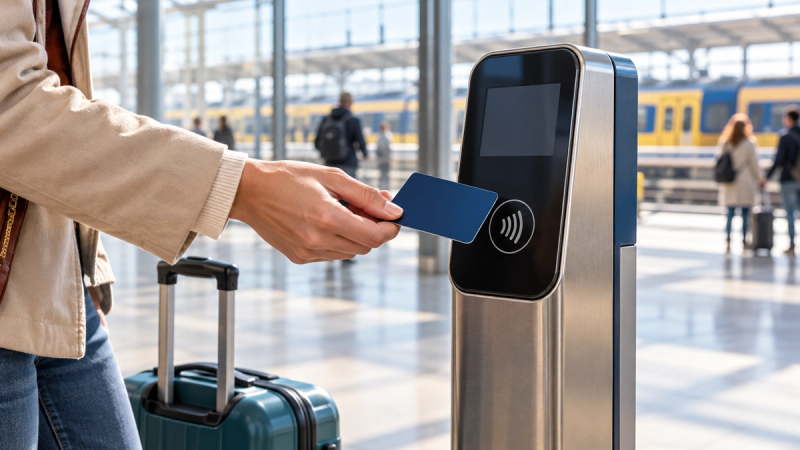
You can use OVpay on Dutch trains, buses, trams and metros with an accepted contactless bank card, phone or smartwatch. For ordinary pay-as-you-go travel, you don't need to register first or load money onto a separate transport card. Check in when you start and check out when you finish, using the same card or device.
The important part is what “same” means. A plastic card and that card in your phone wallet are separate travel identities. And being able to tap across the Netherlands doesn't mean every journey shares one fare cap.
Choose your payment method before the first tap
#OVpay is the payment system. An OV-pas is a transport card used within that system. You can also use an accepted bank card directly, so a visitor doesn't automatically need to buy an OV-pas or an OV-chipkaart before travelling.
NS accepts foreign contactless cards on the Visa, Mastercard, Maestro and V PAY networks, with exceptions for some issuers and card types. A familiar logo is a useful starting point, not a guarantee that your particular card will work. Check the current list in the NS debit-card FAQ, and have another payment or ticket option ready.
Choose the physical card if you want to keep transport independent of your phone battery. Choose your phone if it is your preferred payment device and you can keep it available throughout the journey. A backup card helps with your next journey; it cannot finish the journey started by a different device.
Take a physical card out of your wallet before tapping. Presenting several contactless cards together makes it harder to know which one the reader detected. Keep the card you chose in an easy-to-reach place rather than switching between pockets and devices at each stop.
How to check in and out without mixing things up
#At a train or metro station, look for the correct operator's gate or check-in pole. On a bus or tram, use the onboard reader. Hold your chosen card or device to it, then read the confirmation. An open station entrance is not proof that you have a valid check-in.
At your destination, check out with the same operator and the same payment method. Keep the card or device available for inspection during the trip too. On NS trains, the inspector checks the travel record associated with what you used to enter.
Think of a trip as an unfinished pair until the second tap is confirmed. That habit matters at ungated stations, where it is easy to step off the platform and forget the reader altogether.
Your phone, watch and plastic card stay separate
#If you enter using a phone, leave using that phone's same wallet card. Don't finish with your watch or plastic card just because they draw money from the same account. The payment account can be shared while the travel records are separate.
For a day of Amsterdam sightseeing, keeping one payment method all day also helps preserve the GVB fare-cap calculation. Switching devices halfway through can split journeys across records even when each individual journey has a correct entry and exit.
Transfers: follow the operator, not just the platform
#NS says some train changes require checking out and back in, particularly when switching operators or passing through gates to reach another platform. Look at the operator name above the reader. Don't assume every reader in a railway station belongs to NS.
When you change from a train to a tram, finish the train leg before starting the tram leg. If you switch railway companies, check out with the first company and check in with the next. For a straightforward change between NS trains within the same paid area, follow the station's transfer route; don't go looking for an exit just to tap again. Where gates interrupt the transfer, follow the marked route and check with staff if it is unclear.
Here's an illustrative airport arrival: your journey planner sends you from Schiphol Airport to an Amsterdam station by NS, followed by a GVB tram to your hotel. You check in for NS at the airport, check out of NS at the arrival station, check in on the tram and check out before leaving it. Each person does their own taps with their own chosen payment method.
The exact train, station and tram depend on your hotel and service conditions. This example shows the payment sequence, not a promised connection or timetable. Plan the actual route before setting off.
What OVpay charges, and where Amsterdam's cap applies
#Basic bank-card travel on NS is second class at the full fare. It does not automatically include a rail discount or first-class travel. Look up your planned rail fare before you board rather than treating the card reader as a price display.
Amsterdam's GVB Max rules are a separate, useful feature. At the October 2026 check, qualifying GVB journeys using OVpay are capped at €10.50 per day. You need complete check-ins and check-outs with the same payment method throughout the day. Other operators' journeys do not count, and GVB night buses are excluded.
So an airport train plus several city trams is not an “everything for €10.50” day. The qualifying GVB portion can reach its cap while the NS rail portion is charged separately. A single combined bank debit does not change those coverage boundaries.
| Your travel plan | What to compare | Detail that changes the decision |
|---|---|---|
| A few rides between walks | OVpay fares for your likely journeys | You may spend less than a pass costs |
| Many GVB rides in Amsterdam | GVB Max and the current day or multi-day ticket | Night buses and the validity period need separate checks |
| Amsterdam plus a regional outing | Individual fares and a regional travel ticket | A city-only ticket may not cover the railway leg |
| Several Dutch cities | Rail fares and any eligible rail ticket offer | The GVB cap does not cover national rail travel |
A day ticket can still make sense. Compare its current price, included operators and validity period with the trips you will actually take. A 24-hour ticket and a calendar-day product are different things, especially when your first ride is in the evening.
For example, the Amsterdam & Region Travel Ticket covers specified regional services, including NS trains within the Amsterdam Area. Its days are calendar days ending at 04:00 the following morning. It is a different product from a GVB-only ticket. Check its route map rather than assuming that any ticket with “Amsterdam” in the name covers your destination.
Make the comparison around the whole day. Write down the airport leg, the city rides, any regional trip and the return. Group them by operator. Then compare like with like: the cost of the covered journeys against the pass, plus the cost of anything outside it. There is no reliable universal “buy a pass after three rides” rule because distance and coverage change the answer.
Families and children need a ticket plan of their own
#One bank card is not a group ticket. Each fare-paying traveller needs a separate accepted payment method or their own valid ticket. Decide this before reaching the gate, particularly if one adult normally pays for everything.
Children's fares need a separate comparison. NS has Railrunner tickets for children aged 4–11; that can be more suitable than an ordinary full-fare bank-card journey. Age-based OVpay discounts on buses, trams and metros require setup and should not be confused with NS rail discounts. Don't assume the reader knows a child's age.
For a short family visit, list who needs which ticket for each part of the trip. The adults might use bank cards on the train while a child has a Railrunner. Everyone then follows the rules for their own ticket on the next mode of transport.
If a tap fails or the charge looks wrong
#If the reader rejects your card, read its message before trying again. Check that contactless payment is enabled and that the card is accepted. An unpaid earlier transport charge can also block further travel. Don't board on the assumption that a failed tap will sort itself out later; ask staff or obtain another valid ticket first.
Daily journeys are normally collected together on your bank statement, with a reference beginning NLOV. Review the journey breakdown before deciding that the combined amount is an overcharge. RET's guidance also notes that collection can happen during the day when a payment threshold is reached, so the timing of the debit alone doesn't explain the fare.
For a missed NS check-out using a bank card, NS's correction guidance says you can adjust the journey through OVpay from six hours after the journey. Find it using the NLOV reference and debited amount, then supply the missing end station. Follow the instructions for the payment method you actually used; OV-chipkaart and bank-card corrections use different routes.
If you used one device to enter and another to leave, inspect both travel records. Keep the travel date, stations, operators and payment methods noted while they are fresh. Contact the relevant operator when the record cannot be corrected or the fare still seems wrong. A refund depends on the actual journey and applicable rules.
Already bought an NS e-ticket? Use its barcode
#An NS e-ticket is a different way to travel. You use its barcode to open suitable gates; you do not need a bank-card check-in for the same rail journey. Show it in the NS app or print it, following NS's e-ticket instructions. A screenshot or a PDF merely displayed on a phone is not accepted as a valid NS e-ticket.
Keep that choice clear at the gate. Having paid for a ticket does not mean that an extra bank-card tap is harmless. For each leg, decide whether you are using OVpay or an already purchased ticket, then use that method consistently.
Before your first journey, settle three things: the payment method for each person, the operator for each leg, and the ticket or fare rules that apply. Once those are clear, the actual tapping is the easy part.