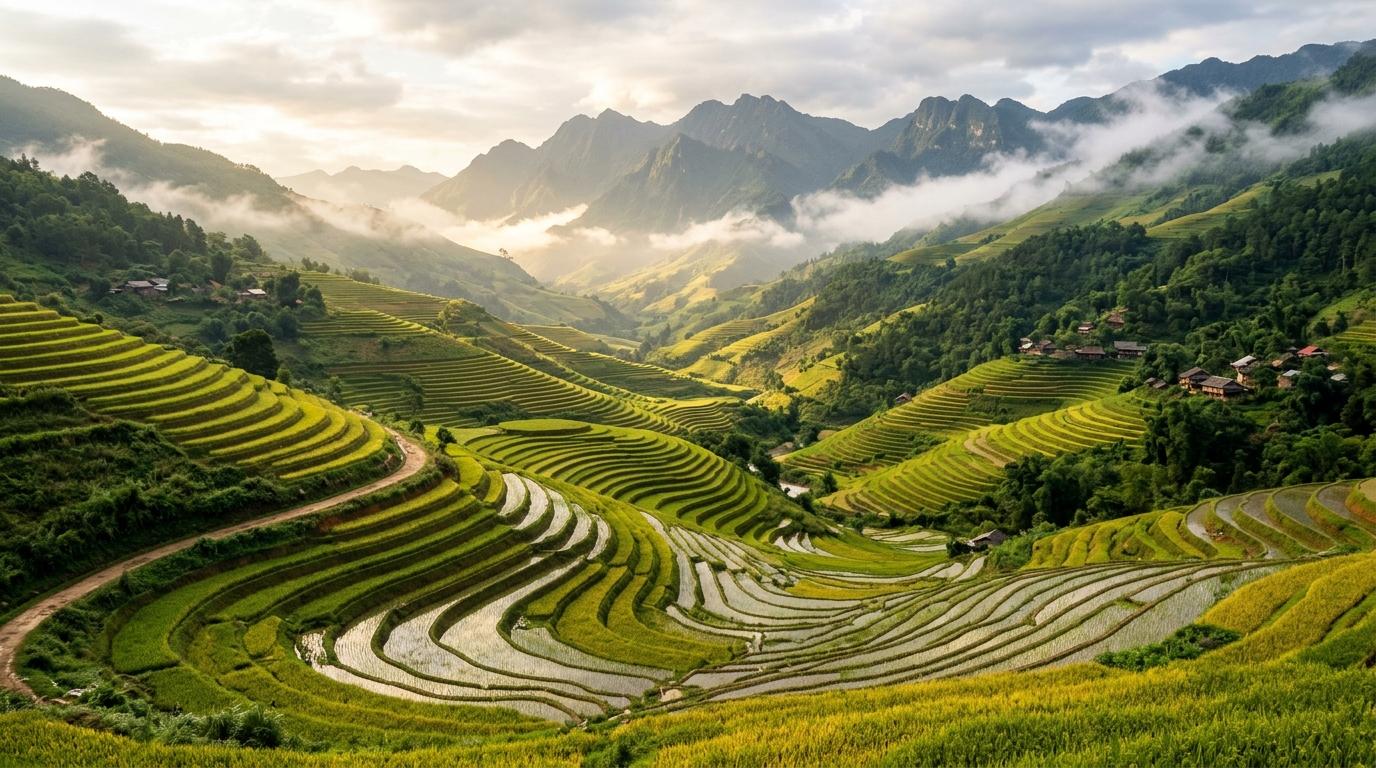
Tucked into the Hoang Lien Son mountains of northwestern Vietnam, Sa Pa (commonly written as Sapa) is famous for its dramatic emerald rice terraces, cool mountain air, and hiking routes connecting ethnic minority villages.
For most travelers visiting northern Vietnam, Sapa is the natural contrast to the chaotic street life of Hanoi. But getting the journey right requires clear planning. The transport choice between an overnight railway berth and an express highway cabin bus sets the tone for your entire trip. Once in town, Sapa's rapid hotel development, unpredictable mountain fog, and tourist traps can catch you off guard if you do not know where to go and when to visit.
This guide provides an honest, logistical breakdown of traveling from Hanoi to Sapa: comparing sleeper trains against luxury cabin buses, mapping out the best trekking routes across Muong Hoa Valley, navigating Fansipan peak, and planning around the seasonal rice harvest calendar.
Getting from Hanoi to Sapa: Sleeper Train vs Cabin Bus
#Sapa sits roughly 320 kilometers northwest of Hanoi, perched at an altitude of 1,500 meters. Because there is no commercial airport in Lao Cai province, every traveler arrives either by railway or by highway.
| Transport Factor | Overnight Sleeper Train (to Lao Cai) | Express Limousine Cabin Bus (Direct to Sapa) |
|---|---|---|
| Travel Route | Hanoi Railway Station to Lao Cai Station | Hanoi Old Quarter to Sapa Town Center |
| Travel Duration | 8 hours train + 50 minutes minibus | 5.5 to 6 hours direct |
| Typical Departure | 21:30 or 22:00 from Hanoi | 07:00 morning or 22:00 overnight |
| Comfort Style | 4-berth soft sleeper cabin with bunk beds | Single or double private sleeper capsules |
| Motion Sickness Risk | Low (steady rail tracks) | Moderate to High (mountain switchbacks) |
| Transfer Requirement | Yes (minibus or taxi from Lao Cai station) | None (arrives directly in downtown Sapa) |
| Approximate Cost | $25 to $45 for train + $3 to $5 minibus | $15 to $25 per cabin berth |
| Best For | Travelers wanting a stable bed and nostalgia | Budget travelers wanting speed and zero transfers |
Option 1: The Overnight Sleeper Train to Lao Cai
#The railway is the historic, romantic way to travel to Vietnam's northern highlands. Trains depart nightly from Hanoi Railway Station (Ga Hà Nội) on Le Duan street between 21:30 and 22:00, arriving in the border city of Lao Cai around 05:30 the next morning.
- The Big Catch: Trains do not go to Sapa town. Sapa is situated high up in the mountains, while the rail line ends in the low river valley at Lao Cai on the Chinese border. When you step off the train at dawn in Lao Cai, you must take a minibus or taxi for the final 35-kilometer winding uphill drive to Sapa, which takes forty-five to sixty minutes.
- Sleep Quality: Trains are louder than hotel rooms, with rhythmic track clatter, but the movement is horizontal and steady. If you suffer from car sickness, the train is vastly more comfortable than a bus navigating mountain curves.
- Cabin Classes: Standard Vietnam Railways (DSVN) runs comfortable four-berth soft sleeper compartments with air conditioning. Several private tourism operators (such as Chapa Express, Laman Express, or Sapaly) attach upgraded luxury carriages to the same state train, featuring wood-paneled walls, cleaner bedding, and complimentary water.
Option 2: The Limousine Sleeper Bus via Highway CT05
#Before 2014, buses took ten treacherous hours over two-lane mountain passes. The opening of the modern Noi Bai-Lao Cai Express Highway (CT05) changed everything, cutting road travel down to under six hours.
- Direct Arrival: Modern sleeper buses drive straight into downtown Sapa near the central lake or bus terminal. You do not need an early-morning transfer in Lao Cai.
- Cabin Style: Modern Vietnamese sleeper buses (often called VIP Cabin buses) feature individual enclosed capsules with privacy curtains, USB charging ports, ambient LED lighting, and massage seats that recline nearly flat.
- The Winding Final Stretch: The first four hours along highway CT05 are smooth and flat. However, the final hour climbing from Lao Cai up route QL4D involves steep mountain switchbacks. If you are prone to motion sickness, take motion sickness medication before departure and request a lower-deck cabin near the middle of the bus.
- Daytime vs Overnight Bus: A morning departure (around 06:30 or 07:00) is generally recommended over an overnight bus. An overnight bus arriving in Sapa at 03:30 or 04:00 AM leaves you stranded in a cold dark bus until morning, whereas a daytime bus allows you to watch the landscape shift from flat Red River delta plains to soaring karst mountains.
When to Visit: Rice Terrace Seasons and Weather
#Sapa experiences four distinct seasons that drastically alter the scenery. Because mountain farmers here harvest only one rice crop per year due to high altitude and cooler temperatures, timing your visit determines whether you see lush green terraces, mirror-like water paddies, golden fields, or dense winter mist.
The Golden Harvest Season (Late August to Late September)
#This is the most famous, postcard-perfect time to visit Sapa. Rice stalks turn rich shades of gold and amber across the terraced amphitheaters of Muong Hoa Valley. Weather is generally sunny with comfortable daytime temperatures around 20 to 25 degrees Celsius. Farmers begin harvesting in late September; by mid-October, most fields are cut down to brown mud and stubble.
The Emerald Green Season (June to Early August)
#During summer, the young rice plants grow vigorously, painting the entire mountain landscape in vibrant shades of green. This season brings warm weather but also frequent monsoon downpours and afternoon thunderstorms. Trekking trails become muddy and slippery, requiring sturdy hiking boots with aggressive tread.
The Watering Season (April to May)
#In spring, mountain communities channel rainwater and stream runoff from Fansipan into the tiered paddies to prepare for planting. The flooded terraces act as thousands of curved mirrors reflecting the sky, clouds, and surrounding peaks. Weather is mild and dry, with blooming peach blossoms and wild orchids.
The Winter Mist and Chill (December to February)
#Winter in Sapa is cold, damp, and frequently wrapped in thick fog known locally as the sea of clouds. Temperatures in town drop between 5 and 10 degrees Celsius, and occasionally plunge below freezing at high altitudes with light snow on Fansipan. While the landscape lacks green rice, winter brings a moody, atmospheric charm with roaring fireplace cafes, hot salmon hotpot dinners, and clear sunny summit days above the cloud inversion.
Trekking in Sapa: Choosing the Right Village Route
#Trekking through rural villages home to the Black Hmong, Red Dao, and Giay ethnic communities is the heart of any Sapa trip. However, commercialization has changed several popular routes.
Cat Cat Village: The Convenient Walk
#Cat Cat is the closest village to Sapa town, located just two kilometers down a steep paved valley road.
- The Reality: While scenic with waterfalls and traditional waterwheels, Cat Cat has been heavily developed into a ticketed tourist park with paved concrete staircases, souvenir stalls lining both sides of the path, and costume rental shops.
- Best For: Travelers with limited mobility, elderly visitors, or those with only an afternoon to spare who want an easy paved walk with mountain views.
Muong Hoa Valley: Y Linh Ho, Lao Chai and Ta Van
#For a genuine hiking experience among terraced fields and peaceful hamlets, head into Muong Hoa Valley, located eight to twelve kilometers south of Sapa town.
- The Classic Trek: A standard six-to-eight-kilometer hike starts near Y Linh Ho, follows dirt buffalo paths down through terraced slopes to the Black Hmong village of Lao Chai, and continues along the river to the Giay village of Ta Van.
- What You See: Working farmers, duck ponds, bamboo groves, suspension bridges over the Muong Hoa stream, and sweeping unobstructed views across the valley.
- Trail Conditions: The dirt tracks become slick red clay after rain. Trekking poles or a bamboo walking stick purchased from local villagers make a tremendous difference on steep descents.
- Village Etiquette: When trekking through villages, avoid taking intrusive close-up photos of children or sacred altars inside homes without asking permission. If local women walk alongside you chatting in English, they will politely offer handmade embroidered crafts at the end of the trail; buying a small coin purse or bracelet is a fair and supportive exchange for their navigation help.
Fansipan Peak: Conquering the Roof of Indochina
#At 3,143 meters above sea level, Fansipan is the highest mountain in Vietnam, Laos, and Cambodia. In the past, reaching the summit required a grueling two-day backcountry trek through dense bamboo jungle. Today, the Sun World Fansipan Legend cable car transports visitors from the valley floor to near the peak in just fifteen minutes.
How the Journey Works
#- Take the scenic Muong Hoa mountain funicular train from Sun Plaza in the center of Sapa town down to the cable car station.
- Board the three-rope cable car for a breathtaking six-kilometer ride rising over 1,400 vertical meters above Muong Hoa valley and the Hoang Lien National Park canopy.
- From the upper cable car station, you can either climb 600 stone stairs past colossal bronze Buddha statues and mountain temples to the summit monument, or take a short secondary peak funicular train to the very top.
The Cloud Strategy for Clear Views
#Mountain weather at 3,100 meters changes within minutes. Sapa town below may be completely overcast while the summit stands in brilliant blue sunshine above the cloud blanket, or vice versa.
- Check the live webcam screens displayed at the Sun Plaza ticket office in town before purchasing tickets. If the summit camera shows thick whiteout fog with zero visibility, wait until afternoon or the next morning.
- Early mornings (between 07:30 and 09:30) typically offer the clearest skies before rising heat generates afternoon cloud cover.
- The summit is consistently 10 to 12 degrees Celsius colder than Sapa town, with intense high-altitude winds. Always carry a windproof fleece or warm jacket even if Sapa town feels pleasantly mild.
Essential Packing for Sapa Mountain Weather
#Sapa's high altitude means weather shifts rapidly from intense UV sunshine to chilly mountain downpours within a single afternoon:
- Footwear with Deep Lug Tread: Regular flat-soled sneakers or running shoes will slip constantly on wet clay trails. Bring broken-in trail runners or lightweight hiking boots with deep rubber lugs.
- Breathable Rain Shell: A lightweight waterproof jacket is far more practical than an umbrella when trekking narrow mountain footpaths.
- Warm Layers: Fleece jackets, thermal underwear, and warm socks are essential from October through March. Most budget homestays and older hotels lack central heating, relying instead on electric heated blankets or small space heaters.
- Cash in Small Vietnamese Dong (VND): ATMs in Sapa town can run out of cash during busy holiday weekends, and village homestays, roadside fruit stalls, and trekking entrance checkpoints do not accept foreign credit cards.
- Insect Repellent and Sunscreen: High-altitude UV rays reflect intensely off water-filled rice paddies, while humid valley floors harbor mosquitoes and biting midges.
Sample 3-Day Sapa Itinerary from Hanoi
#Here is a balanced, practical schedule that avoids exhaustion while covering the best of Sapa:
Day 1: Arrival, Town Walk and Mountain Homestay Check-in
#- Depart Hanoi at 06:30 AM via express limousine cabin bus; arrive in Sapa town around 12:30 PM.
- Enjoy a warm bowl of northern-style pho or grilled pork skewers near the town square.
- Take a twenty-minute taxi down into Ta Van village to check into a peaceful valley homestay overlooking the rice terraces, away from the concrete construction of town.
- Spend a relaxed afternoon exploring the suspension bridge and bamboo groves around Ta Van.
Day 2: Full-Day Muong Hoa Valley Trek
#- Fuel up with breakfast and fresh Vietnamese drip coffee overlooking the morning valley mist.
- Meet a local village guide and embark on an eight-kilometer trek through Y Linh Ho and Lao Chai, winding along agricultural trails and mountain streams.
- Stop for a family-style lunch at a small village eatery.
- Return to your homestay in the late afternoon for a soothing traditional Red Dao herbal bath (herbal plants boiled in wooden barrels, renowned for soothing sore muscles).
Day 3: Fansipan Summit and Evening Return to Hanoi
#- Check out of your homestay after breakfast and head up to the Fansipan cable car station.
- Ascend to the 3,143-meter summit monument to take in panoramic views of the Hoang Lien mountain range.
- Return to Sapa town by 14:30 PM for a final coffee or hot soup.
- Board your 15:30 PM return limousine bus to Hanoi, arriving back in the capital around 21:30 PM.