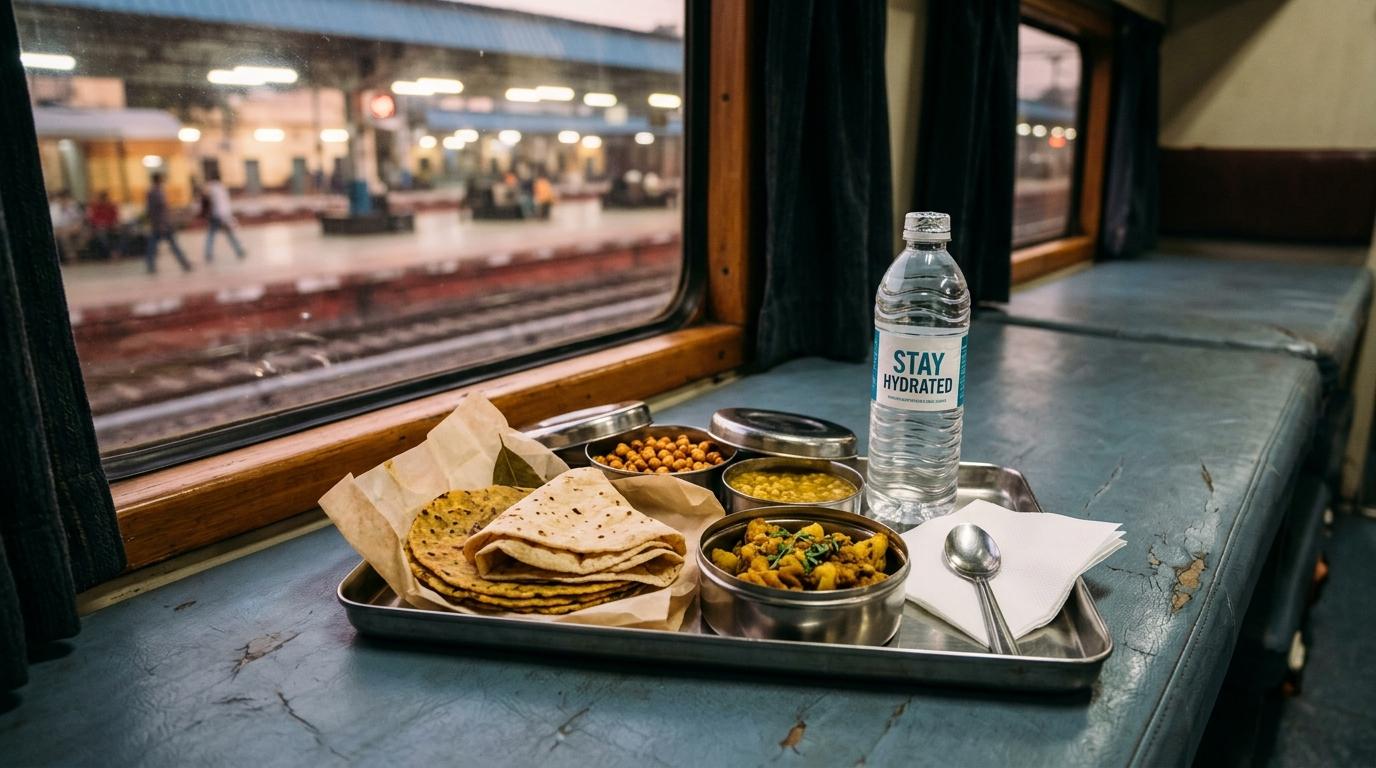
There’s a very specific mood before an overnight train journey in India.
You reach the station a little early. You check the platform. Then the coach position. Then you check it again, just to be safe. Families are sitting on suitcases, someone is guarding a mountain of luggage, kids are already asking for chips, and the train either hasn’t arrived or is standing there with that familiar metal smell.
You find your berth, push the bags under the seat, chain the luggage if needed, adjust the bottles, argue softly about who will sleep where — and then someone says, “Khaana khaaya?”
That is usually where the journey can go right or wrong.
A dinner that is too oily, too spicy, too heavy, too late, or not fresh enough can make the night uncomfortable. Acidity, bloating, thirst, disturbed sleep, and repeated toilet trips are not the memories anyone wants from a train journey.
If you are travelling with children, older parents, or taking a long overnight train for the first time, food planning is not a small thing. It can make the difference between a peaceful night and a very restless one.
This guide keeps things simple: what to eat before an overnight train in India, what to pack, what to buy, and what to avoid.
Quick Answer: Best Dinner for an Overnight Train in India
#If you remember just one thing, remember this:
Eat light, eat early, and avoid messy or highly perishable food.
For most overnight train journeys, these are safe and practical choices:
- Best dinner before boarding: Dal-rice, phulka with dry sabzi, idli-sambar, simple upma, poha, khichdi, or light home-cooked food.
- Best dinner on the train: Simple veg thali, dal-roti, plain rice with dal, or dry sabzi with rotis.
- Best food to pack: Thepla, dry paratha, khakhra, roasted makhana, dry fruits, biscuits, dry aloo or bhindi, and simple sandwiches without mayo.
- Foods to avoid: Heavy gravies, creamy sweets, mayo sandwiches, exposed cut fruits, raw salads, lukewarm egg or meat dishes, very spicy snacks, and anything that leaks or smells strong.
- Drinks: Drink enough water before boarding and in the early evening. After dinner, sip slowly. Avoid tea and coffee late in the evening if you want to sleep well.
For a broader train food guide, you can also read the Indian Railway Food Guide on allblogs.
Should You Eat Before Boarding or On the Train?
#This depends mostly on your train timing.
A train leaving at 6 PM and a train leaving at 10:30 PM need completely different food plans.
If Your Train Leaves Late, Eat Before Boarding
#If your train leaves around 9 PM or later, it is usually better to eat dinner before you reach the station.
A calm meal at home, or food from a trusted place near home, is usually much easier on your stomach than eating hurriedly after boarding. By the time you settle into the train, arrange your luggage, spread the bedsheet, and climb onto your berth, you probably won’t feel like dealing with a full dinner anyway.
Good options before boarding:
- Dal-rice in a small portion
- Phulka with dry sabzi
- Idli with sambar
- Light upma or poha
- Simple khichdi
- Fresh curd rice, only if eaten soon
Try not to turn this meal into a “special travel dinner.” This is not the best time for chole bhature, oily biryani, butter paneer, fried starters, or very spicy street food.
Once you board, you will mostly be sitting or lying down. Heavy food feels much heavier when your body is not moving.
If you think you may feel hungry later, carry a dry snack instead of delaying dinner.
If Your Train Leaves in the Early Evening, Eat Onboard
#If your train leaves between 5 PM and 8 PM, eating dinner on the train may be more practical.
But don’t wait too long. Once people start getting sleepy, bags are locked, berths are opened, and lights are dimmed, dinner becomes a nuisance.
Try to finish dinner by around 8:30 PM if possible.
Better onboard dinner choices:
- Dal-roti
- Veg thali with dry sabzi
- Plain rice with dal
- Fresh idli, if available
- Light packed dinner from home
- Thepla or paratha with dry sabzi
Try to avoid:
- Heavy paneer gravies
- Oily fried rice
- Egg curry or chicken curry served lukewarm
- Very spicy biryani late at night
- Large portions of fried snacks
Eating on the train is part of the fun, of course. But your stomach still has to manage the journey. A slightly boring dinner is often the best dinner before sleep.
What to Pack for a Night Train Dinner
#For overnight train travel, packed food should pass three simple tests:
- Will it stay safe for a few hours?
- Will it be easy to eat without spilling?
- Will it smell okay in a shared coach?
If the answer is yes, it is probably a good train food choice.
Thepla
#Thepla is one of the most reliable Indian train foods.
It is dry, easy to carry, easy to roll, and does not create much mess. You can eat it with dry sabzi, a little pickle, or even just on its own.
Just don’t overdo the pickle. Too much oil, salt, and chilli can make you very thirsty at night.
Dry Paratha
#Aloo paratha, gobi paratha, methi paratha, or plain paratha can work well if they are not too oily and the stuffing is not wet.
Pack each paratha separately in foil, butter paper, or clean food wrap. That way, you don’t have to keep opening one big packet again and again.
Avoid packing curd with paratha unless you plan to eat it soon after leaving home.
Phulka With Dry Sabzi
#This is one of the safest and most familiar options, especially for families.
Pack soft phulkas with dry sabzi like:
- Aloo
- Bhindi
- Beans
- Carrot
- Cabbage
- Methi
- Gobi
- Mixed dry vegetables
Avoid runny gravies. They leak, smell, stain clothes, and are awkward to eat when the train is moving.
Lemon Rice or Tamarind Rice
#If your family prefers rice, lemon rice or tamarind rice can be more practical than plain rice with curry.
Still, rice needs care. Pack it fresh, keep portions small, and eat it within a few hours. Don’t save it for late night after it has been sitting in a warm bag for too long.
Simple Sandwiches
#Sandwiches are fine if they are simple and dry.
A plain veg sandwich with very little chutney is better than a creamy, soggy sandwich full of cucumber, tomato, cheese, and mayo.
Avoid sandwiches with:
- Mayonnaise
- Paneer
- Egg
- Wet chutney
- Too much tomato or cucumber
- Creamy fillings
In hot weather, be extra careful with anything dairy-based.
Backup Snacks to Carry
#Backup snacks are not always a full dinner, but they are very useful.
Trains get delayed. Pantry food may not look good. E-catering may arrive late. Or you may simply feel hungry after everyone has slept.
Carry a few low-mess snacks like:
- Roasted makhana
- Khakhra
- Dry fruits
- Peanuts
- Roasted chana
- Plain biscuits
- Crackers
- Homemade chivda, if not too oily or spicy
- Sealed energy bars
If you are travelling with children, carry at least one snack they already like. A train journey is not the best time to test a new health bar or unfamiliar packaged food.
What to Buy for Dinner on the Train
#Sometimes packing dinner is not possible. Sometimes the train timing is awkward. And sometimes you just don’t want to carry another box from home.
That’s fine. Just choose carefully.
Better Buying Choices
#Look for food that is fresh, hot, simple, and not too oily.
Safer choices include:
- Basic veg thali
- Dal-roti
- Plain rice with dal
- Dry sabzi with rotis
- Fresh idli or dosa from a trusted outlet
- Sealed packaged snacks from known brands
If you are ordering through e-catering, choose a station that arrives at a sensible dinner time. Don’t plan dinner too late at night. If the train gets delayed, a 9 PM dinner can easily become an 11 PM dinner.
Be Careful With Station Food
#Station food is tempting. The smell of hot samosas, vada pav, cutlets, bread omelette, and chai can weaken anyone’s resolve.
The trick is to separate food that is genuinely fresh and hot from food that has been sitting around for too long.
Better station choices:
- Fresh hot food from a busy stall
- Sealed water bottles
- Sealed buttermilk or packaged drinks
- Packaged snacks with intact seals
Avoid:
- Cut fruits kept uncovered
- Raw salads
- Open chutneys
- Lukewarm fried snacks
- Cream-filled sweets
- Food exposed to flies or dust
- Food that looks reheated again and again
A simple rule works well: if it is not freshly hot or properly sealed, skip it.
What to Avoid for an Overnight Train Dinner
#Some foods are perfectly fine at home but troublesome on a night train.
You have less space, shared air, limited washroom comfort, and a body that is about to lie down for hours.
Heavy Gravies
#Butter paneer, rich chicken curry, creamy kofta, thick masala gravies, and similar dishes may sound satisfying, but they are not ideal for night travel.
They can spill easily, smell strong, and feel very heavy once you lie down.
Deep-Fried Snacks as Dinner
#Samosa, kachori, bread pakora, vada, and pakoras are okay once in a while if they are fresh.
But as dinner before sleep? Not the best idea.
Too much fried food can lead to acidity, thirst, and disturbed sleep for many people.
Raw Salads and Cut Fruits
#Raw onion, cucumber, tomato slices, and cut fruit may look fresh, but they depend a lot on clean water, clean knives, and safe handling.
On train journeys, especially overnight ones, cooked food is usually safer.
Creamy Sweets and Dairy-Heavy Desserts
#Rasgulla, rabri, cream rolls, milk cake, and similar sweets are sensitive to heat and storage.
If you want something sweet, choose a dry packaged sweet or a small sealed dessert from a trusted place instead of milk-heavy sweets kept open.
Strong-Smelling Food
#Fish curry, raw onion-heavy meals, strong pickles, and very garlicky food can make the whole bay uncomfortable.
This matters even more in AC coaches, where smells stay longer.
Train food etiquette is simple: you are eating in someone else’s sleeping space too.
Train Food Safety: Rice, Dairy, Eggs, and Meat
#Food safety on trains mostly comes down to four things:
- Time
- Temperature
- Moisture
- Handling
Warm, moist food spoils faster than dry food. Food that is cooked and then kept lukewarm for hours needs extra caution.
Here’s how to think about common dinner items.
Rice
#Cooked rice needs care because it is moist and often packed in bulk.
If you are carrying rice from home, pack it fresh and eat it within a few hours. Avoid keeping rice for late-night eating, especially in hot weather.
If you buy rice on the train, make sure it is served hot. Avoid rice that feels lukewarm, smells sour, or looks dry and reheated.
Lemon rice and tamarind rice are practical, but they still need clean preparation and sensible timing.
Dairy
#Curd, paneer, milk, cream, and dairy sweets are temperature-sensitive.
In hot weather, especially in non-AC travel, dairy can spoil faster than you expect.
Be careful with:
- Curd packed many hours before travel
- Paneer gravies
- Creamy desserts
- Milk-based sweets
- Lassi or chaas from open containers
If you want buttermilk or chaas, choose a sealed pack and drink it soon after buying. Don’t open it and save it for later.
Eggs
#Eggs can be filling, but they need proper cooking and safe storage.
A freshly boiled egg eaten soon may be fine for many travellers. But egg curry, egg biryani, or egg sandwiches kept lukewarm for hours are not ideal for an overnight journey.
If you don’t know how long an egg dish has been sitting around, it is better to skip it.
Meat and Chicken
#Meat and chicken dishes have a higher spoilage risk if they are not cooked, stored, and served properly.
For overnight train journeys, the safest choice is often a simple vegetarian dinner.
If you still prefer non-veg, choose food from a trusted source, eat it fresh and hot, and don’t save leftovers for later. Avoid chicken, meat, or fish that is lukewarm, smells odd, or has been sitting uncovered.
Hydration, Tea, and Coffee Timing
#Hydration on a night train is a small balancing act.
Drink too little and you may wake up thirsty. Drink too much too late and you may keep getting up for the washroom.
Drink Enough Before Boarding
#Drink water during the afternoon and early evening. Don’t start your journey already dehydrated, especially in summer or after a tiring day of packing and commuting.
Sip Slowly After Dinner
#After dinner, sip water slowly. Don’t finish a full bottle just before lying down.
This is especially important for children and older travellers. Night washroom trips on a moving train can be inconvenient and uncomfortable.
Avoid Late Tea and Coffee
#The late-night “chai, coffee” call is hard to ignore. It feels like part of the train journey.
But caffeine can disturb sleep, and tea or coffee late in the evening can increase toilet trips for some people.
If you want proper sleep, try to stop tea and coffee by 6 or 7 PM. If you really want something warm later, keep it small.
Food Tips by Coach and Berth
#Your coach and berth also affect what you should eat.
A meal that is easy on a lower berth may be annoying on an upper berth. A strong-smelling meal that feels okay in Sleeper may feel too much in AC.
Sleeper Class
#Sleeper class has more airflow, but also more dust and movement.
Keep food covered between bites, especially if windows are open or people are walking past often.
Use small containers or individual wraps instead of one large box. It is much easier to manage in a crowded bay.
3AC and 2AC
#In AC coaches, smells stay longer because the windows are sealed.
Avoid fish, raw onions, strong pickles, and very pungent curries. Your co-passengers may be trying to sleep just a few feet away.
Also, hot food cools quickly in AC. Eat soon after opening your meal instead of letting it sit while you arrange blankets and luggage.
Chair Car and Seated Overnight Travel
#If you are travelling overnight in a chair car or seated coach, avoid very heavy food.
Sitting upright for hours after an oily dinner can be uncomfortable.
Choose smaller portions, dry foods, and snacks that don’t need much space. Avoid large thalis unless you have a stable tray.
Upper and Side Upper Berths
#If you have an upper or side upper berth, eat before climbing up for the night.
Balancing a thali, curry container, or rice box on an upper berth is uncomfortable and risky.
Families should try to feed children before bedding is arranged. Once bags are chained, blankets are out, and people have started sleeping, dinner becomes much harder to manage.
Simple Dinner Plans for Common Train Timings
#Here are a few practical plans based on departure time.
If Your Train Leaves Around 5 PM
#Eat a light snack before leaving home. Plan dinner for around 7 to 8 PM.
Good dinner options:
- Roti with dry sabzi
- Dal-rice in a small portion
- Veg thali without heavy gravy
- Thepla with dry aloo
If Your Train Leaves Around 7 PM
#Carry dinner from home or plan a simple onboard meal early.
Good dinner options:
- Paratha with dry sabzi
- Fresh idli-sambar
- Dal-roti
- Lemon rice eaten early
- Phulka with dry sabzi
Try not to wait until 10 PM unless you really have no choice.
If Your Train Leaves Around 9 PM or Later
#Eat dinner before reaching the station. Carry only light backup snacks.
Good backup snacks:
- Khakhra
- Roasted makhana
- Dry fruits
- Biscuits
- A small paratha roll
- Crackers
Don’t board hungry and depend completely on late-night food availability.
Quick Packing Checklist
#Before leaving home, check this once:
- Dinner in leak-proof containers
- Dry snacks in easy-to-open packets
- Tissues or paper napkins
- Hand sanitizer
- Spoon, if needed
- Small garbage bag
- Water bottle
- Regular medicines for acidity or digestion, if you already use them
- Children’s food packed separately
- No loose chutney, runny curry, or uncovered dairy
Keep dinner near the top of your bag. You don’t want to unpack half your luggage after boarding.
Final Thought
#A good overnight train dinner in India is not about eating very little. It is about eating sensibly.
Choose food that is light, fresh, dry, and easy to handle. Eat early when you can. Be careful with rice, dairy, eggs, and meat. Don’t leave tea and coffee too late. And always carry one backup snack, because train timings and hunger don’t always cooperate.
Do this, and your night journey has a much better chance of being what it should be: calm, comfortable, and memorable for the right reasons.