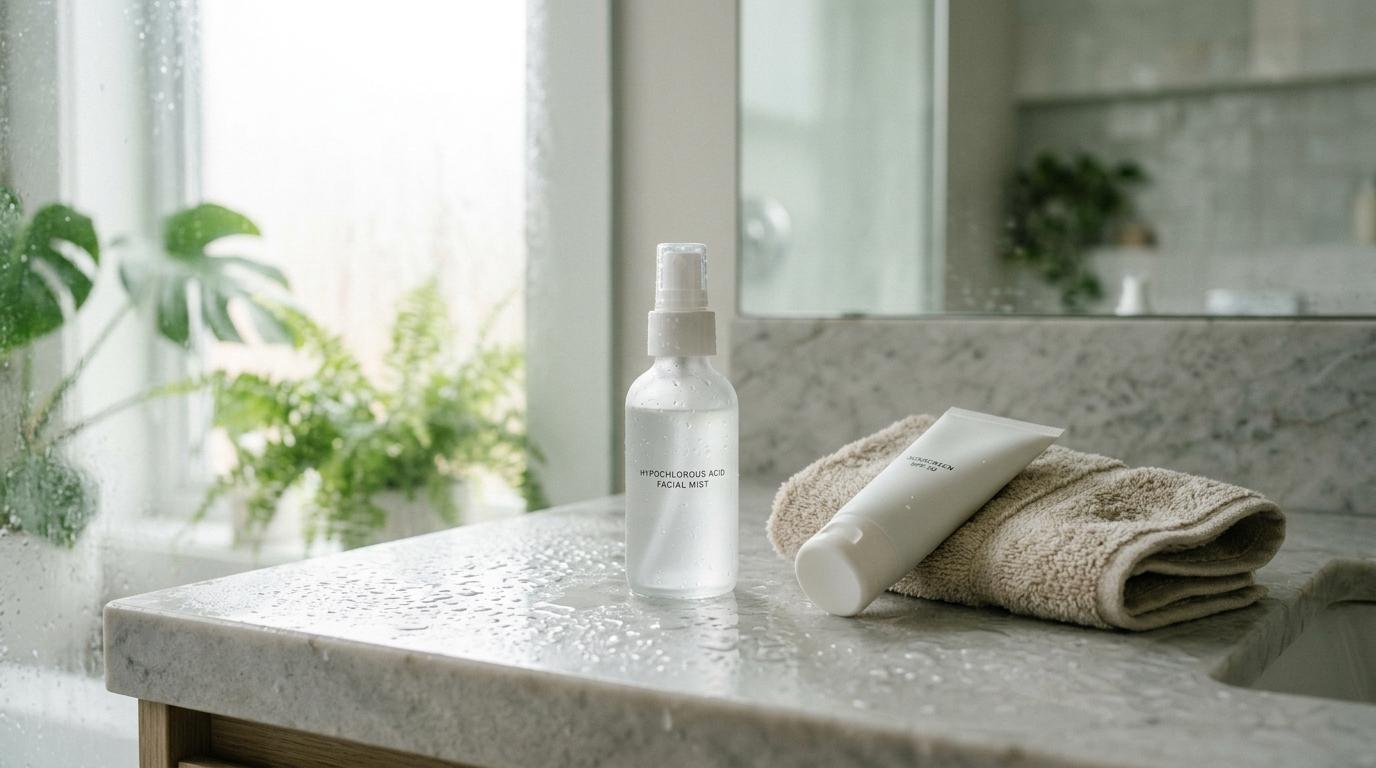
Hypochlorous acid spray for face is a gentle leave-on mist that can help refresh sweaty skin, reduce surface bacteria, and calm the look of redness or irritation. It can be useful in humid weather, after workouts, during travel, or anytime your skin feels a little stressed. It is not a cure for acne, eczema, or rosacea, but it can be a helpful support step in a simple skincare routine.
The name feels very science-lab. The bottles often look clinical. And if you have seen it all over social media, you have probably also seen claims that make it sound like it can fix almost every skin problem overnight.
Realistically, it is much simpler than that.
A good hypochlorous acid spray can be a genuinely useful little product if your skin gets sweaty, irritated, red-looking, or uncomfortable in humid weather. It is also easy to use, which is part of the appeal. You spray it on, let it dry, and carry on.
But it is not magic. It does not replace your cleanser, moisturizer, sunscreen, acne treatment, eczema prescription, or dermatologist. Think of it as a helpful hygiene and calming step, not the star of your entire skincare routine.
What is hypochlorous acid spray?
#Hypochlorous acid, often shortened to HOCl, is a weak acid that your own body naturally makes. Your white blood cells produce it as part of your immune response.
In skincare, brands use a stabilized version of hypochlorous acid in a water-based spray. When made properly for skin, it is usually gentle and easy to fit into a routine.
For the face, hypochlorous acid sprays are commonly used to help with:
- Refreshing sweaty skin
- Reducing surface bacteria
- Calming the look of redness
- Supporting skin that feels irritated or reactive
- Making post-gym or humid-weather skincare feel easier
That does not mean it treats medical skin conditions. If you have severe acne, infected eczema, swelling, pus, crusting, or skin that burns constantly, a cosmetic spray is not enough. That is when it is time to speak with a dermatologist.
For everyday use, though, HOCl spray can be a nice simple add-on, especially if your skin does not tolerate heavy products, fragrance, or strong actives very well.
HOCl spray vs toner vs face mist vs cleanser
#A lot of people are not sure where hypochlorous acid spray fits. Is it a toner? A face mist? A cleanser?
Not exactly.
Here is the easy way to think about it.
The main thing to remember is this: hypochlorous acid spray does not replace cleanser.
It will not properly remove sunscreen, makeup, pollution, oil, or grime. It is better used after cleansing, after sweating, or during the day when you cannot wash your face right away but want your skin to feel fresher.
When is hypochlorous acid spray actually useful?
#You do not need to buy it just because everyone online suddenly has one in their gym bag. But there are a few everyday situations where it can make sense.
1. Humid weather
#Humidity can make your skin feel sticky, sweaty, and annoyed. If you are commuting, walking outside, running errands, or sitting somewhere warm, sweat and oil can sit on your face for hours.
A hypochlorous acid spray for face can help your skin feel cleaner and calmer until you are able to wash properly.
It is not the same as cleansing, but it can make a hot, sticky day feel a little less uncomfortable.
2. After workouts
#Post-gym skin can be tricky. Sweat dries down, oil builds up, bacteria sit on the skin, and towels, hats, helmets, or tight clothing can add friction.
HOCl spray can be a useful in-between step after exercise. It is not a replacement for showering, but it can help tide you over until you can cleanse properly.
This can be especially helpful if you tend to break out on your face, chest, back, or neck after sweating.
3. Sensitive or reactive-feeling skin
#Some people cannot deal with fragranced mists, exfoliating toners, or complicated routines. Everything seems to sting, flush, or make the skin feel worse.
Hypochlorous acid sprays are often very simple, which is why people with sensitive-feeling skin are drawn to them.
Still, gentle does not mean every product will suit every person. Patch testing is always a good idea if your skin is reactive.
4. Travel days
#Travel can make skin act up for all kinds of reasons. You may be touching your face more, sleeping less, washing less often, dealing with airplane air, changing climates, or sweating while carrying bags around.
A travel-size HOCl spray in its original bottle can be handy when your face feels sweaty, uncomfortable, or just not fresh.
The original bottle part matters, though. Try not to pour it into a random mini spray bottle.
Beginner buying checklist: what to check before buying
#Hypochlorous acid sprays have become popular fast, which means there are now a lot of options. Some are simple and well made. Others rely more on trendy packaging and big promises.
Here is what to look for before buying one.
1. Check the ingredient list
#A good beginner-friendly formula should be short and simple. Many hypochlorous acid sprays are based on:
- Water
- Sodium chloride
- Hypochlorous acid
That is usually enough.
Be cautious with formulas that include fragrance, essential oils, harsh actives, or a long list of unnecessary extras. HOCl can be a delicate ingredient, and if your skin is already sensitive, simple is usually better.
If you are easily irritated by skincare, choose fragrance-free.
2. Check the packaging
#With hypochlorous acid, the bottle is not just about looks. HOCl can be unstable if it is exposed to too much light, air, heat, or unsuitable packaging.
Look for:
- Opaque or tinted packaging
- A fine mist sprayer
- A sealed bottle from the brand
- Clear storage instructions
- An expiry date or period-after-opening symbol
Avoid bottles that look damaged, have no expiry information, or seem like they may have been opened. It is not worth the risk.
3. Do not decant it into a travel bottle
#This is one of the most practical rules.
Do not pour hypochlorous acid spray into a random mini bottle for travel. Exposure to air, light, or the wrong type of plastic can affect the formula. You might end up carrying around a spray that no longer works the way it should.
If you want to travel with it, buy a smaller original bottle or check whether the brand sells a travel size.
And if you are flying, check your airline liquid rules before packing it. Nobody wants to watch their full bottle get tossed at security.
4. Check concentration and skin-use wording
#Choose a product that clearly says it is made for skin, face, or cosmetic use.
Do not use household, industrial, cleaning, or disinfectant-grade hypochlorous acid products on your face. Even if they contain HOCl, they are not skincare.
Some cosmetic HOCl sprays list low concentrations, often around 0.01% to 0.015%, but labels vary. For beginners, the most important thing is that the product clearly states it is intended for skin or facial use.
If the label is vague, skip it.
5. Read the claims carefully
#Normal claims are fine. Miracle claims are a red flag.
Reasonable claims may sound like:
- Helps calm the look of redness
- Refreshes sweaty skin
- Helps reduce surface bacteria
- Suitable for sensitive skin
- Supports a simple skincare routine
Over-the-top claims may sound like:
- Cures acne
- Heals eczema
- Fixes rosacea
- Rebuilds your barrier overnight
- Replaces your entire skincare routine
A cosmetic spray should not be marketed like a medical treatment. If it sounds too good to be true, it probably is.
6. Check expiry and size
#Hypochlorous acid products do not stay fresh forever. Always check the expiry date before buying, especially if you are shopping online or buying from a marketplace.
If you are new to HOCl spray, start with a smaller bottle. That way, you can see if you actually like it and finish it within the recommended use period.
A huge bottle is not a bargain if it expires before you use it.
Simple routine for humid weather
#If your skin feels sticky, sweaty, or irritated on humid days, keep the routine simple.
Morning
#- Cleanse with a gentle face wash, or just rinse if your skin does not need cleanser in the morning.
- Spray hypochlorous acid on bare skin.
- Let it air dry fully.
- Apply moisturizer if you need it.
- Apply sunscreen.
During the day
#- Blot sweat with a clean tissue or soft towel.
- Spray HOCl lightly over your face.
- Let it dry instead of wiping it off right away.
- Reapply sunscreen if needed, especially if you are outdoors.
Night
#- Cleanse properly to remove sunscreen, sweat, oil, and pollution.
- Use HOCl spray if your skin feels irritated.
- Let it dry.
- Apply moisturizer.
Keep it boring. Honestly, that is often what stressed-out skin wants most.
How to use hypochlorous acid spray after sweating or the gym
#After a workout, the goal is simple: do not let sweat, oil, bacteria, and friction sit on your skin for too long.
Try this:
- Wash your hands if you can.
- Blot heavy sweat from your face.
- Spray hypochlorous acid over your face, neck, chest, or back if those areas get sweaty or breakout-prone.
- Let it air dry before applying anything else.
- Shower and cleanse properly when you can.
If you work out in makeup, HOCl spray will not clean through that layer properly. It is much better to remove makeup before exercising when possible, even if it feels like an extra chore.
How to use it while travelling
#For travel, keep things easy.
- Carry the original bottle, ideally in a travel-friendly size.
- Do not transfer it into another spray bottle.
- Use it on bare or lightly blotted skin when your face feels sweaty, sticky, or uncomfortable.
- Let it dry.
- Follow with moisturizer if your skin feels dry.
If you are flying, check the liquid limit for your route and pack it in the right bag.
Safety cautions
#Hypochlorous acid spray is generally considered gentle when it is properly formulated for cosmetic skin use. Still, there are a few things to keep in mind.
Patch test first
#Spray a small amount on your jawline or inner arm and wait to see how your skin reacts.
This is especially worth doing if your skin is reactive or you have had bad reactions to skincare products before.
Avoid spraying into your eyes
#Close your eyes before spraying your face. If the product gets into your eyes and feels uncomfortable, rinse with clean water.
Be careful with strong active routines
#If you use strong exfoliating acids, retinoids, benzoyl peroxide, or vitamin C, try not to turn your routine into a chemistry experiment.
HOCl is an oxidizing ingredient, and layering too many strong products can increase irritation or potentially interfere with how some products perform.
A simple way to use it is:
- Cleanse or blot sweat.
- Spray hypochlorous acid.
- Let it dry completely.
- Follow with moisturizer.
- Use sunscreen during the day.
Do not use cleaning products on your skin
#Only use products clearly made for skin or face.
Household disinfectant sprays are not skincare, even if they contain hypochlorous acid.
Store it properly
#Follow the instructions on the label. In general, keep the bottle closed, away from direct sunlight, and out of hot places like cars or sunny bathroom windowsills.
When to see a dermatologist
#A hypochlorous acid spray can support comfort, but it cannot diagnose or treat a skin condition.
See a dermatologist if you notice:
- Deep, painful, cystic acne
- Pus, swelling, warmth, or signs of infection
- Eczema that is weeping, cracked, or spreading
- Redness that keeps getting worse
- Burning or stinging even after using gentle products
- Rashes around the eyes or mouth
- Skin symptoms that affect your sleep, confidence, or daily life
- No improvement even after simplifying your routine
If your skin is in distress, do not keep adding more products. Pause, simplify, and get proper medical advice.
Final take
#A hypochlorous acid spray for face is worth considering if you want something simple and gentle for sweat, humidity, visible redness, or reactive-feeling skin.
Look for a minimal formula, keep it in the original bottle, check the expiry date, and use it as a support step rather than a miracle fix.
The best routine is still the one your skin can tolerate consistently: cleanse, moisturize, use sunscreen, and only add extras when they solve an actual problem.