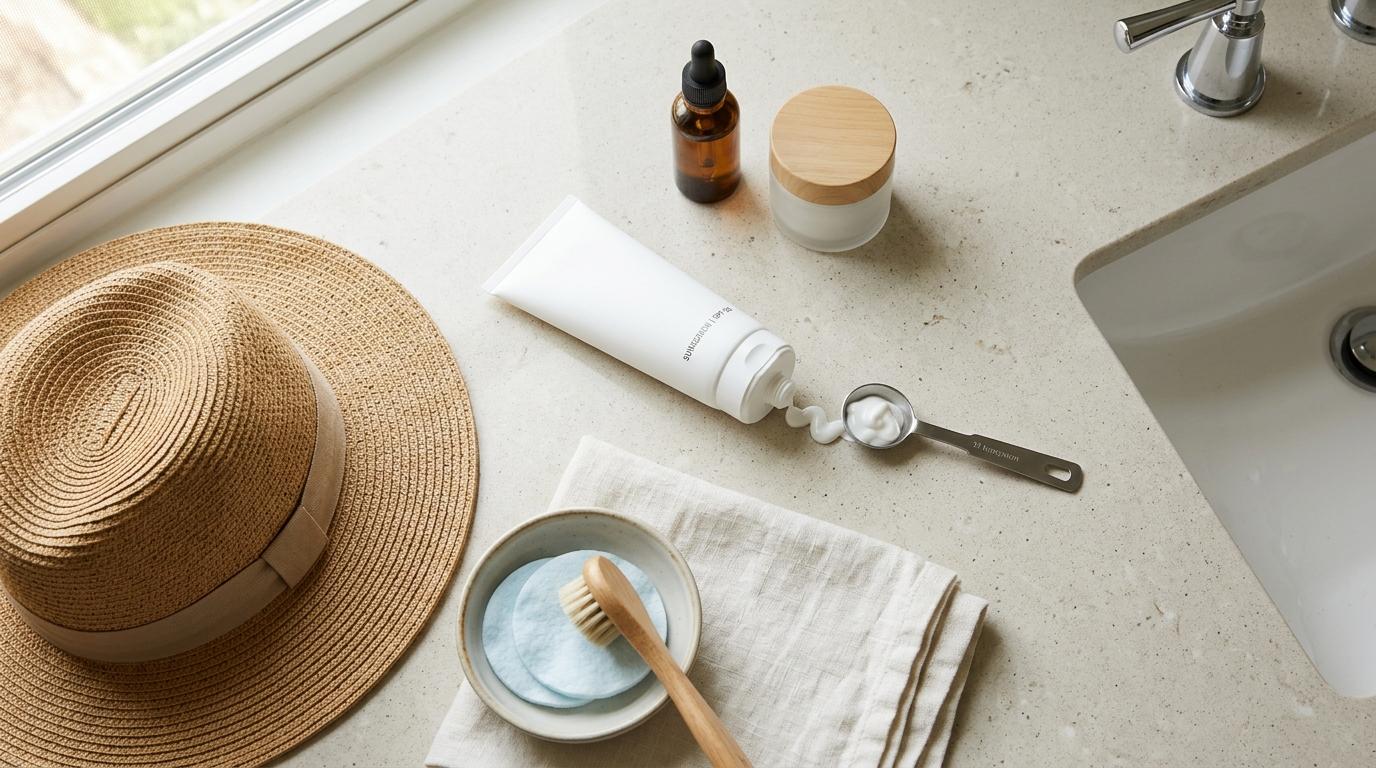
For an adult body, the general rule is to use about 1 ounce of sunscreen, or 30 mL. That’s roughly a shot glass full.
For everyday face and neck application, aim for:
- Face: about 1/4 teaspoon
- Neck: about 1/4 teaspoon
- Face + neck together: about 1/2 teaspoon
Choose a broad-spectrum sunscreen with SPF 30 or higher, apply it generously before going outside, and reapply every 2 hours when you’re in the sun. Reapply sooner if you swim, sweat heavily, or towel dry.
Here’s the part most people don’t love hearing: sunscreen only protects the way it’s supposed to when you use enough of it. And most of us use less than we think, especially when we’re rushing, sweating, layering makeup, or trying to make an expensive tube last longer.
This guide keeps it simple.
No lab coat. No measuring spoon every morning. Just practical amounts you can actually remember.
Why the Amount of Sunscreen Matters
#The SPF number on your sunscreen bottle is tested using a specific amount of product: about 2 milligrams of sunscreen per square centimeter of skin.
That sounds technical, but the takeaway is easy:
If you apply a tiny, thin layer, you probably are not getting the full SPF on the label.
So if your sunscreen says SPF 30, that SPF 30 protection assumes you applied enough, spread it evenly, and reapplied when needed. A small dab stretched across your whole face usually won’t do the job.
You don’t need to be perfect every single day. Nobody is. But having a realistic baseline helps, especially for the spots we tend to miss: the neck, ears, hands, shoulders, feet, and around the hairline.
Sunscreen Amount Guide for Face, Neck, Ears, and Body
#Use this as a practical starting point. You may need a little more or less depending on your body size, how much skin is exposed, and whether your sunscreen is a thick cream, light lotion, gel, or spray.
If you’re wearing shorts, sandals, a tank top, swimwear, or anything with cutouts, your sunscreen amount goes up quickly. That isn’t “too much.” That’s just what it takes to cover exposed skin properly.
How Much Sunscreen to Use on Your Face
#For your face alone, aim for about 1/4 teaspoon.
That should cover your:
- Forehead
- Cheeks
- Nose
- Chin
- Jawline
- Skin near the hairline
If that amount feels greasy, sticky, or heavy, don’t automatically solve the problem by using much less. It may simply mean that sunscreen isn’t the right texture for your skin.
A simple morning routine:
- Apply moisturizer first, if you use one.
- Let it settle for a minute.
- Apply sunscreen as the last step of skin care.
- Spread it evenly over your whole face.
- Pay extra attention to the nose, jawline, and hairline.
- Let it set before applying makeup, if you wear makeup.
Try not to mix sunscreen in your hand with moisturizer, foundation, or facial oil. It seems convenient, but it can make the sunscreen harder to apply evenly. Layering is usually the better habit.
Don’t Forget Your Neck
#Your neck needs its own sunscreen.
Not the tiny leftover bit from your face. Not whatever is still on your fingers. A real amount.
Use about 1/4 teaspoon for your neck, and cover:
- Front of the neck
- Sides of the neck
- Back of the neck
- Under the jaw
- Base of the neck, if your shirt exposes it
The back and sides of the neck get a lot of sun, especially if your hair is short, tied up, tucked behind your ears, or if you spend time walking, driving, or exercising outdoors.
Your Ears Need Sunscreen Too
#Ears are one of those areas people forget until they burn.
Use a small amount and cover:
- Tops of the ears
- Backs of the ears
- Earlobes
- Outer rims
This matters even more if you wear baseball caps instead of wide-brim hats, keep your hair up, have short hair, or spend a lot of time outside.
Two-Finger Rule vs. Teaspoon Rule
#Both methods can help. One is more measured, and the other is easier for daily life.
The Teaspoon Rule
#The teaspoon rule is more accurate.
For your face, use about 1/4 teaspoon.For your face and neck together, use about 1/2 teaspoon.
Why it helps:It gives you a real visual for what “enough” looks like. A lot of people are surprised the first time they measure it.
The downside:Most people are not going to measure sunscreen with a spoon every morning. Understandable.
Best way to use it:Try it once at home. Measure the amount into your palm so you can see what it looks like. After that, you can estimate more easily.
The Two-Finger Rule
#The two-finger rule means squeezing two lines of sunscreen along your index and middle fingers, usually from the base of the fingers to the tips.
Why it helps:It’s quick, easy to remember, and convenient for everyday use.
The downside:It isn’t exact. The amount depends on your finger size, the sunscreen tube opening, and the formula. A thick cream and a runny fluid won’t come out the same way.
Best way to use it:Use it as a shortcut for face and neck. If you’re unsure, compare your two-finger amount with 1/2 teaspoon once and adjust from there.
Which Sunscreen Rule Should You Follow?
#If you want the simplest version, use this:
- Face only: about 1/4 teaspoon
- Face + neck: about 1/2 teaspoon, or roughly the two-finger rule
- Full body: about 1 ounce / 30 mL
The goal is not to obsess over exact measurements. The goal is to stop accidentally under-applying, because that’s what most people do.
What to Look for on the Sunscreen Label
#Before worrying too much about the exact amount, make sure your sunscreen has the basics.
Look for:
1. SPF 30 or Higher
#SPF 30+ is a good everyday choice for exposed skin.
2. Broad Spectrum
#“Broad spectrum” means the sunscreen helps protect against both UVA and UVB rays.
3. Water Resistance, If You Sweat or Swim
#Water-resistant sunscreens are usually labeled for 40 minutes or 80 minutes.
This does not mean waterproof. It means the sunscreen held up for that amount of time in water or sweat under testing conditions.
If your sunscreen is not water-resistant and you’re sweating in hot, humid weather, it may wear off faster.
How Much Sunscreen to Use in Humid Weather
#Humidity can make sunscreen feel like a lot. Your skin may sweat sooner, your face may feel sticky, and heavier formulas can become uncomfortable fast.
But humid weather is not a reason to use less sunscreen.
It usually means you need a formula that feels better on your skin.
For hot or humid days:
- Choose a broad-spectrum SPF 30+ sunscreen.
- Use a water-resistant formula if you sweat easily.
- Apply generously before going outside.
- Let it settle before stepping into the heat, if you can.
- Reapply every 2 hours when you’re in the sun.
- Reapply sooner if you sweat heavily or wipe your face.
A lightweight sunscreen you’ll actually use properly is much better than a thick one you hate and barely apply.
When to Reapply Sunscreen
#Morning sunscreen is not a full-day pass.
If you’re outdoors or getting steady sun exposure, reapply every 2 hours. You should also reapply after sweating, swimming, or towel drying.
Water-resistant does not mean waterproof. And it definitely does not mean towel-proof. If you rub your skin with a towel, some sunscreen comes off.
How to Reapply Without Feeling Sticky
#Reapplying sunscreen can feel annoying, especially when it’s hot, humid, or you’re already sweaty. But a few small habits make it easier.
- Blot sweat or oil gently first.
- Avoid rubbing your face aggressively.
- Reapply an even layer.
- Use enough product, not just a tiny touch-up.
- For the body, apply directly to exposed skin and rub it in well.
- For the face, pay attention to the nose, hairline, jawline, ears, and neck.
If you wear makeup, reapplying sunscreen can be frustrating. Still, if you’re outside for a long time, it needs to be refreshed. Choose the method you can apply evenly and generously, not just the one that sounds good in theory.
Common Spots People Miss
#Before heading out, do a quick check. These areas are easy to forget:
- Tops of ears
- Backs of ears
- Back of neck
- Sides of neck
- Hairline
- Hair part
- Around the nose
- Jawline
- Backs of hands
- Tops of feet
- Ankles
- Shoulders
- Upper chest
- Lips, using an SPF lip product
If an area is exposed, it needs sunscreen or another form of sun protection, such as clothing, shade, sunglasses, or a hat.
How Much Spray Sunscreen Should You Use?
#Spray sunscreen can be convenient, especially for the body. But it’s also very easy to under-use.
If you use a spray sunscreen:
- Spray until the skin has an even, visible sheen.
- Rub it in after spraying.
- Do not spray it directly into your face.
- Be careful on windy days.
- Reapply it the same way you would reapply lotion sunscreen.
A quick mist usually is not enough. If you can barely see it on your skin, you probably did not apply enough.
Can You Use Too Much Sunscreen?
#Most people have the opposite problem: they use too little.
That said, you don’t need to keep layering endlessly. Use a generous, even amount for the skin you’re covering.
If your sunscreen pills, feels greasy, stings, breaks you out, or never seems to settle, the formula may not be right for your skin or routine. Trying a different texture can help.
Common sunscreen textures include:
- Gel
- Fluid
- Lotion
- Cream
- Stick
- Spray
The best sunscreen is one you’ll apply generously and reapply when needed.
A Simple Daily Sunscreen Routine
#For a normal day when your face, neck, ears, and hands are exposed:
- Apply your skin care first, if you use any.
- Use about 1/4 teaspoon of sunscreen for your face.
- Use about 1/4 teaspoon for your neck.
- Cover your ears if they are exposed.
- Apply sunscreen to the backs of your hands.
- Reapply if you’re outside for a long time, sweating, or wiping your skin.
For a beach, pool, hiking, sports, or long outdoor day:
- Use about 1 ounce / 30 mL for the full body.
- Apply sunscreen before sun exposure.
- Choose a broad-spectrum SPF 30+ sunscreen.
- Use a water-resistant sunscreen if swimming or sweating.
- Reapply every 2 hours.
- Reapply after swimming, sweating, or towel drying.
Safety Note
#Sunscreen should not cause ongoing discomfort.
If you notice persistent stinging, redness, rashes, swelling, breakouts, or any reaction that worries you, stop using that product and speak with a dermatologist.
You may also want to check with a dermatologist if you have very sensitive skin, a medical skin condition, or you’re not sure which sunscreen is best for you.