Expired sunscreen is not reliable. Replace it when the expiration date has passed, when the bottle has no date and is more than three years old, or when the formula looks, smells, or feels different. Heat, direct sun, beach bags, hot cars, and messy opened bottles can make sunscreen less dependable, so check before you rely on old SPF.
The simple rule: if it is expired or changed, replace it
#Almost everyone has a half-used bottle of sunscreen sitting in a drawer, beach bag, bathroom cabinet, office tote, or suitcase from last summer. It may look fine. It may even smell fine. But sunscreen is not a product to stretch casually when you need real sun protection.
The easiest rule is simple: if your sunscreen is expired, replace it. If it has changed, replace it. If there is no date and you cannot confirm its age, treat it as old and replace it.
This matters most on beach days, long commutes, outdoor weddings, sports days, hikes, school events, festivals, and travel days where you may spend hours outside. Those are exactly the moments when sunscreen needs to be dependable.
Why sunscreen expiration matters
#Sunscreen sits near beauty products, but it has a specific protective job. In the United States, the FDA treats sunscreens and cosmetics with SPF as over-the-counter drugs because they make sun-protection claims. That means the SPF on the label depends on the formula staying stable for its tested shelf life.
Over time, reliability can change. Heat, sunlight, humidity, repeated opening, and poor storage can affect the product. A bottle may still squeeze out like lotion, but that does not prove it is giving the level of protection printed on the front.
Start with the label
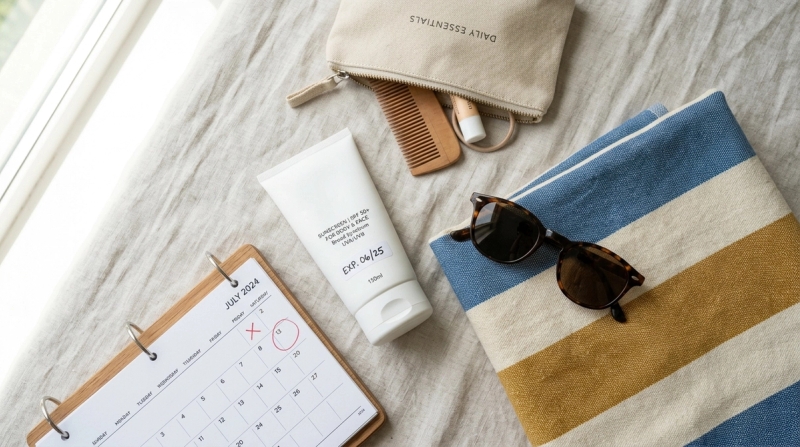
#Before smelling it or testing the texture, check the sunscreen expiration date. Look on the back of the bottle, the base, the tube crimp, the cap area, or the outer box if you still have it.
You may see wording such as EXP, use by, best before, expiry, or a stamped month and year. If the printed date has passed, replace the sunscreen even if it looks normal.
If the date is close but not past, and the sunscreen has been stored well with no smell, color, or texture change, you can use it for normal daily use. Do not save it for a trip months later.
No expiration date? Use the three-year rule
#If there is no visible expiration date, use the purchase date. A practical FDA-style rule is to discard sunscreen after three years from purchase when no expiration date is shown.
The easiest habit is to write the purchase month and year on the bottle with a permanent marker. For example: “Bought: May 2026.” If you cannot remember when you bought it and it feels like it has been through several summers, replace it.
What about opened sunscreen?
#Opening sunscreen does not automatically ruin it. An opened bottle can still be usable if it is within date, stored properly, and unchanged. But opened sunscreen usually has a harder life than an unopened bottle.
It may be opened with sandy hands, kept beside wet towels, tossed into gym bags, left in a car, packed in a suitcase, or stored in a damp bathroom. So with opened sunscreen, check both the date and the product condition.
If it is within date, stored in a cool place, and looks, smells, and feels normal, it is usually okay to keep using. If anything seems off, replace it.
Heat, cars, beach bags and bad storage
#Sunscreen storage matters. Heat and direct sunlight can reduce sunscreen quality. A bottle stored in a cool cabinet is likely to hold up better than one that has been baking in a car, lying on a sunny towel, or sitting in a hot travel pouch.
Better habits are simple: keep sunscreen in a cool, dry place when not using it; avoid long-term car storage; keep it shaded at the beach; close the cap firmly; and avoid repeated hot, damp storage. If the sunscreen has been in heat and now looks watery, separated, sticky, or strange, do not trust it.
Signs sunscreen has gone bad
#Check old sunscreen with your eyes, nose, and fingers. Replace it if the date has passed, the date is unreadable, or the bottle has no date and is older than three years from purchase.
Also replace it if watery liquid comes out first, the formula looks split, it smells sour or rancid, it feels gritty or clumpy, it becomes unusually sticky, or the color has changed. A white sunscreen turning yellowish or a tinted sunscreen shifting color is a warning sign.
Do not use a compromised sunscreen “only on the body.” If it is not reliable enough for your face, it is not reliable enough for your arms, neck, feet, or shoulders either.
Keep, replace or use backup protection?
#When you replace it, choose broad spectrum sunscreen
#When buying a new bottle, choose a fresh broad spectrum sunscreen with an SPF you will actually use. Broad spectrum means the product is intended to help protect against both UVA and UVB rays.
Texture matters. If you dislike the scent, finish, or feel, you are less likely to apply enough or reapply. A comfortable, clearly labelled, fresh sunscreen you use consistently is better than an expensive bottle that stays untouched.
What not to do with old sunscreen
#Do not mix expired sunscreen with lotion. Do not add water. Do not rely on shaking a separated formula. Do not make DIY sunscreen from kitchen ingredients. Sunscreens are tested as finished formulas, and once the product is expired or visibly changed, replacing it is the safer decision.
Travel and outdoor-day checklist
#Check sunscreen before leaving home, not after reaching the beach or airport. Look at the date, squeeze out a small amount, check texture, smell it, look at color, and think about where it has been stored.
If anything seems off, buy a fresh bottle before you go. If you are already outside, move into shade, wear a hat, cover shoulders and arms, use sunglasses, limit direct sun, and buy fresh broad spectrum sunscreen as soon as possible.
Safety note
#This article is general education, not dermatology advice. If you develop painful rash, blistering, severe sunburn, swelling, or a reaction after using sunscreen or another skincare product, wash it off and speak with a dermatologist or qualified healthcare professional.
Final takeaway
#Expired sunscreen is not worth guessing over. Check the date first, use the three-year rule when there is no date, then check storage history, smell, color, texture and separation. If it is expired or changed, replace it. A fresh bottle is a small buy that makes your skincare routine and outdoor days easier to trust.