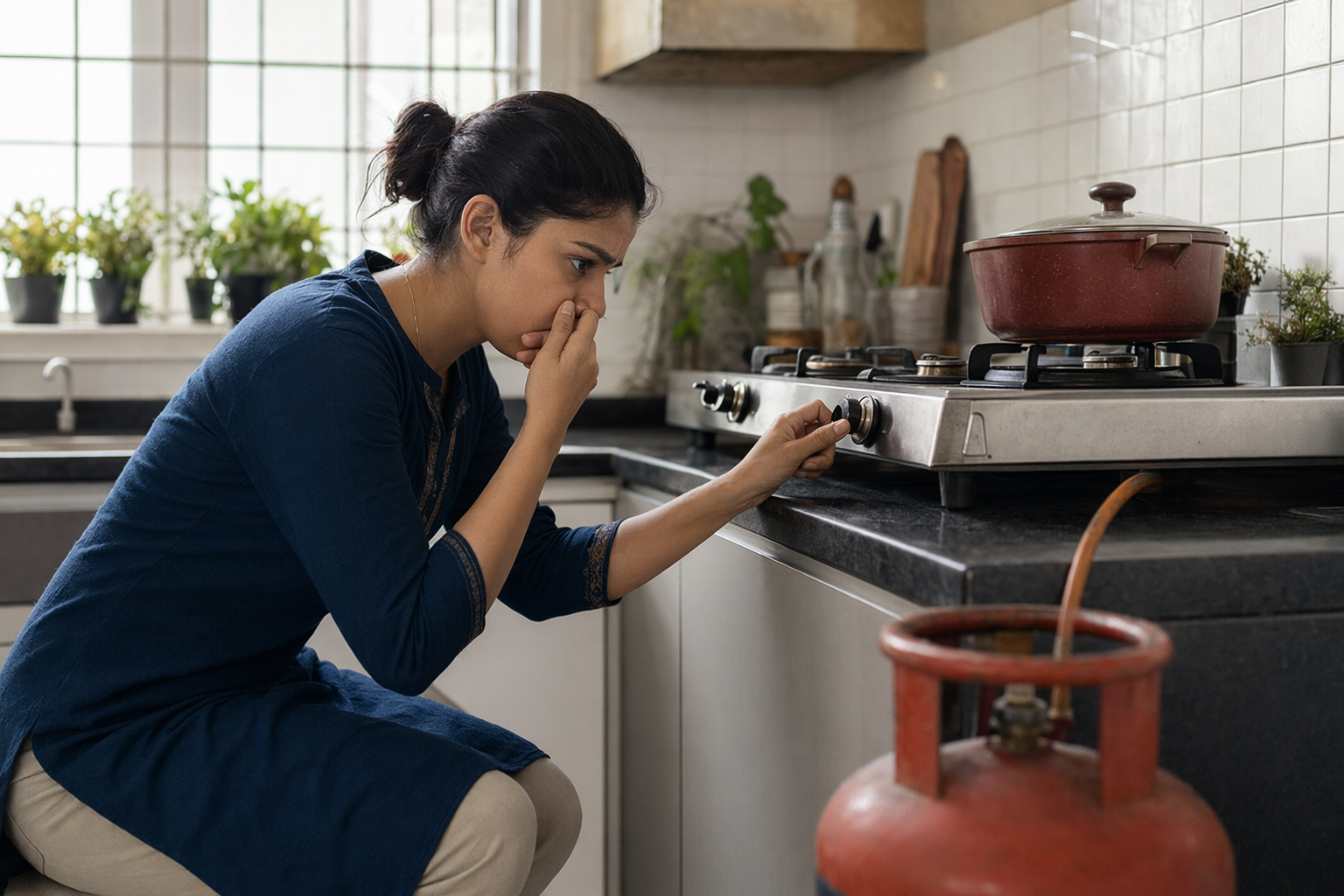
I’ll be honest, LPG safety became a “health and wellness” topic for me only after one scary evening in my own kitchen. Before that, gas cylinder stuff was just… background life. The blue cylinder, the regulator, the rubber tube, the smell of tadka, the usual Indian kitchen chaos. Then one night I walked in and got that sharp rotten-egg-ish smell, and my stomach just dropped. Not dramatic movie-style dropped, but that cold feeling where your brain says, something is wrong, move now. Since then I’ve kept a proper LPG gas leak checklist stuck inside my kitchen cabinet, because in an emergency you don’t think clearly. You just don’t. And in India, where LPG cylinders are still such a normal part of everyday cooking, knowing what to do in the first 30 seconds can literally protect your lungs, your skin, your home, and everyone sleeping in the next room.
Quick note before we get into it: this is not medical advice, and I’m not a fire officer. But I’ve pulled together practical safety steps based on standard LPG safety guidance used in India, including the 1906 LPG emergency helpline, fire emergency numbers like 101 and 112, and basic first-aid principles. Also, please don’t wait for a “major” leak to take it seriously. A small leak is still a leak. And LPG is sneaky because it’s heavier than air, so it can collect near the floor, under cabinets, in drains, or in poorly ventilated corners. That one fact changed how I look at my kitchen, honestly.
First, What Exactly Is LPG and Why Does It Smell So Weird?
#LPG, or liquefied petroleum gas, is mainly propane and butane. In its natural form it doesn’t really have a strong smell, so suppliers add an odorant, usually something like ethyl mercaptan, to make leaks easier to detect. That’s the strong rotten egg or cabbage-like smell people talk about. It’s not there to annoy you while making chai. It’s there to save your life, basically.
The health side matters because LPG can displace oxygen if it builds up in a closed room. That means you might feel headache, dizziness, nausea, weakness, confusion, breathlessness, or even fainting in a serious leak. If it catches fire, then burns and smoke inhalation become the bigger danger. And if your burner is not burning properly, or the flame is yellow and sooty, incomplete combustion can produce carbon monoxide, which is a seperate but very serious risk because carbon monoxide has no smell. This is why ventilation is not some old aunty advice, it’s real wellness. Indoor air quality has become a big health trend in recent years, with more people using AQI monitors, exhaust fans, and smart home sensors, but the humble open window still does a lot.
My Immediate LPG Leak Checklist: The First 60 Seconds
#If you smell gas, don’t stand there sniffing again and again like I did the first time. I know it’s tempting to “confirm” it. But don’t. Your job is not to investigate like a detective, your job is to reduce ignition risk and get people safe. Here’s the checklist I follow now, and I’ve made my family practise it too, even though my husband thought I was being over the top. I wasn’t.
- Do not light a match, agarbatti, candle, cigarette, lighter, or gas stove. Not even “just to check.” Never check a leak with flame.
- Do not operate electrical switches. Don’t switch lights on or off. Don’t turn the exhaust fan on if it’s off. Don’t use doorbells, mixer-grinders, phone chargers, or anything that could spark.
- Turn off the stove knobs if they are on, but only if you can do it quickly without bending into a strong gas cloud.
- Turn the regulator knob to OFF. If you are trained and it feels safe, close the cylinder valve or detach the regulator and put on the safety cap. If the smell is strong, skip the heroics and evacuate.
- Open doors and windows gently for ventilation. Since LPG is heavier than air, lower-level ventilation helps too. Don’t use electric fans to “push” the gas out.
- Move everyone out, especially children, elderly people, pregnant women, pets, and anyone with asthma, COPD, heart disease, or breathing issues.
- Call for help from outside the house. In India, call the LPG emergency helpline 1906 for gas leakage. If there is fire or immediate danger, call 101 or 112.
The India-Specific Numbers I Keep Saved
#Please save these in your phone and also write them on paper. I say paper because during emergencies phones are either missing, dead, or in the room you don’t want to enter. Very typical, no? In India, the pan-India LPG emergency helpline is 1906. This is the number generally used for LPG leakage complaints related to domestic LPG. For fire services, 101 is the traditional fire emergency number, and 112 is India’s single emergency response number in many states and union territories. Your local distributor number should also be saved. And if you live in an apartment, save the security gate, maintenance office, and nearest hospital casualty number too.
- LPG emergency helpline in India: 1906
- Fire emergency: 101
- National emergency response: 112
- Your LPG distributor: save it as “Gas Leak Distributor” not just the agency name, because panic brain is useless
- Apartment security or society manager: important if the cylinder room, pipeline, or neighbours are involved
What Not to Do During an LPG Leak, Because These Mistakes Are So Common
#This is the part where I sound like that annoying safety poster, but honestly these are the mistakes that cause disasters. Don’t switch on the light to see better. Don’t switch off a light that is already on. Don’t turn on the kitchen chimney or exhaust fan. Don’t use your mobile phone inside the kitchen if the smell is strong. Don’t ring the neighbour’s bell if gas may have spread near the entrance. Don’t try to drag a leaking cylinder across the house unless emergency staff or your distributor tells you and it’s clearly safe. Don’t spray room freshener, perfume, deodorant, mosquito spray, or anything aerosol-y. And please don’t gather everyone around the leak to discuss it. Indian families, we do this. We stand around and debate. No. Go outside first, talk later.
Also don’t assume that because the cylinder is “new” it cannot leak. Leaks can happen at the regulator, rubber hose, valve, washer, stove knob, loose connection, or damaged pipe. Sometimes the smell is from a burner knob left open by mistake, sometimes from a faulty regulator. Either way, treat it seriously till a trained person checks it.
If Someone Has Inhaled Gas: First Aid and Health Steps
#This is where the wellness angle gets real. Gas leak safety isn’t just about property damage. It’s about oxygen, lungs, brain, burns, panic, and recovery after the incident. If someone feels dizzy, nauseous, confused, unusually sleepy, breathless, or has a headache after exposure, move them to fresh air immediately. Keep them sitting or lying comfortably. Loosen tight clothing. Do not give alcohol. If they are unconscious, not breathing normally, or having a seizure, call emergency help right away. If you are trained in CPR, start it when needed. If you’re not trained, emergency operators can sometimes guide you until help arrives.
People with asthma, COPD, heart conditions, infants, older adults, and pregnant women should be checked sooner, even if they seem okay after a few minutes. I know we all have that “it’s fine, it passed” attitude, but sometimes symptoms come later, especially after smoke exposure or panic breathing. If there was fire, soot, coughing, burns, or chest tightness, don’t wait at home doing haldi milk and hoping. Go to a hospital or call a doctor.
If LPG Touches Skin or Eyes
#Most domestic leaks are gas vapour, but liquid LPG can cause cold burns or frostbite-like injury because it expands rapidly and becomes extremely cold. If liquid LPG contacts skin, don’t rub the area. Move away from the source, remove contaminated clothing only if it’s not stuck to the skin, and flush the area with clean water. For eyes, rinse gently with clean running water for several minutes and seek urgent medical care. Burns are not a “home remedy” situation. I’m all for aloe vera on tiny kitchen burns, but not for LPG-related injuries. That needs proper care.
How I Check My Kitchen Every Week Now
#After that scary evening, I became a little boring about kitchen checks. But boring is good when boring keeps your family alive. Once a week, usually Sunday morning before the house gets chaotic, I check the rubber hose for cracks, hardness, burn marks, oiliness, or loose ends. I make sure the tube is not touching hot surfaces and is not folded sharply behind the stove. I check that the regulator sits properly. I look at the flame colour. A healthy LPG flame is usually blue. If it’s yellow, lazy, smoky, or making the vessel black, something may be wrong with combustion or burner cleaning.
I also make it a point to keep the cylinder upright and in a ventilated place. Not inside a sealed cabinet with ten plastic bags and old newspapers shoved around it. Yes, I used to do that. Many of us do, because Indian kitchens are small and storage is always a fight. But clutter around a cylinder is a fire risk and it also makes leaks harder to notice. I keep matchboxes, oil bottles, paper towels, and cleaning sprays away from the stove area. It’s basic, but basic is what works.
The Soap-Water Test: Useful, But Don’t Overdo It
#If you suspect a tiny leak at a joint and there is no strong gas smell, many safety guides mention the soap-water test. You apply a little soapy water on the connection and look for bubbles. Bubbles can indicate a leak. But please don’t do this in a strong leak situation, and never use a flame. Also don’t dismantle the regulator, valve, or stove parts like you’re suddenly a technician. If there is doubt, call your distributor or 1906. I personally use the soap-water test only after changing a cylinder, and even then I’m careful. If I smell gas, I don’t play mechanic.
My rule now is simple: if I feel embarrassed calling for help, I call anyway. Safety embarrassment is cheaper than hospital bills, fire damage, or lifelong regret.
Smart Gas Detectors and 2026 Home Wellness Trends
#One thing I’ve noticed in the last couple of years is how “wellness” has moved beyond yoga mats and protein powders into home safety and indoor air. People are buying air purifiers, carbon monoxide alarms, kitchen chimneys with better suction, and smart sensors. In 2026, the whole smart-home safety trend is much more normal, especially in cities. LPG gas leak detectors are now available in many price ranges, including plug-in alarms and some models with mobile alerts or auto shut-off features. I like this trend, with one warning: gadgets are backup, not replacement for common sense.
If you buy a gas detector, choose one meant for LPG, install it as per instructions, and remember that LPG is heavier than air, so placement matters. Many LPG detectors are placed lower than natural gas detectors, because natural gas rises but LPG settles downward. Read the manual, seriously. Also test the alarm periodically and don’t ignore low-battery beeps. A dead sensor is just wall decoration. And if you live with older parents who may not smell gas strongly, or if you have domestic help using the kitchen, a detector can be a genuinely good investment.
Apartment Living: Extra Steps Because Your Leak Is Not Only Your Leak
#In apartments, LPG leaks can become complicated because gas can travel through stairwells, ducts, drains, and shared spaces. If you smell gas in a corridor, basement, lift lobby, or near a cylinder storage area, don’t use the lift. Avoid switching common-area lights if you suspect gas. Alert security from a safe distance. If there is a piped gas system, close your appliance valve if safe, evacuate, and call the gas supplier emergency number. For cylinder users, call 1906 and the distributor. If the smell is strong, fire services should be involved. And please don’t let a crowd gather. Crowds are terrible in emergencies. Someone will light a cigarette, someone will make a phone call right there, someone will insist they know better because “I worked in Dubai once.” Just move people away.
After the Leak Is Controlled: Don’t Restart Cooking Immediately
#This is a step people skip. Once the smell reduces, everyone relaxes and someone says, “Chalo, make tea.” Please don’t. Wait until the area is properly ventilated and checked. Let the distributor mechanic or authorized technician inspect the regulator, hose, stove, valve, and cylinder. Replace damaged parts. If the rubber tube is old, hardened, cracked, or loose, replace it with an approved LPG hose. Don’t use random transparent plastic pipe from a hardware shop because it “fits.” It has to be suitable for LPG. Also ask the mechanic to check the washer and connection when a cylinder is changed.
If anyone had symptoms, keep an eye on them for the next few hours. Headache, vomiting, coughing, chest tightness, confusion, burns, or fainting need medical attention. Children may not explain symptoms properly, so watch behaviour too. Are they unusually sleepy? Irritable? Breathing fast? Don’t dismiss it. I say this as someone who used to wait too long before going to a doctor because I didn’t want to “make a scene.” Sometimes making a scene is the healthy choice.
My Family Drill, Which Sounds Silly Until It Isn’t
#Every few months I do a tiny family drill. Not a full military parade, just a five-minute reminder. Where is the regulator? What does OFF look like? Which door do we use to exit? Where is the 1906 number written? Who takes the child? Who handles the dog? Where do we stand outside? It sounds like too much, but during emergencies people freeze. Muscle memory helps. I also told my house help clearly: if she smells gas, she doesn’t have to ask permission to leave the kitchen or call me. Safety first. Always.
One more thing: teach kids without terrifying them. I told my niece, “If you smell rotten eggs in the kitchen, don’t touch switches, tell an adult, and go outside.” That’s enough. No need to make children anxious, but they should know the basics. Same with elderly parents. My dad used to say, “We’ve used cylinders for 40 years, nothing happened.” True. But seatbelts also matter even if you never had an accident.
A Simple Printable LPG Leak Checklist for Indian Homes
#- Smell gas? Stay calm and don’t ignite anything.
- Do not use matches, lighters, candles, cigarettes, agarbatti, or diyas.
- Do not operate electrical switches, fans, chimneys, appliances, plugs, or doorbells.
- Turn off stove knobs and regulator only if safe to do so.
- Open doors and windows gently. Don’t use electric fans.
- Evacuate people and pets. Avoid lifts if you live in a building.
- Call 1906 for LPG leakage from outside the house. For fire or major danger, call 101 or 112.
- Get the system checked by an authorized person before using it again.
- If anyone feels dizzy, breathless, confused, burnt, or unwell, seek medical care.
Small Prevention Habits That Actually Make a Difference
#Prevention is not glamorous. Nobody claps because you replaced a hose on time. But it matters. Turn the regulator off when not in use, especially at night or when leaving home. Don’t leave cooking unattended. Keep vessels from overflowing and putting out the flame. Clean burners so the flame stays blue. Keep the cylinder upright. Don’t store extra cylinders casually inside living spaces. Replace old tubes and regulators as recommended by your LPG provider. Make sure delivery staff check for leakage when they connect a new cylinder. And if something feels off, trust your nose.
I’ve also started thinking of ventilation as part of health, not just comfort. A lot of Indian kitchens trap heat, oil fumes, incense smoke, cleaning chemical smells, and sometimes gas. Even without a leak, poor kitchen air can irritate eyes, throat, and lungs. So yes, use the exhaust when cooking normally, open windows when possible, and keep the area breathable. Just remember: during an active suspected leak, don’t switch electrical exhausts on or off.
Final Thoughts: Safety Is Wellness, Even If It’s Not Pretty
#We talk a lot about wellness like it’s green juice, sleep trackers, supplements, morning walks, and meditation. And those things are nice, sure. But real wellness is also knowing what to do when your kitchen smells like gas at 10:30 pm and your child is in the next room. It’s saving emergency numbers. It’s replacing a cracked hose. It’s not being shy about calling 1906. It’s teaching your family that no meal, no cylinder, no embarrassment is worth risking life and lungs.
So maybe today, just take five minutes. Check your LPG hose. Save 1906, 101, and 112. Write the checklist somewhere visible. Tell the people at home what to do. Not in a scary way, just a practical way. I hope you never need it, genuinely. But if you do, you’ll be glad you prepared. And if you like reading practical health and home-safety stuff like this, I’ve found AllBlogs.in a nice place to browse when I’m in one of my “let me fix my life one small habit at a time” moods.