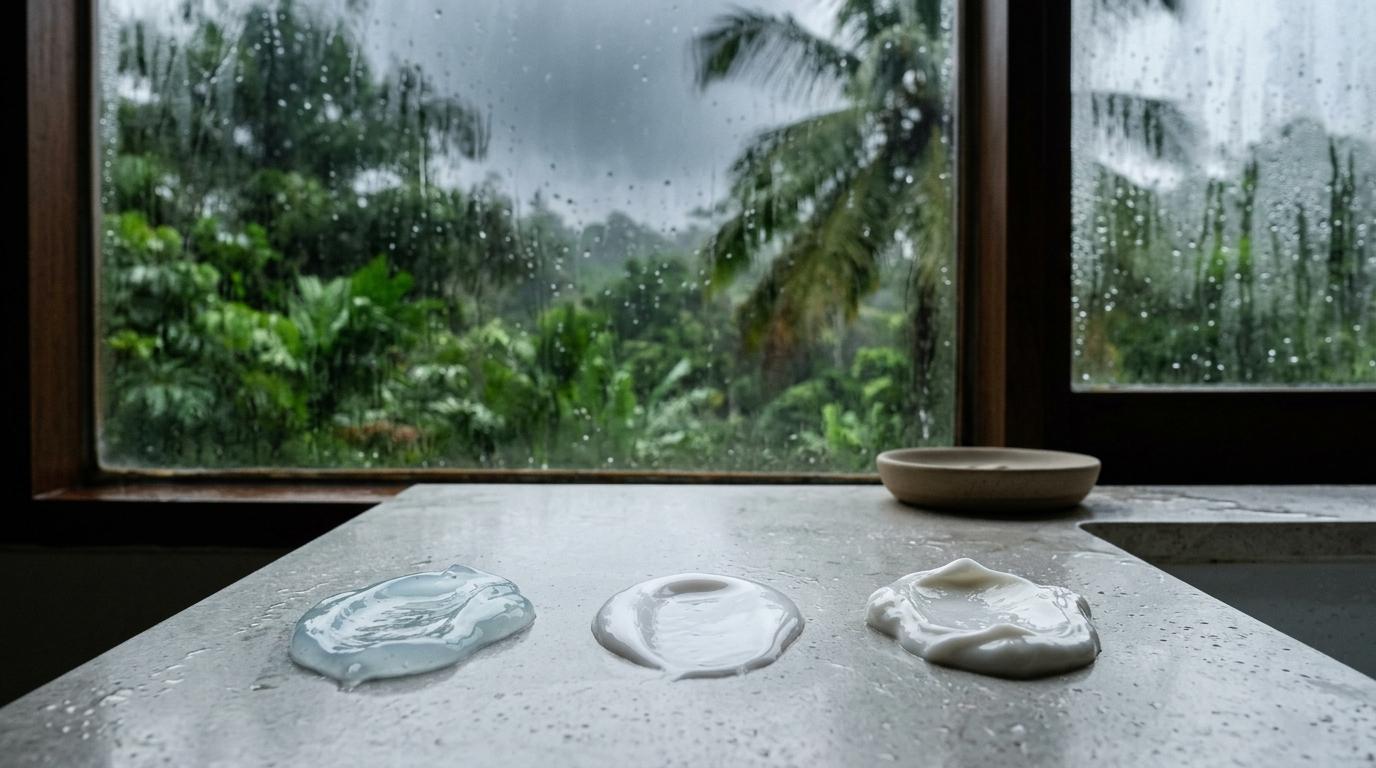
For most oily and combination skin types, a lightweight gel moisturizer is usually the easiest choice in humid weather. Lotions work well for normal or slightly dry skin. Creams are better for very dry skin, colder months, dry rooms, or strong air conditioning. The point is not to stop using moisturizer; it is to choose a texture that keeps your skin comfortable without feeling sticky.
Humid weather makes skincare tricky. You wash your face, apply moisturizer, add sunscreen, step outside, and within an hour your face looks oily again. It can feel like your skin is rejecting everything.
But that does not always mean your skin is “too oily” for moisturizer. More often, it just means the texture is not right for the weather.
If you are confused, start with this simple rule: in humid weather, go lighter.
You do not need a complicated routine. You just need to understand the difference between gel, lotion, and cream.
Why moisturizer still matters when the weather is humid
#When your face already looks oily, skipping moisturizer can feel like the obvious move. A lot of people do this during summer or monsoon season.
But oil and hydration are not the same thing.
Your skin can look greasy on the surface and still feel tight, dull, or uncomfortable underneath. This is especially common if you wash your face often because of sweat, sunscreen, pollution, travel, or that constant sticky feeling.
A good moisturizer helps your skin feel balanced and supports your skin barrier. In humid weather, you are not looking for a thick, buttery, “deep nourishment” kind of feel. You just want your skin to feel normal.
A good humid-weather moisturizer should:
- Absorb easily
- Feel comfortable under sunscreen
- Not stay sticky after a few minutes
- Not make your face look extra shiny
- Keep your skin from feeling tight after cleansing
Gel vs lotion vs cream: quick comparison
#Gel moisturizer: usually best for oily and combination skin
#Gel moisturizers are often the easiest option when the weather is hot and humid. They feel light because many are water-based and designed to absorb quickly.
If your skin gets shiny by mid-morning, or your T-zone becomes oily while your cheeks feel normal, a gel moisturizer is a good place to start.
A gel moisturizer may suit you if:
- Your face feels greasy soon after using cream
- Your sunscreen feels too heavy over moisturizer
- Your skin feels sweaty or coated during monsoon
- You want hydration without an oily finish
- You are new to skincare and want one simple daily moisturizer
That said, some gels can feel too light. You may notice this around your mouth, on your cheeks, or after cleansing.
If that happens, try a gel-cream. It usually feels light like a gel, but gives a little more comfort than a pure gel.
Lotion: the comfortable middle option
#Lotions sit between gels and creams. They are lighter than creams, but usually more comforting than gels. If your skin is normal, slightly dry, or oily only in some areas, lotion may feel better than a gel.
Think of lotion as the balanced option. It works well when gel feels too watery, but cream feels like too much.
A lotion may suit you if:
- Your skin is not very oily, but the weather is humid
- Your cheeks feel dry after washing your face
- You spend time indoors with a fan or air conditioning
- You want something light, but not completely invisible
- Your skin likes a soft, natural finish
For combination skin, you can use gel on your T-zone and a tiny bit of lotion on your cheeks. This often works better than forcing one product all over the face.
Cream: not bad, just not always right for humidity
#Creams are not the enemy. They are just not always the best match for hot, sticky weather.
A cream can feel useful when your skin is dry, flaky, irritated, or exposed to cold air. It can also be helpful at night if you sleep in a strongly air-conditioned room.
But in humid weather, a thick cream can sit on top of your skin, mix with sweat, and feel uncomfortable under sunscreen.
Cream may still make sense if:
- Your skin is genuinely very dry
- Your skin feels tight even after using lotion
- You spend long hours in air conditioning
- You use it at night in a dry room
- You apply it only on dry patches instead of the whole face
If you have oily or combination skin, you probably do not need a heavy cream during the day in humid weather. Keep it for times when your skin actually feels dry or uncomfortable.
A simple way to choose your moisturizer
#If you are buying a moisturizer for humid weather, use this quick guide:
- Very oily skin in humid weather: choose gel
- Combination skin: start with gel, then add lotion only on dry areas if needed
- Normal skin: choose lotion or gel-cream
- Dry skin in humid weather: choose lotion or light cream
- Very dry skin or strong air conditioning: use cream, especially at night
- Unsure skin type: start with gel or gel-cream, then adjust
Start with the lightest texture that keeps your skin comfortable for a few hours.
Ingredients to look for in humid-weather moisturizers
#Skincare shoppers are increasingly ingredient-aware. People do not just want nice packaging; they want formulas that make sense.
You do not need to become a skincare expert. You only need to recognize a few common ingredients that work well in lightweight moisturizers.
Glycerin
#Glycerin is a humectant, which means it helps attract and hold water in the upper layers of the skin. In humid weather, it supports hydration without needing a heavy, oily texture.
Hyaluronic acid
#Hyaluronic acid is another humectant. It helps skin feel hydrated without making it greasy. You will often find it in gel moisturizers, serums, and gel-creams.
Ceramides
#Ceramides help support the skin barrier. Heat, sweat, frequent cleansing, pollution, and sun exposure can all make your skin feel more sensitive or uncomfortable. Many lightweight lotions and gel-creams include ceramides now too.
Niacinamide
#Niacinamide, also known as vitamin B3, is common in products made for oily and combination skin. It is often used in formulas that support the skin barrier and improve the look of uneven tone or excess shine. It can be useful, but it is not magic in a bottle.
Humid weather skincare checklist
#- Cleanse gently to remove sweat, sunscreen, and excess oil without harsh scrubbing.
- Do not over-wash, because repeated cleansing can leave skin tight or irritated.
- Apply moisturizer on slightly damp skin.
- Start with a small amount, then add more only where needed.
- Choose gel for daytime if your skin is oily.
- Give moisturizer a minute to settle before applying sunscreen.
- Use sunscreen daily; moisturizer does not replace SPF.
- Adjust at night if air conditioning makes your skin dry.
- Change one product at a time so you know what is working.
- Patch-test new products, especially if your skin reacts easily.
Should you use moisturizer before sunscreen in humidity?
#Usually, yes. A light gel moisturizer under sunscreen works well for many people, especially if the sunscreen itself feels matte or slightly drying.
If your sunscreen already feels moisturizing and your skin is very oily in humid weather, sunscreen alone may be enough in the morning. This depends on your skin and the sunscreen texture.
At night, use moisturizer again after cleansing.
Common mistakes to avoid
#Using your winter cream in peak humidity
#If your face feels sticky every day, your cream may simply be too rich for the season. Keep it for dry weather, nighttime, air-conditioned rooms, or dry patches.
Skipping moisturizer completely
#Skipping moisturizer can leave your skin feeling tight after washing and uncomfortable under sunscreen. Instead of skipping it, choose a lighter texture.
Applying too much product
#Even a good gel moisturizer can feel sticky if you use too much. Start small. You can always add a little more.
Changing everything at once
#If you change your cleanser, moisturizer, sunscreen, and serum at the same time, you will not know what helped or what caused irritation.
Choosing only by skin type
#Skin type matters, but climate matters too. Oily skin in dry winter weather and oily skin during a humid monsoon do not always need the same moisturizer.
When to consult a dermatologist
#Most moisturizer confusion can be fixed by changing the texture. But some skin concerns need proper guidance.
Consider seeing a dermatologist if:
- Your skin burns, stings, or turns red with basic moisturizers
- You get recurring painful bumps or irritation
- Your skin is peeling, cracking, or constantly itchy
- You suspect eczema, rosacea, or another skin condition
- You have tried several simple products and still feel confused
- Your skin reaction is sudden, severe, or getting worse
This article is general skincare guidance, not a diagnosis or treatment plan. A dermatologist can help you understand what your skin actually needs.
Final answer: gel, lotion, or cream?
#For hot, humid, or monsoon weather, start with a gel moisturizer if you have oily or combination skin. Choose lotion if your skin is normal or slightly dry. Keep cream for very dry skin, winter, dry rooms, strong air conditioning, or specific dry patches.
Do not overbuy. And do not skip moisturizer just because your skin looks oily. Match the texture to the weather, your skin type, and how your face actually feels after a few hours.
Disclaimer: This article is for general informational purposes only and is not medical advice. Patch-test new skincare products and consult a dermatologist for personal guidance if your skin is irritated, painful, or not improving.