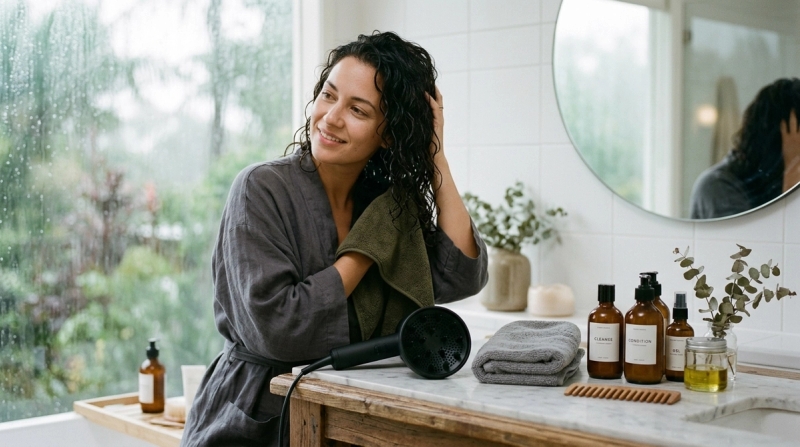
If you have curly or wavy hair, humid weather can make drying confusing. The best answer for many people is to air dry briefly, then diffuse gently on low or medium heat. Air drying is best for heat-free, relaxed days. Diffusing helps when humidity, monsoon dampness, flat roots or long drying time cause frizz.
Diffuser vs Air Drying: Quick Comparison
#When Should You Diffuse or Air Dry?
#Choose a diffuser for curly hair or wavy hair when:
- The weather is humid, rainy, or sticky.
- It is monsoon season.
- Your hair takes hours to dry.
- Your roots always look flat after air drying.
- Your curls or waves lose shape before they fully dry.
- You need to leave the house soon.
- You want more volume and definition.
Choose to air dry curly hair or wavy hair when:
- The weather is dry or mild.
- You are staying indoors.
- Your hair dries fairly quickly.
- You want a softer, more natural finish.
- Your hair feels weak, dry, or overworked.
- You want a heat-free day.
- You do not mind less root volume.
Choose the combination method when your hair is thick, dense, slow to dry, puffs up while wet, or needs less heat but more control. Let your hair air dry for 10 to 30 minutes, then diffuse gently until it is mostly dry.
Humidity and Frizz Decision Checklist
#1. Is it raining, sticky, or very humid?
#Use a diffuser, or air dry for a short time and then diffuse. Humidity slows down drying. When hair stays wet for too long, curl shape can get disturbed and you may touch it more, which can lead to frizz.
2. Do your waves fall flat when you air dry?
#Diffuse your roots. Wavy hair often needs a little lift near the scalp. You can diffuse only the roots and let the ends air dry.
3. Does your hair take more than 3 to 4 hours to dry?
#Try the combination method. Let your hair air dry for a short while, then diffuse on low or medium heat.
4. Is your hair feeling dry, weak, or damaged?
#Air dry when you can, or diffuse less often. Diffusing is still heat, so use lower settings and give your hair heat-free days.
5. Are you leaving the house soon?
#Diffuse gently before you go. In humid weather, stepping outside with soaking wet curls can make frizz harder to control.
6. Do you want softer curls with less volume?
#Air dry. Air drying usually gives a softer, more relaxed result, though roots may be flatter.
The Best Humid-Weather Method: Air Dry First, Diffuse After
#If you are stuck between diffuser vs air drying, try both:
- Style your hair while it is wet.
- Gently squeeze extra water with a microfiber towel or cotton t-shirt.
- Let your hair air dry for 10 to 30 minutes.
- Diffuse on low or medium heat and low speed.
- Stop when your hair is mostly dry, or fully dry if your hair frizzes easily.
This gives styling products time to settle before heat. It also avoids blasting soaking wet hair immediately while preventing hours of damp hair in humid air.
Low-Heat Diffuser Steps for Curly and Wavy Hair
#Step 1: Apply styling product to wet hair
#Start with your usual leave-in conditioner, curl cream, mousse, gel, or simple product mix. In humid weather, a hold product like gel or mousse can help curls and waves keep shape. Avoid piling on too much product, because heavy buildup can make hair sticky or flat.
Step 2: Use a heat protectant
#If you use heat, even low or medium heat, apply a heat protectant. It helps reduce heat-related dryness and damage risk.
Step 3: Remove extra water gently
#Do not rub wet curls with a rough towel. Use a microfiber towel or soft cotton t-shirt and squeeze upward toward the scalp to remove dripping water without breaking curl clumps.
Step 4: Start with the hover method
#Attach the diffuser, set low speed and low or medium heat, then hold it near the hair without pushing into the curls. Let the outer layer begin to set.
Step 5: Cup the curls when partly dry
#Once hair is no longer soaking wet, place small sections into the diffuser bowl. Lift the diffuser toward the scalp and hold briefly. Do not bounce it around.
Step 6: Focus on roots if short on time
#Drying the roots first helps volume and stops the scalp area from staying damp too long. You can air dry the ends afterward.
Step 7: Stop if hair or scalp feels too hot
#Your scalp should not feel uncomfortable. Lower the heat, move the dryer away, or stop if it feels too hot.
How to Air Dry Curly Hair Without Making Frizz Worse
#Mistake 1: Rubbing your hair with a towel
#A regular towel can rough up the hair surface and break curl clumps. Use a microfiber towel or cotton t-shirt instead.
Mistake 2: Touching your hair while it dries
#Wet curls are easy to disturb. Style, place, and leave them alone until dry.
Mistake 3: Going outside with soaking wet hair
#In humid or monsoon weather, very wet hair can become frizzy faster. If possible, dry it mostly before stepping out.
Mistake 4: Skipping hold product
#Some hair can air dry without gel or mousse, but humid weather often needs a little hold to keep curl shape together.
Mistake 5: Sleeping with wet hair
#Sleeping on wet hair can create flat roots, odd curl shapes, and friction. If you wash at night, dry hair enough before bed.
Mistake 6: Leaving roots wet for hours
#If your roots stay wet much longer than your ends, diffuse only the roots on low or medium heat.
Heat Damage and Scalp Safety
#Diffusing is usually gentler than straighteners or curling irons, but it is still heat. Dermatology guidance generally recommends limiting excessive heat, using lower heat settings, and gently absorbing moisture with a towel or t-shirt before styling.
To keep diffusing gentle:
- Use low or medium heat instead of high heat.
- Use low speed to avoid roughing up hair.
- Keep the dryer moving.
- Do not hold hot air on one scalp area for long.
- Stop if the scalp feels hot or uncomfortable.
- Use heat protectant before diffusing.
- Avoid rough scrunching while drying.
- Give your hair heat-free days.
- Remove extra water first with a microfiber towel or cotton t-shirt.
If your hair is very dry, brittle, or fragile, reduce heat frequency. If your hair becomes frizzy because it stays wet too long, use the gentlest diffuser method instead of simply increasing heat.
Do You Actually Need to Buy a Diffuser?
#Not always. If your hair air dries well, your climate is not very humid, and you like the result, you do not need to buy a diffuser.
A diffuser may be worth it if:
- Your curls or waves collapse while air drying.
- You struggle with frizz in humid weather.
- Your hair takes a very long time to dry.
- Your roots always dry flat.
- You want more volume.
- You need a quicker routine during monsoon season.
For most people, the basics are enough: a microfiber towel or soft cotton t-shirt, a hold product, heat protectant if using heat, and a diffuser used on low or medium heat.
Final Verdict
#In humid or monsoon weather, diffusing usually gives better control than fully air drying. It helps curls and waves dry faster, set their shape sooner, and stay less frizzy. Air drying is still useful for mild weather, relaxed days, and heat-free breaks.
For many curly, wavy, and frizz-prone hair types, the best answer is both: air dry briefly, then diffuse gently on low or medium heat.