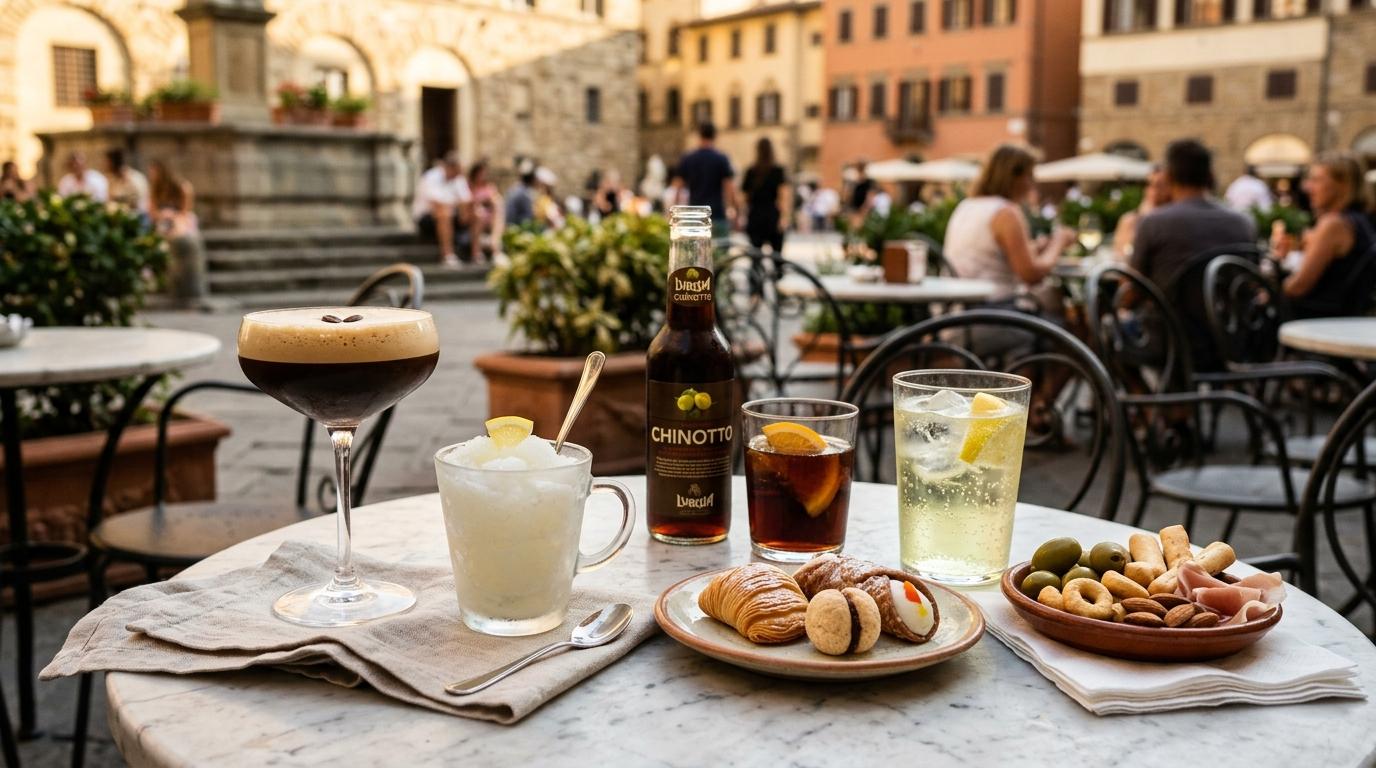
Italy is a surprisingly easy place to enjoy without alcohol, especially once you understand what an Italian bar actually is.
In Italy, a bar is not just somewhere you go for wine, spritzes, or late-night drinks. It is more like an all-day café. People stop in for a quick espresso before work, a cappuccino and pastry in the morning, a fresh orange juice, a cold soda in the afternoon, an icy granita, or a bitter aperitivo before dinner.
So if you are looking for Italian café drinks without alcohol, you are not stuck with plain water. You have plenty of good options. You just need to know what to order.
This guide covers the most useful alcohol-free Italian café and bar drinks, including caffè shakerato, Italian granita, chinotto, cedrata, limonata, spremuta, cioccolata calda, espresso, cappuccino, and bottled non-alcoholic aperitivo drinks like Sanbittèr and Crodino.
Quick answer: what to order
#If you are standing at an Italian bar and not sure what to ask for, start here:
- Want cold coffee? Order a caffè shakerato, a shaken iced espresso with a foamy top.
- Want something icy and sweet? Order an Italian granita, especially if you are in Sicily.
- Want a refreshing afternoon soda? Try chinotto, cedrata, or limonata.
- Want a non-alcoholic aperitivo? Order Sanbittèr, Crodino, or another zero-proof bitter aperitivo.
- Want a morning drink? Choose espresso, cappuccino before late morning, or spremuta d’arancia.
- Want something warm and cozy? Order cioccolata calda, Italian hot chocolate that is thick, rich, and almost dessert-like.
The short version: in Italy, you can drink very well without drinking alcohol.
How to order at an Italian bar
#Italian bars are usually casual, quick, and very local. You can go for breakfast, coffee, a sandwich, a pastry, a soda, or a pre-dinner drink. Some are simple neighborhood counters. Others are beautiful historic cafés with table service and higher prices.
1. Decide whether you want the counter or a table
#You can usually drink:
- Al banco — standing at the counter
- Al tavolo — sitting at a table
Drinking at the counter is usually faster and often cheaper. Sitting at a table may cost more, especially in touristy areas, major squares, train stations, or old historic cafés.
2. Sometimes, you pay first
#In many traditional Italian cafés, you pay at the cash register first. Then you take your receipt, called a scontrino, to the barista and place your order.
In smaller or more relaxed places, you might order first and pay later. If you are not sure, pause for a moment and watch what the locals do.
3. Use the Italian drink name if you can
#You do not need perfect Italian. A few simple phrases are enough.
- Un caffè shakerato, per favore — A shaken iced espresso, please.
- Una granita al limone, per favore — A lemon granita, please.
- Un chinotto, per favore — A chinotto, please.
- Una spremuta d’arancia, per favore — A fresh orange juice, please.
- Un Crodino, per favore — A Crodino, please.
4. Do not expect huge cups of ice
#Cold drinks in Italy are usually chilled, but they are not always packed with ice. A soda may come with one or two cubes, or no ice at all. A caffè shakerato is shaken with ice, but normally strained and served without ice in the glass.
If you want ice, ask for ghiaccio. If you want extra ice, ask for più ghiaccio.
What each drink tastes like
#One of the nicest things about non-alcoholic Italian drinks is that they are not all sugary and simple. Many are bitter, citrusy, herbal, icy, creamy, or coffee-forward.
Caffè shakerato
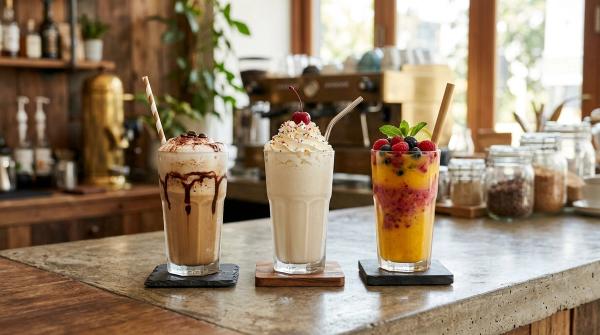
#A caffè shakerato is one of the best non-alcoholic Italian drinks for coffee lovers, especially in warm weather.
It is made by shaking freshly brewed espresso with ice, usually with sugar, until it turns cold and foamy. It is often served in a stemmed glass or a small tumbler.
What it tastes like: Cold, strong, lightly sweet, and frothy. It has the punch of espresso, but it feels smoother and more elegant than a regular iced coffee.
Sugar, caffeine, ice: It contains caffeine because it is espresso-based. It usually includes sugar, partly because sugar helps create the foam. You can ask for it senza zucchero if you want it without sugar, though the texture may be a little different. It is shaken with ice, then usually strained before serving.
Traveler note: If you ask for “iced coffee” in English, you may not get what you imagine. Order caffè shakerato if you want the classic Italian cold coffee experience.
Italian granita
#Italian granita is icy, spoonable, and especially beloved in Sicily. It is made with water, sugar, and flavors like lemon, almond, coffee, strawberry, pistachio, or seasonal fruit.
It is not exactly sorbet, and it is not exactly a slush. The texture depends on where you are. Some versions are grainy and crystalline. Others are smoother and softer.
What it tastes like: Cold, sweet, bright, and refreshing. Lemon granita is sharp and clean. Almond granita tastes creamy and fragrant without feeling heavy. Coffee granita is bittersweet and energizing.
Sugar, caffeine, ice: Granita is usually sweet and ice-based. It is caffeine-free unless you choose coffee granita.
Traveler note: Granita can be more filling than it looks, especially if it comes with brioche. In Sicily, granita with brioche can be breakfast, snack, and dessert all in one.
Chinotto drink
#A chinotto drink is one of Italy’s most interesting sodas. It is dark like cola, but the flavor is more bitter, herbal, and citrusy.
Chinotto is made with the small bitter citrus fruit of the same name. If you like bitter flavors, this could easily become your favorite Italian soda. If you only like very sweet soft drinks, it may catch you off guard.
What it tastes like: Bittersweet, dark, aromatic, and slightly medicinal in a good way. Think of it as cola’s more grown-up Italian cousin, with a bitter citrus edge.
Sugar, caffeine, ice: Chinotto is carbonated and usually sweetened. It is generally caffeine-free, unlike many cola drinks. It is served chilled, sometimes with ice and a slice of citrus.
Traveler note: Chinotto is an acquired taste. If you enjoy tonic water, bitter orange, amaro-style flavors, or herbal drinks, try it. If bitterness bothers you, start with limonata or cedrata instead.
Cedrata
#Cedrata is a sparkling citron soda. It is usually bright yellow, sweet, and very citrus-forward.
What it tastes like: Sweet, aromatic, citrusy, and slightly floral. It is much less bitter than chinotto, so it is often easier for first-time visitors to enjoy.
Sugar, caffeine, ice: Cedrata is carbonated, sweetened, caffeine-free, and served cold. Ice may be minimal.
Limonata
#Limonata is Italian lemon soda. It is sparkling, citrusy, and often sharper than the still lemonade travelers may know from other countries.
What it tastes like: Tart, bright, refreshing, and sometimes lightly bitter depending on the brand. Some bottled versions include pulp or sediment, so do not be surprised if it looks a little cloudy.
Sugar, caffeine, ice: Limonata is carbonated, sweetened, caffeine-free, and served cold.
Sanbittèr, Crodino, and other non-alcoholic aperitivo drinks
#If you want to join aperitivo hour without alcohol, order a Sanbittèr, Crodino, or another bottled non-alcoholic aperitivo.
These drinks are made for the aperitivo ritual. They are small, sparkling, bitter, botanical, and usually served in a way that feels more grown-up than a regular soda.
What they taste like: Bitter, herbal, citrusy, lightly sweet, and aromatic. They are closer in mood to Campari or Aperol-style flavors than to lemonade or orange soda, but without the alcohol.
Sugar, caffeine, ice: They are usually caffeine-free and sweetened. They are often served cold, sometimes poured over ice with an orange slice.
Traveler note: These drinks are bitter on purpose. If you are expecting fruit punch, the first sip may surprise you. The bitterness often makes more sense with salty snacks.
Espresso
#In Italy, if you order un caffè, you are usually ordering an espresso.
What it tastes like: Short, strong, concentrated, and fast. It is meant to be a small coffee, not a big mug.
Sugar, caffeine, ice: Espresso contains caffeine. It is served hot and usually without sugar added, though sugar is almost always nearby.
Cappuccino
#A cappuccino is espresso with steamed milk and foam. It is a breakfast classic.
What it tastes like: Warm, milky, balanced, and softer than straight espresso.
Sugar, caffeine, ice: Cappuccino is caffeinated, milk-based, and served hot. Sugar is optional.
Traveler note: Cappuccino is usually treated as a morning drink in Italy. People commonly order it at breakfast, but not usually after lunch or dinner. You can order what you like, of course, but cappuccino in the morning and espresso later in the day is the safest local rhythm.
Spremuta d’arancia
#Spremuta d’arancia means freshly squeezed orange juice.
What it tastes like: Fresh, citrusy, and naturally sweet or tart, depending on the oranges.
Sugar, caffeine, ice: No caffeine. Usually no added sugar. Usually no ice.
Cioccolata calda
#Cioccolata calda is Italian hot chocolate, and it can be very thick.
What it tastes like: Rich, dark, warm, and almost pudding-like. It is often closer to a spoonable dessert than a thin cocoa drink.
Sugar, caffeine, ice: It is sweet, warm, and contains no ice. It may contain a little caffeine from the chocolate.
When to order each drink
#Italian café culture has a rhythm. You do not have to follow it perfectly, but knowing it helps you order in a way that feels natural.
Morning
#Good morning orders include:
- Espresso
- Cappuccino
- Spremuta d’arancia
- Cornetto with coffee
- Granita with brioche, especially in Sicily when it is warm
Mid-morning
#Good mid-morning orders include:
- Espresso
- Spremuta
- Granita
- Limonata, if it is already hot outside
Afternoon
#Good afternoon orders include:
- Caffè shakerato
- Chinotto
- Cedrata
- Limonata
- Granita
- Espresso
This is when cold, non-alcoholic Italian drinks really shine. A caffè shakerato is especially useful when you want caffeine but cannot face a hot espresso.
Aperitivo hour
#Good pre-dinner orders include:
- Sanbittèr
- Crodino
- Other non-alcoholic bitter aperitivo drinks
- Chinotto
- Limonata, if you want something simpler
Aperitivo is not only about alcohol. It is about slowing down before dinner, having a drink, and maybe nibbling on something salty.
Evening or colder weather
#Good evening or cold-weather orders include:
- Espresso
- Cioccolata calda
- Chinotto
- Non-alcoholic aperitivo drinks
Food pairings
#The right snack makes these drinks even better, and Italian bars usually make it easy.
Caffè shakerato pairings
#Pair with:
- A small biscuit
- A plain pastry
- A light almond cookie
- A simple slice of cake
Because caffè shakerato is strong and cold, it works best with something small and not too creamy.
Granita pairings
#Pair with:
- Brioche col tuppo
- A simple sweet pastry
- Nothing at all, if you want it as a light snack
In Sicily, granita with brioche is a classic. You can spoon the granita, dip the brioche, or do both.
Chinotto pairings
#Pair with:
- Potato chips, called patatine
- Salted nuts
- Olives
- Small sandwiches
- Savory pastries
The bitterness of chinotto works beautifully with salt and fat.
Cedrata and limonata pairings
#Pair with:
- Chips
- Focaccia
- Light sandwiches
- Fried snacks
- Simple aperitivo nibbles
Their citrus flavor cuts through salty snacks nicely.
Sanbittèr and Crodino pairings
#Pair with:
- Green olives
- Peanuts
- Taralli
- Chips
- Small pizzette
- Simple aperitivo plates
Some bars bring snacks with aperitivo drinks, but do not assume they will always be free or generous. It depends on the bar, the city, and the style of the place.
Spremuta pairings
#Pair with:
- Cornetto
- Plain pastry
- Yogurt, where available
- A light breakfast
Fresh orange juice is a natural breakfast drink.
Cioccolata calda pairings
#Pair with:
- Plain biscuits
- Whipped cream, if offered
- A small pastry
It is already rich, so you may not need much food with it.
Sugar, caffeine, ice, and digestion notes
#Sugar
#Many Italian café drinks without alcohol are sweetened, especially:
- Granita
- Cedrata
- Limonata
- Chinotto
- Sanbittèr and Crodino-style aperitivi
- Cioccolata calda
If you are watching sugar, safer choices are usually:
- Espresso without sugar
- Cappuccino without added sugar
- Spremuta, though it still contains natural fruit sugar
- Caffè shakerato senza zucchero, if the bar will make it that way
Caffeine
#Caffeinated drinks include:
- Espresso
- Cappuccino
- Caffè shakerato
- Coffee granita
- Cioccolata calda, lightly, because of the chocolate
Usually caffeine-free options include:
- Chinotto
- Cedrata
- Limonata
- Fruit granita
- Almond granita
- Spremuta
- Sanbittèr and Crodino-style aperitivo drinks
Ice
#Italy does have ice, but many drinks are served chilled rather than filled with it.
Expect:
- Caffè shakerato: shaken with ice, served strained
- Sodas: chilled, sometimes with a little ice
- Granita: fully ice-based
- Spremuta: usually no ice
- Espresso and cappuccino: hot
- Cioccolata calda: hot
Digestion and local habits
#Italian drink customs often connect to digestion. Milky coffees are usually kept to the morning. Bitter aperitivo drinks are meant to wake up the appetite before dinner. Very icy drinks may be served with less ice than travelers from some countries expect.
You do not have to treat these as strict rules. They are just useful clues for ordering in a way that feels natural.