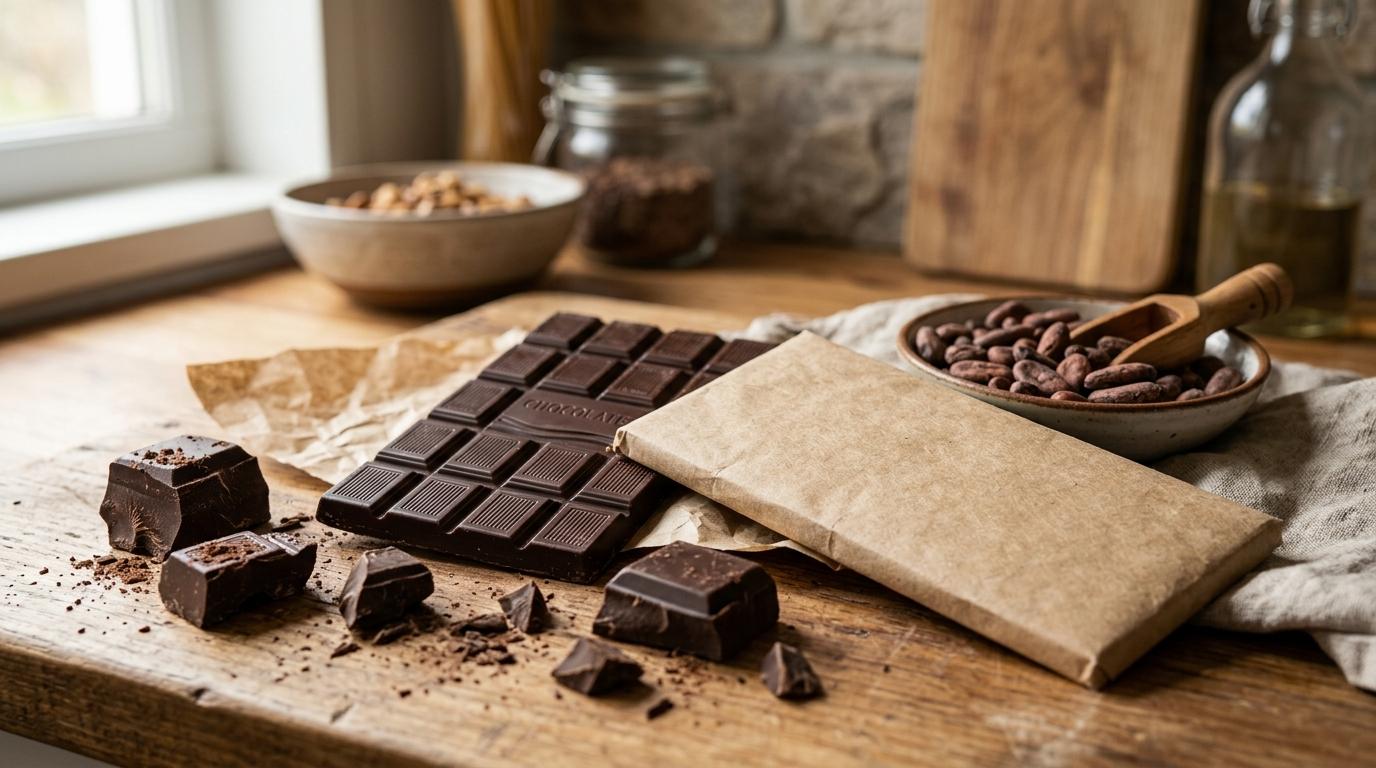
You’re standing in a supermarket aisle, holding a dark chocolate bar. The front says “70% cocoa” or “intense dark”, so it feels safe. Then you turn the pack around and the usual question pops up:
Is dark chocolate veg or non-veg?
For most plain dark chocolate, the answer is simple: it is usually vegetarian. But chocolate labels can be sneaky. Some bars contain milk even though they are called dark chocolate. Some filled or fancy chocolates may also contain ingredients that strict vegetarians or vegans avoid.
So instead of guessing, here’s a clear way to check.
Quick answer: Is dark chocolate veg or non-veg?
#Plain dark chocolate is usually vegetarian. Basic dark chocolate is made with cocoa solids, cocoa butter and sugar. These ingredients come from plants.
But dark chocolate is not always vegan. Many dark chocolate bars contain milk solids, milk fat, whey, lactose or other dairy ingredients. In India, these are considered vegetarian, but they are not vegan.
Filled chocolates need extra checking. If the chocolate has marshmallow, jelly, caramel, nougat, shiny coating, red filling, mousse, truffle or dessert-style layers, read the label carefully. These chocolates may contain gelatin, carmine, shellac, egg, whey, milk solids or other ingredients that some people avoid.
Simple rule: For packaged chocolate in India, first check the green dot. Then read the ingredient list. Don’t rely only on the word “dark” on the front of the pack.
What does the green dot mean in India?
#In India, the green dot is usually the first thing people look for when checking whether a packaged food is vegetarian.
If a chocolate pack has the green dot, it is labelled vegetarian under Indian food labelling rules.
That is helpful, but it does not tell you everything.
Green dot means vegetarian, not vegan
#This is where many people get confused.
In India, vegetarian food can include milk and milk products. So a chocolate bar can contain milk solids, milk fat, butter oil or whey and still have the green dot.
So remember:
- Green dot = vegetarian
- Green dot does not mean dairy-free
- Green dot does not automatically mean vegan
If your question is only, “Is this dark chocolate veg or non-veg?”, the green dot is a good first check.
But if your question is, “Is this dark chocolate vegan?”, you need to read the ingredients too.
Don’t skip the ingredient list
#The front of the chocolate pack may say things like:
- Dark
- Intense
- Premium
- 70% cocoa
- Bitter
- Rich cocoa
- Plant-based style
These words can be useful, but they are not enough.
Turn the pack around and read the ingredient list.
A simple dark chocolate may include:
- Cocoa solids
- Cocoa mass
- Cocoa liquor
- Cocoa butter
- Sugar
- Lecithin
- Natural or added flavours
For most vegetarians, these ingredients are usually fine, especially if the pack has the vegetarian mark.
But if you are vegan, or buying for someone with stricter food rules, look for dairy ingredients such as:
- Milk solids
- Milk powder
- Skimmed milk powder
- Whole milk powder
- Milk fat
- Butter fat
- Whey
- Casein
- Lactose
- Cream
- Ghee
- Clarified butter
These ingredients do not make chocolate non-vegetarian in India, but they do make it non-vegan.
Dark chocolate, milk chocolate and vegan chocolate are not the same
#This is one of the biggest reasons for confusion. People often use these terms loosely, but they mean different things.
1. Dark chocolate
#Dark chocolate usually has more cocoa and less milk than milk chocolate. A plain dark chocolate bar can be vegetarian, and it can also be vegan if it does not contain dairy or other animal-derived ingredients.
But don’t assume all dark chocolate is dairy-free.
Some dark chocolates contain milk solids, milk fat or whey to improve taste, texture or smoothness.
So if you are searching for dark chocolate vegetarian India, the practical answer is:
Plain dark chocolate is generally vegetarian, but the final answer depends on the label.
2. Milk chocolate
#Milk chocolate contains cocoa ingredients, sugar and milk solids. In India, milk chocolate is usually vegetarian if it has the green dot and does not contain any non-veg ingredients.
But milk chocolate is not vegan because it contains dairy.
So milk chocolate is generally:
- Vegetarian, if labelled with the green dot
- Not vegan, because it contains milk
If you avoid dairy for ethical, religious, allergy or lifestyle reasons, milk chocolate is not the right choice.
3. Vegan chocolate
#Vegan chocolate is made without animal-derived ingredients. It may be dark chocolate, or it may use plant-based ingredients instead of dairy.
A vegan chocolate pack may say:
- Vegan
- Dairy-free
- Plant-based
- No milk ingredients
- Certified vegan
These labels are helpful, but still read the ingredient list. The current pack in your hand matters most, because recipes can change.
Also, “may contain milk” and “contains milk” are not the same thing. Let’s clear that up.
“Contains milk” vs “may contain milk”
#This small line creates a lot of confusion on chocolate labels.
“Contains milk”
#This means milk is part of the recipe.
For example:
- Contains milk solids
- Contains milk powder
- Contains whey
- Contains milk fat
If you are vegan, avoid chocolate that says this.
“May contain milk”
#This is usually an allergen warning. It means the chocolate may have been made in a factory or on equipment where milk is also handled.
Milk is not necessarily an intentional ingredient in the recipe.
For vegetarians, this usually does not change the vegetarian status of the chocolate.
For vegans, people decide differently. Some vegans avoid products with “may contain milk”, while others are comfortable with it because milk is not deliberately added.
But if you have a milk allergy, take this warning seriously and follow medical advice.
Indian chocolate label checklist
#If you are buying chocolate in India, use this quick label check.
Step 1: Check the green dot
#For Indian packaged food, the green dot is your first vegetarian check.
If the pack has the green dot, it is labelled vegetarian. If it has the non-vegetarian symbol, avoid it if you follow a vegetarian diet.
Step 2: Read the ingredient list
#Do not stop at the word “dark” on the front.
Check for:
- Gelatin
- Carmine
- Cochineal
- Shellac
- Confectioner’s glaze
- Egg
- Egg albumen
- Milk solids
- Milk powder
- Whey
- Milk fat
- Lactose
- Casein
If you are vegan, dairy ingredients matter. If you are a strict vegetarian, also watch for insect-derived colours and glazes.
Step 3: Decide whether you need vegetarian or vegan
#This is important.
For many vegetarians in India, dairy is acceptable.
For vegans, dairy is not acceptable.
So a chocolate can have a green dot and still not be vegan.
Step 4: Be extra careful with filled chocolates
#Plain dark chocolate bars are usually easier to check.
Be more careful with:
- Truffles
- Assorted chocolate boxes
- Marshmallow chocolates
- Jelly-filled chocolates
- Candy-coated chocolates
- Chocolate-coated nuts
- Imported dessert chocolates
- Strawberry or red-coloured fillings
- Nougat or mousse-filled chocolates
These are more likely to contain hidden animal-derived ingredients.
Step 5: Check the current pack every time
#Don’t rely on memory.
A chocolate you bought last year may not have the same recipe today. Brands can change ingredients, factories, suppliers or country-specific formulations.
Always check the current pack in your hand.
Imported chocolate checklist for Indian shoppers
#Imported chocolates can be confusing because they may not follow the same label style you are used to in India.
If you are buying chocolate abroad, at duty-free, from an international aisle or from a seller carrying imported packs, check carefully.
1. Don’t expect the Indian green dot everywhere
#Products sold officially in India may carry Indian labelling, sometimes through an importer sticker.
But if you are buying chocolate abroad or from a travel store, you may not see the green dot.
In that case, the ingredient list becomes your main guide.
2. Watch for E-numbers
#Some imported chocolates use E-numbers instead of familiar ingredient names.
Common ones to know:
- E120: Carmine or cochineal, not vegetarian
- E904: Shellac, avoided by vegans and many strict vegetarians
If you see these and you follow a vegetarian or vegan diet, it is safer to choose another chocolate.
3. Check for dairy even in dark chocolate
#Imported dark chocolate may still contain dairy.
Look for:
- Milk powder
- Whey powder
- Butterfat
- Milk fat
- Lactose
- Cream powder
The word “dark” does not always mean dairy-free.
4. Vegan labels are useful, but still check
#A certified vegan logo or vegan claim is helpful. But it is still worth reading the ingredient list and allergen statement, especially if you are buying for someone with allergies or very strict dietary needs.
Also, remember that the same brand may use different ingredients in different countries.
So, is dark chocolate vegetarian in India?
#Most plain dark chocolate sold in India is vegetarian if it has the green dot and does not list any non-veg ingredient.
But the word “dark” alone is not proof.
A dark chocolate bar can be:
- Vegetarian and vegan, if it has no animal-derived ingredients
- Vegetarian but not vegan, if it contains milk solids, whey, lactose or milk fat
- Not vegetarian, if it contains gelatin, carmine, egg or certain insect-derived glazing ingredients
The safest habit is simple:
Check the green dot first. Then read the ingredient list.
Final takeaway
#If you are buying a plain dark chocolate bar in India, it is usually vegetarian when it has the green dot. But vegetarian and vegan are not the same thing.
A green dot tells you the chocolate is labelled vegetarian. The ingredient list tells you what is actually inside.
So before buying, take a few seconds to check the back of the wrapper. It matters even more when you are buying for children, guests, strict vegetarians, vegans, people with allergies or while travelling.
Green dot first. Ingredients second. That’s the easiest way to avoid confusion.