The little dal packet that saved my mood at 38,000 feet
#I started carrying ready-to-eat Indian meals in cabin baggage after one truly tragic flight meal somewhere between Delhi and Frankfurt. You know the kind. The tray arrives with a brave little bread roll, a cube of butter colder than my ex’s heart, and something that is technically “vegetarian curry” but tastes like boiled airport carpet. I was tired, slightly grumpy, and missing proper food so badly that I promised myself, never again. Next trip, I packed a pouch of dal makhani, a couple of thepla, instant poha, and a tiny spoon I stole from my own kitchen drawer. Not glamorous. But when the cabin lights dimmed and everyone was poking at mystery pasta, I was eating warm-ish dal with torn thepla and honestly, it felt like home had boarded the plane with me.
This post is basically my love letter to Indian travel food, but also a practical chat about what you can and can’t carry. Because ready-to-eat meals sound simple until security asks, “What is this packet?” and suddenly your rajma chawal becomes an international diplomatic situation. I’ve learnt this through trial, error, and one very oily pickle leak that made my backpack smell like a Punjabi wedding buffet for two weeks.
First, what do we mean by ready-to-eat Indian meals?
#When I say ready-to-eat Indian meals, I’m talking about those sealed pouches and cups you find in supermarkets and travel stores: dal tadka, chole, pav bhaji, upma mix, poha, biryani, rajma, khichdi, pongal, instant idli mix, paratha packs, dehydrated curries, even those retort pouches that just need heating. Some are shelf-stable and some need refrigeration, and that difference matters more than people think. A vacuum-packed thepla is one thing. A fresh paneer wrap sitting in your bag for 14 hours is another story, and not a cute one.
My own travel kit changes depending on where I’m flying. For short domestic flights in India, I prefer dry or semi-dry foods: methi thepla, podi idli, lemon rice if I’m leaving from home, makhana, roasted chana, khakhra. For international flights, I get more careful. I stick to factory-sealed packets with clear labels, no meat, no dairy-heavy fresh stuff, no homemade wet chutney in suspicious unmarked containers. It sounds boring, but airport security people are not there to appreciate your grandmother’s coconut chutney, unfortunately.
The cabin baggage rule nobody explains properly: solid is easier, wet is drama
#The most useful thing I’ve learned is this: dry food usually travels better than wet food. Not always, because rules vary by airport and country, but generally. Security screening tends to get more fussy when something behaves like a liquid, gel, paste, sauce, chutney, gravy, or oil. On many international routes, cabin liquids and gels are limited to small containers, commonly 100 ml each, packed in a clear resealable bag. Airport security has the final say, and honestly their mood also feels like part of the rulebook sometimes.
So instant poha mix? Usually easy. Dry upma cup? Easy. Sealed khakhra? Easy. Thick dal pouch? Maybe okay if it’s commercially packed, but it can still be questioned because it’s gravy-ish. Wet chutney, raita, sauce sachets, pickle oil? That’s where things become messy. I wrote a whole mental note after one trip to Singapore where my friend’s green chutney was treated like chemical warfare. If you’re confused about accompaniments, this piece on Chutney in Cabin Baggage from India: Dry vs Wet Rules explains that dry podi and powders are way less troublesome than wet chutneys and leaky dips.
My Mumbai-to-London food bag, and why it worked
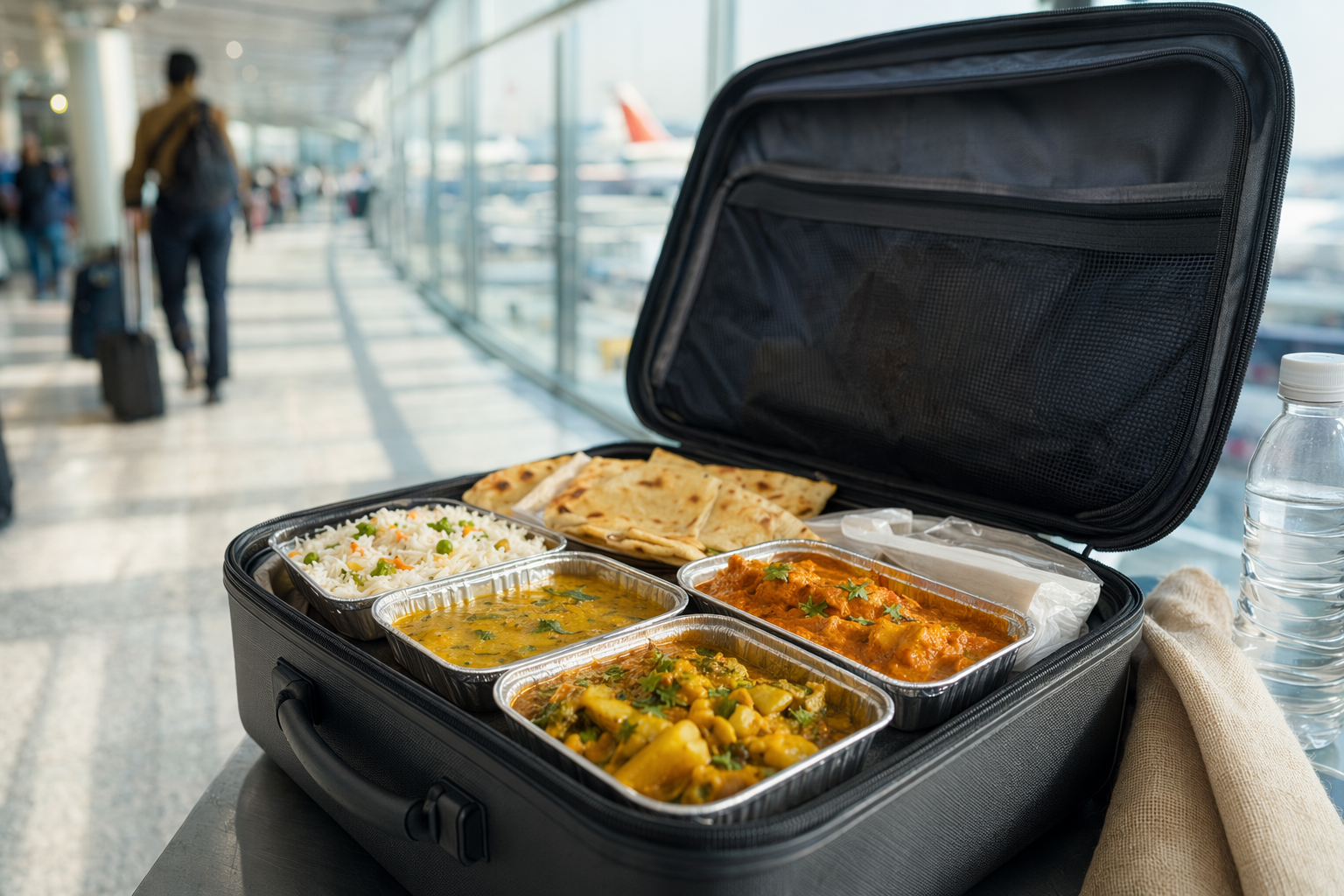
#One of my smoothest food-carrying trips was Mumbai to London. I had an early morning flight, the kind where you leave home at 2:30 a.m. and your soul is still sleeping. Before leaving, I packed two methi theplas wrapped in foil, one sealed packet of ready-to-eat dal, a dry upma cup, roasted makhana, and some tea bags because hotel tea abroad can be... I don’t know, emotionally weak. I also carried a small empty steel dabba. Empty, because carrying wet homemade sabzi in cabin baggage on an international flight felt like asking for trouble.
At security, nobody cared about the thepla or makhana. The dal pouch got a second look, probably because it showed up as a dense rectangle on the scanner, but the officer saw the label and waved it through. On the flight I didn’t heat the dal, of course. Don’t be that person demanding the crew microwave your packet during service, they’re already juggling a hundred things. I ate the thepla with the dal at room temperature later during my layover. Was it restaurant-quality? No. Did it taste better than a sad airport sandwich costing almost as much as a small dosa empire? Absolutely.
London has incredible Indian food, by the way. Southall for Punjabi food, Wembley for Gujarati snacks, Brick Lane if you want the famous curry-house energy, though I personally find some places there more touristy than tasty. But after a long flight, before the Tube ride and hotel check-in and the tiny panic of “where is my passport,” that little travel meal was perfect. Not because it was fancy. Because it was mine.
What security usually cares about, in normal human language
#Security staff are mostly looking for liquids over the allowed limit, suspicious packaging, sharp objects, and things that could spill, smell, or create a safety issue. Food is not automatically banned. But food that is liquid-like can fall under liquid rules. Food that is oily can leak. Food that is homemade and unlabeled may invite questions. And food that contains meat, dairy, seeds, plants, or fresh produce may become a customs issue at your destination, even if it passed airport security in India.
- Factory-sealed ready-to-eat packets are easier to explain because the ingredients and expiry date are printed on them.
- Dry snacks like khakhra, makhana, roasted chana, mathri, sev, and plain biscuits usually behave well in bags and on scanners.
- Gravy meals, chutneys, sauces, curd, raita, and pickle oil can count as liquid or gel depending on the screening point.
- Self-heating meal packs can be risky because they may include heating chemicals, so I avoid carrying those in cabin baggage.
- Customs rules at arrival are a seperate headache. Australia, New Zealand, the US, and many other places can be strict about food declarations.
And please, declare food if the arrival card asks. I know we Indians have this instinct of “arre it’s just snacks,” but customs officers don’t see it that way. In countries with strict biosecurity rules, undeclared food can lead to fines. I’d rather lose a packet of poha than start my holiday with an expensive lecture in an airport office.
The great achar temptation, and my personal oily disaster
#Let’s talk pickle. Achar is the emotional support animal of Indian travel food. Mango pickle with paratha. Lemon pickle with curd rice. Gongura pickle with plain rice. A tiny dab can make a boring meal suddenly alive. But in cabin baggage, pickle is a troublemaker. It’s oily, strong-smelling, sometimes semi-liquid, and if the lid opens even slightly, your bag is finished. I once carried homemade mango pickle from Jaipur to Goa, thinking I had packed it well. I had not. The oil escaped, soaked into a paperback book, and for the next several days my clothes smelled like mustard oil and regret.
If you must carry pickle, use tiny sealed sachets or keep it in checked baggage with serious leak protection. I mean plastic wrap, zip pouch, another pouch, maybe prayers also. For cabin baggage, I mostly skip it now. If you are still tempted, this guide on Can You Carry Pickle on Flights from India? Achar Rules is worth reading before your achar becomes everyone’s problem in row 21.
My favourite Indian ready-to-eat foods for flights
#I’ve tested a slightly embarrassing number of foods on flights, trains, buses, and random airport floors. Some are brilliant. Some become rubbery. Some smell too much, which is not a crime exactly, but your co-passengers may disagree. I love Indian food loudly, but a closed aircraft cabin is not the place to open anything with aggressive garlic tadka unless you enjoy silent judgement.
- Thepla: honestly the king of travel food. It survives long journeys, doesn’t need cutlery, and tastes good with tea, dal, dry chutney powder, or nothing at all.
- Instant poha cups: light, familiar, and easy if hot water is available at the airport lounge or after landing. On the plane, don’t assume crew will help.
- Dry upma mix: not glamorous, but very reliable. Add hot water, wait, stir, done. It reminds me of early morning train journeys in South India.
- Ready-to-eat dal pouches: comforting, but choose thicker ones and keep them sealed. I like dal tadka more than dal makhani for travel because it feels less heavy.
- Khichdi cups: soft, calming, good when your stomach has given up after too much airport coffee.
- Makhana: light, crunchy, not messy, and it doesn’t make you feel like you swallowed a brick. If you’re comparing dry snacks with meal packets, check this practical post on Can You Carry Makhana on International Flights from India?.
I used to carry biryani packs too, but I’ve stopped doing it in cabin baggage. Not because biryani isn’t glorious. It is. Hyderabad biryani eaten properly, from a real place, with mirchi ka salan and raita, is one of life’s big pleasures. But sealed travel biryani in a plane cabin can smell strong, and it’s often oily. Also cold biryani from a pouch is not the same joy. It feels like you’re insulting biryani and yourself.
Food memories that shaped my travel packing
#My obsession with carrying Indian food didn’t begin in airports. It started on trains. As a kid, I remember my mother packing aloo paratha in foil for Delhi to Amritsar, with sugar tucked in a small paper packet because she liked one sweet bite after the spicy pickle. My uncle would bring bread pakora from the station, my cousins wanted chips, and me and him used to fight over the last piece of paratha like it was family property. Those meals were chaotic, greasy, and perfect.
Later, when I started travelling alone, food became a kind of anchor. In Bangkok, after a week of eating amazing pad thai, mango sticky rice, grilled satay, and fiery papaya salad, I suddenly missed plain dal-chawal so much I almost laughed at myself. In Paris, surrounded by bakeries and cheese shops, I still found myself eating khakhra in my hotel room at midnight because dinner had been beautiful but tiny. In Dubai, of course, Indian food is everywhere, from Karama cafeterias to polished restaurants in hotels, but even there, carrying a small snack helped during long transit waits.
That’s the thing about food travel. You go somewhere because you want to taste the world, but you carry your own flavours because you don’t want to feel lost in it. Sounds dramatic, but it’s true. A packet of dal can be emotional. Don’t laugh.
Cabin baggage packing: the unsexy details that save your trip
#Packing ready-to-eat meals is not just tossing packets into a bag. I wish it was. You need to think about pressure changes, rough handling, leaks, smell, and whether you can actually eat the thing without creating a disaster on your jeans. I’ve learned to pack like a slightly paranoid auntie, and frankly aunties are usually right.
- Keep food in original packaging if possible. Labels help at security and customs.
- Put every pouch inside a zip-lock bag. Then put wet-ish things inside another bag. Double bagging is not overthinking, it is wisdom.
- Carry disposable or lightweight cutlery only if allowed, and avoid knives. A spoon is enough for most things.
- Avoid glass jars. They are heavy, breakable, and generally annoying.
- Pack strong-smelling food away from clothes. Better yet, don’t carry very strong-smelling food in cabin baggage.
- Check your airline and airport rules before flying, especially for international routes and transit airports.
One more thing: don’t pack your entire kitchen in cabin baggage. I know it’s tempting when you’re going abroad for studies or a long work trip. But cabin space is limited, and security lines are stressful. Put most sealed food in checked luggage if it’s allowed, and keep only what you’ll actually eat during the journey in your cabin bag. Your shoulders will thank you.
Where ready-to-eat meals fit in the bigger Indian food travel story
#India has always been a country of portable food. Thepla from Gujarat, sattu from Bihar, podi from Tamil Nadu and Andhra kitchens, dry chutneys from Maharashtra, mathri from North India, banana chips from Kerala, murukku, chivda, laddoos, roasted peanuts, tilgul, nankhatai. We didn’t suddenly invent travel food because airports got expensive. We’ve been doing this forever. Ready-to-eat packets are just the modern, sealed, barcode-wearing cousins of the tiffin.
And honestly, I like that. I like seeing poha cups at airport stores next to overpriced muffins. I like that Indian students flying to Canada carry dal pouches like treasure. I like that families going on package tours to Europe pack khakhra and chai masala because after three days of bread, soup, and salad, someone will definately say, “bas ab kuch Indian chahiye.” It’s funny, yes, but also deeply human.
At the same time, I don’t want ready-to-eat packets to replace eating local food. Please don’t go to Thailand and eat only packaged upma in your hotel room. Don’t go to Italy and refuse pasta because you packed rajma. That would be sad. The best version, at least for me, is balance: eat local, explore markets, try the messy street snack, sit in the tiny restaurant with plastic chairs, and keep your Indian meal for the moments when you’re tired, delayed, homesick, or just need masala.
Airport and destination notes I keep in my head
#Different airports feel different with food. Indian domestic security is usually relaxed about dry snacks, though liquids can still be questioned. International departures are stricter because of liquid rules and the destination country’s import restrictions. Transit airports can complicate things too. If you buy or carry something before a connection, you may be screened again, and that second airport may not care what the first airport allowed.
For the US, Australia, New Zealand, and parts of Europe, I’m extra cautious with food. I avoid fresh fruits, seeds, homemade dairy items, meat products, and unlabeled mixes. I declare when required. For Gulf travel, dry Indian snacks are common, but again, don’t assume everything is allowed. For Southeast Asia, I’ve had easy experiences with sealed vegetarian snacks, but I still avoid carrying wet homemade stuff. Rules change, enforcement differs, and sometimes the person at the counter simply says no. It happens.
Also, airline cabin etiquette matters. If your meal smells very strong, maybe wait. If your neighbour looks unwell, maybe don’t open garlic pickle. If turbulence starts, do not attempt dal. I once tried eating cup poha during a bumpy descent and ended up wearing half of it. Not my proudest culinary moment.
A small sample food kit I’d pack tomorrow
#If I had a long international flight tomorrow, leaving from India, my cabin food kit would be simple: two theplas, one dry snack like makhana or roasted chana, one instant poha or upma cup, a sealed sweet like chikki, tea bags, and maybe one small commercially sealed dal pouch if I really felt I’d need a meal during a long layover. No pickle. No curd. No chutney. No glass. No fresh cut mango even though my heart says yes.
For a domestic flight, I’d be more relaxed. Idli with podi, lemon rice, paratha rolls, khakhra, homemade sandwiches, even dry sabzi if packed properly. But I still avoid anything too wet. Cabin bags are not forgiving. Once something leaks, it leaks into your charger, your book, your sweater, your dignity.
My basic rule: if I can eat it neatly with one hand while sitting in a cramped airport chair, it belongs in cabin baggage. If it needs a plate, three accompaniments, and emotional support, it goes in checked luggage or stays home.
The taste of home, but don’t let it stop you from tasting the world
#The funniest part is that carrying Indian meals has made me a better eater when I travel, not a worse one. Because I know I have backup food, I’m more willing to explore. I’ll try the unfamiliar soup, the fermented thing, the market snack I can’t pronounce, the tiny restaurant where nobody speaks much English but everyone is eating happily. If dinner fails, fine. I have khakhra. That safety net makes me braver.
Some of my best travel memories are still local meals: hot appam and stew in Kochi, misal pav in Pune that nearly blew my ears off, khao soi in Chiang Mai, fresh simit in Istanbul, dosa at a Bengaluru darshini where the sambar was somehow better than anything fancy, and a bowl of ramen in Tokyo that made me stop talking for ten full minutes. But tucked between those memories are quieter ones: eating thepla at a Paris train station, sharing chikki with a stranger during a delayed flight, stirring instant upma in a hotel mug because there was no bowl. Not Michelin-star stuff. Still real food travel.
So yes, carry your ready-to-eat Indian meals if they make your journey easier. Pack smart, respect the rules, don’t be careless with wet foods, and don’t forget that customs is serious business. But also leave room in your stomach and your plans for the place you’re visiting. The packet in your bag is comfort. The street outside your hotel is adventure. You need both, I think.
And if you’re the kind of person who plans trips around snacks, airport food hacks, and where to find the best local meals after landing, you’ll probably enjoy wandering through more stories on AllBlogs.in. I do, usually with a cup of chai and something crunchy nearby.