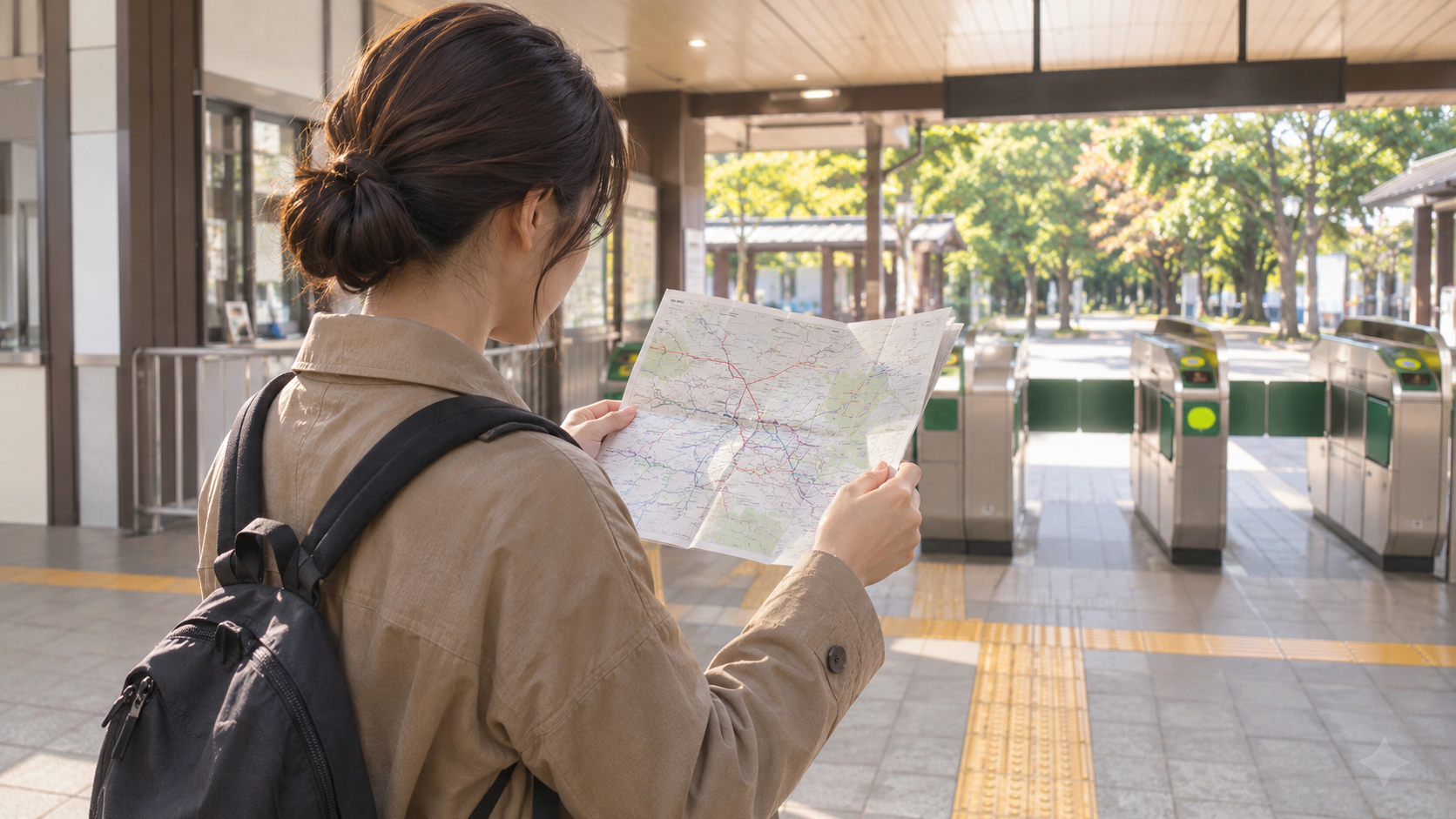
Kintetsu Nara is a useful arrival for many park-first visits; JR Nara can suit a convenient JR journey or a pass you already hold. Compare the route from your hotel to your first stop, and save the full station name: these are two separate stations.
I'd make this decision before adding another temple to the itinerary. It is easy to write “train to Nara” in a plan and leave the details until breakfast. Then the route search gives you two stations, several train types and a fare that doesn't seem to match the ticket you've already bought.
You can sort most of that out with three pieces of information: where you're starting, the first place you want to visit and the exact ticket or pass you intend to use. The shortest train ride is only one part of the day.
Put both stations on the same map
#JR Nara serves JR trains. Kintetsu Nara serves Kintetsu trains. They are not two names for one interchange, and getting off at one doesn't put you inside the other operator's station.
Mark your first attraction as well as the stations. For a park-centred visit, Kintetsu's location can save some approach walking. For a plan beginning elsewhere in the city, compare the actual route rather than treating the whole of Nara as one destination pin.
Naramachi is a useful example. Nara City's tourism guidance puts Gangoji Temple in that area about 15 minutes on foot from Kintetsu Nara and about 20 minutes from JR Nara. Both are workable starting points for that particular visit; the difference doesn't automatically justify a more awkward train journey.
Todai-ji is another useful reality check. The temple's own access guidance allows about 20 minutes on foot from Kintetsu Nara. Arriving near the park doesn't mean stepping off the train at the Great Buddha Hall.
If you're travelling with someone who walks more slowly, start with their comfortable distance. A route that looks compact on a map may still involve several separate walks once you add station exits, entrances and the journey back.
Start the search at your hotel, not the city name
#“Osaka to Nara” can mean quite different mornings. A hotel beside Namba and one near Osaka Station give you different starting advantages. Don't cross the city merely because a guide uses the other station as its default origin.
From the Namba area, compare the Kintetsu journey from Osaka-Namba to Kintetsu Nara first. Nara City's published access summary gives about 40 minutes for a direct service. Your walk to Osaka-Namba, waiting time and the final approach still sit outside that figure.
From the Osaka Station or Tennoji side, compare JR options early. The same official summary gives about 50 minutes from Osaka Station and about 36 minutes from Tennoji on direct Yamatoji Rapid services. Those are representative train times, not a promise for whichever departure you find on your phone.
Kyoto gives you a genuine choice at the main station. The city's Nara access guidance lists roughly 45 minutes for JR's Miyakoji Rapid and roughly 35 minutes for a Kintetsu Limited Express. The latter has an additional ticket requirement, and other Kintetsu services have different timings or connections.
Use your actual travel date and departure time when checking a route. Read the transfers and train category. A suggested Kintetsu journey may involve changing trains; a general city summary doesn't guarantee that every departure is direct.
I would compare two complete routes and stop there unless one has a clear problem. You don't need to research every train in Kansai to choose a day trip.
“Express” and “Limited Express” need a closer look
#On Kintetsu, regular services and Limited Express trains have different ticket requirements. A Limited Express has reserved seats, and you need its Limited Express ticket as well as the basic fare.
That distinction matters when buying online. Kintetsu sells supplement-only Limited Express tickets, and also offers some products combining the supplement and basic fare. Read the confirmation to see which you have.
If you bought only the reserved-seat supplement, you still need to cover the basic journey. The operator lists options including an appropriate ticket, pass or supported payment method. A seat reservation on your phone doesn't by itself prove that you have paid both parts.
Likewise, a pass covering the basic Kintetsu route doesn't automatically include the Limited Express supplement. The current one-day pass page states that the additional Limited Express ticket is still required.
For a first visit, I'd write the two parts together in the travel note: basic fare covered by this product; Limited Express supplement covered by this reservation. If you're taking a regular service, record that instead so you don't buy a supplement out of habit.
Check the destination and train time on a reserved ticket before leaving the hotel. If your plans change, use the conditions for that exact ticket; a general comparison article can't establish your right to change or refund a particular purchase.
Use a pass because it covers your journey
#The national Japan Rail Pass covers eligible JR services. It doesn't cover the Kintetsu journey to Nara. If you already have an active national pass and a convenient JR route, that can make JR Nara the straightforward choice.
A regional pass is a separate product. Look at its coverage map and conditions instead of assuming that all passes sold for Kansai include the same trains, buses and supplements.
Kintetsu's one-day pass has designated train zones and designated Nara Kotsu bus coverage. Those boundaries matter if you are adding other places to the day. Check your planned journeys against the exact version of the pass before buying.
Owning a pass and needing to buy one are different situations. If you already hold a suitable pass, compare the extra cost of using another route. If you own neither, compare the total cost of ordinary tickets with the pass for journeys you actually intend to make.
Don't add bus rides to the budget simply to make a pass look cheaper. You may prefer to walk between nearby stops, pause for lunch and stay in one part of the city. A busy sightseeing day can still contain very few paid journeys.
| Your starting situation | Compare first | What still needs checking |
|---|---|---|
| Hotel near Namba, park first | Osaka-Namba to Kintetsu Nara | Train type, supplement if applicable and walk to the attraction |
| Hotel near Osaka Station or Tennoji | JR journey to JR Nara | Exact service, pass coverage and onward walk or bus |
| Starting at Kyoto Station | JR and Kintetsu side by side | Transfers, full fare, reserved-seat needs and first stop |
| Active pass already covers your route | The covered journey | Whether convenience elsewhere is worth a separate fare |
Count the minutes outside the train
#For each option, include the walk from your hotel, any local connection, the wait, the train and the final walk or bus. Add them before choosing on speed.
Here is an illustrative comparison, not a timetable quote: a train ride that saves ten minutes loses that advantage if reaching its departure station takes fifteen minutes longer. Your complete journey would then take five minutes more before considering the walk after arrival.
The same logic works at the Nara end. A slightly longer rail journey may still suit a first stop near its station. A faster train can leave you with a longer walk in weather or with luggage you would rather avoid.
Include waiting time honestly. If one convenient train is leaving soon and another requires a longer wait, the advertised journey duration doesn't decide that morning. Search again when your departure time changes instead of relying on a screenshot from a different hour.
Once you have a sensible route, allow some room for getting through the station. A theoretical two-minute connection might be possible in a routing tool and still be a poor choice for someone reading signs in an unfamiliar place.
Three different mornings, three reasonable choices
#Consider a couple staying near Namba who want to start with the park. They don't hold a rail pass and prefer a simple journey. I'd have them compare the direct Kintetsu option first, then decide whether an ordinary service or a reserved Limited Express suits their budget and departure time.
Now imagine a traveler staying near Kyoto Station with an active national JR Pass. They want a relaxed Naramachi visit before deciding how much park walking to do. JR Nara is a reasonable arrival to compare first. The slightly different station position may matter less than the covered, convenient journey and their chosen first area.
For a third example, imagine a family near Tennoji with one person who tires after long walks. A useful plan begins with the JR route and the onward bus options, then compares the whole journey with Kintetsu. Choosing the station closer to a particular sight doesn't remove the need to check transfers, lifts and the attraction's approach.
These are planning examples, not instructions for every person in those areas. Change the pass, hotel or first stop and you may change the answer. That is why I would save the complete route rather than a bare recommendation to “use JR” or “use Kintetsu.”
Decide where to finish before locking in the return
#You don't have to use the same station in both directions, provided each journey has a valid ticket or payment method. Compare the return from the place where you expect to finish, not from the station where you arrived by default.
If you begin at the park and finish in Naramachi, both stations may be worth checking again. If a reserved train fixes your return time, make that appointment part of the afternoon plan rather than discovering it while you order another coffee.
Check where your return train takes you in Kyoto or Osaka. A service that gets you to the city but leaves an inconvenient hotel connection may be less useful after a long day of walking.
For a flexible afternoon, save a couple of later options and note any last connection that matters. Do this before the phone battery becomes low. If service disruption changes the route, check a current operator notice or ask staff rather than assuming the saved itinerary still applies.
Keep the walking plan realistic
#Nara's sightseeing areas connect by bus as well as on foot. The prefecture groups the city's major visitor areas around Nara Park, Naramachi and Nishinokyo. A plan moving between areas needs more thought than one staying near a few park-side sights.
For Todai-ji, the temple lists city-loop bus access from both JR Nara and Kintetsu Nara, followed by a short walk from the named stop. Check the current route and stop before boarding. “Take a bus toward the park” is too vague when several services share a station forecourt.
If step-free access matters, look beyond the arrival station. Confirm station lifts, transfers, the bus journey and the actual venue entrance with the operators and venue. A short line on a map doesn't establish a step-free route.
If you bring luggage, confirm a storage plan before relying on a locker. Size, opening hours and availability can matter as much as whether a station lists lockers at all. Leaving a bag at your accommodation may make the entire comparison easier.
For a late start or wet afternoon, reduce the sightseeing list before trying to save a few minutes on the railway. Pick the place you most want to visit, check its current admission arrangements and build the arrival around that. You can leave another part of Nara for a future day.
Save a travel note you can use at the gate
#Keep the full departure and arrival station names, train type, any required change and your fare or pass arrangement together. Include the first walking or bus leg and the return station you plan to use.
For a Limited Express, keep the reserved train details and the basic-fare arrangement visible in the same note. For a pass, save its relevant coverage map and check how to present that particular ticket at the gate.
Before you leave, search once more using the time you expect to travel. Then put the phone away until you need the next detail. You've chosen a route to help you enjoy Nara; you don't have to keep reopening the comparison after every stop.