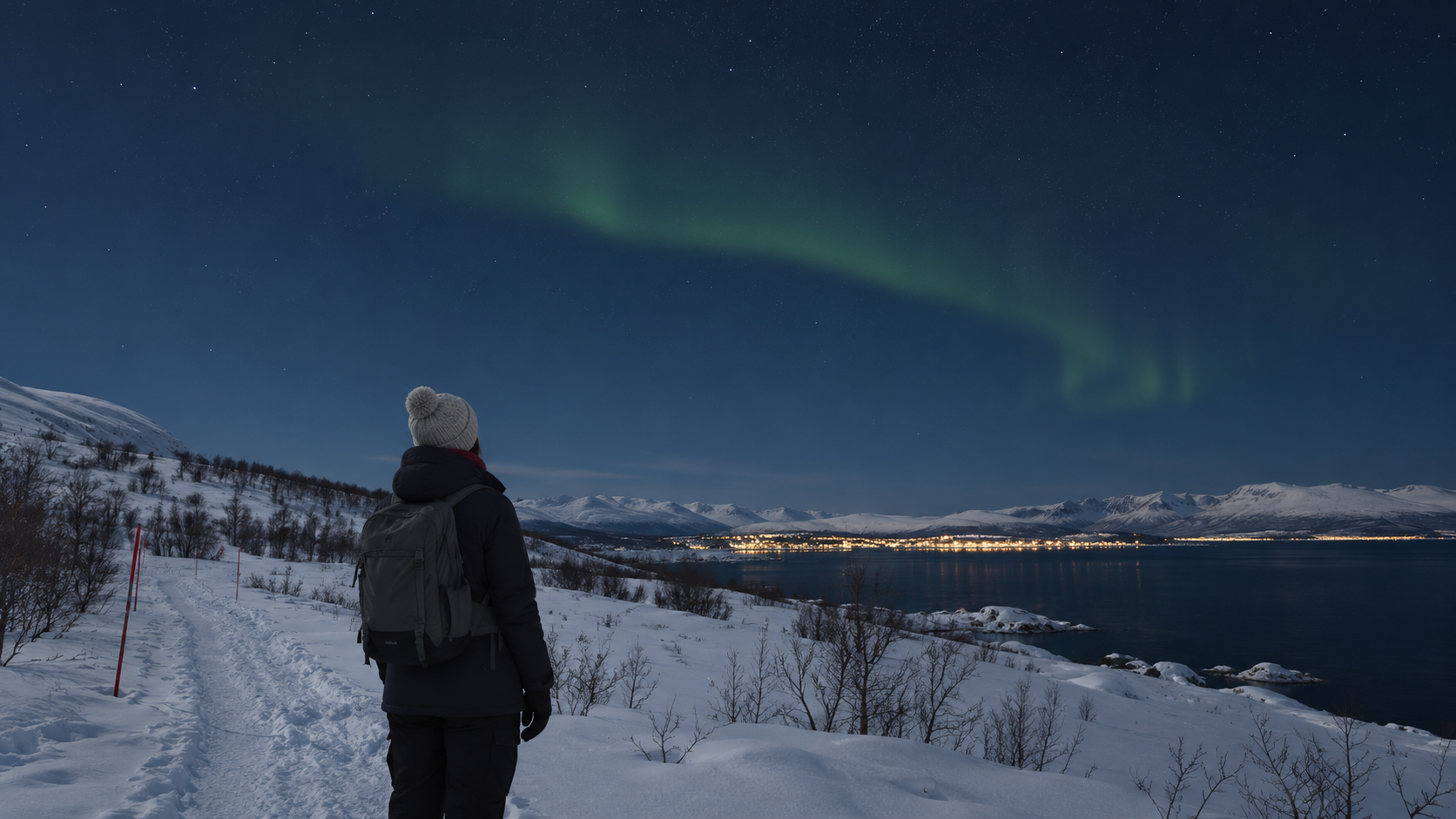
If I were planning my first northern-lights trip to Tromsø, I would not book one night, one tour, and one perfect photo in my head. I would give the weather some room to be weather. The northern lights can be visible in the Tromsø region from late August to early April, but they still need darkness and clear enough sky. Nobody can sell a guarantee for that.
That is not meant to make the trip sound less exciting. It is what makes the plan better. Tromsø works best when the aurora is one important part of a winter stay, not a performance that has to happen on a single evening.
I would choose the season based on the whole trip
#Late autumn and winter are not identical versions of the same trip. From early in the northern-lights season, you may find milder conditions and more daylight than in the deepest winter. In the darker winter months, the atmosphere can feel more distinctly Arctic, but the cold and limited daylight deserve real planning.
I would not call one month universally best. A person who wants a gentler first winter trip may prefer the shoulder of the season. Someone who wants the shortest days, snowier surroundings and a fuller winter feeling may make a different choice. The sensible question is: what kind of day do you want when the sky is cloudy at night?
That question matters because it will be cloudy sometimes. Tromsø's official visitor guidance is clear on this point: clear sky and darkness matter, sightings are never guaranteed, and more nights give the weather and aurora activity more chances to line up. I would build the trip around that uncertainty instead of treating it as a small disclaimer at the bottom of a booking page.
I would stay at least three nights if the aurora is the priority
#One night can work if you are passing through and get lucky. It is not the plan I would choose if seeing the lights is the main reason for the journey. A three-night base gives you a first evening to settle in, more than one weather window, and a chance to use a later tour if the first night does not work out.
That does not mean three nights guarantees anything. It simply gives the plan more resilience. A longer stay can make sense if you also want daytime activities, slower mornings or flexibility around flight delays and weather.
Here is the shape I would use for a first visit:
- Arrival day: Keep expectations low. Check into your accommodation, buy anything you forgot, walk around the centre if conditions are comfortable, and save your energy for the evening.
- First full day: Use daylight for a city activity, a museum, a quiet café or a short guided outing. Keep the evening free for your first aurora attempt.
- Second full day: Treat this as the flexible day. If the first night worked, you can explore without pressure. If it did not, you still have a proper second chance.
- Final morning: Leave room for an easy departure. Do not plan an ambitious outdoor activity right before a flight in winter conditions.
This is not a fixed itinerary that everyone should copy. It is a way of protecting the reason you came without letting it take over every hour.
I would choose a tour based on the actual experience, not the word “chase”
#Northern-lights tours are not all the same. Some move around to look for clearer skies. Some are based at a fixed camp with a more settled experience. Some are smaller and quieter; others have larger groups and more structure. None of those is automatically better. I would look at what each one actually includes before deciding.
Ask practical questions:
- How long will you be outside, and how much time is spent in the vehicle?
- Does the trip focus on moving to clearer conditions, or staying at one base?
- Are warm suits, boots, food, hot drinks, photography help, toilets and hotel drop-off included?
- What is the group size, and how much walking is involved?
- What happens when conditions are poor or the route changes?
These questions are not fussy. They decide whether the night feels manageable when you are standing still in the cold. I would also check the operator's current cancellation and rebooking terms directly before I pay, because those details can change by season.
City viewing and guided trips are different choices
#On a clear night, the aurora may be visible from Tromsø itself, especially away from the brightest central lights. That can be a lovely surprise. I would treat it as a bonus, not as a reason to skip planning.
A guided trip can help because local guides watch weather patterns, know where it is safe to stop, and can drive beyond city light when conditions suggest that is useful. It also takes away the pressure of navigating unfamiliar winter roads in the dark.
I would be cautious about hiring a car only for aurora chasing if I had little experience with icy winter driving. A map makes the route look simple. Darkness, wind, snow and roadside stopping are a different thing. If you want independence, choose it because you are comfortable with winter travel and have a wider plan for the car—not because a tour sounds less adventurous.
The clothes matter more than the photo plan
#Northern-lights viewing includes a lot of waiting. That is the part people often underestimate. You are not hiking steadily and generating heat. You may be standing outside, looking up, adjusting a camera or sitting quietly between clouds.
If I were packing, I would build from the feet up: insulated winter boots with room for warm socks, wool or synthetic base layers, a warm mid-layer, an insulated outer layer, hat, neck coverage, gloves and a spare pair of warm socks. Avoid relying on cotton near the skin because it holds moisture and gets cold when damp.
Your own comfort changes the whole night. If your feet are cold after twenty minutes, you stop paying attention to the sky. If your gloves are too thin to use your phone, every small task becomes annoying. Warm gear is not an accessory here. It is part of being able to wait patiently and safely.
I would not use an aurora forecast as a promise
#Forecasts can be useful for deciding whether to go outside or how optimistic to feel. They cannot override cloud cover, darkness, local weather or the fact that the lights are a natural phenomenon. I would use forecasts as one input, alongside the local conditions and the advice of a guide.
The mistake is treating a high number on an app as a ticket. It is not. In Tromsø, being underneath the auroral zone means you do not need to wait for the most dramatic possible activity to have a good chance, but you still need the sky to cooperate.
For a first trip, I would take the pressure off the photograph. Your eyes, your camera and a phone sensor do not all see the same thing. A faint arc that looks subtle in person may show more colour in a long-exposure image. That does not make the in-person moment less real; it just means the camera is not a neutral judge of whether the night was worthwhile.
The camera plan I would keep simple
#If photography mattered to me, I would learn the basic controls on my phone or camera before I was outside in gloves and darkness. I would bring a small tripod only if I knew how to use it and could carry it safely. I would keep one spare battery warm in an inside pocket because cold conditions can drain batteries faster than a normal city evening.
I would not spend the whole tour looking at a screen. Take a few careful photographs, then look up. The trip does not become more successful because every minute has proof attached to it. A guide can usually advise where to stand and when to keep lights low; that is more useful than trying to copy a random settings list that may not suit the conditions.
Leave the daytime open for Tromsø itself
#I would not spend every daylight hour recovering from a late tour, then rush out again without seeing the city. Tromsø has enough to fill the day at a slower pace: its waterfront setting, Arctic history, museums, cafés and nearby outdoor activities all give the trip a shape beyond the sky.
The right daytime plan depends on your energy. Some visitors will want a guided cultural activity. Others will want a short walk, a sauna, a café and an early dinner before a late night. The useful thing is to avoid booking every daytime hour so tightly that a delayed tour, poor sleep or rough weather turns the whole trip into a checklist.
If you add another outdoor trip, make sure it has its own value. Do not book a second activity only because it includes the words “northern lights.” Ask what you will do if clouds arrive. A good winter plan should still feel like a trip when the sky stays quiet.
What I would do if the forecast looks bad
#I would not cancel the whole evening based on one glance at an app. Weather can change quickly, and a guide who is following local conditions has more context than a single broad forecast. I would check the operator's own update process and make a decision within their terms.
If the night is clearly not going to work, I would use the time well: have a slower dinner, rest, organise clothes for another attempt, and keep the next evening open. The worst version of this trip is treating one cloudy night as a personal failure. It is simply part of travelling for a natural event.
I would also keep a small contingency fund in the plan for an extra tour or a change in activity if that is something I might want. It is not mandatory. It just prevents the whole trip from being financially locked into the first decision.
Be respectful when you go out at night
#The search for a dark sky does not give visitors permission to treat every roadside, beach or small community as a photo set. I would stay with a registered guide or use clearly appropriate public places, keep noise down, never block access, and follow local safety directions.
If you take photos, keep your light controlled. Do not shine a bright torch across another group's view. Do not wander off alone in the dark because you saw a better angle. If your guide asks everyone to stay near the vehicle, there is usually a reason.
I would tell someone my plan before an independent evening out, keep my phone charged, and take the route home seriously. The purpose is to enjoy the dark sky, not make an unfamiliar winter night harder than it needs to be.
This is also why I would avoid treating local culture as decoration around an aurora photo. Tromsø is a living place, and northern Norway has communities, landscapes and traditions that deserve more than a quick backdrop. Choose activities and guides thoughtfully, listen when people explain how the place works, and leave the area as you found it.
The plan I would actually keep
#I would choose a season that suits my tolerance for cold and darkness. I would stay several nights, book a tour whose practical setup fits me, and pack for standing still outside. I would leave time for Tromsø in daylight and accept that the weather may rewrite the evening.
That sounds less dramatic than “guaranteed northern lights,” but it is the better promise. A clear, bright display can become the highlight. If it does not happen, the trip should still have been worth making.