Peru may be famous for the pisco sour, but you definitely do not need alcohol to enjoy what people drink here.
In fact, Peru is a pretty great country for non-drinkers. You can order sweet purple corn drinks by the pitcher, warm herbal brews from street carts, bright yellow soda that Peruvians are very proud of, fresh market juices, and mountain teas that show up everywhere in the Andes.
This guide covers the best non-alcoholic drinks to try in Peru, including chicha morada, emoliente, Inca Kola, fresh fruit juices, coca tea, and Andean herbal teas. It also includes the practical stuff that actually matters when you are traveling: ice, sugar, dairy, hygiene, and what to know before trying coca products.
Quick Answer: Best Peruvian Drinks for Non-Drinkers
#If you just want a simple starting point, try these first:
- Chicha morada: A sweet, deep purple drink made from purple corn, fruit, spices, lime, and sugar. Classic, refreshing, and non-alcoholic.
- Emoliente: A warm herbal drink sold from street carts, often made with barley, flaxseed, herbs, lime, and sweetener. Very local and especially nice on cool mornings or evenings.
- Inca Kola: Peru’s bright yellow national soda. Very sweet, almost bubblegum-like, and best tried with chifa, Peru’s Chinese-Peruvian food.
- Mate de coca: Coca leaf tea, common in high-altitude places like Cusco and Puno. Traditional, but important to treat carefully because it can affect drug tests and should not be taken across borders.
- Fresh juices and refrescos: Look for maracuyá, lúcuma, papaya, pineapple, camu camu, and other fruit drinks in markets, cafés, and restaurants.
- Traveler basics: Be careful with ice, tap water, dairy that is not properly chilled, and drinks that are much sweeter than you expect. Useful phrases include sin hielo for no ice, poco azúcar for little sugar, and sin azúcar for no sugar.
Why Peru Is So Good for Alcohol-Free Drinks
#Peruvian food gets most of the attention, and fair enough. It is one of the best reasons to visit. But the drinks are part of the same story.
The coast, the Andes, and the Amazon all show up in what people drink. Purple corn from the Andes becomes chicha morada. Street carts pour hot emoliente when the evening gets chilly. Market stalls blend tropical fruit into juices and smoothies. Restaurants serve Inca Kola with ceviche, arroz chaufa, and pollo a la brasa.
There is a lot to try, but it helps to know what you are ordering. Some drinks sound similar but are completely different. Some are alcohol-free, while others are fermented. Some are traditional but still very sugary. And some are treated like medicine, even though it is better to think of them as drinks, not cures.
So here is the practical, traveler-friendly version.
Chicha Morada: Peru’s Purple Corn Classic
#Chicha morada is probably the easiest place to start if you want a non-alcoholic Peruvian drink.
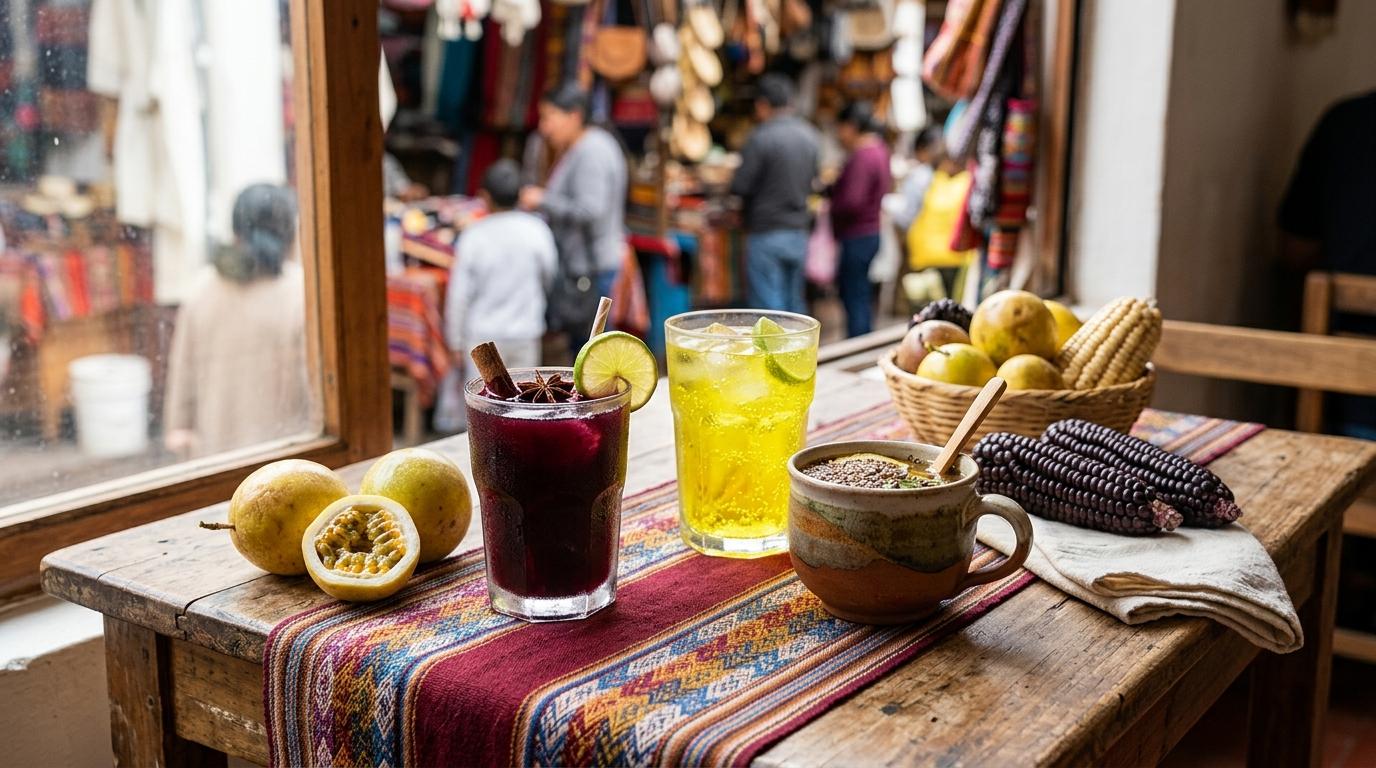
It is very Peruvian, easy to find, and approachable even if you have just arrived in the country. The drink is made from maíz morado, or purple corn. Usually, the corn is boiled with pineapple rind, cinnamon, cloves, and sometimes apple or quince. Once the mixture cools, lime juice and sugar are added. Some versions also come with little pieces of fruit in the glass.
The result is a deep purple drink that is sweet, lightly spiced, and refreshing. It is not fizzy and it is not alcoholic. If you are trying to imagine the flavor, think of something closer to a spiced fruit punch than a regular juice.
Chicha morada vs chicha de jora
#This is the big thing to know if you are avoiding alcohol.
- Chicha morada is the purple corn drink. It is sweet, unfermented, and normally non-alcoholic.
- Chicha de jora is a fermented corn drink. It contains alcohol.
So if you do not drink, ask specifically for chicha morada. Do not just ask for “chicha” unless you are sure what the place means by it.
Where to try chicha morada
#You can find chicha morada all over Peru, especially in:
- Traditional Peruvian restaurants
- Cevicherías
- Casual lunch spots
- Cafés
- Market food stalls
- Supermarkets and small shops, usually bottled or packaged
Restaurant versions are often made in big batches, so you may not be able to control the sweetness. At a juice stall or casual counter, you can sometimes ask for menos azúcar or poco azúcar.
What to watch for
#Chicha morada is usually boiled during preparation, which is a good thing. But that does not automatically mean every glass is safe for every traveler.
The real questions are what happened afterward. Was it cooled properly? Was ice added? Are the pitcher and cups clean?
If your stomach is sensitive, try your first chicha morada in a proper restaurant or café. At markets and street stalls, look for busy places with lots of turnover and clean handling.
Emoliente: The Warm Herbal Street Drink
#Emoliente is one of those drinks you start noticing once you know what to look for.
It is warm, herbal, slightly thick, and usually sold from street carts. You will often see emoliente vendors early in the morning or in the evening, especially when the weather is cool. The vendor usually pours a hot herbal base, then mixes in lime, sweetener, and sometimes extra herbal extracts depending on what the customer wants.
Common ingredients can include toasted barley, flaxseed, horsetail herb known as cola de caballo, plantain leaf, and other herbs. The flaxseed can give the drink a slightly slippery or thick texture, which might surprise you the first time.
It is not a delicate tea. It is more rustic than that. Think hot, herbal, street-corner comfort.
How to order emoliente
#You can keep it very simple:
Un emoliente, por favor.One emoliente, please.
If you want it less sweet:
Con poco azúcar, por favor.With little sugar, please.
If you want no sugar:
Sin azúcar, por favor.Without sugar, please.
Some locals ask for specific herbal additions, but you do not need to make it complicated. Try the regular version first and see what you think.
Where to try emoliente
#The classic place to drink emoliente is from a street cart.
Look near busy corners, plazas, bus stops, transit areas, and residential neighborhoods in the morning or evening. A good sign is a vendor with steady local customers. If people are lining up and the drink is being served hot, that is usually better than a cart where everything looks like it has been sitting untouched.
Is emoliente healthy?
#In Peru, emoliente is often treated like a comforting, medicinal-style drink. Someone might suggest it if you feel cold, tired, or a little off.
That said, it is better to enjoy it as a traditional herbal drink, not as a guaranteed remedy. Also, it is often sweetened, so if you are watching your sugar intake, ask for less sugar or no sugar.
Inca Kola: Peru’s Bright Yellow Soda
#You will see Inca Kola everywhere in Peru.
It is bright yellow, very sweet, and hard to miss. The flavor is also hard to describe. Many travelers say it tastes like bubblegum, cream soda, or candy. It is associated with lemon verbena, known locally as hierbaluisa, but honestly, the main impression is sweet, nostalgic, and very soda-like.
Inca Kola is a big part of Peruvian food culture. It is not a health drink, and it is not trying to be one. It is just soda — proudly sweet, instantly recognizable, and very Peruvian.
Where to try Inca Kola
#You can buy Inca Kola almost anywhere:
- Restaurants
- Chifas, or Chinese-Peruvian restaurants
- Convenience stores
- Supermarkets
- Bus stations
- Snack shops
- Casual lunch spots
The most classic pairing is probably Inca Kola with chifa, especially arroz chaufa. The sweetness works surprisingly well with salty, savory food. Or at least, Peruvians certainly think so.
What to know before ordering
#If you do not usually like sweet soda, share one first. It really is sweet.
If you want something more traditional and less intense, try chicha morada or a fruit refresco instead. Just keep in mind that those can also be quite sweet depending on where you order them.
Mate de Coca: Traditional, Useful, but Worth Understanding First
#If you travel to high-altitude places like Cusco, the Sacred Valley, Puno, or Huaraz, you will probably be offered mate de coca, or coca leaf tea.
It is made by steeping coca leaves in hot water. The flavor is earthy, grassy, and slightly bitter. Hotels, restaurants, and local shops in highland areas often serve it because coca has long been used traditionally by people living and traveling at altitude.
But this is one drink where you should know the cautions before you say yes.
Coca tea is not just another herbal tea
#Coca leaves are widely consumed in Peru, and mate de coca is part of highland culture. However:
- Coca products can cause a positive result on some drug tests.
- You should not take coca leaves or coca tea bags across international borders.
- Coca products may be illegal or restricted in other countries, even if you are only passing through.
- If you are subject to workplace, athletic, immigration, or legal drug testing, it is safest to avoid mate de coca.
Also, do not treat coca tea as a guaranteed cure for altitude sickness. Altitude symptoms can be serious. If you feel unwell at altitude, slow down, rest, drink safe fluids, and get medical help if symptoms are worrying or getting worse.
A non-coca alternative: muña tea
#If you want a hot Andean tea without coca, look for muña.
Muña is an Andean herb with a minty, slightly oregano-like flavor. It is lovely after meals and especially nice when you are cold in the mountains.
Like coca tea, enjoy it as a local herbal drink rather than a medical promise.
Fresh Juices and Refrescos: What to Try Without Alcohol
#Peru’s fruit scene is one of the best parts of traveling there.
Markets and cafés often serve fresh juices, smoothies, and refrescos, which are lighter fruit-based drinks. Some are familiar, some are new, and some are the kind of thing you try once and then order every day for the rest of the trip.
Here are a few worth looking for.
Maracuyá
#Maracuyá is passion fruit.
It is tart, fragrant, and refreshing, usually served sweetened. You will see it in juices, refrescos, desserts, and sauces.
If you like sour flavors, maracuyá is a great choice. If you do not want it too sweet, ask for poco azúcar.
Lúcuma
#Lúcuma is a Peruvian fruit with a flavor people often describe as caramel-like, maple-like, or a little like sweet potato.
It has a dense, dry texture, so it is usually blended rather than juiced. You may see jugo de lúcuma con leche, which means lúcuma juice or smoothie with milk.
It can be delicious, but pay attention to dairy handling, especially in hot weather or at very basic stalls.
Camu camu
#Camu camu comes from the Amazon and is known for being very tart.
Because it is so acidic, drinks made with camu camu are often heavily sweetened. Expect a bright sour flavor balanced with sugar.
Papaya, pineapple, orange, and mixed juices
#You will also find plenty of familiar fruits like papaya, pineapple, mango, banana, and orange. Market juice counters may offer all kinds of combinations.
Fresh juice can be excellent in Peru, but remember the safety basics: clean equipment, safe water, safe ice, and fruit that looks properly handled.
Where to Try Non-Alcoholic Peruvian Drinks
#You do not need to hunt too hard. These drinks are easy to find, but different places are better for different things.
Markets
#Markets are great for:
- Fresh fruit juices
- Smoothies
- Refrescos
- Local fruit you may not recognize
- Sometimes chicha morada
Markets are also where you need to pay the most attention to hygiene. Look for stalls with high turnover, clean counters, carefully handled fruit, and blenders that are washed properly between orders.
If you are unsure, order something without ice, or choose fruit that is peeled and blended in front of you.
Useful phrases:
- Sin hielo, por favor. Without ice, please.
- Con agua embotellada? With bottled water?
- Poco azúcar, por favor. Little sugar, please.
- Sin leche, por favor. Without milk, please.
Cafés
#Cafés are a nice middle ground. They are usually comfortable, and you may have more control over what goes into your drink.
You may find:
- Chicha morada
- Maracuyá drinks
- Hot herbal teas
- Fruit smoothies
- Coffee and chocolate drinks
- Bottled Inca Kola or other sodas
Cafés in tourist areas are usually more used to requests like no ice, less sugar, or dairy-free options.
Restaurants
#Restaurants are probably the easiest place to try chicha morada in a relaxed way. Many casual Peruvian restaurants serve it by the glass or pitcher.
Restaurants are also good for:
- Inca Kola
- Bottled water
- Refrescos
- Lemonades
- Herbal teas
- Fresh juices, depending on the menu
For a very local pairing, try Inca Kola at a chifa. For a classic lunch drink, order chicha morada with a menú del día or a traditional Peruvian meal.
Street stalls and carts
#Street stalls are part of the fun, especially for emoliente.
Choose vendors who are busy, serve drinks hot, and keep their workspace reasonably clean. Avoid anything that looks like it has been sitting too long, especially if it includes dairy or ice.
Street drinks can be memorable, but you do not need to try every single thing from the street to have a good food trip. Use your judgment.
Sugar, Ice, Hygiene, and Dairy: Practical Traveler Cautions
#This is not the most exciting part of a drinks guide, but it can make a big difference to your trip.
Sugar: traditional does not always mean light
#Many Peruvian drinks are sweet by default.
Chicha morada, Inca Kola, maracuyá refrescos, camu camu drinks, and blended juices can all contain a lot of sugar. That does not mean you need to avoid them. Just know what you are ordering.
Try these phrases:
- Poco azúcar: little sugar
- Sin azúcar: without sugar
- Menos azúcar: less sugar
Batch-made drinks, like restaurant chicha morada, may not be adjustable. Fresh juices often are.
Ice: ask when in doubt
#Tap water in Peru is generally not recommended for travelers to drink untreated. Ice can be a concern if you do not know what water was used.
In established restaurants, hotels, and modern cafés, ice is often made with purified water. In small markets or street stalls, it is harder to know.
If you want to be cautious, say:
Sin hielo, por favor.Without ice, please.
Hot drinks like emoliente or tea can feel like a safer choice, especially when served steaming hot. Still, cleanliness matters.
Hygiene: look before you order
#For markets and street stalls, use your eyes.
Good signs include:
- A busy stall with steady turnover
- Clean cups or disposable cups
- Fruit stored properly
- A blender rinsed between orders
- A vendor who handles money and food carefully
- Drinks made fresh, not sitting uncovered
If something feels off, skip it. There will almost always be another stall nearby.
Dairy: be more cautious in basic stalls
#Milk-based drinks can be delicious, especially lúcuma with milk. But dairy needs proper refrigeration and careful handling.
Be more careful with dairy drinks in:
- Hot weather
- Rural areas
- Small stalls without visible refrigeration
- Places where milk or blended drinks seem to be sitting out
If you want to avoid dairy, ask:
Sin leche, por favor.Without milk, please.
Simple Ordering Phrases for Non-Drinkers in Peru
#A few Spanish phrases make ordering much easier.
- No tomo alcohol. I do not drink alcohol.
- Es sin alcohol? Is it without alcohol?
- Tiene alcohol? Does it have alcohol?
- Quiero una chicha morada. I want a chicha morada.
- Un emoliente, por favor. One emoliente, please.
- Sin hielo, por favor. Without ice, please.
- Poco azúcar, por favor. Little sugar, please.
- Sin azúcar, por favor. Without sugar, please.
- Sin leche, por favor. Without milk, please.
- Agua embotellada, por favor. Bottled water, please.
If you are not sure whether something is fermented, ask directly:
Tiene alcohol?Does it have alcohol?
A Good First-Timer Tasting Plan
#If you want an easy way to explore Peruvian drinks without alcohol, start with chicha morada at a restaurant. It is classic, easy to find, and a great introduction to Peruvian flavors.
Then try Inca Kola with chifa or another casual meal. Do not expect subtlety. It is sweet, bright, and part of the experience.
Look for emoliente from a busy evening cart. Order it with little sugar if you prefer. Sip it hot and see what you think.
At a market or café, try a maracuyá refresco or a fresh fruit juice. If dairy handling looks good and you are comfortable with milk, try lúcuma con leche.
If you go to altitude, learn about mate de coca before drinking it. If drug testing or border rules are a concern, skip it and choose another tea, like muña.