If I were planning my first Sapporo Snow Festival trip in 2027, I would lock in the confirmed dates first and leave the rest of the schedule flexible. The festival is set for 4 to 11 February 2027 across Odori, Tsudome and Susukino. That is enough to plan a good winter city break. It is not a reason to pretend that every performance, food stall, shuttle detail or sculpture list is already confirmed.
That distinction matters. Festival pages often get written too early, then quietly turn last year's information into this year's promise. I would rather build a plan around the facts that are confirmed, know what needs a final check, and arrive with a day that still works if snow, queues or weather change the pace.
I would make Odori the centre of the trip
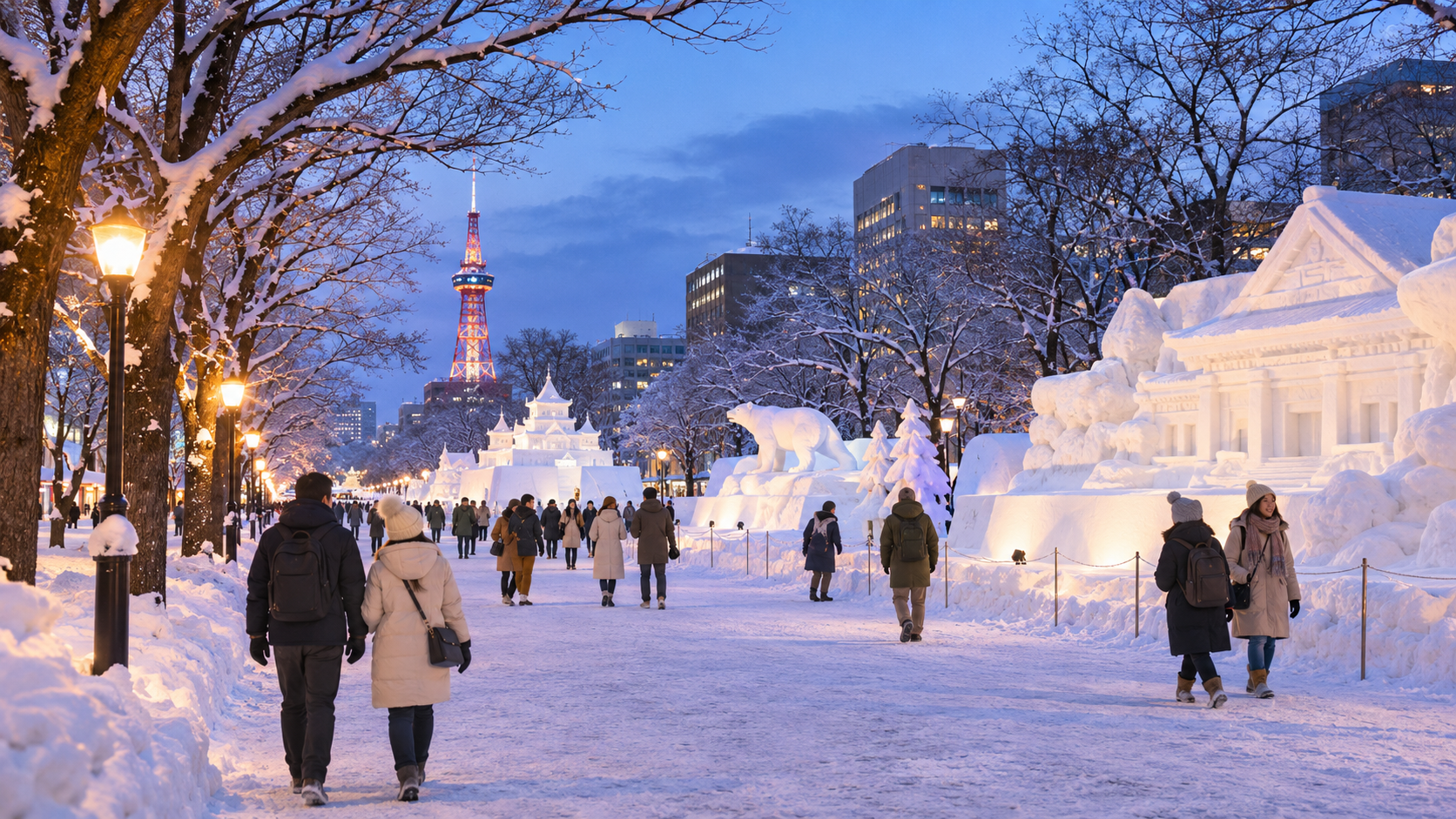
#Odori Park is the natural anchor because it runs through the central city and the official festival plan spreads the main site from west 1-chome to 11-chome. In 2027, the announced layout includes large snow sculptures across several blocks, smaller works, winter attractions, an international snow-sculpture competition and a Sapporo International Art Festival presence.
If I had only one evening at the festival, I would spend it at Odori. It lets you see the scale of the event, move at your own pace and decide which parts are worth returning to in daylight. The official site says lighting at Odori is scheduled until 22:00, so evening viewing belongs in the plan—but I would recheck the exact programme and any night-specific arrangements before travel.
Odori is long enough that it rewards a simple route. Start at one end, pick a few sections you genuinely want to see, then leave room to stop for food or warm up. Trying to photograph every sculpture in one relentless walk turns the evening into a cold task list.
I would treat the three sites as three different plans
#The festival is not one compact park. Each site has a different feel and needs a different amount of time.
Odori: the main sculpture walk
#Odori is the place for the big snow sculptures, smaller displays, night lighting and the sense that the whole city has stepped outside. It is the easiest site to pair with a central dinner, a hotel break or an evening walk around the city.
For a first visit, I would see Odori once in daylight and once after dark if the schedule allows. Daylight helps you see the detail and scale. Night changes the feeling, but it can also bring more people, colder temperatures and slower movement.
Tsudome: the active, family-oriented stop
#The Tsudome site is planned to run from 10:00 to 16:00 during the 2027 festival. It is positioned more as a daytime outing, with snow activities and indoor spaces rather than a late-night sculpture walk. I would put it on a separate day, especially if travelling with children or anyone who wants more than a short stop in the cold.
The official site currently notes access from Sakaemachi Station with a walk and shuttle-bus arrangements, and it says there is no general public parking. That is useful direction, but I would check the final 2027 transport details close to the trip. Old shuttle frequency and fare information is exactly the sort of detail that should not be copied from a previous year.
Susukino: a shorter evening add-on
#Susukino is the ice-sculpture side of the festival. It works well as an evening add-on after Odori or dinner, rather than a full-day destination. The confirmed 2027 dates cover Susukino too, but the detailed 2027 programme is still being updated. I would use the final official map to decide where it fits once I know where I am staying.
There is no need to force all three sites into one day. That plan usually means too much time outside, too much transit and very little chance to enjoy what is in front of you.
Here is how I would structure a first visit
#This is a flexible three-day shape, not a promise that you must see Sapporo in exactly this order.
Day one: arrive, get comfortable, see Odori at night
#I would keep the first afternoon light. Check into the hotel, buy anything you forgot, get your bearings and avoid scheduling a far-away activity that makes the evening stressful. If energy and weather are good, walk part of Odori after dark. The goal is to enjoy the first impression, not complete the whole festival.
Day two: Odori in daylight, then Susukino if it fits
#Use daylight for the parts of Odori you missed or want to see clearly. Build in a warm indoor break. In the evening, choose either a slower return to Odori or a shorter visit to Susukino. I would not treat this as a race between sites. One unhurried evening is better than two hurried ones.
Day three: Tsudome or a Sapporo day beyond the festival
#If snow activities matter to your group, make Tsudome the main plan. If they do not, use the day for another part of Sapporo and keep the festival as a flexible evening return. This is also the best place in the schedule for weather changes. A morning of heavy snow may make an outdoor plan slower, but it does not have to spoil the whole day.
I would book the right location, not a fantasy of zero walking
#For a first visit, staying near central Sapporo makes the festival easier to use in small pieces. You can return to the hotel to warm up, drop off shopping or take a break before heading out again. That is more useful than saving a little on a room that turns every return trip into a long journey.
But I would not promise that one neighbourhood is right for every traveller. The better choice depends on arrival station, budget, mobility needs, room size, late-night preferences and how much time you actually plan to spend at Odori. Use a map once the final festival maps are available, then choose the option that reduces your own friction.
For winter travel, I would also check the practical hotel details: how close the nearest transport is in snowy conditions, whether the room has enough space to dry outerwear, and what happens if an arrival is delayed. These are not glamorous booking filters. They are often the things you remember when your gloves are wet at the end of the day.
Pack for standing around, not only for walking
#The difference matters. A long walk can make you warm. Watching a sculpture, waiting for someone, taking photos or queuing for food can make you cold quickly.
If I were packing, I would start with boots that have grip, warm socks, base layers, an insulating layer, a wind-resistant outer layer, a hat that covers the ears, gloves that let me use a phone, and something for the neck. I would keep hand warmers as an optional comfort item, not as the main plan. The main plan is proper layers and footwear that does not make every patch of ice feel risky.
I would also carry a small bag that can hold a water bottle, a portable battery, tissues and a dry pair of gloves or socks if there is room. Do not overload yourself with camera equipment you will not use. Winter travel already comes with more clothing, more layers and more decisions.
I would plan for slower movement than the map suggests
#In a warm city, a short walk on a map can be an easy decision. During a snowy festival evening, the same distance can mean slower pavement, crowds, stopping for photos and more time spent taking gloves on and off. I would leave bigger gaps between plans than I normally would.
That is especially useful for anyone travelling with children, limited mobility, a stroller, older relatives or a lot of winter luggage. I would not assume a route is comfortable because it is technically walkable. The final official maps and current local conditions should guide the day.
I would also choose one indoor fallback for each long outdoor block. It could be a café, a museum, a hotel break or a sit-down meal. The point is not to hide from winter. It is to avoid reaching the point where everyone is too cold to enjoy the next site.
I would be careful with “must-see” lists
#The festival will publish more detailed 2027 information closer to the event. Until then, I would not plan around a named sculpture, a specific food booth, a stage time or a historic shuttle fare. Those details can be fun, but they are not stable enough yet to be treated as confirmed travel advice.
What is safe to plan now is the shape: the dates, three sites, Odori's central role, Tsudome's daytime focus and the need for warm, flexible days. Once the final guide is live, recheck:
- site maps and opening hours;
- shuttle routes, fares and frequency;
- accessibility arrangements and any entry rules for activities;
- individual event schedules;
- weather and transport conditions during your stay.
This is not extra admin for the sake of it. It is how you avoid turning a current page into stale advice.
If I were travelling with a family or a mixed-energy group
#I would split the festival into shorter pieces and let people opt into different parts. One person may want to stay outside for a long sculpture walk. Another may be happier with an hour at Odori and a warm break. Tsudome may be the more useful daytime choice for people who want snow activities, while Susukino may suit an adult evening walk better.
Trying to keep everyone together for every minute is usually what makes a winter day feel stressful. I would agree on a meeting point, keep phones charged, and make it normal for someone to head indoors rather than push through the cold. That is not wasting the festival. It is making a busy event work for real people.
Make room for warm breaks and ordinary meals
#I would not plan to eat every meal standing outside at festival stalls, even if the food looks tempting. Cold weather changes your pace. Sit down for a proper meal when you can, drink water as well as hot drinks, and use indoor stops as part of the schedule rather than as a sign that you are doing less.
Sapporo is a city, not only a festival ground. The best first trip leaves some time for that. A café stop, a museum, a neighbourhood walk or an unplanned hour out of the cold can make the festival days feel more relaxed and more memorable.
I would also keep one ordinary meal in the plan. Not every memorable trip moment has to be a festival queue or a perfect photo. A warm bowl, dry gloves and a quiet table can reset the whole day.
The small decisions I would make before leaving the hotel
#I would check the weather, charge the phone, put a portable battery in the bag and decide which single site is the priority for that block of time. I would take a screenshot or offline copy of the final official map in case the signal is poor or my hands are too cold to search properly.
I would also agree on a simple return plan with anyone travelling with me. Pick a meeting point, a time to stop walking and an indoor fallback. Those choices sound ordinary, but they let the actual festival feel open rather than stressful.
The plan I would keep
#I would arrive with 4 to 11 February 2027 in the calendar, stay close enough to use Odori in pieces, give Tsudome its own daytime slot if it matters, and save Susukino for an evening that has room for it. I would pack for snow and standing still, then check the detailed official programme again before I leave.
That is less flashy than a list of secret spots. It is also the kind of plan that survives a queue, a snowfall or a change of mind once you are actually there.