The Magic of Zermatt and the Matterhorn
#There is no mountain peak in the world more recognizable than the Matterhorn. 
Its jagged, chisel-faced pyramid rises 4,478 meters (14,692 feet) into the thin alpine air above the Swiss canton of Valais, standing completely isolated like a natural cathedral. At its base sits Zermatt, a storybook Swiss mountain village where traditional sun-blackened larch-wood chalets sit beside quiet cobblestone lanes.
Because combustion-engine cars were strictly banned in 1961, there are no roaring trucks, no exhaust fumes, and no traffic jams in Zermatt. 
The air is crisp and pure, filled only with the quiet hum of tiny electric luggage taxis and the distant sound of cowbells ringing on high alpine meadows.
Visiting Zermatt on a 3-day trip gives you the perfect amount of time to explore the high Alps. 
You can ride Europe's highest open-air cogwheel train up to Gornergrat, catch the iconic Matterhorn mirror reflection at Lake Riffelsee before the morning wind begins, hike the famous 5-Lakes Walk through pine forests, and stand on the eternal ice of Glacier Paradise at nearly 3,900 meters.
Here is a practical, step-by-step 3-day itinerary covering train logistics, ticket discount hacks, altitude safety, and the best viewpoints in Zermatt.
Logistics: How to Get to Car-Free Zermatt via Täsch
#The single most common mistake drivers make when heading to Zermatt is punching "Zermatt" into their GPS and expecting to drive right up to their hotel lobby.
You cannot drive a private car into Zermatt. 
The public road ends five kilometers down the mountain valley in the small village of Täsch.
The Matterhorn Terminal Täsch
#If you are traveling by car through Switzerland:
- Drive to the Matterhorn Terminal Täsch, a massive modern multi-story covered parking facility with over 2,100 parking bays.
- Take a parking ticket at the barrier gate and park in any open stall. Parking costs roughly 16 to 18 Swiss Francs (CHF) per 24-hour period.
- Grab your luggage and head directly into the terminal hall. The parking facility connects seamlessly to the railway platforms.
- Board the Matterhorn Gotthard Bahn shuttle train. These sleek red-and-white commuter trains leave Täsch every 20 minutes, 365 days a year.
- The shuttle ride takes exactly 12 minutes to glide up the scenic valley canyon, dropping you off directly inside the main railway station in the heart of Zermatt (Bahnhof Zermatt).
Arriving by Train from Zurich or Geneva
#If you are using public transit from Zurich Airport or Geneva Airport, you do not need to worry about transfers at Täsch. 
Simply take the Swiss Federal Railways (SBB) mainline train to the junction town of Visp or Brig, then change onto the Matterhorn Gotthard Bahn regional train that carries you straight up into Zermatt station. The entire journey is seamless and covered 100 percent by the Swiss Travel Pass.
Moving Luggage Inside the Village
#Once you exit Zermatt station, you will see a fleet of small, boxy electric shuttles lined up outside. 
Most luxury and mid-range hotels in Zermatt provide free pick-up service in their private electric hotel cars; check your hotel confirmation before arriving and give them a quick call from the train platform so a driver meets you with your luggage. 
If you are staying at an independent holiday apartment, you can easily walk—most parts of the central village are within a 5 to 12-minute flat walk from the station.
Understanding the Three Mountain Excursions
#Before you start buying tickets, you need to understand that Zermatt has three distinct mountain rail systems leading up three different peaks:
- Gornergrat Railway (The Essential Viewpoint): A historic 1898 electric cogwheel train that winds up the eastern mountain ridge to 3,089 meters. This is where you see the Gorner Glacier and the famous Riffelsee lake reflection.
- Sunnegga and Blauherd (The Hiking Paradise): A subterranean funicular railway that shoots straight through the mountain rock to Sunnegga (2,288m), connecting by cable car to Blauherd (2,571m). This is the starting point for the legendary 5-Lakes Walk.
- Matterhorn Glacier Paradise (The Extreme Altitude Summit): A massive multi-stage cable car system ending at Klein Matterhorn at 3,883 meters—the highest cable car station in Europe. It features year-round snow, an underground glacier ice palace, and views extending all the way into Italy.
Day 1: Arrive, Historic Hinterdorf Stroll, and Gorner Gorge
#Your first day is about getting your bearings, adjusting to the village altitude (1,605 meters / 5,265 feet), and exploring Zermatt's fascinating history.
Afternoon: Walking the 500-Year-Old Hinterdorf Quarter
#After settling into your accommodation, head to the oldest part of town: the Hinterdorf (Old Village).
Located just off the bustling main street (Bahnhofstrasse), this quiet quarter contains roughly 30 preserved historic barns, granaries, and residential chalets built from dense alpine larch wood between the 16th and 18th centuries. 
Look closely at the wooden support stilts under the barns: you will see large, circular flat stone discs (Mäuseplatten) sandwiched between the timber posts and the barn floor. 
These round stone slabs were an ingenious alpine invention designed to prevent mice and rats from climbing into the grain storage houses. The resin-rich larch timber has blackened naturally under centuries of intense high-altitude sunlight, giving the neighborhood a gorgeous, weathered bronze patina.
Continue walking past the historic mountaineers' cemetery at St. Mauritius Church, where climbers who lost their lives attempting the Matterhorn—including members of Edward Whymper's fateful first ascent in 1865—are laid to rest under simple stone crosses.
Late Afternoon: The Wooden Catwalks of the Gorner Gorge
#From the village church, take an easy 15-minute scenic walk following the rushing glacial waters of the Mattervispa river south toward the Gorner Gorge (Gornerschlucht).
Over thousands of years, melting waters from the Gorner Glacier have carved a dramatic, sheer chasm through green serpentinite rock. 
For a few francs, you can enter the gorge and walk along narrow wooden footbridges and catwalks bolted directly into the sheer canyon walls. The turquoise glacier meltwater thunders through the canyon feet below you, creating cool mists and narrow moss-lined rock arches that provide a dramatic contrast to the open mountain peaks above.
Evening: Traditional Valais Cheese Fondue or Raclette
#Head back into town for your first alpine dinner. 
Zermatt sits in the heart of the Valais canton, famous for its rich mountain dairy culture. Order a steaming pot of traditional Swiss cheese fondue made with local Gruyère and Vacherin Fribourgeois melted with dry white wine and a splash of kirsch cherry schnapps. 
Dip cubes of crusty bread into the bubbling cheese, or order a plate of Raclette—local semi-hard cow's milk cheese melted from a half-wheel directly over a broiler and scraped onto hot boiled potatoes, sweet gherkins, and pickled pearl onions.
Day 2: Gornergrat Cogwheel Train, Riffelsee Reflection, and Alpine Hike
#Day two is your marquee Matterhorn experience. To get the postcard photograph of the Matterhorn mirrored in still water, you must be up and out early.
The Golden Early Morning Rule: Beat the Thermal Winds
#The surface of Lake Riffelsee is only calm when the morning air is dead still.
By 10:00 AM, the morning sun begins heating the lower mountain valleys. This rising warm air creates thermal valley breezes that blow across the high alpine lakes, turning the glassy surface into choppy ripples that instantly erase the reflection. 
Furthermore, moisture rising from the valley often condenses into clouds around the summit of the Matterhorn by midday, hiding the peak behind white fog.
- Set your alarm early: Aim to board the 7:30 AM or 8:00 AM Gornergrat train from the dedicated Gornergrat station located directly across the street from Zermatt's main train station.
- Sit on the right side: As you board the train, immediately grab a window seat on the right-hand side of the carriage facing forward. As the train climbs out of the village through pine and larch forests, the massive pyramid of the Matterhorn will sit right outside your window the entire ride.
Disembark at Rotenboden for Lake Riffelsee
#Do not ride the train all the way to the summit first. 
Instead, disembark at the second-to-last station: Rotenboden at 2,815 meters.
From the Rotenboden platform, follow the clearly marked gravel trail down the hillside for roughly ten minutes until you reach the shoreline of Lake Riffelsee.
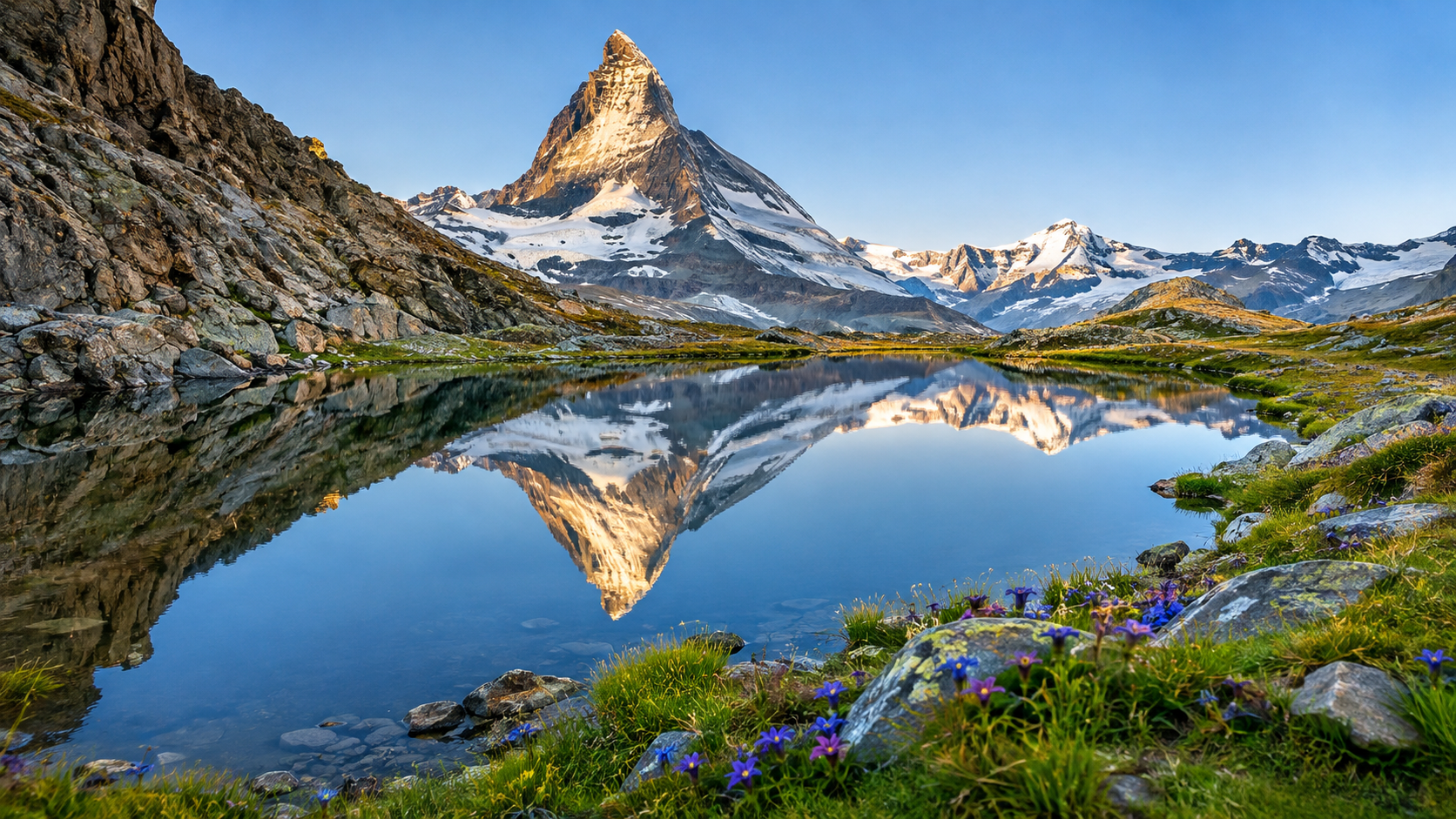
If you arrived before 9:00 AM, you will be rewarded with one of the greatest sights in nature: the air is crystal-clear and freezing cold, the water is as smooth as polished plate glass, and the towering white-and-charcoal pyramid of the Matterhorn is reflected upside-down in the lake with razor-sharp perfection.
Take your photographs, walk along the grassy banks dotted with purple alpine gentian wildflowers, and soak in the absolute silence before the later tour groups arrive.
Summit Station: Gornergrat at 3,089 Meters
#Walk back up the trail to Rotenboden station, hop back on the next cogwheel train, and ride five more minutes to the end of the line: the Gornergrat summit station at 3,089 meters (10,134 feet).
Step out onto the 360-degree viewing platform behind the historic 3100 Kulmhotel Gornergrat (the highest hotel in the Swiss Alps). 
From here, you are surrounded by an amphitheater of 29 massive mountain peaks exceeding 4,000 meters, including the Monte Rosa massif and Switzerland's highest peak, the Dufourspitze (4,634m). 
Looking directly down from the viewing deck, the colossal Gorner Glacier—a vast highway of blue ice, deep crevasses, and moraine rock—snakes along the valley floor like a prehistoric frozen serpent.
Afternoon Hike: Descending to Riffelberg
#Instead of riding the train all the way back down, hike the beautiful, gentle downhill trail from Rotenboden down to Riffelberg (roughly 1.5 to 2 hours of easy walking).
The trail winds across open alpine tundra and granite boulder fields with the Matterhorn standing directly in front of you with every step you take. Keep your eyes peeled for alpine marmots sunning themselves on the rocks and herds of black-necked Valais mountain goats grazing on the high slopes.
At Riffelberg, reward yourself with a hot lunch on the outdoor terrace of the historic mountain lodge before boarding the train back down to Zermatt village.
Day 3: The 5-Lakes Walk and Matterhorn Glacier Paradise
#Your third day combines Zermatt's most scenic alpine trail with a high-altitude cable car flight onto the eternal ice.
Morning: The 5-Seenweg (5-Lakes Walk)
#The 5-Seenweg is widely considered the finest day hike in the Swiss Alps. It is a 9.3-kilometer (5.8-mile) trail that links five distinctly different alpine lakes: Stellisee, Grindjisee, Grünsee, Moosjisee, and Leisee.
- Getting to the Trailhead: Walk to the Sunnegga valley station in Zermatt. Board the subterranean funicular that shoots through the mountain bedrock to Sunnegga, then transfer onto the gondola cable car up to Blauherd at 2,571 meters.
- Lake 1: Stellisee: The hike begins with a gentle 20-minute walk to Stellisee, the most dramatic lake on the trail. Large granite boulders sit along the shoreline, and the Matterhorn looms directly above the far bank, creating another breathtaking mountain reflection.
- Lake 2: Grindjisee: The trail descends through rocky terrain into a secluded hollow surrounded by rare alpine larch trees. The water here is deep green and calm, reflecting the forest and the peaks.
- Lake 3 & 4: Grünsee and Moosjisee: You pass Grünsee (the Green Lake), framed by rugged moraine rock, before descending toward Moosjisee, an artificial reservoir whose water glows an astonishing milky turquoise-white color from suspended glacial rock flour.
- Lake 5: Leisee and Sunnegga: The trail finishes at Leisee, a popular swimming lake with wooden lounge chairs, picnic tables, and a small wooden raft that kids can pull across the water on a cable.
From Leisee, take the glass elevator or short walk up to Sunnegga station. The entire loop takes about three to 3.5 hours of gentle downhill walking and is suitable for anyone with basic fitness and good walking shoes.
Afternoon: Matterhorn Glacier Paradise at 3,883 Meters
#Take the funicular back down to Zermatt, walk across the village to the southern cable car terminal, and prepare for high-altitude drama.
Board the multi-stage Matterhorn Express gondola, which sweeps over pine forests up to Trockener Steg. Here, you transfer onto the state-of-the-art 3S Matterhorn Glacier Ride cable car, which ascends a sheer granite wall to Klein Matterhorn at 3,883 meters (12,740 feet).
Step out onto the viewing platform: you are standing at the highest accessible cable car point in Europe. 
The air is thin and freezing cold—temperatures hover around -2°C to 2°C (28°F to 35°F) even in the middle of July. You can see across the entire Alps, from Mont Blanc in France all the way to the Gran Paradiso in Italy.
Take the elevator deep inside the glacier bedrock to visit the Glacier Palace (Gletscher-Palast). Here, an underground ice cavern carved 15 meters below the glacier surface features ice tunnels, frozen slides, and intricate ice sculptures illuminated by soft blue and violet lights.
High Altitude Safety and Acclimatization
#Standing at 3,883 meters is not like walking through a city park. The atmospheric pressure at Glacier Paradise is roughly 40 percent lower than at sea level, meaning your body receives significantly less oxygen with every breath.
- Pace Yourself: Do not run, jump, or rush up the stairs at the summit station. Walk at half your normal speed, take deep steady breaths, and allow your heart rate to stay calm.
- Hydration: High-altitude mountain air is extraordinarily dry. Drink water continuously throughout the day. Dehydration accelerates the onset of altitude headaches and fatigue.
- Sun Protection: UV radiation increases by 10 to 12 percent with every 1,000 meters of elevation, and the glacier snow reflects up to 80 percent of that solar radiation back into your face. Always wear high-category UV sunglasses (Category 3 or 4) and apply mineral sunscreen to your face, lips, and neck, even on overcast days.
Swiss Pass Hacks: How to Save Hundreds on Lifts
#Switzerland is notoriously expensive, and mountain railway tickets can quickly cost more than your hotel room. A round-trip ticket on the Gornergrat train alone costs roughly 110 to 132 CHF per adult in peak summer.
Here is how smart travelers slash their lift costs in half:
- The Swiss Travel Pass: Covers the train from Zurich/Geneva into Zermatt and the shuttle train from Täsch for free 100 percent. More importantly, it gives you a 50 percent discount on the Gornergrat cogwheel train, the Sunnegga-Blauherd cable cars, and Matterhorn Glacier Paradise.
- The Swiss Half Fare Card: If you are staying in Switzerland for a couple of weeks without a full Swiss Travel Pass, buy the 120 CHF Half Fare Card. It immediately pays for itself after two mountain excursions in Zermatt by cutting all cable car and train tickets by 50 percent.
- Check the Live Summit Webcams First: Never purchase an expensive ticket up to Gornergrat or Glacier Paradise the night before. Mountain weather can change overnight. Download the free Zermatt app on your phone. First thing in the morning, check the live video webcams at the summit stations. If the summit webcam shows thick white fog and zero visibility, do not waste 100+ francs riding up; wait for the afternoon or spend the morning hiking the lower valley trails instead.
With an early morning alarm, sturdy boots, and an eye on the summit webcams, your three days beneath the Matterhorn will be the crown jewel of your travels in the Alps.