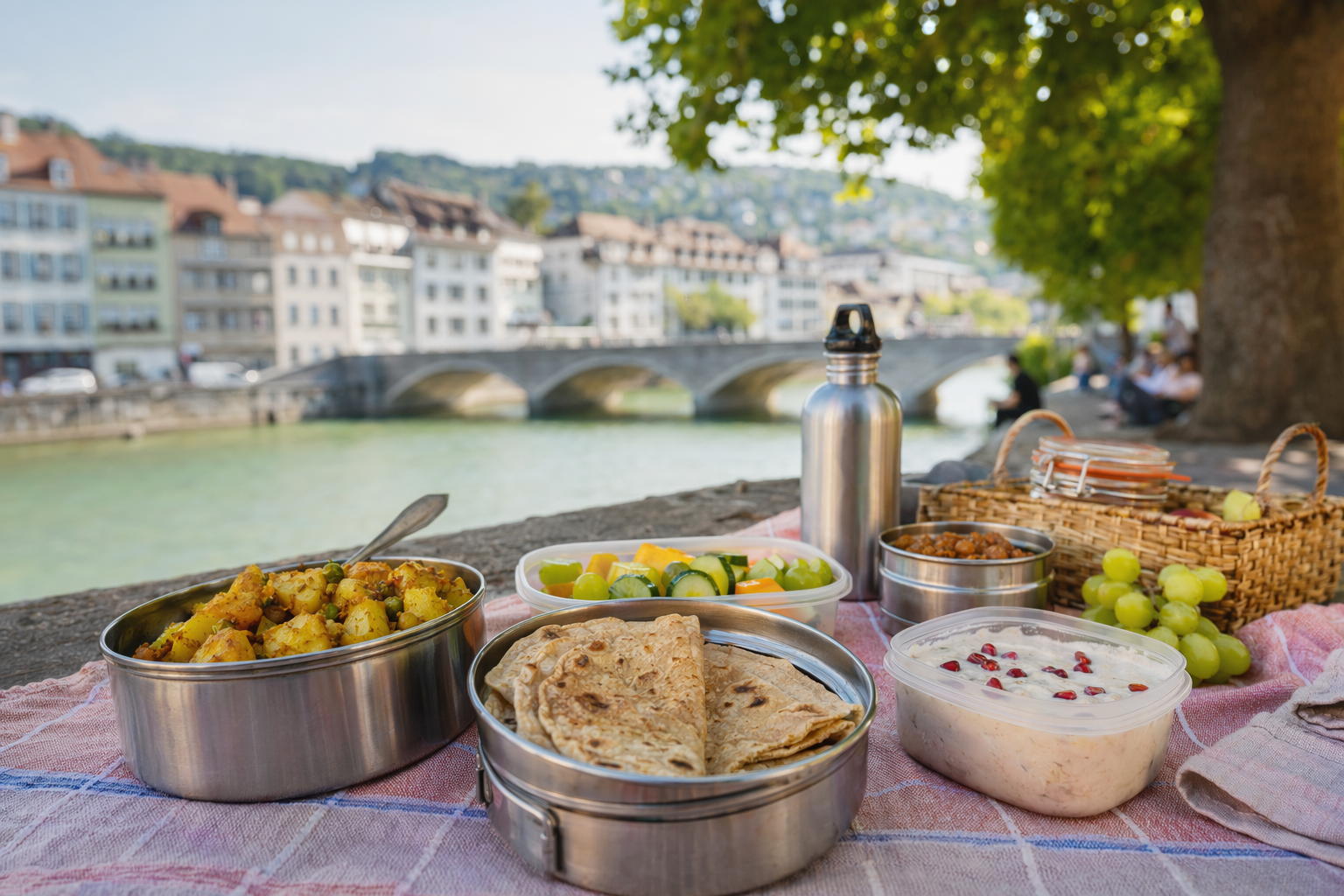
I have a theory, and I will defend it with my last piece of methi thepla: Indians are secretly the best day-trip picnic planners in Europe. We may pretend to be spontaneous, but somewhere in the backpack there is always a foil-wrapped paratha, a tiny achaar bottle, one emergency Haldiram packet, and a steel spoon that has travelled more countries than most people. My Schengen day trips started like most things in my life - slightly overpacked, hungry, and full of optimism. One Saturday I was in Paris, eating idli podi from a dabba on a train to Strasbourg, and by evening I was sitting near the river in Petite France with supermarket strawberries, Comté cheese, and masala peanuts. Very odd combo. Very excellent.
This guide is for Indians doing those classic Schengen day trips - Amsterdam to Bruges, Paris to Luxembourg, Vienna to Bratislava, Munich to Salzburg, Milan to Lake Como or Lugano, Copenhagen to Malmö, Barcelona to Girona, Lisbon to Sintra, and all those little train adventures where breakfast is in one country and dinner is somehow in another. In 2026, food travel in Europe feels very picnic-friendly. People are travelling more by rail, spending less on sit-down restaurants, hunting local markets, buying plant-forward food, carrying reusable boxes, and doing what I call supermarket tourism. Honestly, give me a European supermarket and 20 minutes, I’m happier than in half the museums. Sorry, art people.
First, the Schengen Picnic Mindset - Don’t Cook a Full Shaadi Meal
#The biggest mistake I made on my first few Europe day trips was packing like I was feeding a cricket team. Four aloo parathas, two fruits, namkeen, biscuits, one suspicious chutney, boiled eggs, extra chai sachets, and then I’d still buy a pretzel because, obviously, I have no self control. By 3 pm my bag smelled like pickle and regret. The trick is balance: carry Indian comfort food for the train or early lunch, then buy local things at the destination. That’s where the travel magic happens. Your thepla with Dutch aged Gouda? Shockingly good. Lemon rice with Greek olives? Weird but not bad. Khakhra with French goat cheese? I did it near Annecy and I am not ashamed.
Also remember that Schengen is not one single food culture. It’s 29 countries in 2026, with Bulgaria and Romania now fully inside Schengen for land travel too after the 2025 change. But customs rules can still matter, especially around Switzerland, Norway, and other non-EU Schengen places. If you are already inside the Schengen zone and going by train for a day, you normally won’t face passport checks every five minutes, but you should still carry passport or residence card. And don’t try to bring meat or dairy from outside the EU into the EU because that can get messy. Within Europe, packaged food is generally easier, but fresh dairy or meat across certain borders may have limits. Basically, don’t be that person arguing with a customs officer about homemade chicken curry.
My Core Indian Picnic Box - What Actually Survives a Schengen Day Trip
#- Thepla or dry paratha - methi thepla is king because it stays soft, doesn’t leak, and tastes fine even when cold. Aloo paratha is emotional support, but it can get heavy and oily if you pack too many.
- Podi idli - my favourite for early trains. No chutney needed if you toss the idlis with podi and ghee. If you’re vegan, use sesame oil. It smells amazing but also, uh, maybe open the box carefully in quiet Swiss trains.
- Lemon rice, tamarind rice, or poha - great for vegetarian travellers, easy to eat with a spoon, and doesn’t scream “I have gravy in my bag”. Avoid curd rice unless you have a cool bag and are eating it quickly.
- Dry snacks - khakhra, chivda, roasted makhana, peanuts, chikki, til laddoo, banana chips. I always pack one salty and one sweet thing because train hunger is unpredictable and dramatic.
- Mini masala kit - chilli flakes, chaat masala, black salt, and tea bags. I know, it sounds auntie-ish. But sprinkle chaat masala on cucumber from a German supermarket and tell me it didn’t improve your life.
The 2026 Food Travel Trend Indians Should Totally Use - Grocery Picnics
#One of the nicest travel trends I’ve noticed recently is that people are treating grocery stores and markets like food destinations. In 2026, with restaurant prices still feeling a bit spicy in cities like Paris, Amsterdam, Zurich, Copenhagen, and Venice, travellers are doing “market-lunch” days. You buy bread, cheese, fruit, salads, local pastries, olives, drinks, maybe vegan spreads, and eat in a park or beside a canal. It’s not cheap-cheap everywhere, but it’s cheaper than a full restaurant meal and honestly more fun sometimes. Plus, Indian vegetarians get more control. You can read labels, check egg content, avoid beef stock in soups, and choose what works.
European supermarkets have also become much better for plant-based and allergy-friendly food. Even small stores in train stations now often have vegan sandwiches, hummus pots, cut fruit, oat milk coffee, protein puddings, falafel wraps, and salads. QR menus and allergen charts are very normal now, especially in bigger cities. But still, ask. “Vegetarian” in India and “vegetarian” in Europe can mean different things. Some places think fish is not meat. Some soups have chicken stock. Some cheese uses animal rennet. I learned this the annoying way in Austria when I was very confident about a cheese dumpling soup and then, well, no. Lesson recieved.
Best Schengen Day Trips for Picnic People Like Us
#Vienna to Bratislava is one of my favourite easy food day trips because it feels almost unfairly simple. One hour by train, different country, cute old town, and you can picnic by the Danube if weather behaves. I packed masala poha from Vienna, then in Bratislava bought a trdelník, strawberries, and local sheep cheese for my non-veg friend. For vegetarians, Slovak food can be potato-heavy and cheese-heavy, so markets are safer. Vienna’s Naschmarkt is excellent before you leave, especially for olives, breads, nuts, and fruit. Don’t overbuy though, I always do, and then I walk around with a bag like a vegetable vendor.
Amsterdam to Haarlem or Zaanse Schans is another lovely one. I know people rush to Bruges from Amsterdam, but Haarlem is calmer and easier for a picnic. Pick up stroopwafels, Dutch cheese, berries, and fresh bread from Albert Heijn or a local market, then add your khakhra or thepla. Zaanse Schans has windmills, yes, but it also has that snacky open-air vibe where you sit and eat something while ducks judge you. If you do Amsterdam to Bruges, carry breakfast because the train connections can make you hungry at strange times. Bruges is gorgeous but touristy, so picnic beside the canals and then buy fries after. Belgian fries with Indian chilli powder from your bag? Please try once.
Paris to Luxembourg or Strasbourg is more elegant, in a very French “you are underdressed but fed” way. Before leaving Paris, I like the area around Gare du Nord for Indian food supplies if I’m staying nearby. There are South Asian groceries and restaurants around La Chapelle and Gare du Nord, including places where you can find dosa, thali, sweets, and snacks. For a more French picnic, grab a baguette, fruit, yogurt, and pastries. In Strasbourg, the Alsatian food is famous for tarte flambée, sausages, choucroute and all that, which is not always ideal for strict vegetarians, so I usually carry tamarind rice and then buy a pretzel, local apple juice, and something sweet. Strasbourg’s riverside picnic spots are just too pretty, like postcard pretty, irritatingly pretty.
Munich to Salzburg is a classic and I love it in an old Bollywood-song kind of way. Mountains, clean trains, dramatic skies. From Munich, Viktualienmarkt is brilliant for picnic shopping, though not always cheap. You’ll find bread, fruit, pickles, cheeses, juices, and seasonal produce. Salzburg has plenty of cafés, but if you’re doing the fortress, Mirabell Gardens, and old town in one day, a packed lunch saves time. I once ate lemon rice on a bench near Mirabell while a violinist played nearby and it felt fancy even though my spoon was plastic. German and Austrian bakeries are great for pretzels, seed rolls, apple strudel, and nut pastries. Just check if pastries have gelatin or lard if that matters to you.
Milan to Lake Como or Lugano is where my picnic habits become slightly dramatic. Lake Como deserves good food. Not necessarily expensive food, just good. Pack thepla or paneer rolls from your apartment if you have kitchen access, then buy Italian tomatoes, focaccia, basil, fruit, and maybe burrata if you can keep it cool and eat soon. Lugano is in Switzerland, still Schengen but not EU, so keep customs common sense in mind if carrying lots of food. Switzerland is pricey, no shock there, so Indians with picnic boxes are honestly doing financial planning. Sit by the lake, eat your home-packed food, buy one proper gelato or coffee, and call it luxury.
Vegetarian, Jain, Vegan, Halal - Practical Stuff Nobody Tells You Properly
#For Indian vegetarians, Schengen travel is much easier now than it used to be, but you still need street-smart food sense. Italy, Spain, Portugal, Greece, Germany, Netherlands, France, Austria, and the Nordic countries all have more vegan options in 2026 than even a few years back. But Jain food is still tricky outside Indian restaurants. Onion-garlic-free meals are not common unless you cook yourself or contact a restaurant in advance. Carry Jain thepla, sukha bhel mix, khakhra, dry fruits, ready-to-eat upma cups, and fruit. Instant meals are handy but remember hotel kettles can be questionable. I once opened a kettle in Prague and saw noodles floating from someone’s previous life. Never recovered.
Halal travellers will usually find better options in bigger cities and near immigrant neighbourhoods - Paris, Brussels, Amsterdam, Berlin, Vienna, Milan, Barcelona, Lisbon. For day trips into smaller towns, carry your lunch unless you’re okay with vegetarian or seafood options. For vegans, hummus is your European best friend. So is falafel, oat milk coffee, tomato pasta, vegetable sushi, supermarket salads, and those plant-based spreads that look boring but taste nice with chilli flakes. If you are strict about cross-contamination, don’t be shy to ask. People may not always understand Indian restrictions, but most places now understand allergies and vegan labels better than before.
My Favourite Local Things to Add to Indian Picnic Food
#This is where the fun starts. I don’t believe in eating only Indian food abroad because then what’s the point, but I also don’t believe in suffering through bland food just to be “authentic”. So I mix. In France, buy baguette, soft cheese, berries, mustard crisps, and sparkling water. Add thepla. In Spain, buy olives, pan con tomate ingredients, tortilla if you eat egg, oranges, and roasted almonds. Add masala peanuts. In Portugal, get fresh bread, piri-piri chips, fruit, and pasteis de nata if you eat egg. In Germany and Austria, get pretzels, pickles, seed bread, fruit yogurt, and apple strudel. Add lemon rice. In the Netherlands and Belgium, get stroopwafels, cheese, fries, and berries. Add khakhra for crunch. In Switzerland, buy chocolate and maybe nothing else if your budget is crying.
A small warning: European parks and old towns are not always picnic-anywhere zones. Some places don’t allow eating on monument steps, fountains, church entrances, or certain historic squares. Venice especially has rules about sitting and eating in random public spots. In many cities, parks are fine, riversides are fine, lakesides are usually fine, but keep it tidy. Indians already get judged for travelling in groups sometimes, so please don’t leave chutney sachets and tissue paper flying around. Carry a small trash bag. Carry wet wipes. Carry a reusable bottle because refill points are common in many cities now, and buying bottled water all day is just throwing euros into the wind.
Packing Gear That Changed My Picnic Life
#- A leak-proof steel or BPA-free lunchbox. Not “mostly leak-proof”. Proper leak-proof. Europe’s cobblestone streets will test your dabba like a laboratory.
- One tiny insulated pouch for curd, paneer, cheese, or cut fruit. If it’s summer, don’t play games with dairy. Food poisoning in Salzburg station bathroom is not the travel story you want.
- Reusable cutlery, napkins, wet wipes, and a foldable tote. A tote is essential because you will buy random jam, postcards, and three fruits you didn’t need.
- A mini spice box. Even if it’s just salt, chilli, and chaat masala. This is not overpacking, this is cultural survival.
- One zip pouch for “train snacks” separate from lunch. Because digging inside a backpack at 7:10 am while the train is moving and your tea is spilling is not graceful. I have done it. Badly.
Sample Day-Trip Picnic Plans I’d Actually Use
#| Route | Pack from home or hotel | Buy locally | Best picnic spot vibe |
|---|---|---|---|
| Paris to Strasbourg | Podi idli, dry chutney, banana | Pretzel, apple juice, pastry | Riverside in Petite France |
| Vienna to Bratislava | Poha, thepla, chikki | Fruit, local bread, coffee | Danube walk or old town benches |
| Munich to Salzburg | Lemon rice, masala peanuts | Pretzel, strudel, berries | Mirabell Gardens or riverbank |
| Amsterdam to Haarlem | Khakhra, paneer roll | Stroopwafel, cheese, grapes | Canal-side bench |
| Milan to Como | Thepla, dry potato sabzi | Focaccia, tomatoes, gelato | Lakefront steps or garden area |
| Copenhagen to Malmö | Upma cup, roasted makhana | Cinnamon bun, fruit, plant-based yogurt | Park or waterfront, wind included for free |
These are not perfect itineraries, by the way. Trains get delayed, markets close early, rain comes sideways, and sometimes you eat lunch at 11:30 because your stomach is still on India time. That’s okay. The whole point of a Schengen day-trip picnic is flexibility. If the museum queue is too long, you sit outside and eat. If the restaurant menu looks too meaty, you eat your dabba and then buy dessert. If the weather is freezing, your picnic becomes a train picnic, which is less romantic but still valid. Some of my best meals in Europe were eaten on platforms, honestly.
Indian Food Supplies in Europe - Where I Usually Look
#Big Schengen cities nearly always have Indian or South Asian grocery shops now, and they are lifesavers. Paris around La Chapelle, Amsterdam around parts of the Bijlmer and other South Asian pockets, Berlin’s Indian stores, Vienna’s Asian groceries, Milan and Rome’s ethnic stores, Barcelona’s Raval area, Lisbon’s Martim Moniz side - you can usually find ready snacks, frozen parathas, masalas, pickles, tea, Maggi, poha, dosa batter sometimes, and sweets. Restaurant chains and Indian eateries change timings often, so I always check maps before going. Saravanaa Bhavan has had branches in several European cities over the years, and South Indian spots near major stations are particularly useful because idli and dosa travel better in your stomach before a long day than a heavy buffet.
But don’t rely only on Indian shops. Learn the local supermarket names: Carrefour, Monoprix, Lidl, Aldi, Rewe, Edeka, Spar, Coop, Migros, Albert Heijn, Delhaize, Continente, Mercadona, Conad. They become your travel friends. Many have fresh bakery sections, vegetarian labels, vegan shelves, and affordable fruit. I love buying one local snack in every country. Like paprika chips in Hungary, speculoos in Belgium, rye crackers in Finland, chocolate in Switzerland, olives in Spain, and those dangerously good cinnamon buns in Sweden and Denmark. Then I compare them with Indian snacks, which is unfair because chivda is emotionally powerful.
A Little Food Safety Talk, Sorry But Needed
#If you’re travelling in summer, be careful with paneer, curd, coconut chutney, mayo sandwiches, and cooked rice that sits too long. Rice can spoil faster than people think. Keep portions small and eat early. Dry foods are your safest bet. If you make rolls, avoid watery fillings. Use dry sabzi, pickle lightly, wrap in parchment or foil, then box it. Don’t pack glass jars unless you enjoy carrying stress. For flights inside Schengen, liquids over 100 ml in cabin baggage can still be an issue depending on airport security rules, so chutneys, pickles, curd, and sauces need planning. Trains are easier, which is another reason I love rail trips. No one is measuring my imli chutney like it’s a chemical weapon.
Also, keep smells in mind. I say this with love as someone who once opened garlic pickle in a nearly silent train coach between Zurich and Lucerne. The silence changed. People didn’t say anything, but spiritually they said a lot. Dry thepla? Fine. Lemon rice? Usually fine. Fish pickle? Maybe don’t. Strong achar? Open outdoors. We want to enjoy our food without becoming the main character of someone else’s complaint.
My Perfect Schengen Picnic Day, If I Had to Design One
#Wake up early in a tiny apartment kitchen in Vienna, make quick poha with peanuts, pack two theplas, fill coffee in a reusable cup, and catch the train to Bratislava. Eat poha before 10 because I have no patience. Walk the old town, buy strawberries and a pastry, sit by the river, sprinkle chaat masala on cucumber like a genius, and then spend the afternoon wandering without a restaurant reservation controlling my life. Evening train back, maybe one hot meal in Vienna if I’m still hungry. That’s the formula. Indian base, local additions, no stress. It works in almost every Schengen city if you adapt it a bit.
And yes, sometimes I still want a proper restaurant meal. Picnics are not a religion. If I’m in Bologna, I want pasta. If I’m in Lisbon, I want to sit with coffee and pastry. If I’m in Brussels, fries are non-negotiable. If I’m in Nice, I want socca and sea air. But having a picnic box means I’m not desperate. Desperate hunger makes bad travel decisions. It makes you pay 14 euros for sad fries near a landmark. It makes you eat a cheese sandwich with one lettuce leaf and call it lunch. We deserve better.
The best Schengen picnic for Indians is not about carrying your whole kitchen. It’s about carrying just enough home so you can enjoy the foreign bits properly.
Final Thoughts - Dabba, Train Ticket, Open Mind
#Schengen day trips are made for food people. You can cross borders for breakfast, eat lunch by a lake, buy dessert in a market, and be back at your hotel before midnight with crumbs in your jacket pocket. For Indians, the picnic angle makes it cheaper, easier, and honestly more personal. Your dabba becomes part of the journey. It sits beside French berries, Dutch cheese, Italian focaccia, German pretzels, Swiss chocolate, Spanish olives, and suddenly travel feels less like ticking places off and more like tasting your way through them. Which is the best way, I think.
So pack light-ish, check local rules, respect public spaces, try local food, carry your chaat masala, and don’t let anyone shame you for eating thepla in Europe. That thepla has probably seen more culture than they have. And if you’re planning more food-filled trips, picnic routes, or just want travel stories that don’t sound like they were written by a tourism board, have a browse through AllBlogs.in sometime - I’ve found myself lost there more than once, usually while hungry.