The plug panic nobody talks about until your phone is on 3%
#I used to think a travel adapter and a voltage converter are the same thing. Like, same family, same job, bas plug laga do and life sorted. Then one very dramatic evening in Bangkok, my cousin was trying to charge her phone in a hostel near Sukhumvit, and the plug just kept falling out of the socket like it had personal issues. We had three Indians standing around one wall socket, discussing electricity like retired engineers, while Google Maps, Grab, and our dinner plan were all dying together. That was the day I properly understood the difference between travel adapter vs voltage converter. And honestly, if you travel from India even once or twice, this tiny topic becomes weirdly important.
Because see, from India we are used to 230V electricity and those big Type D plugs, sometimes Type C, sometimes the fat round Type M for heavier appliances. Abroad, sockets change like food menus. UAE is mostly UK-style Type G. Thailand can be mixed. Europe loves Type C and Type F. The US, Canada and Japan are a totally different scene with flat pins and lower voltage. So yes, you may need an adapter. But do you need a voltage converter also? Most of the time, no. Sometimes, absolutely yes. And that “sometimes” can save your charger, your hair straightener, or your mood before a wedding function in Italy.
First, the simple difference: adapter changes shape, converter changes electricity
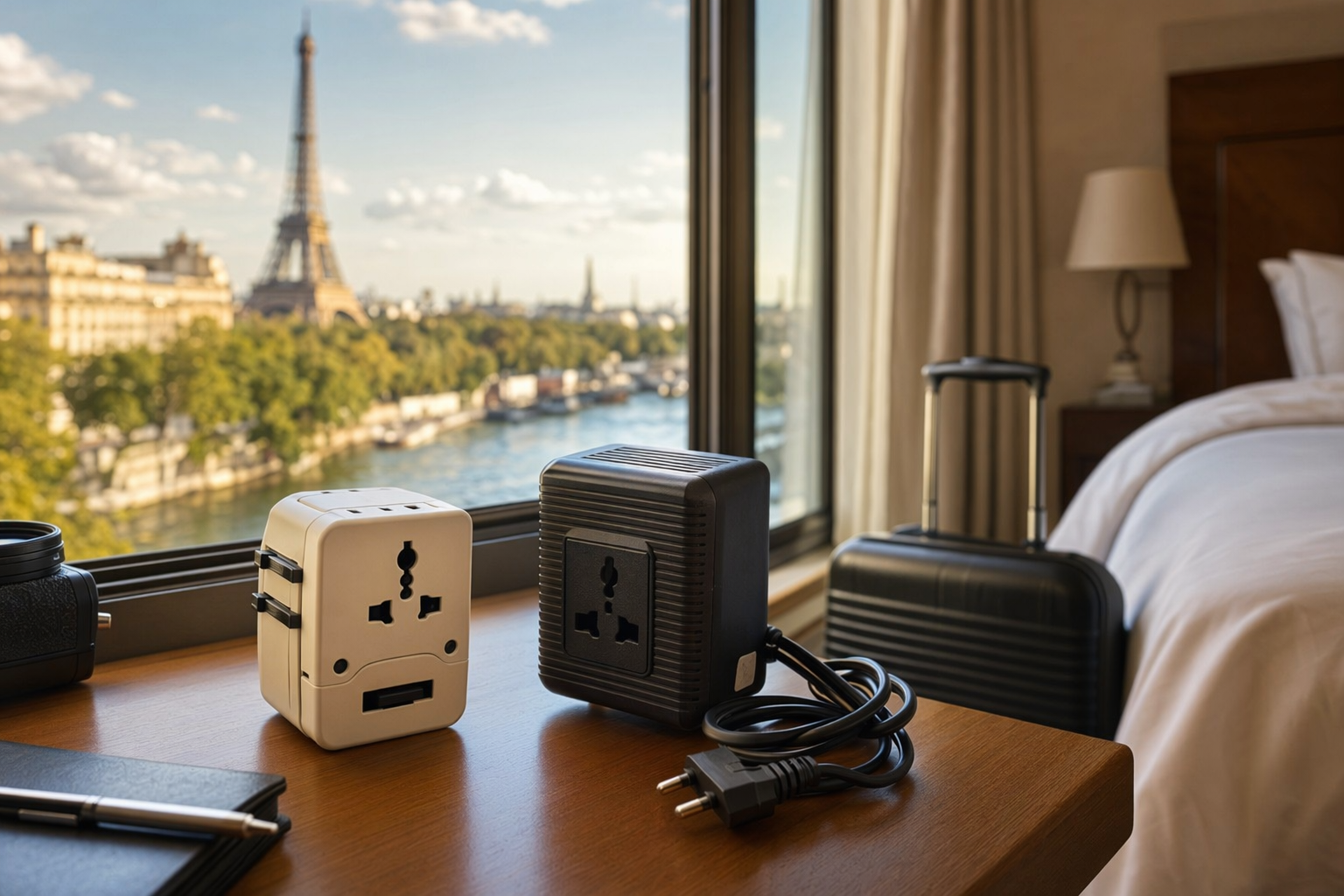
#A travel adapter is basically a plug shape translator. It lets your Indian plug physically fit into a foreign socket. That’s it. It does not make 110V become 230V, it does not protect your device from everything, and it definitely does not perform any magic, even though airport shops charge like it is made of gold.
A voltage converter, on the other hand, changes the voltage. If the wall socket gives 110V and your appliance needs 230V only, then a converter can step it up. If the wall gives 230V and your appliance needs 110V only, then it can step it down. In travel language, people say “converter” for smaller electronic travel devices and “transformer” for heavier loads, but as a normal traveller you mainly need to understand one thing: it must match the wattage of your device. If not, it can overheat, smell burnt, trip the power, or just die quietly. I have seen all versions, and none are cute.
| Item | What it does | When Indian travellers usually need it |
|---|---|---|
| Travel adapter | Changes plug shape only | Almost every international trip, unless your hotel has universal sockets |
| Voltage converter | Changes voltage from 110V to 230V or reverse | Only for single-voltage devices like some hair dryers, trimmers, irons, older gadgets |
| Universal adapter with USB | Fits many socket types, often includes USB-A/USB-C ports | Very useful for phones, power banks, cameras, earbuds |
| Surge protector | Helps with power spikes, not voltage conversion | Nice to have in places with unstable power, but bulky for light travel |
The label trick I wish someone told me before my first long trip
#Before packing anything that plugs into a wall, turn it around and read the tiny print. I know, it’s usually written in ant-size font and you need mobile torch to see it. Look for “Input”. If it says something like 100-240V, 50/60Hz, congratulations, it is dual voltage or worldwide voltage. That means it can work in India, Europe, US, Japan, Singapore, Australia, most places basically. You still need the correct plug adapter, but not a voltage converter.
Most modern phone chargers, laptop chargers, camera battery chargers, Kindle chargers, earbuds, power bank chargers, and USB-C GaN chargers are already 100-240V. My MacBook charger, Samsung fast charger, GoPro battery charger, and even my cheap little toothbrush charger all had it printed. I checked like a paranoid person after that Bangkok socket drama. So for these, adapter is enough. If you are carrying a universal adapter with USB-C Power Delivery, even better, because you can charge directly without carrying five Indian plugs.
Golden rule from my own messy suitcase: if the label says 100-240V, you need only a plug adapter. If it says only 220-240V or only 110V, pause and think before plugging it in.
Where Indians get confused: our 230V life versus 110V countries
#India runs on around 230V and 50Hz. Many countries in Europe, the UK, UAE, Singapore, Malaysia, Thailand, Australia and New Zealand are also roughly in the 220-240V range, though plug shapes differ. So if you are going from India to Dubai, London, Paris, Bali, Singapore or Vietnam, voltage usually isn’t the headache. Plug shape is. Your Indian charger may not fit the wall, but electrically it is usually fine if your device supports 230V.
The bigger confusion starts when we travel to the US, Canada, parts of the Caribbean, Taiwan, Mexico, and Japan. US and Canada are around 120V, Japan is around 100V. If your device is dual voltage, again no issue. If you carry something that only says 220-240V, it may not work properly there. A hair dryer may blow weak air, a kettle may heat painfully slow, and some devices may refuse to start. The reverse is more dangerous: plugging a 110V-only device into 230V can fry it fast. Like fast-fast. One American friend plugged her 110V curling iron in Delhi using only a shape adapter and it made that sad electric smell within seconds. We all know that smell.
My New York trimmer incident, because of course I learnt the hard way
#On one trip to New York, I carried a small beard trimmer from India. Not fancy, just one of those regular rechargeable ones I had bought online. I assumed all chargers are universal now, because phones are, laptops are, life is modern and all that. In the hotel near Queens, I plugged it in with my universal adapter. Light came on, then blinked, then nothing. I thought maybe the socket was loose. Tried another one. Same. Later I checked the charger properly and it was only rated for 220-240V. In the US 120V socket, it wasn’t getting enough power. It didn’t explode or anything, but it refused to charge and I spent the rest of the trip looking slightly more junglee than planned.
Now I do this boring thing before every trip: I put all chargers on the bed, check labels, and keep only the ones that say 100-240V. For grooming stuff, I either carry USB charging versions or buy a small travel-friendly dual-voltage model. Not glamorous advice, I know. But travel is not always beaches and sunsets, sometimes it is standing in hotel bathroom at 7 am whispering bad words at a dead trimmer.
So do you need both adapter and converter?
#For most Indian travellers, you need a travel adapter almost always, and a voltage converter only rarely. If you are carrying only phone, laptop, camera, smartwatch, earbuds, power bank, e-reader and maybe a USB toothbrush, you can usually skip the converter. Buy a good universal travel adapter and one solid USB-C charger. That setup has worked for me in Thailand, UAE, Singapore, Europe and the US, except for that trimmer stupidity which was my fault only.
You may need a converter if you are taking single-voltage appliances. The most common culprits are hair dryers, hair straighteners, curling irons, clothes steamers, electric kettles, old shavers, some baby bottle warmers, and random kitchen gadgets people pack for long stays. Indian families travelling for weddings abroad, students moving into dorms, parents carrying baby gear, and people doing long Airbnb stays should be extra careful. Short vacation travellers can avoid this headache by not carrying high-watt appliances at all.
- If your device says 100-240V: carry only plug adapter.
- If your device says 220-240V only and you are going to the US, Canada or Japan: you may need a step-up converter, or better, don’t carry that device.
- If your device says 110-120V only and you are bringing it to India or Europe: do not plug it with just an adapter.
- If it heats, spins, steams or has a motor: double-check twice. These are the ones that create drama.
Hair dryers and straighteners are the real villains, sorry
#I know many people, especially on family trips and destination weddings, who pack their trusted hair straightener because “hotel one is useless”. Fair. But hair tools are usually high wattage. A small phone charger may be 20W or 30W. A hair dryer can be 1200W to 2000W. A travel converter that says 200W cannot handle that. It will overheat, and you will be left with frizzy hair plus one dead converter. Not a good combo.
My practical Indian jugaad is simple: for trips under two weeks, use the hotel dryer if available, or buy a dual-voltage travel hair tool before leaving India. Many decent hotels, serviced apartments and even good hostels abroad provide hair dryers. Budget stays may not, so check the room amenities before booking. In Europe or Southeast Asia, I’ve seen basic hostels from roughly ₹1,200 to ₹4,000 per dorm bed depending on city and season, budget hotels often around ₹5,000 to ₹12,000 a night in popular areas, and of course prices jump like mad during holidays, events and summer months. The point is, don’t assume every room has every appliance. Message them. Ask: “Do you have hair dryer and universal sockets?” Sounds silly, saves luggage space.
Buying adapters in India versus at the airport
#Please buy your adapter before reaching the airport. I have paid stupid money for one at Delhi airport because I forgot mine at home, and it still hurts little bit. A basic country-specific adapter in Indian markets or online can be quite cheap. A good universal adapter with Type A, C, G, I pins and USB ports costs more, but it lasts across trips. Airport shops, hotel lobbies, and touristy electronics stores sell them too, but you’ll pay convenience tax, basically.
One trend I genuinely like is the new compact universal adapter with USB-C ports and 20W, 30W or higher PD charging. Some even charge laptops if the wattage is enough, though don’t blindly trust marketing stickers. Check the output. I now carry one universal adapter and one separate 65W GaN charger with two USB-C ports and one USB-A port. It handles phone, laptop, power bank and camera batteries. For me, this is lighter than carrying three bulky Indian chargers plus a multi-plug. Also, many hotels have limited sockets placed in the most useless corners, like behind a side table that weighs 40 kg. A longer USB-C cable is underrated, boss.
Country socket cheat-sheet from an Indian traveller’s point of view
#This is not a full engineering chart, but it covers the places Indians commonly visit. UAE, UK, Singapore and Malaysia commonly use Type G, the chunky three-rectangular-pin plug. Europe is mostly Type C or Type F, except the UK and a few differences here and there. Thailand and Vietnam can be mixed, and sometimes the same hotel has different sockets in different corners. Australia and New Zealand use Type I, slanted flat pins. US, Canada and Japan use Type A or Type B flat pins. India mainly uses Type C, D and M, depending on device and building age.
If you’re doing multi-country trips, especially Europe plus UK or Southeast Asia hopping, don’t buy five single adapters unless you enjoy cable chaos. Universal adapter is easier. But if you are going to only one country for a long stay, like a student moving to Germany or Canada, a couple of good country-specific adapters may be more stable and less bulky than one big cube adapter. Universal adapters sometimes feel heavy and hang awkwardly from loose sockets. In old hotels and hostels, they can sag down like tired people in Mumbai local after office hours.
Accommodation, charging points, and the small things nobody puts in Instagram reels
#Hotels have improved a lot. Newer hotels in Dubai, Singapore, Bangkok, London and many European cities often have USB ports near the bed, sometimes even universal sockets. But don’t depend on it. USB ports in rooms can be slow, broken, or placed only on one side of the bed, which starts a whole diplomatic issue if you’re travelling with spouse, sibling or friend. In hostels, one socket per bunk is common in good ones, but older dorms may have two sockets for six people. Then everyone becomes very spiritual and patient.
Airbnbs and serviced apartments are mixed. Some hosts keep adapters because international guests keep asking. Some don’t. Before booking, I quickly scan photos for sockets near bed and desk, especially if I’m working while travelling. If I’m carrying laptop, camera, phone, and power bank, I need a proper charging station at night. Also, if you are going in peak travel months like European summer, Christmas-New Year, cherry blossom season in Japan, or big event weekends, don’t assume shops nearby will have exactly what you need. Buy adapters in advance. It’s not a seasonal travel tip in the usual sense, but trust me, it matters when every pharmacy and electronics shop is closed on Sunday in some European towns.
Transport days are when power planning becomes survival planning
#On sightseeing days, even a half-charged phone is manageable. On transport days, no chance. You need phone for airport boarding pass, cab apps, metro maps, hotel address, translation, Forex card app, UPI won’t work abroad everywhere obviously, but banking OTPs still come, and family WhatsApp messages like “reached?” start arriving every 20 minutes. Airports usually have charging stations, but sometimes all sockets are occupied or dead. Trains in Europe may have sockets, buses may not. Budget airlines don’t care about your battery emotions.
I carry a power bank in cabin baggage, never check-in. Airlines have rules for lithium batteries and power banks, and generally they must go in hand baggage, not checked luggage. Capacity limits can vary by airline, so check before flying, especially if you carry big 20,000 mAh or 27,000 mAh ones. Also pack your adapter in your cabin bag, not deep inside checked suitcase. I made that mistake during a long layover in Doha and had to sit near a charging pole staring at my Indian plug like it betrayed me personally.
Safety stuff: boring but please don’t skip
#Cheap adapters can be risky. I am not saying buy the most expensive influencer-recommended gadget, but avoid no-name plastic things that feel loose, heat up quickly, or have no fuse where required. UK-style plugs and many Type G adapters come with fuses, which is a good safety feature. Don’t overload one adapter with a multi-plug and then attach laptop, iron, hair dryer, two phones and a camera charger. That is not jugaad, that is asking for a small electrical horror movie.
In places with older wiring, budget guesthouses, mountain stays or beach huts, voltage fluctuations can happen. I’ve seen flickering lights in otherwise lovely properties in island areas and hill towns. For expensive camera gear and laptops, a decent branded charger and surge-protected adapter is worth it. If the socket sparks, feels hot, or the plug doesn’t sit properly, use another one. Also, never use travel adapters in bathrooms unless the socket is clearly designed for it. Water and electricity, we learnt this in school only, but travel brain sometimes becomes overconfident.
What I pack now for international trips
#My current charging pouch is not fancy, but it works. One universal adapter. One 65W USB-C charger. Two USB-C cables, one short and one long. One USB-A cable because some old buses and hotel lamps still have USB-A. One small power bank. One camera battery charger if I’m carrying camera. That’s it. No converter, unless I am carrying something special and single-voltage, which I try not to.
- Before packing, I check every device label for 100-240V.
- I avoid carrying Indian kettles, irons, steamers and high-watt hair tools abroad.
- I keep adapter and power bank in cabin bag, not checked luggage.
- For family trips, I carry one extra simple adapter because someone always forgets. Always.
- For long stays, I buy a local extension board after reaching, but only from a proper store.
A quick word for students, remote workers, and family travellers
#If you are moving abroad from India for studies or work, don’t depend only on one universal adapter for months. Carry it for arrival, yes. But once settled, buy proper local plug chargers or extension boards that match the country’s standards. For laptops, your original charger will usually handle worldwide voltage, but check anyway. Students going to Canada, US, UK, Germany, Australia, Ireland, Singapore - all of you, please make a small power plan before landing with two suitcases and one tired parent.
For families, especially with kids, charging needs multiply. Tablet, baby monitor, bottle warmer, electric toothbrush, phones, camera, smartwatch, maybe nebulizer or medical device. For medical equipment, don’t guess. Check the manufacturer label and speak to the provider if needed. Hotels can sometimes arrange adapters, but not always converters. And if you’re carrying something essential, carry backup options. Travel is fun, but kids plus dead device plus jet lag is a proper test of character.
My final answer: adapter yes, converter maybe
#So, travel adapter vs voltage converter: do you need both? My honest answer after enough socket-related embarrassment is this: almost every Indian traveller needs a travel adapter. Very few need a voltage converter. If your gadgets are modern and say 100-240V, relax. Buy a good adapter, maybe with USB-C, and you’re sorted. If you carry hair dryers, straighteners, steamers, old trimmers, kettles or anything single-voltage, then either get the correct converter with enough wattage or, better, leave it at home and use local/hotel options.
The annoying part is, you only think about this when you can’t charge. So check before leaving India, not after landing tired at midnight in a hotel room where the only socket is behind the mini fridge. I’ve done that dance. Not recommended. Anyway, hope this saves you one burnt charger and at least two arguments on your next trip. For more practical, slightly real-world travel notes like this, I keep finding useful reads on AllBlogs.in too, so have a look there when you’re planning your next escape.