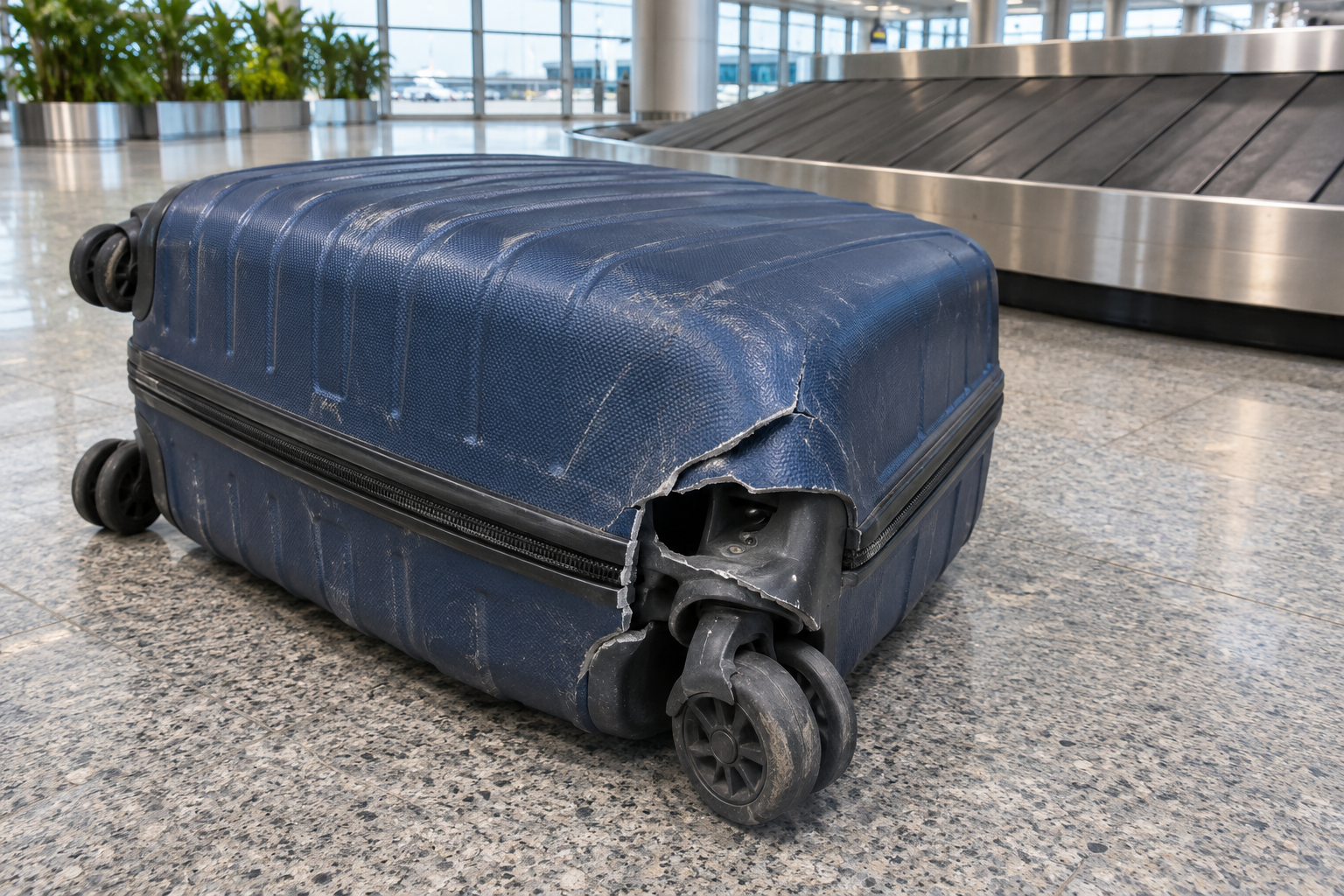
A suitcase with a broken wheel is awkward before you even get to the paperwork. You have to drag it past a line of people standing at the belt. Your ride might already be waiting. If I could make one stop before going outside, it would be the airline’s baggage desk, with the wheel, the case and the baggage tag still together.
Report new checked-suitcase damage to the airline as soon as possible. If you’re at baggage claim, ask the desk to document the damage and give you a reference. Then check how to submit the actual written claim and which deadline applies to your itinerary. I’d keep copies of both. A report number helps you follow up and the written claim tells the airline what you’re asking it to resolve.
What I’d do while I’m still at the airport
#Move the suitcase out of the path of other passengers. Take a photo of the whole bag, then close-ups of the damaged area and a photo showing the baggage tag with the bag. If one side sits lower or the handle slides out of its housing, show that with a photo or a short video if you can do it safely. Keep the tag attached for the inspection.
Ask for the airline’s baggage service desk or the handling agent working for it. I’d explain exactly what happened in one sentence: “I collected this checked bag here after the flight and found the wheel housing split.” Use what you observed. If the desk inspects the bag, ask for a copy of its record or a reference number, and ask where to send supporting documents. If it gives you a link or tells you to use a form, write down the name of the form and ask how soon it’s due.
| What I’d save | What it helps show |
|---|---|
| One full-bag photo plus close-ups | Which piece was damaged and what state the bag was in |
| Baggage tag and flight details | Which checked bag traveled on the itinerary |
| Desk report or reference | When and where you reported it |
| Purchase record or repair estimate if available | What it could reasonably cost to address the damage |
| Written claim, attachments and submission confirmation | What you sent and when |
If the desk is closed, take your photos, keep the tags and use the airline’s designated baggage channel as soon as you can. Save the confirmation or a copy. If you’ve got a connection, make sure you know which counter or online channel handles the specific itinerary. Keep boarding passes and bag records for every leg.
Write the follow-up before the deadline
#I’d send a short factual note while details are fresh. Include the baggage report reference, itinerary, bag tag number, description of the damage and photos. Explain how it affects the bag. A handle that won’t retract, a wheel that broke free and a crack that prevents the case from closing tell the claim handler more than “the bag looks terrible.” Include a purchase record or a repair estimate if you have one, and ask what else the carrier needs.
The deadline depends on your itinerary and the applicable rules. For an international itinerary governed by the Montreal Convention, Article 31 calls for a written complaint about damage to checked baggage promptly after discovery and within seven days of receipt. That specific rule should not be used as a deadline for every trip. Check the carrier process and any rules for your route. I’d submit promptly even if I had to send an estimate later with the same claim number.
Make sure you save the actual confirmation. If the site only shows you a status page after submitting, keep a screenshot for your records. If you transmit anything that contains your contact details or travel documents, use the carrier’s stated claim channel. I’d keep one folder for the photos and report, so a second person reviewing the claim gets the same set of materials.
If it’s a scuff, a broken wheel or damage inside
#Under U.S. Department of Transportation guidance, airlines are generally responsible for repairing or reimbursing damage to baggage or contents while the bag was in their control, subject to applicable limits and exclusions. Ordinary wear and tear differs from a newly damaged component. U.S. DOT says an airline cannot categorically exclude damage to checked-bag wheels, handles, straps or similar components just because of the part involved. Whether a specific claim qualifies still depends on the condition and circumstances.
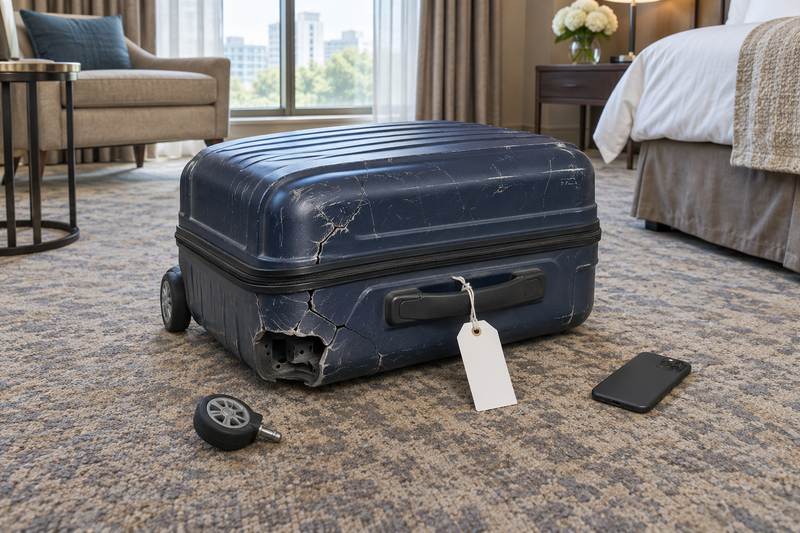
If you find damage inside the bag after reaching your hotel, photograph the suitcase and the contents as you found them. Keep the parts and packaging. Tell the airline when you first noticed it and send the report promptly. Coverage can differ for domestic and international trips, and packing and contract terms can matter. I’d describe any pre-existing marks accurately so the reader of the claim can focus on the new damage.
Put the report and the claim in the same folder
#Imagine the agent at the airport gives you a reference and asks you to file online. Make a note of the reference and the time you spoke. Open the airline’s form while you still have your boarding pass and the bag tag handy. If the airline asks you to identify the damaged part, “left rear wheel assembly split where it meets the shell” gives it a starting point. A close-up should show the break. A photo taken a few steps back helps connect that picture to your suitcase.
For a simple wheel claim, I’d write something like this.
I collected my checked suitcase from flight [number] at [airport] on [date]. The left rear wheel housing was split when I lifted the bag off the belt, and the suitcase would not roll properly. I reported it at the baggage desk under [reference]. The bag tag number is [number]. I have attached photos. Please tell me whether you need to inspect it and how you handle repair.
Replace the description with what happened to your bag. Skip guesses about which airport handled it badly or which cart dropped it. If you noticed it at the hotel, say when you first saw it. Keep the initial note short enough to read on a phone and make each attachment easy to identify from the description.
Name the attachments so you can find them again. A folder with a full-bag photo, a close-up and the airline’s confirmation will make the next exchange easier. Put the date you sent the written complaint next to the date you received the bag. If the Montreal Convention applies, count its seven-day baggage damage window from the day you received the bag.
Before paying for a repair or buying another bag
#Ask if the airline wants an inspection or uses its own repair service. Keep the bag and anything that broke off until the claim handler tells you what to do next. If you need to buy or repair something urgently to keep traveling, ask the airline what it wants you to document, and save any receipt. Ask whether the carrier requires authorization for that expense.
If a claim stalls, I’d reply through the same channel using the original reference and the date I submitted it. If the carrier declines it, ask for the reason in writing. With the reason, records and dates together, you can check the appropriate consumer complaint or insurance process for the trip. At the belt, the only part you need to solve immediately is the one in front of you. Get the damage on record while you still have the bag and the tag.