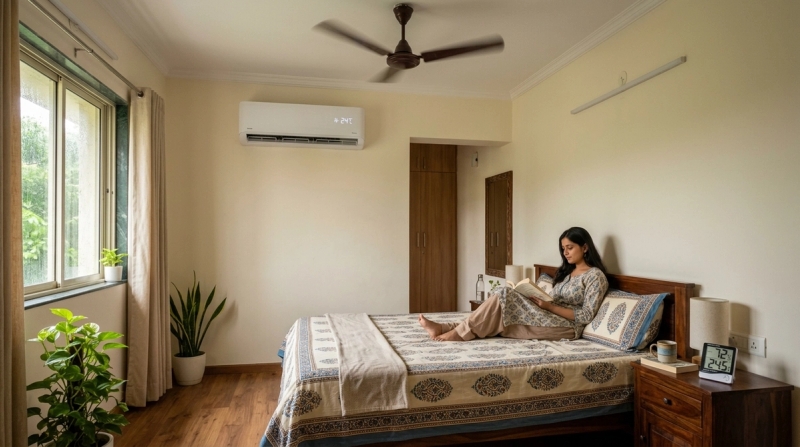
For most Indian homes, 24°C is the most practical AC temperature setting. It is comfortable for everyday use, easier on electricity bills, and also matches the energy-saving guidance promoted by BEE/PIB in India.
But anyone who has lived in an Indian apartment knows this: comfort is not just about the number on the AC remote.
A room can be at 24°C and still feel sticky. Another room can feel perfectly fine at 26°C if the air is moving and the humidity is under control.
So instead of only asking, “What temperature should I set my AC to?”, think about three things together:
- Temperature
- Air movement
- Room humidity
A simple starting point is this:
Set the AC to 24°C, use a ceiling fan on low or medium speed, and switch to AC dry mode when the room feels sticky or damp.
Try to keep room humidity below 60%. If possible, aim for around 30% to 50% for better comfort.
This guide explains how to use Cool mode, Dry mode, and AC fan mode properly, when to use a ceiling fan with your AC, and when a dehumidifier may be more useful than simply lowering the temperature.
Why 24°C Is a Good AC Temperature Setting
#In India, the Bureau of Energy Efficiency, or BEE, has promoted 24°C as the default and optimum AC setting for comfort and energy saving.
That does not mean 24°C will feel perfect in every room, every day.
A top-floor bedroom in May, a west-facing living room, a humid Mumbai flat, or a small rented room with poor ventilation can all feel different. Still, for most homes, 24°C is the best place to start.
Many people set the AC to 18°C as soon as they enter a hot room. It feels like the obvious thing to do. The room is hot, so the lowest number should cool it faster, right?
Not really.
The AC temperature setting is only the target temperature. If you set it to 18°C, the AC does not suddenly throw colder air in a magical way. It simply keeps working for longer until the room reaches that lower temperature.
That means:
- More compressor running time
- Higher electricity use
- A room that may become too cold later
- More chance of discomfort during sleep
A better routine is:
- Set the AC to 24°C.
- Close the doors and windows.
- Switch on the ceiling fan at low or medium speed.
- Give the room some time to cool.
- Reduce the temperature by 1°C only if you still feel uncomfortable.
Even a small increase in AC temperature can reduce electricity use. BEE has often mentioned that increasing the AC setting by 1°C can save around 6% electricity. So moving from 18°C or 20°C to 24°C can make a noticeable difference over a full summer.
The 18°C Myth: Lower Does Not Mean Faster Cooling
#Setting the AC to 16°C or 18°C is one of the most common habits in Indian homes.
The logic is understandable: if the room is very hot, a very low setting should cool it quickly.
But an AC does not work like a fan regulator or a water tap. You cannot “open it more” by choosing 18°C.
In simple terms, your AC cools the room until it reaches the temperature you selected. If you choose 18°C, the machine has to work much longer than it would at 24°C.
This is especially common at night.
At 11 pm, after a hot day, 18°C may feel wonderful. But by 3 am, the same room can feel freezing. Then you wake up, switch off the AC, feel hot again after some time, and the cycle continues.
For daily use, avoid making 18°C your default setting.
Start with 24°C. If the room is still uncomfortable after 20 to 30 minutes, reduce it gradually.
Best AC Temperature for Sleep
#The best AC temperature for sleep in many Indian homes is usually between 24°C and 26°C.
The right number depends on:
- Your bedding
- Room size
- Humidity
- Whether the room gets afternoon sun
- How many people are sleeping in the room
- Personal comfort
If your AC has Sleep mode, use it. Sleep mode usually adjusts cooling slowly through the night so the room does not become colder than needed.
A practical night setting:
- Start at 24°C or 25°C
- Use Sleep mode if available
- Keep the ceiling fan on low speed if the air feels still
- Avoid very low settings unless truly needed
- If the room feels sticky, check humidity instead of lowering the temperature again and again
For children, older adults, or anyone who catches a cold easily, gentle cooling at a slightly higher temperature is usually better than aggressive cooling at 18°C or 20°C.
Use a Ceiling Fan With AC, But Keep It Gentle
#A ceiling fan and AC combo works very well in Indian apartments.
The fan helps circulate cool air around the room. Without it, one part of the room may feel cold while another corner still feels warm.
A fan also creates a light breeze on your skin, which makes the room feel cooler than it actually is. Because of this, many people feel comfortable at 24°C instead of lowering the AC to 21°C or 22°C.
Best way to use a ceiling fan with AC:
- Keep the fan on low or medium speed
- Avoid very high speed unless needed
- Keep doors and windows closed while cooling
- Switch off the fan when nobody is in the room
Remember: fans cool people, not rooms.
So if no one is sitting or sleeping there, keeping the fan on does not really help.
This is one of the easiest ways to save electricity without feeling uncomfortable.
AC Modes Explained: Cool Mode, Dry Mode, and Fan Mode
#Most AC remotes have several modes, but many of us only use Cool mode.
That is fine during peak summer, but Cool mode is not always the best choice. Sometimes the room is not very hot. It is just humid, sticky, or poorly ventilated.
Here is how to choose the right AC mode.
1. Cool Mode: Best for Proper Hot Days
#Use Cool mode when the room is genuinely hot and you want the AC to bring down the temperature.
This is the main mode for Indian summers, especially in April, May, and June, or whenever outdoor temperature is high.
Use Cool mode when:
- The room feels hot even with the fan on
- Afternoon heat is trapped inside
- You need actual temperature reduction
- The air does not feel especially damp or sticky
A good setup is:
Cool mode at 24°C + ceiling fan on low or medium speed.
Give the room some time. If you keep changing the temperature every few minutes, the AC cannot work efficiently.
If the room feels more sticky than hot, try Dry mode instead.
2. AC Dry Mode: Best for Sticky and Humid Weather
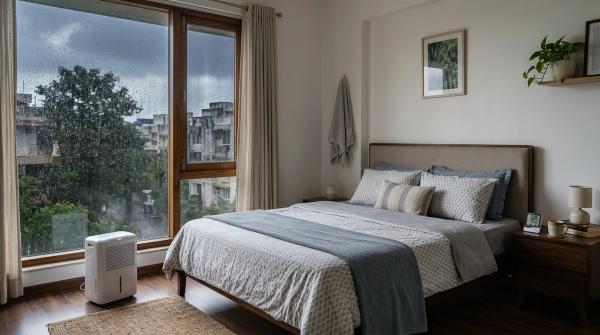
#AC dry mode is useful during monsoon, coastal weather, or humid days when the room feels damp even though it is not extremely hot.
In Dry mode, the AC focuses more on removing moisture from the air. The fan usually runs slower, and the compressor may run differently compared with regular Cool mode.
The room may not become much colder, but it can feel more comfortable because the humidity drops.
Use AC dry mode when:
- The room feels sticky
- Bedsheets or clothes feel slightly damp
- The weather is humid but not very hot
- You do not want strong cooling
- The air feels heavy even though the temperature seems okay
Dry mode can sometimes use less electricity than full Cool mode, depending on the AC model, room condition, and humidity level.
But Dry mode is not a magic fix for serious dampness.
If walls remain wet, paint is peeling, cupboards smell musty, or mould keeps coming back, you may need to check for:
- Water seepage
- Poor ventilation
- Plumbing leaks
- Damp exterior walls
- Closed wardrobes with trapped moisture
In such cases, a dehumidifier may help, but the actual moisture source still needs to be fixed.
3. AC Fan Mode: Best for Air Movement Only
#AC fan mode does not cool the room like Cool mode.
In Fan mode, the compressor stays off. Only the indoor blower runs. It simply circulates the air already inside the room.
Use AC fan mode when:
- The weather is mild
- You want airflow, not cooling
- The room has already been cooled
- You do not want the compressor running
- You just need some air movement
AC fan mode can be useful early in the morning, late in the evening, or during pleasant weather.
But if the room is hot and closed, Fan mode will not reduce the temperature. It will only move warm air around.
In many cases, a regular ceiling fan may do the same job more efficiently.
Room Humidity: The Comfort Factor Most People Ignore
#Temperature is only half the story. Room humidity matters just as much.
When humidity is high, sweat does not evaporate easily from your skin. That is why you feel sticky, sweaty, and uncomfortable even when the AC is running.
This is also why a room at 27°C can feel unbearable in humid weather, while the same 27°C can feel fine in a drier room.
General EPA and CDC humidity guidance suggests keeping indoor relative humidity below 60%, with an ideal range around 30% to 50% where possible.
For Indian apartments, a simple rule is:
- Below 60% RH is a good upper limit
- 30% to 50% RH is usually comfortable
- High humidity makes rooms feel sticky and heavy
- Damp rooms can develop musty smells and mould-friendly conditions
A small digital hygrometer can help. It is inexpensive and shows your room humidity clearly.
If your room often feels sticky even at 24°C, a hygrometer can tell you whether the problem is temperature or humidity.
Signs Your Room Humidity Is Too High
#You do not always need a device to know the room is too humid.
Watch for these signs:
- The room feels sticky even with the AC on
- Windows show condensation from inside
- There is a musty smell
- Bedsheets or clothes feel slightly damp
- Paint starts peeling in corners
- Wardrobes smell closed and damp
- Walls feel cool and moist when touched
- Mould spots appear near corners or behind furniture
If these signs keep coming back, do not just keep lowering the AC temperature.
Check humidity, ventilation, and possible water seepage.
Dehumidifier vs AC: Which One Do You Need?
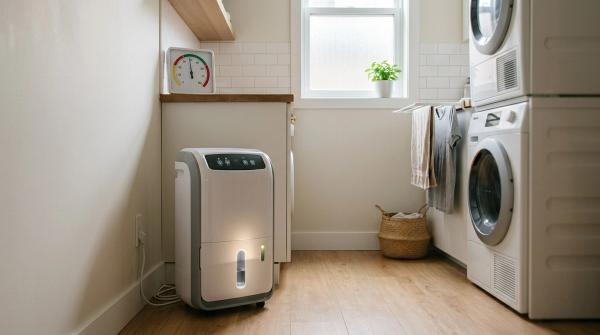
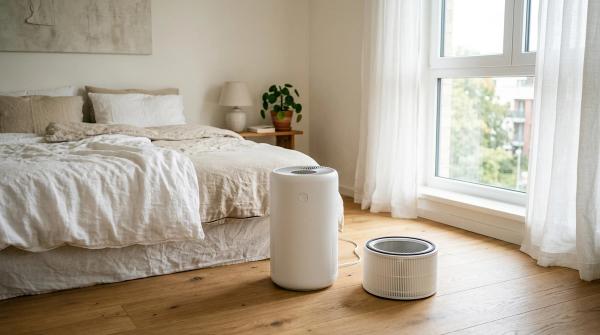
#An AC removes some moisture while cooling. Cool mode and Dry mode both help with humidity to some extent.
For many Indian flats, that is enough.
But sometimes heat is not the main problem. Moisture is.
That is when the dehumidifier vs AC question becomes important.
Dehumidifier vs AC Comparison
#Simple Verdict
#Start with AC dry mode if the room feels sticky during humid weather. Since it is already built into most ACs, it is the easiest first step.
Consider a dedicated dehumidifier if:
- The room stays damp even after using Dry mode
- Wardrobes smell musty
- Closed rooms feel damp
- You do not need cooling, only moisture removal
- Dampness is frequent, not occasional
But if there is visible leakage, wall seepage, or plumbing-related dampness, neither an AC nor a dehumidifier will solve the real problem. The moisture source has to be repaired.
Best AC Setting by Situation
#| Situation | Suggested Setting | Fan Use | Humidity Check |
|---|---|---|
| Hot summer afternoon | Cool mode at 24°C | Ceiling fan on low or medium | Check if the room still feels sticky |
| Humid monsoon evening | AC dry mode | Fan low, if needed | Keep RH below 60% |
| Mild weather | AC fan mode or regular fan | Fan only may be enough | Usually not needed unless the room feels damp |
| Sleeping at night | 24°C to 26°C, Sleep mode if available | Low fan speed | Check if the room feels damp or too cold |
| Damp room without much heat | Dry mode first, dehumidifier if it continues | Gentle airflow | Use a hygrometer if possible |
| Room cooled but air feels still | AC fan mode or ceiling fan | Yes | Not always needed |
How to Save Electricity Without Feeling Sweaty
#Saving electricity does not mean sitting in discomfort. It simply means using the AC smarter.
Here is a practical routine.
1. Start at 24°C
#Make 24°C your default AC temperature setting.
Do not jump straight to 18°C every time. Start at 24°C, wait, and adjust only if needed.
2. Use the ceiling fan
#A low-speed fan helps distribute cool air and makes the room feel more comfortable.
This often lets you stay comfortable at a higher AC temperature.
3. Use Dry mode in humid weather
#If the room feels sticky, lowering the temperature may not help much.
Try AC dry mode instead.
4. Keep doors and windows closed
#Small gaps allow warm, humid air to enter.
This makes the AC work harder and can keep the room feeling damp.
5. Clean AC filters regularly
#Dusty filters reduce airflow.
When airflow is poor, the AC may feel weak even if the machine itself is working fine.
6. Block afternoon heat
#Use curtains or blinds, especially in west-facing rooms and top-floor flats.
Stopping direct sunlight from entering the room can reduce the cooling load significantly.
7. Avoid overcooling at night
#Use Sleep mode or increase the temperature slightly before sleeping.
Overcooling wastes electricity and may make the room feel uncomfortable later in the night.
Apartment Cooling Checklist
#Before blaming the AC, quickly check these basics:
- Set the AC to 24°C first.
- Use a ceiling fan on low or medium speed.
- Close windows and doors while cooling.
- Switch to AC dry mode if the room feels sticky.
- Keep room humidity below 60%, ideally around 30% to 50%.
- Clean AC filters regularly.
- Use curtains or blinds during strong afternoon sun.
- Check gaps around windows and doors.
- Avoid very low settings like 18°C as a daily habit.
- Use Sleep mode at night if your AC has it.
- Consider a dehumidifier only if dampness keeps coming back.
Common AC Mistakes to Avoid
#Setting 18°C every time
#This usually makes the compressor run longer and increases electricity use. It does not guarantee faster comfort.
Ignoring humidity
#If the room feels sticky, the problem may not be temperature. Dry mode may work better than lowering the AC setting.
Running the fan too fast
#A gentle fan helps. A very high fan speed can feel uncomfortable, especially while sleeping.
Using Dry mode for extreme heat
#Dry mode is useful for humidity, not peak summer heat. On very hot days, Cool mode is the better choice.
Forgetting to clean filters
#Poor airflow can make an AC feel weak. Sometimes the issue is not the temperature setting at all. It is simply a dirty filter.
Final Takeaway
#For most Indian apartments, start with a simple formula:
AC at 24°C + ceiling fan on low or medium + Dry mode when the room feels sticky.
Keep indoor humidity below 60%, and ideally around 30% to 50%.
This setup works well for everyday comfort, helps control electricity use, and prevents you from overcooling the room when the real problem is humidity.