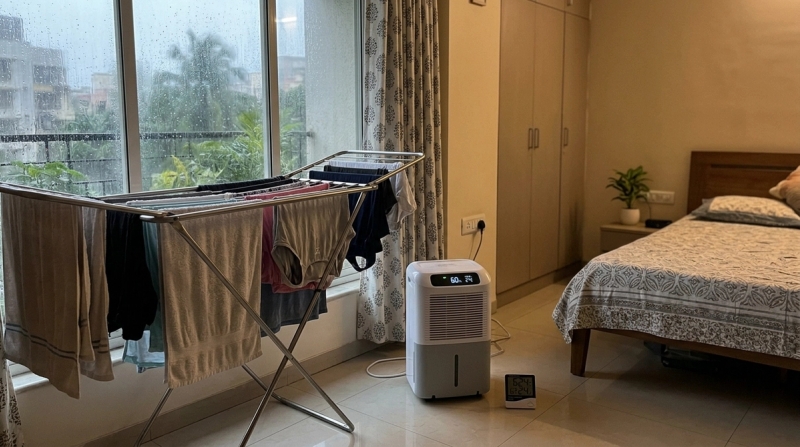
How to calculate dehumidifier electricity cost
#Electricity bills in India are charged in kWh, commonly called units. The calculation is simple:
Watts ÷ 1000 × hours used × electricity rate = running cost
If your dehumidifier is rated at 300 watts:
- 300 ÷ 1000 = 0.3 kW
- 0.3 × 6 hours = 1.8 units
- 1.8 × ₹8 = ₹14.40 per day
- ₹14.40 × 30 = ₹432 per month
Use ₹8 only as an example. Your actual per-unit rate depends on your city, state, DISCOM, tariff slab and monthly usage. Check your latest electricity bill before estimating monthly cost.
Monsoon examples for Indian homes
#Small bedroom in a rented flat
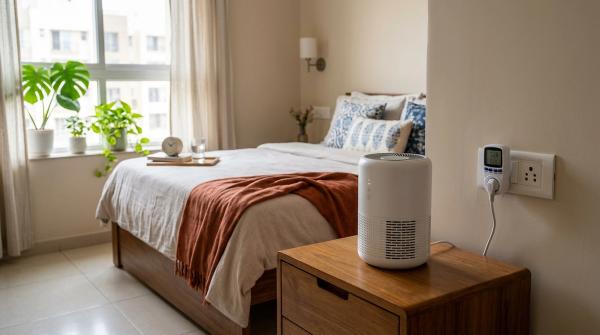
#A 250W unit used for 5 hours costs:
250 ÷ 1000 × 5 × ₹8 = ₹10 per day
That is about ₹300 for 30 days. This can be enough if your bedsheets feel damp, your wardrobe smells musty or the bedroom stays sticky during rainy weeks.
Indoor laundry during monsoon
#A 320W dehumidifier used for 8 hours in a closed laundry room costs:
320 ÷ 1000 × 8 × ₹8 = ₹20.48 per day
That is about ₹614 for 30 days. You may not need this every day, but it can help during long rainy spells when clothes dry indoors and start smelling damp.
Damp living room in a coastal apartment
#A 500W dehumidifier used for 6 hours costs:
500 ÷ 1000 × 6 × ₹8 = ₹24 per day
That is about ₹720 for 30 days. A bigger unit may make sense for large rooms, open spaces, ground-floor flats or very damp coastal homes. But bigger machines usually use more power, so the unit should match the room.
How many watts does a dehumidifier use?
#Dehumidifier wattage depends on type and capacity. Capacity is usually shown as litres per day, which means how much water the machine can remove in 24 hours under test conditions. You may see models listed as 10L/day, 12L/day, 20L/day, 22L/day, 30L/day or higher.
A higher litre rating usually means more moisture removal, but it can also mean higher electricity use. ENERGY STAR and US Department of Energy guidance use efficiency measures such as Integrated Energy Factor, or IEF, which describes how many litres of water a dehumidifier removes per kWh. For buyers, the practical point is simple: do not look only at litres per day. Also check wattage.
Compact vs 20L/day vs larger dehumidifiers
#Mini dehumidifiers use little electricity, but they also remove very little water. They may help inside a cupboard or small storage corner, but they are often underpowered for a proper bedroom during Indian monsoon.
For many homes, a 10L to 22L compressor dehumidifier is more practical. Large units are useful only when the space truly needs them.
When is it worth running daily?
#Daily monsoon use may be worth it if:
- the room feels sticky even with a fan
- clothes take too long to dry indoors
- dried clothes still smell damp
- wardrobes, shoes, bags or books smell musty
- bathrooms stay wet for hours
- bathroom moisture spreads into nearby rooms
- windows or walls often show condensation
- you live in a coastal or high-humidity area
It may not be necessary if:
- your home dries well with normal ventilation
- dampness happens only occasionally
- the real problem is a plumbing leak
- there is active seepage from walls or ceilings
- you only need moisture control inside one cupboard
A dehumidifier can control moisture in the air, but it cannot repair leaks, seepage or structural dampness. The EPA recommends keeping indoor relative humidity below 60%, ideally between 30% and 50% where possible. During Indian monsoon, keeping every room in the ideal range all day may be unrealistic, but keeping key rooms below 60% can improve comfort.
How to reduce electricity waste
#Close the room while using it
#A dehumidifier works best in a closed space. If windows and doors are open during rain, humid outdoor air keeps entering and the machine has to work longer.
Use the humidity setting
#If your model has a humidistat, set a target humidity. For many Indian homes, 50% to 55% RH is a practical monsoon target. Once the room reaches the target, the compressor can cycle off instead of running continuously.
Use it where moisture actually is
#Do not expect one unit in one corner to dry the whole flat. If wardrobes smell damp, run it in that bedroom and open cupboard doors for a while. If laundry is the problem, place it near the drying rack in a closed room.
Start with limited runtime
#Try 3 to 6 hours first. If humidity rises quickly again, increase runtime or use it at specific times: after bathing, during indoor drying, in the evening or overnight in the dampest room.
Clean the filter
#A dirty filter blocks airflow and reduces performance. During daily monsoon use, check the washable pre-filter regularly and clean it as the manual says.
Quick monthly cost estimates
#These examples use ₹8 per unit only for easy calculation.
Your actual cost changes with tariff, runtime, room size, humidity, compressor cycling, efficiency and how often doors or windows are opened.
Checklist before buying or running daily
#- Find the actual problem: humidity, indoor laundry, wardrobe smell, bathroom moisture, seepage or leakage.
- Check room size before choosing capacity.
- Check wattage, not only litres per day.
- Use the cost formula before buying.
- Read your electricity bill for your real per-unit rate.
- Prefer auto humidity control if you plan frequent use.
- Close the room while running the machine.
- Avoid oversizing blindly.
- Clean the filter as per the manual.
- Empty the tank on time or set up drainage safely.
- Do not ignore leakage, seepage or serious mold.
Safety notes for damp homes
#A dehumidifier is helpful, but it is not a repair tool. If you see active leakage, swollen walls, peeling paint, black mold patches, repeated water damage or water near electrical points, do not simply keep running the dehumidifier. Contact a qualified plumber, electrician, waterproofing expert, building maintenance team or mold professional as appropriate.
Place the dehumidifier where it cannot get splashed, tipped over or blocked by clothes. Keep the air intake and outlet clear.
Source-aware notes
#This guide uses general moisture-control guidance from the EPA for indoor relative humidity and dehumidifier efficiency concepts from ENERGY STAR/US DOE references. Indian electricity cost examples are illustrative; readers should use their own electricity bill because tariffs vary by DISCOM and slab.
Final takeaway
#The dehumidifier electricity cost in India is easy to estimate once you know wattage, daily usage hours and your electricity rate. A 300W unit used for 6 hours at ₹8 per unit costs about ₹14.40 per day, or ₹432 per month. The smart monsoon approach is to match the dehumidifier to the room, close the space while using it, use humidity settings when available and fix leaks or seepage instead of relying on a machine to hide the problem.