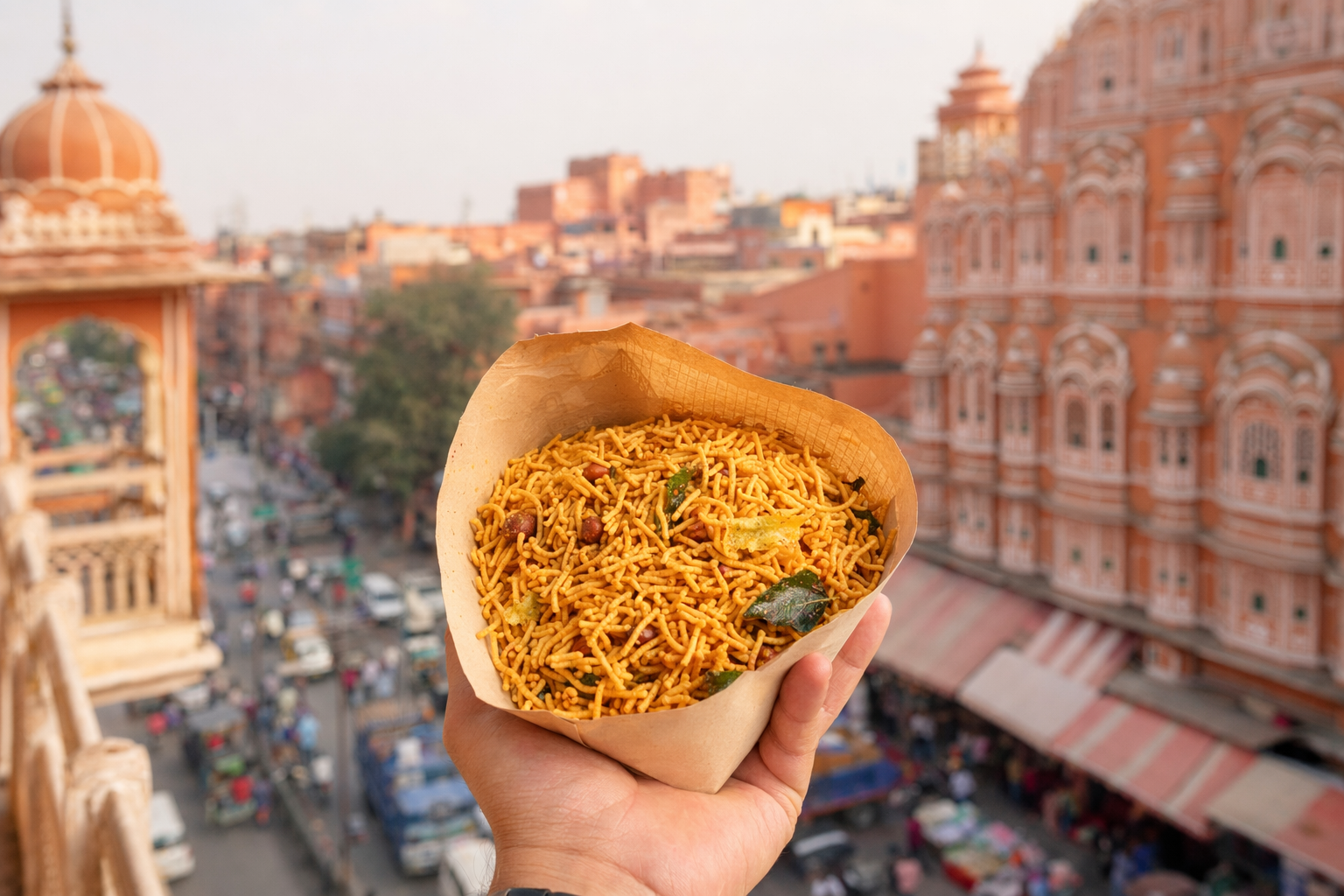
That crunchy little packet I now refuse to travel without
#I didn’t plan to become the person who packs Bikaneri bhujia with the seriousness of someone carrying medicines, passport photocopies, and emergency cash. But here we are. My backpack has a snack pocket now. A proper one. And if I’m leaving home for more than, like, six hours, there’s usually a packet of bhujia sitting in there, quietly doing God’s work.
My first real bhujia travel moment happened on an overnight train from Bikaner to Delhi, years ago, when I was still the kind of traveler who thought one packet of glucose biscuits was “enough planning.” Big mistake. Somewhere after midnight, the pantry guy disappeared, everyone in my berth had gone weirdly silent, and my stomach started making those dramatic whale noises. A Marwari uncle across from me opened a newspaper parcel, smiled like he had been waiting for this exact scene, and handed me a fistful of spicy, thin, golden bhujia. I ate it with cold roti, then with a banana, then straight from my palm. Not elegant. Very effective.
Since then, Bikaneri bhujia has become my most trusted travel snack. It is light, doesn’t need a spoon, doesn’t cry if your train is late, and it can rescue the most boring airport sandwich. But packing it well? That’s where people mess up. I’ve messed it up too. Crushed bhujia dust in a suitcase is not romance, friends. It smells amazing for five minutes and then you realise your socks are now masala-flavoured.
Why Bikaneri bhujia is such a brilliant travel snack, honestly
#Let’s get one thing clear: Bikaneri bhujia is not just “sev.” I mean, yes, it sits in that family of crunchy fried namkeen, but proper Bikaneri bhujia has its own personality. It’s usually made with moth dal flour along with gram flour and spices, and that moth dal gives it a deeper, slightly earthy bite. The strands are thin, crisp, and spicy in a way that wakes you up without slapping you in the face. Unless you buy the extra teekha one and then, well, you did that to yourself.
Bikaner, in Rajasthan, knows dry snacks like coastal towns know fish. The region is hot, dry, and historically full of traders, desert routes, long journeys, and households that understood shelf-stable food before “meal prep” became a fancy Instagram phrase. Bhujia fits that landscape. It travels. It stores. It doesn’t need refrigeration. It’s the kind of food that makes sense when you understand the place it came from.
And yes, Bikaneri Bhujia has Geographical Indication recognition in India, which basically means the name is tied to the region and its traditional identity. I’m not saying every packet with a camel drawing is automatically magical, but the GI status does tell you this isn’t some random snack trend invented last Tuesday. It has a place, a history, and a whole economy of people behind it. You feel that when you walk through Bikaner’s old markets, especially around Kote Gate, where namkeen shops seem to breathe spice into the air.
The best travel snacks are not the fanciest ones. They’re the snacks that survive heat, boredom, delays, bad tea, and your own terrible planning.
My Bikaner memory: dust, chai, namkeen shops, and too many packets
#Bikaner is not a city that tries too hard for tourists, at least that’s how it felt to me. Jaipur has its polished pink drama, Jodhpur has the blue-city postcard thing, Udaipur has lakes and honeymoon couples taking photos every 8 seconds. Bikaner feels drier, sharper, a bit more practical. The sun is strong, the streets are busy, the snacks are serious.
I spent one afternoon doing what I call “research” but was actually just wandering from namkeen shop to namkeen shop, pretending I could tell the difference between seven kinds of bhujia after my tongue had already given up. Some shops had big steel containers filled with mixtures, sev, papdi, and bhujia. Some had sealed branded packets stacked up like edible architecture. The air had that fried besan smell, warm and nutty, mixed with asafoetida, chilli, and old market dust. It sounds bad when I write it like that, but it was beautiful. Really.
A shopkeeper gave me a small sample and watched my face carefully. This happens a lot in India, no? The vendor’s eyes are basically asking, “Do you understand what I just gave you?” I nodded too quickly, coughed once because the spice hit late, and bought two packets. Then I bought three more from another place because obviously I needed comparison data. By evening my bag was full of namkeen and I had no space for the scarf I’d actually gone to buy.
One thing I learned that day: fresh bhujia from a good Bikaner shop tastes brighter than the supermarket packet. Not always, and not in some snobby way. But when it’s newly fried and properly cooled before packing, the crunch has this clean snap. The spice feels alive. Packaged bhujia is still wonderful and more practical for travel, but if you’re in Bikaner itself, eat some loose fresh bhujia on the same day. Sit with chai. Don’t rush it.
The packing problem: bhujia is strong, but it is not invincible
#People assume dry snacks can survive anything. They can’t. Bhujia hates three main things: moisture, pressure, and bad storage smells. Moisture makes it limp and sad. Pressure turns it into spicy sand. Strong smells, like perfume or pickles leaking in your bag, can creep into it if it’s not sealed well. I once packed bhujia next to a small bottle of hair oil that leaked just a little. Not enough to ruin the bag, but enough that the bhujia tasted faintly coconutty and tragic.
The big trick is deciding what kind of journey you’re packing for. A two-hour bus ride is not the same as a 14-hour train journey. A domestic flight is not the same as landing in another country where customs rules may be strict about food. A winter road trip is not a monsoon trek where everything inside your bag sweats. Same snack, different strategy.
If you’re comparing dry Indian snacks for flights, makhana is another one that behaves well, especially if it’s sealed and not oily. I wrote separately about that whole carry situation in Can You Carry Makhana on International Flights from India?, and honestly a lot of the same common-sense stuff applies here: sealed packs, clear labels, and don’t act surprised if security or customs asks what you’re carrying.
My basic packing rule: sealed for flights, decanted for trains, tiny boxes for road trips
#For flights, I prefer factory-sealed packets. Not because loose bhujia is illegal or anything everywhere, but because sealed packaging is easier to explain, easier to inspect, and less likely to spill. It has ingredient info, brand name, manufacturing details, and looks like what it is. A snack. Not a mysterious powdery substance wrapped in newspaper, which, um, is not the vibe you want at airport security.
For trains, I’m more relaxed. I’ll open a packet and transfer some into a small airtight dabba or zip pouch, because eating from a large family pack in a train berth is how you accidentally feed the entire coach floor. A small container is easier to pass around too. And trains are social. Someone will offer thepla, someone will have oranges, someone will ask where you bought the bhujia. Suddenly your snack is a conversation.
For road trips, small boxes win. Always. Keep one near the front seat and another in the main bag if you’re travelling with snack monsters, also known as friends. If you keep one large pack open, it gets stale faster because everyone keeps opening it every 12 minutes. I do this thing where I divide bhujia into mini portions before leaving. It feels fussy at home, but later, when you’re on a highway between Jaipur and Ajmer and the dhaba is still 40 km away, you will bless your past self.
| Journey type | Best packing style | My little warning |
|---|---|---|
| Domestic flight | Unopened sealed packet in cabin or check-in bag | Avoid giant loose bags because spills are annoying and oily crumbs travel everywhere |
| International flight | Factory-sealed, labeled packet, and check destination food rules | Some countries are strict with food items, so declare if required and don’t argue |
| Train journey | Airtight small box plus backup sealed packet | Keep it away from wet food like curd rice, chutney, cut fruit |
| Road trip | Portion into 2-3 small containers | Don’t leave it in direct sun on the dashboard, it tastes tired later |
| Hotel snacking | Clip the packet tightly or use a zip pouch | Hotel rooms can be humid, especially near the coast or in monsoon |
How much bhujia should you pack? More than you think, less than your emotions say
#This is where I become slightly unreasonable. I always think, “Let’s take one extra packet.” Then another. Then I remember I am not relocating to Mars. Bhujia is available in many places now, especially in Indian grocery stores, but travel hunger is different. You don’t want to be stuck with only overpriced chips when you could have had spicy comfort from home.
My rough formula is: one small 150-200 gram packet for two people for a day of travel, if bhujia is just one snack among others. If you’re planning to use it as a topping for poha, upma, sandwiches, curd rice, or hotel-room jugaad meals, carry more. If you’re with kids, carry less spicy options too, unless your children are braver than me, which is possible.
For a long weekend trip, I’d pack two medium packets: one plain-ish classic bhujia and one mixture or spicy version. For a week-long trip where I know food might be unpredictable, maybe three. But don’t carry a kilo unless you’re visiting family abroad and they specifically requested it. Otherwise you’ll spend the whole trip protecting bhujia like it’s jewellery.
- For solo travel, one small sealed pack and one tiny day pouch is enough most times.
- For train journeys with friends, carry a medium pack because sharing will happen even if you pretend it won’t.
- For international trips, smaller sealed packs are better than one huge packet, because you can open one at a time and keep the rest fresh.
- For trekking or humid places, pack only what you’ll eat soon. Crunchy snacks and damp weather are not besties.
The humidity issue nobody respects until their bhujia goes soft
#Humidity is the villain in so many Indian snack stories. You open a packet of something crunchy in Goa or Kochi or during monsoon in Jaipur, and within an hour it starts losing its spirit. Not fully ruined, but not itself either. Bhujia becomes chewy, oily, and a bit clumpy. Still edible? Usually yes. Joyful? Not really.
Monsoon fried snacks are a whole mood, and also a whole risk. Moisture changes the crunch, and stale oil aromas show up faster when the weather is damp. I think about this every time I eat kachori in the rains, especially after one very greedy Jaipur food walk where I learned the difference between fresh-fried and “hmm, this has been sitting.” If you’re into that fried-snack humidity rabbit hole, my notes on Jaipur Pyaaz Kachori in Monsoon: Food Walk Guide are basically from the same school of crunchy-food paranoia.
For humid destinations, don’t open the main packet unless you’re going to finish it. Use a clip, rubber band, or better, transfer to an airtight container. I like those flat rectangular boxes because they fit in backpacks without creating awkward bulges. Zip pouches work too, but bhujia can poke tiny oily crumbs into the corners and then cleaning them is irritating. Not impossible, just irritating.
What to eat bhujia with when you’re actually travelling
#The best thing about Bikaneri bhujia is that it upgrades boring food instantly. This is not chef talk. This is survival talk. Hotel breakfast poha that tastes like it has given up? Add bhujia. Airport sandwich too soft? Add bhujia. Dal-rice in a highway dhaba needs crunch? Add bhujia. Cup noodles in a mountain guesthouse? Okay, not traditional, but add a little on top after cooking and tell nobody I said this.
On trains, I love bhujia with plain paratha or roti. It’s dry-on-dry, yes, but with chai it works. If someone has pickle, even better. In Rajasthan, I’ve eaten it with kachori, which is completely unnecessary and also excellent. At home, people sprinkle bhujia over upma, poha, chaat, curd, even bread-butter. While travelling, I’ve used it inside a bun with sliced cucumber from a clean source and a little ketchup. Was it gourmet? No. Did it make a bus delay feel less miserable? Absolutely.
One of my favourite backpack meals was in a cheap guesthouse in Pushkar. I had curd from a shop, leftover plain rice from dinner, and bhujia from Bikaner. Mixed it all with salt and chilli. Look, I know someone’s grandmother may object, but it tasted like comfort. Cold, crunchy, spicy, creamy. Travel does this to you. It makes you grateful for strange combinations.
- Sprinkle bhujia only at the end, otherwise it gets soggy and then why did we even bother.
- Don’t mix it into very wet chutney unless you like spicy paste. Some people do. I don’t judge, much.
- Carry a spoon or tissue if you’re sharing, because everyone digging oily fingers into one packet is how group trips become stomach stories.
Buying good Bikaneri bhujia before a trip
#If you’re buying from Bikaner, lucky you. Taste before buying when possible. Ask when it was packed. If it’s loose bhujia, check that it smells fresh and nutty, not heavy or rancid. Good bhujia should feel crisp, not greasy-wet. The color can vary from pale golden to deeper yellow-orange depending on spices, so don’t judge only by color. Smell is your friend.
If you’re buying branded packets in another city, check the manufacturing date and best-before date. I know this sounds like boring parent advice, but old namkeen is depressing. Also look for puffed packets, broken seals, or packets that feel like they’ve been crushed under a sack of onions. A little breakage is normal. A packet that feels like powder is not worth your suitcase space.
There are many brands tied to Bikaner’s namkeen culture, from old family names to big national snack companies. Haldiram’s roots are famously associated with Bikaner’s bhujia trade, and you’ll see many other Bikaneri-style brands across India too. I’m not here to declare one winner because people get emotional about namkeen loyalties. My rule is simple: if it smells fresh, tastes balanced, and doesn’t leave a weird oily coating on your mouth, it’s coming with me.
Flights, customs, and not being that confused person at the counter
#For domestic flights in India, dry packaged snacks are usually straightforward, but airport security can always inspect items if they want. Keep packets accessible if you’re carrying several. Don’t bury them under chargers, coins, and half your life. If you pack in checked luggage, put bhujia inside a zip bag or plastic pouch, because pressure and rough handling can burst packets. I learnt that after one suitcase arrived smelling like a namkeen factory. Could be worse, but still.
International travel needs more care. Different countries have different food import rules, and they can change. Dry, commercially sealed snacks are generally easier than homemade or fresh foods, but “easier” doesn’t mean automatically allowed everywhere. Always check the destination country’s official customs or biosecurity guidance before flying, especially if you’re carrying food for family. Declare when required. Honestly, declaring is less scary than trying to explain later why you have six packets of spicy fried noodles in your bag.
Also, avoid carrying loose bhujia internationally. I know aunties will say, “Arre beta, just pack in dabba,” and sometimes it goes fine, but sealed labeled packs are cleaner, clearer, and less stressful. If you’re gifting, keep packets unopened. If someone abroad specifically wants fresh loose bhujia from Bikaner, maybe vacuum seal it if the shop offers that, but still check rules. Don’t rely on WhatsApp airport wisdom from someone who travelled in 2018.
What about freshness, oil, and stomach safety?
#Bhujia is fried, spiced, and dry, so it lasts better than fresh sweets or dairy-heavy snacks. But it is still food. Oil can go stale. Spices can lose aroma. Open packets can attract moisture. If it smells paint-like, bitter, or oddly heavy, don’t eat it just because you carried it all the way. Travel already challenges your stomach enough. No need to add suspicious namkeen to the plot.
This is where bhujia is very different from fresh regional foods. Like, I adore chhena poda from Odisha, but packing a fresh dairy-based sweet for travel is a whole different game, with timing and temperature and common sense involved. If you’re deciding between fresh sweets and dry snacks for a train or flight, my Chhena Poda Travel Packing: Freshness & Carry Tips piece is a useful comparison. Bhujia is simpler, but not excuse-proof.
If you have acidity issues, go slow. Spicy fried snacks plus travel dehydration plus too much tea can be a bad combination. I say this as someone who has made the same mistake repeatedly and then acted shocked. Drink water. Eat something plain with it. Don’t finish half a packet during a bumpy bus ride and then blame the road.
My “never again” packing mistakes
#I have made almost every bhujia mistake possible, which is why I’m annoyingly confident now. I packed an open packet in a tote bag once, thinking the clip was enough. It was not. The clip slipped, bhujia spilled into my notebook, and for weeks my travel diary had masala dust in the spine. Very poetic, but also gross.
Another time I put a packet in the outside pocket of my backpack during a crowded bus ride. Someone’s elbow, or maybe my own water bottle, crushed it into powder. I still ate it by sprinkling it over curd, but the snack had lost its cheerful shape. It became bhujia sediment. Useful, not joyful.
And please, don’t pack bhujia with wet toiletries. Shampoo, face wash, sunscreen, anything that can leak. Keep snacks in a separate pouch. I now have a “food pouch” and I’m not ashamed. It contains bhujia, nuts, sometimes khakhra, a spoon, tissues, ORS sachets, and one emergency chocolate that always melts because I never learn.
- Never trust a packet clip alone inside a stuffed backpack.
- Never put bhujia next to bananas unless you enjoy banana-scented masala crumbs.
- Never open the big family pack first. Open the smallest packet and protect the rest.
- Never assume your travel friends “don’t snack much.” They are lying, maybe even to themselves.
A simple packing method that actually works
#Here’s my current system, and it’s not fancy. First, I buy smaller sealed packets instead of one huge pack. Then I put them inside a larger zip pouch, mostly to protect my clothes if a packet bursts. If I know I’ll eat during the journey, I fill one small airtight box with bhujia and keep it in my day bag. The unopened packets go deeper in the luggage. That’s it. No drama.
If I’m carrying bhujia as a gift, I keep it in the original packaging and wrap the packets between soft clothes. Not with perfume, not with shoes, not near anything wet. If the packet is delicate or already a bit puffy, I don’t carry it on a long flight. I choose another one. Your snack should not look like it’s under emotional pressure before the trip even starts.
For road trips, I put bhujia in steel or hard plastic containers, because car bags get kicked around. For treks, I avoid oily loose snacks unless the route is dry and short. Crumbs in a tent are just asking for ants, and nobody wants to wake up to a wildlife documentary inside their sleeping bag. In the hills, I prefer smaller sachets that can be finished in one sitting.
Bikaneri bhujia as a souvenir: small packet, big feelings
#Food souvenirs are my favourite souvenirs because they don’t become clutter. You eat them, share them, remember the place, and then they’re gone. Bikaneri bhujia is perfect for that. It’s affordable, light, and instantly recognizable to anyone who grew up around Indian snacks. Give someone a packet and they’ll usually say, “Oh nice!” before even looking at the brand.
But I think the best way to gift it is with a little story. Tell them where you bought it. Tell them about the shopkeeper who insisted his masala was better than the famous brand. Tell them how Bikaner’s dry heat makes you crave salty, spicy things with chai. Food without story is still tasty, but food with story travels better. Maybe that sounds dramatic. I don’t care. I believe it.
When I came back from Bikaner, I gave my parents a packet and my father opened it immediately, before dinner, then complained it was too spicy while continuing to eat it. That is the correct response to good bhujia, I think. Mild suffering, complete commitment.
Final thoughts from a person with crumbs in every bag
#Bikaneri bhujia is not the healthiest snack in the world, and I’m not going to pretend it is. It’s fried, salty, spicy, and very easy to overeat. But travel food is not only about nutrition charts. It’s also about comfort, practicality, memory, and that tiny spark of happiness when your train is late and you still have something good to munch.
Pack it sealed when you need things official and tidy. Portion it when you want easy snacking. Protect it from moisture, crushing, and weird smells. Eat it with poha, paratha, curd rice, sandwiches, or straight from the packet while staring out of a bus window at fields passing by. Buy it fresh if you’re in Bikaner. Gift it if you have space. And don’t be surprised if one day you become like me, the person who checks for passport, wallet, phone, and bhujia before leaving.
Anyway, that’s my crunchy little packing guide. If you’re as obsessed with regional snacks and slightly chaotic food journeys as I am, wander through AllBlogs.in sometime. There’s always another edible travel story waiting there, and probably another snack worth stuffing into your backpack.