Choosing food for a flight sounds like it should be simple. Then you get to the airline meal options and suddenly you’re staring at codes like VGML, AVML, and VJML like you’re decoding airport Wi-Fi passwords.
And the tricky part is this: “vegetarian” does not mean the same thing on every airline meal menu.
One meal might be vegetarian but include dairy. Another might be egg-free but contain onion or garlic. A meal that works for one Indian vegetarian traveler may not work for someone who is vegan or Jain.
So before you fly, it helps to know what the main vegetarian airline meal codes actually mean. Pick the right one, request it early, confirm it before travel, and still carry a few backup snacks because, unfortunately, special meals do sometimes go missing.
One quick warning before we get into the codes: airline meal rules can vary by airline, route, airport, and catering company. Deadlines and ingredients can also change. If your diet is religiously strict, medical, allergy-related, or very specific, always confirm directly with the airline.
Quick answer
#If you’re in a hurry, these are the main vegetarian meal codes to know:
- VGML — Vegetarian Vegan MealBest if you need a vegan airline meal. It should avoid meat, fish, poultry, dairy, eggs, and other animal-derived ingredients.
- AVML — Asian Vegetarian MealBest if you want Indian-style vegetarian food. It usually avoids meat, fish, poultry, and eggs, but may include dairy such as paneer, curd, butter, cream, or ghee.
- VJML — Vegetarian Jain MealBest if you need a Jain meal on a flight. It avoids meat, fish, poultry, eggs, and root vegetables such as onion, garlic, potato, and carrot. Dairy rules can vary, so confirm with the airline if that matters to you.
- VLML — Vegetarian Lacto-Ovo MealA Western-style vegetarian meal. It avoids meat and fish but may include eggs, milk, cheese, butter, and other dairy products.
The simplest rule is this: choose based on what you must avoid, not based on which meal sounds tastiest.
If you are strictly vegan, VGML is usually safer than AVML. If you follow Jain dietary rules, choose VJML, not a regular vegetarian meal.
And yes, even if you choose the correct meal code, pack snacks. You’ll be glad you did if the meal isn’t loaded, isn’t suitable, or simply isn’t enough.
Vegetarian airline meal-code cheat sheet
#Airlines often use four-letter codes for special meals. The names are fairly standard, but the actual food can vary a lot.
Treat this table as a guide, not a guarantee. If one ingredient is a deal-breaker for you, ask the airline before you fly.
VGML vs AVML vs VJML
#Most confusion happens between VGML, AVML, and VJML because all three sound vegetarian. But they are meant for different needs.
VGML: best for strict vegan requirements
#Choose VGML if you need a vegan meal on a flight.
This is usually the safest code if your main requirement is avoiding animal-derived ingredients. A VGML should not contain meat, fish, poultry, dairy, eggs, or similar animal products.
That said, it may not always be the most exciting meal. Depending on the airline and caterer, a VGML could be pasta, rice with vegetables, salad, fruit, or another plant-based dish. It may be plain, Western-style, or less spicy than an Indian vegetarian meal.
If you are vegan but prefer Indian food, don’t assume AVML is the better choice. AVML can contain dairy. Choose VGML first, then carry your own snacks if you want something more familiar or filling.
AVML: best for Indian-style vegetarian food
#Choose AVML if you want an Asian or Indian vegetarian meal and you are comfortable with possible dairy.
This is often the preferred option for Indian vegetarian travelers because it is more likely to include familiar food: rice, dal, sabzi, curry-style dishes, and stronger seasoning than a generic vegetarian meal.
But AVML is not the same as vegan.
It may include:
- Paneer
- Curd
- Butter
- Ghee
- Cream
- Milk-based sauces or desserts
If you are vegan, dairy-free, or lactose intolerant, AVML can be risky unless the airline confirms exactly what is being served.
VJML: best for Jain dietary requirements
#Choose VJML if you need a Jain meal on a flight.
A Jain meal is more specific than a regular vegetarian meal. It should avoid meat, fish, poultry, eggs, and root vegetables. That usually means no onion, garlic, potato, carrot, and similar underground vegetables.
Do not rely on a standard vegetarian meal if you follow Jain dietary rules. Regular vegetarian airline meals may still use onion, garlic, potato, or root-based ingredients in gravies, snacks, sauces, and side dishes.
One thing to check carefully is dairy. Some Jain meals may include dairy, depending on the airline’s definition and catering process. If you need a meal that is both Jain and vegan, contact the airline directly. There may not be one perfect standard code for that on every route.
How to request and confirm your airline meal
#Special meals are usually not loaded automatically. You need to request them in advance and make sure the request stays attached to your booking.
1. Add the meal when you book
#The best time to choose your meal is while booking your ticket.
Look for wording like:
- Special meal
- Meal preference
- Dietary meal
- Meal request
If you booked through a travel agent or online travel portal, double-check that the meal request was actually sent to the airline. Sometimes a meal looks selected on a third-party site but does not appear properly in the airline’s system.
When in doubt, check directly on the airline’s website or contact customer support.
2. Use Manage Booking after ticketing
#If you forgot to add your meal during booking, log in to the airline’s Manage Booking section.
Many airlines let you add or change special meals there. If the exact code is shown, choose carefully: VGML, AVML, VJML, or whichever code fits your diet.
If the website only shows meal names instead of codes, read the descriptions closely. “Vegetarian” can mean different things in different airline systems.
3. Check the deadline
#Special meal deadlines vary.
Some airlines need requests at least 24 hours before departure. Others require more time, especially for Jain meals, kosher meals, or meals on certain international routes.
Do not wait until airport check-in if the meal really matters to you. By then, catering may already be finalized.
4. Reconfirm before you travel
#Meal requests can disappear after schedule changes, aircraft changes, rebookings, upgrades, or ticket modifications. It’s annoying, but it happens.
A good routine is:
- Check once after booking.
- Check again closer to departure.
- Confirm the meal for every flight sector, not just the first one.
This is especially important if you have connecting flights.
5. Ask politely after boarding
#Once you’re onboard, cabin crew may come around to confirm special meals. If no one checks with you, politely ask whether your requested meal is loaded.
Keep it simple. For example:
“Hi, I had requested a VGML/VJML meal. Could you please check if it’s loaded for this seat?”
If the meal was not loaded, focus first on finding a safe option or using your backup snacks. You can deal with complaints or refund requests later. If you need help with that, see Airline Special Meal Not Loaded.
A note on allergies and medical diets
#A vegetarian, vegan, AVML, or Jain meal code does not automatically mean the meal is allergen-free.
It also does not guarantee zero cross-contact with allergens or restricted ingredients.
If you have a serious allergy, celiac disease, or a medical dietary restriction, contact the airline directly before travel. Ask about ingredients, preparation, handling, and cross-contact. Also check what food you are allowed to bring onboard and through security.
Most importantly, carry safe backup food that you know you can eat.
What to pack as backup food
#Even if you request the right meal and confirm it twice, pack backup snacks.
Flights get delayed. Aircraft change. Catering can make mistakes. Your meal may be loaded under the wrong seat number. A short sector may not have the special meal you expected. Or the meal may technically match the code but still not suit your taste, appetite, or level of strictness.
The point is not to replace every airline meal. It’s just to make sure you are not stuck hungry with no safe option.
Good backup snacks for vegetarian, vegan, and Jain travelers
#Choose food that is dry, sealed, easy to carry, and not messy.
Good options include:
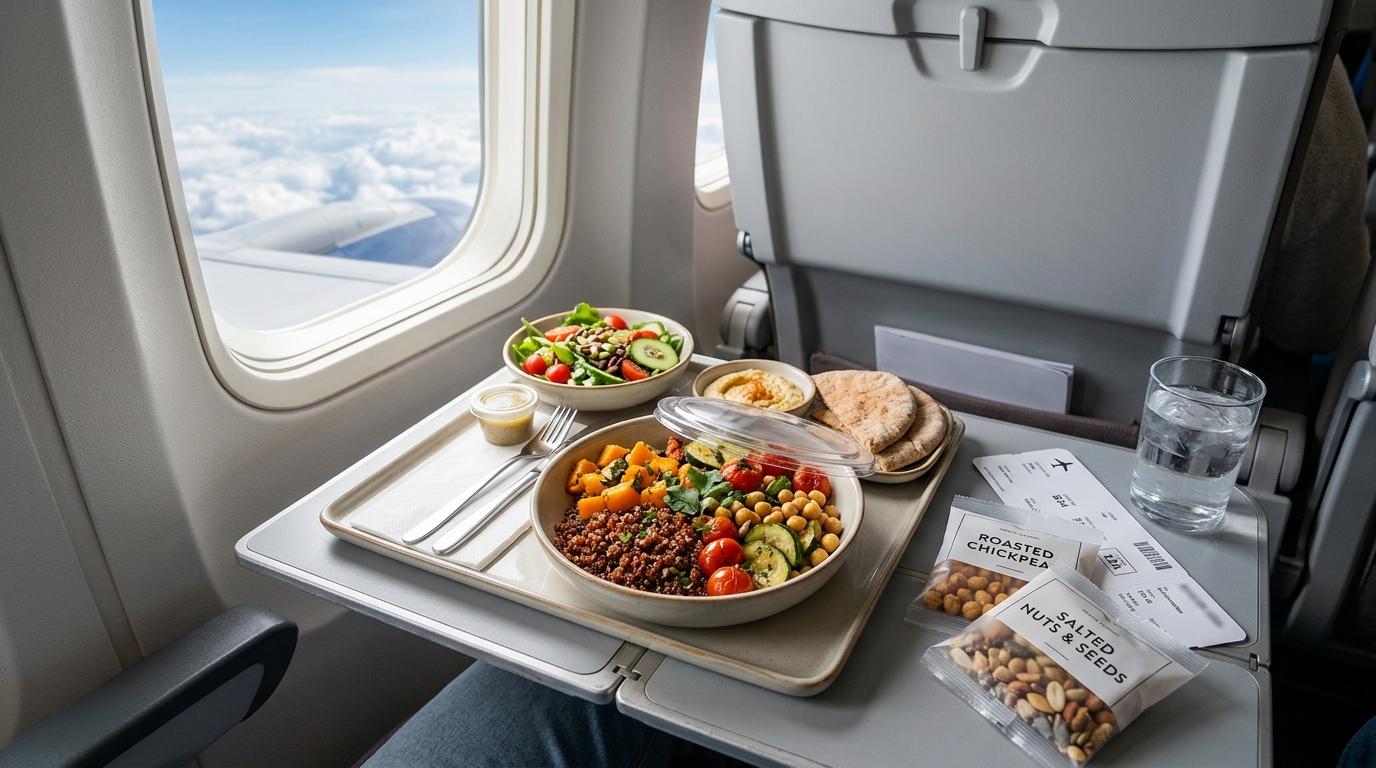
- Roasted makhana
- Roasted chana
- Dry fruits and nuts
- Thepla or paratha without restricted ingredients, if suitable for your diet
- Khakhra
- Plain crackers
- Energy bars or protein bars, after checking the ingredients
- Peanut butter sachets, if allowed and within liquid or gel limits
- Instant poha, upma, or other dry ready mixes, if suitable
- Cup noodles or ready cups that match your diet, if you can get hot water
- Homemade dry snacks in small portions
- Fruit that you will finish before landing
For more ideas, see Ready-to-Eat Indian Meals in Cabin Baggage and Shelf-Stable Vegetarian Protein Snacks for Travel.
Be careful with liquids, gels, and chutneys
#Airport security rules can restrict liquids, gels, pastes, sauces, chutneys, pickles, dips, curd, and similar foods in cabin baggage.
The exact rules depend on the airport and route. In general, dry snacks are much easier to carry through security than wet foods.
Do not rely on hot water
#Cabin crew may be able to give you hot water, but don’t depend on it.
Service can be limited because of turbulence, timing, aircraft type, or crew workload. If your backup meal needs hot water, also carry something you can eat as-is.
Be careful with fresh produce on international flights
#Fresh fruit and vegetables can cause problems when you arrive in another country. Many destinations restrict or require declaration of agricultural products.
If you carry an apple, banana, carrot sticks, or similar fresh food, eat it before landing or follow the destination country’s customs rules. Don’t casually carry fresh produce off the plane unless you know it is allowed.