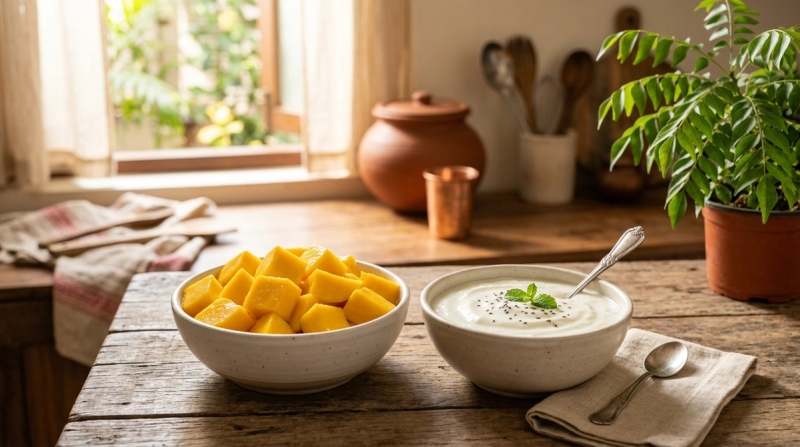
Mango season arrives and suddenly the kitchen feels happier. Mango slices after lunch, mango lassi in the afternoon, aamras, mango shrikhand, mango with dahi — honestly, summer has its own menu.
And because both mango and curd are so common in Indian homes, one question comes up every year:
Can we eat mango with curd, or can it cause acidity, bloating, gas, or heaviness?
The honest answer is: it depends.
Some people enjoy mango with curd throughout summer and feel absolutely fine. Others drink one glass of mango lassi and then spend the next few hours burping, feeling acidic, or complaining that their stomach feels “too full.”
So instead of treating it as a strict yes or no, it is better to look at your digestion, portion size, timing, and the freshness of the curd.
Quick note: This article is for general food and wellness information only. It is not medical advice. If you have frequent acidity, severe stomach pain, vomiting, diabetes, allergies, lactose intolerance, or any ongoing digestive issue, please speak to a doctor or qualified health professional.
So, Can You Eat Mango With Curd?
#Yes, many people can eat mango with curd in small amounts, especially if the mango is fully ripe, the curd is fresh and mild, and the portion is not too large.
But it does not suit everyone.
If you often get acidity, reflux, bloating, loose motions, or heaviness after dairy, then mango and curd together may not be the best combination for you. The same applies if very sweet foods or thick dairy drinks usually make your stomach uncomfortable.
A simple way to judge it is this:
If mango lassi or a mango-curd bowl makes you feel good, you can enjoy it occasionally and sensibly.If it repeatedly makes you feel acidic, gassy, bloated, or heavy, your body is already giving you the answer.
Why Mango and Curd Are Such a Loved Summer Combo
#Taste-wise, it is easy to understand why this combination is so popular.
Curd is creamy, cooling, slightly tangy, and filling. Mango is sweet, juicy, fragrant, and honestly feels like summer in a bowl. Put them together and you get something that tastes rich and refreshing without much effort.
That is why mango lassi, mango dahi bowls, mango shrikhand, and homemade mango-curd desserts are so common.
From a basic nutrition point of view too, the pairing does not sound bad. Curd gives protein, calcium, and creaminess. Mango gives natural sweetness, fibre, and vitamins. Together, it can feel like a satisfying snack.
But digestion is personal.
What feels light and refreshing to one person may feel heavy and uncomfortable to another. That is where all the confusion begins.
Traditional View vs Practical View
#In many traditional food systems, including Ayurveda, mango and curd are often treated with some caution. Mango is usually considered heat-producing, while curd is seen as cooling but also heavy. Because of this, some people believe the combination may slow digestion or create discomfort.
You do not have to treat this as a hard rule for every single person. But it does explain why many families avoid mixing fruits with curd, especially at night or during peak summer.
The more practical way to look at it is this: notice how your own body responds.
If you digest dairy well, do not usually get acidity, and eat a small portion, mango with curd may be perfectly fine for you.
But if you already struggle with reflux, bloating, lactose intolerance, or a sensitive stomach, the combination may feel too rich or heavy.
Instead of asking only, “Is mango with curd good or bad?”, ask yourself:
- How much am I eating?
- Am I having it after a heavy meal?
- Is the curd fresh or very sour?
- Is the mango fully ripe?
- Do I normally digest curd well?
- Do I get acidity easily in summer?
- Am I adding extra sugar?
- Am I having it late at night?
These small details matter more than people think.
Can Mango With Curd Cause Acidity or Bloating?
#It can, for some people.
A lot of people search for things like mango curd digestion, mango lassi acidity, and can mango with curd cause gas during summer. So let’s keep it simple.
1. Acidity and heartburn
#Mango contains natural fruit acids, especially if it is not fully ripe. Curd also has a naturally sour taste because of lactic acid.
For many people, this is not a problem. But if you are prone to acidity or reflux, the combination may feel too tangy, heavy, or rich.
A large glass of thick mango lassi after lunch may trigger:
- Burning in the chest
- Burping
- Sour taste in the mouth
- Heaviness
- Nausea-like discomfort
- A full, uneasy feeling
If you already notice mango acidity in summer, avoid using very sour curd. Also avoid having mango-curd combinations after spicy, oily meals or late at night.
2. Bloating and gas
#Mango has fibre and natural sugars. Curd has dairy proteins and some lactose. When you combine both in a large quantity, especially in a thick lassi or dessert bowl, it can become quite dense for the stomach.
Some people may feel:
- Gas
- Burping
- Tightness in the stomach
- Sleepiness after eating
- Mild cramps
- A heavy, overfull feeling
This does not mean mango and curd are “dangerous” together. Most of the time, discomfort happens because the portion was too big, the curd was too sour, the meal was already heavy, or your digestion does not handle dairy very well.
3. Lactose intolerance
#Many people have difficulty digesting lactose, the natural sugar found in milk and dairy products.
Curd is often easier to digest than milk because it is fermented, but it can still cause symptoms in people who are sensitive to dairy.
If milk, paneer, curd, or lassi usually gives you gas, cramps, bloating, or loose motions, adding mango to curd will not magically make it easier. In fact, a large mango lassi may make the discomfort more noticeable because it is sweet, thick, and filling.
4. Very sour curd may irritate the stomach
#Fresh, mild curd is usually easier on the stomach than old curd that has turned very sour.
If you are making mango lassi or a mango-curd bowl, avoid curd that tastes too sharp or smells overly sour. Sour curd with sweet mango may taste interesting, but if you are prone to acidity, it can trouble your stomach.
When Mango With Curd May Be Okay
#You may be able to enjoy mango with curd if:
- You usually digest curd well.
- You do not get frequent acidity or reflux.
- The mango is fully ripe and sweet.
- The curd is fresh and not too sour.
- You keep the portion small.
- You eat it as a snack, not after a heavy meal.
- You avoid adding extra sugar.
- You have it during the day, not late at night.
For many people, a small bowl of fresh curd with a few pieces of ripe mango feels much lighter than a huge glass of thick mango lassi.
When You Should Avoid or Be Careful
#It is better to avoid or limit mango with curd if:
- You often get acidity or heartburn.
- You feel bloated after curd or lassi.
- You suspect lactose intolerance.
- Dairy gives you loose motions or cramps.
- Your stomach is already upset.
- You are eating a heavy, oily, or spicy meal.
- The curd is very sour.
- The mango is raw, semi-ripe, or too tangy.
- You are having it late at night.
- You tend to overeat mangoes in summer.
Also be careful if you have diabetes, food allergies, or any chronic digestive condition. Mango is naturally sweet, and curd-based drinks can become calorie-dense, especially when sugar is added.
For personal advice, speak to a doctor or dietitian.
Mango Lassi and Acidity: How to Make It Lighter
#Mango lassi is delicious. No argument there.
But it is also one of the easiest ways to overdo the mango-curd combination. Restaurant-style mango lassi is often thick, very sweet, chilled with ice, and served in a large glass. That can be too much for the stomach, especially in hot weather.
If you love mango lassi, these tips can make it gentler.
Use fully ripe mangoes
#Choose sweet, ripe mangoes. Avoid semi-ripe or tangy mangoes if you are prone to acidity.
Use fresh, mild curd
#Fresh curd is better than very sour curd. If the curd smells sharp or tastes too sour, avoid using it for lassi.
Skip extra sugar
#Mango is already sweet. Adding more sugar can make the drink heavier and more likely to cause discomfort.
If the mango is not sweet enough, it is better to wait for a ripe one instead of adding two or three spoons of sugar.
Keep the portion small
#Instead of a tall glass, have a small glass. It sounds basic, but portion size makes a big difference.
Avoid too much ice
#Ice-cold drinks feel refreshing, but some people find them harder to digest. Slightly chilled lassi is usually better than very cold lassi, especially if you get bloating, throat irritation, or heaviness.
Add simple spices if they suit you
#A pinch of roasted jeera powder or cardamom can make mango lassi feel lighter for some people.
But keep it simple. Do not add too many ingredients just because they are considered healthy.
Tips for a Simple Mango-Curd Bowl
#A mango-curd bowl can be lighter than lassi if you keep it basic.
Try this:
- Take a small bowl of fresh curd.
- Add chopped ripe mango.
- Do not add sugar or syrup.
- Avoid too many toppings.
- Eat slowly.
- Stop before you feel too full.
If you want a little flavour, add a pinch of cardamom. If you prefer a slightly savoury touch, add a tiny pinch of roasted jeera powder.
Try not to turn it into an overloaded bowl with mango, curd, sugar, granola, nuts, seeds, syrup, and ice all together. It may look nice, but it can become heavy very quickly.
Best Time to Eat Mango With Curd
#Timing matters a lot for digestion.
Better time
#Mid-morning or late afternoon is usually a better time to have mango with curd. Treat it like a snack, not as an add-on after a full meal.
For example:
- A small mango-curd bowl in the mid-morning
- A small mango lassi in the afternoon
- A few mango pieces with curd as a light snack
This is usually better than having it after a full thali, biryani, chole bhature, or a heavy dinner.
Time to avoid
#Try not to eat mango with curd:
- Late at night
- Immediately after a heavy meal
- After oily or spicy food
- When you already feel acidic
- When your stomach is bloated
- When the curd is very sour
- When you are recovering from loose motions or stomach upset
A thick, sweet dairy bowl after a full meal is one of the most common reasons people feel heavy later.
How Much Mango With Curd Is Sensible?
#There is no perfect portion that works for everyone, but smaller is usually safer.
A sensible serving can be:
- Half a small mango with a few spoonfuls of curd
- A small bowl of curd with chopped mango
- A small glass of mango lassi
Avoid treating mango lassi like a drink to wash down a full meal. It is filling enough to be a snack by itself.
Also, if you are eating mango more than once a day, do not mix every serving with curd. Give your digestion some variety.
Safer Summer Pairing Ideas
#If mango with curd does not suit you, you do not have to give up mango. Just eat it differently.
Eat mango on its own
#This is often the simplest and easiest option. Have ripe mango as a mid-morning or afternoon snack.
Keep curd and mango separate
#If you like dahi with lunch, have it with lunch. Then eat mango later after a gap instead of mixing both together.
Try mango with soaked nuts
#A small portion of mango with a few soaked almonds can feel satisfying without involving dairy.
Try coconut-based options
#If dairy bothers you, mango with coconut milk or a coconut-based preparation may suit you better. Keep the portion small and avoid extra sugar.
Keep meals lighter on mango days
#If you know you are going to have mango lassi or a mango-curd bowl, keep the rest of your meal lighter. Too much oily, spicy food plus a thick mango lassi can be a lot for the stomach.
Who Should Speak to a Doctor?
#Please speak to a doctor, gastroenterologist, or qualified healthcare professional if you have:
- Regular acidity or reflux
- Severe stomach pain
- Vomiting
- Repeated loose motions after dairy or fruit
- Suspected lactose intolerance
- Food allergies
- Diabetes
- Chronic digestive disease
- Unexplained weight loss
- Ongoing digestive discomfort
Food changes can help with mild discomfort, but they should not replace proper medical advice. If symptoms are severe or keep coming back, it is better to get checked.
Final Takeaway
#So, can you eat mango with curd in summer?
Yes, you can — if it suits your digestion.
Keep it fresh, small, and simple. Use ripe mangoes, fresh mild curd, and avoid extra sugar. Have it during the day as a snack, not after a heavy meal and not too late at night.
But if you often deal with acidity, bloating, reflux, lactose intolerance, or a sensitive stomach, mango and curd may not be the best combination for you. You can eat them separately, reduce the portion, or try another summer pairing.
The best rule is still the simplest one: pay attention to how your body feels after eating.
If mango lassi makes you happy and comfortable, enjoy it wisely. If it leaves you acidic, heavy, and uncomfortable every time, your stomach has already answered the question.