I’ve got this tiny travel rule that has saved me from many sad airport meals: if I have a layover in Singapore, I do not waste it on a dry sandwich wrapped in plastic. Changi Airport is one of those rare airports where eating on a budget doesn’t feel like punishment. Actually, some of my favourite Singapore meals have happened while dragging a half-broken cabin bag through Terminal 3, sweaty and sleepy, trying to decide if I wanted laksa or chicken rice before a 2 a.m. flight.
And yes, I know Changi has fancy restaurants, bubble tea counters, bakeries that smell unfairly good, and all that shiny Jewel stuff. But this guide is really for the person with, say, three to seven hours between flights, a hungry stomach, and no desire to spend restaurant money just because they are stuck airside or landside. Food courts are where Changi becomes genuinely useful. You get local food, quick service, decent portions, and that comforting cafeteria chaos that makes me feel like I’ve briefly entered Singapore instead of just passing through it.
First thing: are you airside, landside, or brave enough to clear immigration?
#This matters more than people realise. Changi is easy to move around, but airport food hunting can become stressful if you don’t know which side of security you’re on. If you are in transit and not entering Singapore, you’ll be using whatever food courts and casual dining are inside the transit areas of your terminal. If you can clear immigration, then suddenly Terminal 3 basement food court, Jewel’s basement food hall areas, and some public-side options open up. That’s when the budget game gets more fun.
I usually only go landside if I have at least four hours, and honestly I prefer five. Immigration at Changi is normally smooth, but “normally” is the dangerous word in airports. You still need to factor in walking, train between terminals, security again, and that weird airport time warp where 20 minutes disappears because you stopped to stare at a waterfall. If your layover is under three hours, don’t play hero. Eat near your gate. If it’s four hours or more, then maybe, maybe, go explore.
- Under 3 hours: stay in transit, eat fast, don’t wander too far from your departure terminal.
- 3 to 5 hours: you can do a proper meal, but choose a food court close to where you need to return.
- 5+ hours: landside food court plus Jewel stroll is realistic, as long as your visa/entry situation is sorted.
- Overnight layover: check opening hours on Changi’s official dining directory before dreaming about laksa at 3 a.m., because not every stall keeps vampire hours.
Terminal 3 Basement 2 Kopitiam: my reliable budget comfort zone
#If someone asked me where to eat cheaply at Changi without thinking too much, I’d send them to the Kopitiam food court in Terminal 3, Basement 2, public area. This is not a secret secret, but it has that practical Singapore food-court energy: trays clattering, aunties moving fast, office workers eating quietly, families arguing about what to order, and travellers like me standing there with passport pouch dangling from the neck like a confused tourist. Which, fine, I am.
The thing I like about this place is choice. You can usually find rice plates, noodles, soups, Indian food, vegetarian-ish options depending on stall and time, drinks, kopi, toast-style snacks, and local favourites that feel much more satisfying than a random airport burger. Changi’s official dining listings regularly show Kopitiam as one of the airport’s food-court style options, but stalls and hours can shift, so I always do a quick check on the airport website if I’m arriving late or during some awkward mid-afternoon gap.
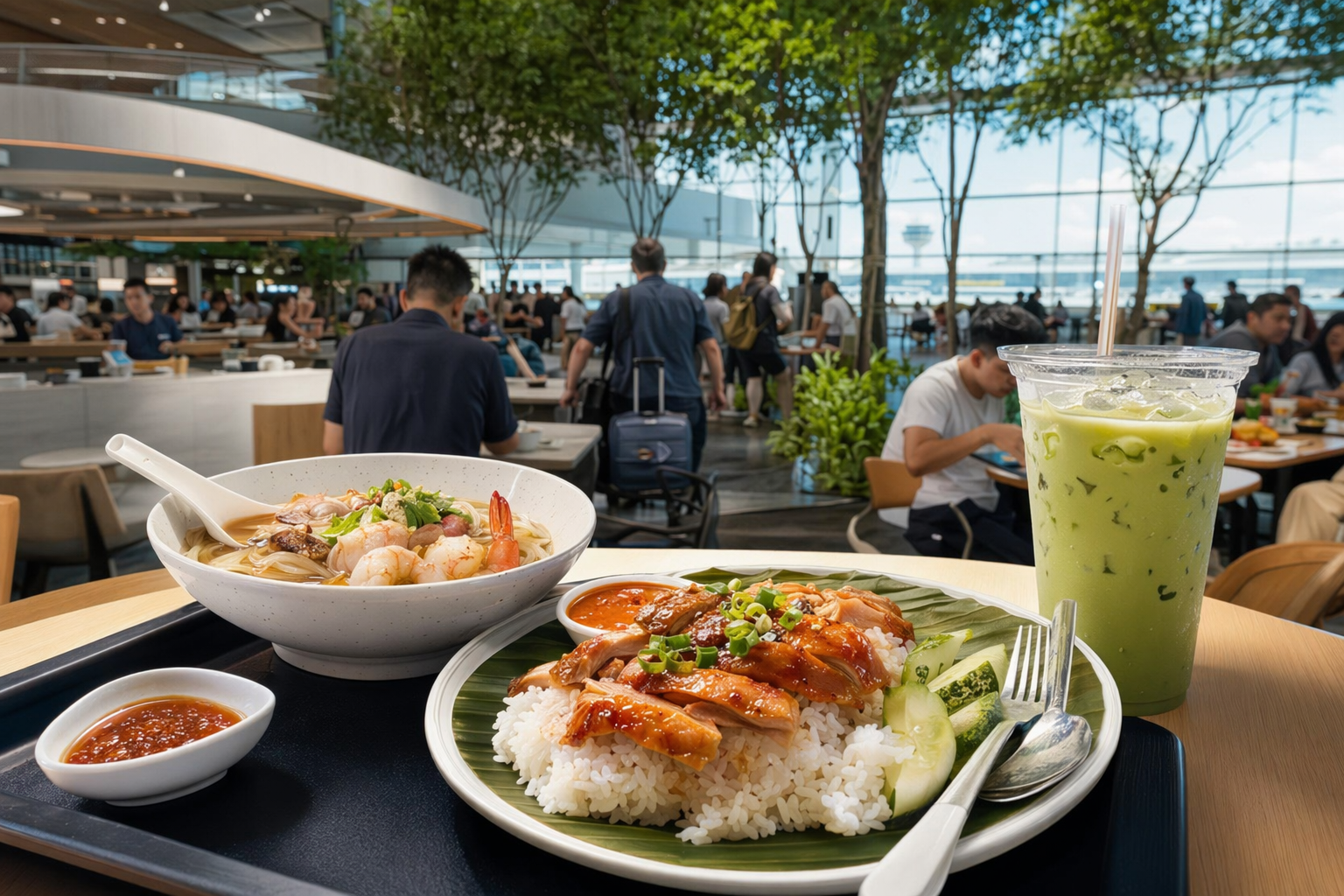
My most recent meal there was a chicken rice situation after a flight where I had slept badly and looked like I’d been folded into the seat pocket. I went for the roasted chicken because the skin looked glossy and, I dunno, emotionally supportive. The rice had that gentle chicken fat fragrance, not the most legendary chicken rice in Singapore, obviously, but for an airport basement? I was happy. Add chilli sauce, a bit of dark soy, cucumber slices, and suddenly the layover didn’t feel like a punishment anymore.
Budget-wise, food courts at Changi are still airport food, so don’t expect old-school hawker centre prices from some neighbourhood corner. But compared with sit-down airport restaurants, the difference is huge. The win is not just the price. It’s the speed and portion size. You can sit down, eat something hot, refill your mood, and get back to your gate without making the meal into a whole event.
Jewel Changi for food-court wandering, but don’t get distracted too hard
#Jewel is dangerous. Not dangerous like unsafe, I mean dangerous like you enter for “a quick cheap meal” and then suddenly you are watching the Rain Vortex, taking photos you swear you won’t take, buying kaya cookies for people who didn’t ask, and wondering if you can fit one more drink before boarding. I’ve done this. More than once. No regrets, but also... my gate was not amused.
For budget eaters, Jewel’s basement levels are the zone to aim for rather than the polished full-service restaurants upstairs. Food-court style dining around Jewel, including Food Republic/Five Spice style setups depending on the current tenant mix, tends to offer Singaporean and Asian casual meals in a setting that’s cleaner and calmer than a street hawker centre but still cheaper than most airport restaurants. Again, check the current Changi/Jewel dining directory before you commit, because airport tenant lists change and nobody wants to drag luggage to a closed stall.
What I usually look for here: something soupy if I’m dehydrated, something rice-based if I need to survive a long-haul, and nothing too creamy before a flight because my stomach is not that brave. Noodle soups are underrated layover food. A bowl of fishball noodles, ban mian, or laksa if you can handle the richness, feels like a proper Singapore stopover without needing to leave the airport ecosystem.
My honest Changi rule: if your layover is short, eat for survival. If it’s long, eat for joy. Jewel is joy, but joy takes time.
Terminal 4 Food Emporium and the quiet-terminal advantage
#Terminal 4 has a different personality. It’s sleeker, a little quieter, sometimes almost too calm, like the airport is whispering. I actually like eating there because it doesn’t always have the same frantic energy as the bigger terminals. Food Emporium in T4 is one of those practical food-court names that tells you exactly what it is. Nothing poetic, just food. Thank you.
If you’re flying from T4, don’t automatically run to Jewel unless you have loads of time. The shuttle transfer adds time, and budget travel is partly about not creating problems for yourself. T4’s food-court options can cover the basics: local plates, noodles, rice, drinks, and quick meals before boarding. It’s not where I’d plan a grand culinary pilgrimage, but for a sensible layover meal, it works. Sometimes the best airport meal is the one that doesn’t make you sprint afterward.
I once had a simple noodle bowl there before a low-cost flight, and I remember almost nothing about the dish except that it was hot, salty in the right way, and exactly what my body wanted after too much airplane air. That sounds like faint praise, but it isn’t. Airport meals have jobs. Some meals are fireworks. Some meals are blankets. This was a blanket.
The “staff canteen” myth: worth it, but only if you know what you’re doing
#Every Changi budget food discussion eventually brings up staff canteens. People talk about them like hidden treasure caves, and to be fair, airport staff canteen meals can be cheaper and more local-feeling than the shiny passenger areas. But I’m always careful recommending them because access, location, opening times, and public pricing can vary, and they are not designed primarily as tourist attractions. Also, if you’re on a tight layover, wandering around looking for a semi-hidden canteen is how you become that sweaty person begging security staff for directions.
If you have plenty of time and you’re already landside, sure, ask politely at information or check the official airport map. Some travellers have found good-value meals in staff dining areas over the years. But I wouldn’t build my whole Changi food plan around it. Terminal 3 Kopitiam or Jewel basement food halls are easier, more predictable, and honestly still affordable enough for most layover budgets.
What to eat if you want Singapore flavour without leaving the airport
#Singapore food is basically a love letter written in chilli, coconut milk, soy sauce, wok smoke, pandan, and rice. It’s Chinese, Malay, Indian, Peranakan, Eurasian, and more, all bumping elbows in one tiny, hungry island. A food court won’t give you the full depth of eating your way through Maxwell, Tekka, Geylang Serai, or Old Airport Road Food Centre, but it gives you a compact airport-friendly version. And for a layover, that’s enough to make the trip feel real.
Chicken rice: safe, iconic, and usually a good airport choice
#Chicken rice is the dish I suggest to nervous first-timers because it looks simple but has layers. The rice should be fragrant, the chicken tender, the chilli sharp enough to wake you up. At Changi food courts, it’s commonly available in some form, and it travels well from stall to table, which sounds silly but matters in a busy airport. I prefer roasted chicken when I’m tired, steamed when I’m trying to pretend I’m being healthy. Both are lies, probably, but tasty lies.
Laksa: delicious, risky shirt-wise
#Laksa before a flight is a personality test. Coconut-rich broth, noodles, chilli, sometimes prawns or fishcake, herbs if you’re lucky. It’s gorgeous. It is also splashy, heavy, and not the smartest choice if you’re wearing a white shirt before a 12-hour flight. I still order it sometimes because I have no self-control. The airport versions can be milder than hawker versions, but that’s not always a bad thing before boarding.
Nasi lemak and curry rice: for when you’re properly hungry
#If I land at Changi starving, I look for rice plates. Nasi lemak with coconut rice, sambal, egg, peanuts, cucumber, and some kind of chicken or fish is a beautiful thing, though the sambal heat can vary a lot. Curry rice or economic rice stalls are also useful because you can point at what you want, which is perfect when your brain is operating at 40 percent after a red-eye. Just watch the add-ons because budget meals can become not-so-budget if you choose three meats and a fancy drink.
Vegetarian meals: possible, but ask properly
#Vegetarian eating at Changi is definitely possible, but it’s not always as effortless as people imagine. Some noodle broths use seafood or chicken stock, sauces may contain shrimp paste, and “no meat” doesn’t always mean vegetarian in the strict sense. Indian stalls are often the easiest first stop for vegetarian travellers because you might find prata, dosa-style items, rice sets, or vegetable curries depending on the stall, but still ask. Nicely. Repeatedly if needed.
If you’re comparing airport layover survival strategies across Asia, I wrote notes in a similar spirit for Hong Kong Airport Vegetarian Food Guide for Indian Layovers, because Hong Kong is one of those places where vegetarians really do need label-checking and backup snacks. For Southeast Asia beyond Singapore, the Kuala Lumpur Vegetarian Food Guide for Indian Travelers is also useful, especially if you’re the kind of person who plans trips around food courts and train connections. Which, um, guilty.
My cheap Changi meal formulas that actually work
#I have eaten enough rushed airport meals to know that “cheap” is not always cheap if you order badly. Drinks, desserts, sides, and impulse snacks are where your budget quietly gets mugged. So I use little formulas. Not strict rules, because travel is supposed to be fun, but guidelines that stop me from spending restaurant money in a food court.
- The hot bowl formula: one noodle soup plus plain water. Good when you’re tired, dry from flying, or not ready for fried food.
- The rice plate formula: chicken rice, nasi lemak, biryani-style plate, or curry rice with one main protein and one vegetable. Filling, fast, usually best value.
- The snack meal formula: kaya toast or prata-style snack plus kopi or tea. Best for morning layovers when you don’t want a huge meal.
- The don’t-do-this formula: main meal, bubble tea, dessert, packaged snacks, and then complaining the airport is expensive. I have done this and yes, it was my fault.
One small thing: Singapore portions can look moderate if you’re used to massive servings, but rice and noodles fill you up more slowly. I’ve made the mistake of adding too much, then sitting on the plane feeling like a dumpling with a passport. Not ideal.
Drinks: kopi, teh, juice, water, and the pre-flight stomach question
#I love airport drinks almost as much as airport meals, which is a problem. Changi has plenty of fun drink choices, from kopi and teh to fresh juices, soy milk, bubble tea, and bottled everything. But before a flight, I try to think about hydration and sugar. A sweet iced tea feels amazing for about 18 minutes, then I’m thirsty again. Fresh juice can be lovely, but not all juices are equal before boarding, especially if they’re super acidic or loaded with added syrup.
If you’re trying to choose smarter, I have a whole little rant-guide here: Airport Fresh Juice Before a Flight: What to Buy and What to Skip. For Changi specifically, my go-to is usually water with the meal and maybe kopi after, unless it’s a night flight. Drinking strong coffee at 10 p.m. before a long flight is something I keep doing and then pretending I don’t know why I can’t sleep.
Timing your meal so you don’t end up running with noodles in your soul
#The trick with Changi is that everything feels efficient, so you get overconfident. You think, “Oh, I can totally eat in Terminal 3, see Jewel, buy snacks, clear security, and reach a gate in Terminal 1.” And sometimes you can. But sometimes your boarding gate is approximately in another postal code and your airline starts boarding early and suddenly you are speed-walking with chilli breath.
For transit passengers, I like eating about 90 minutes before boarding if I’m already in the right terminal. That gives me time to queue, eat slowly enough to not choke, use the washroom, refill water, and wander to the gate. If I’m landside, I want to be heading back airside at least two hours before departure for international flights, more if I’m anxious or travelling with kids. Changi is excellent, but it is still an airport, not a magic tunnel.
A realistic 3-hour layover plan
#Stay airside. Pick the closest decent food option in your terminal. Eat one proper hot meal. Skip Jewel unless you’re already landside for some reason. Don’t chase a famous dish. The famous dish does not care if you miss your flight.
A realistic 5-hour layover plan
#If entry requirements work for you, clear immigration, go to Terminal 3 Kopitiam or Jewel basement, eat, walk around Jewel for 20 to 40 minutes, then go back. Keep an eye on your boarding time, not just departure time. Boarding time is the bossy older sibling of departure time.
A realistic overnight layover plan
#Check hours first. Seriously. Some airport food courts and stalls close or reduce options late at night. If you land late, eat when you see something open rather than assuming better food is around the corner. I have learned this the sad way, wandering past closed shutters while my stomach made whale noises.
Halal, dietary notes, and the label-reading reality
#Singapore is generally much easier for halal food than many airports, and Changi usually has halal-certified or Muslim-friendly options across different terminals, but don’t assume every local dish is halal just because it looks simple. Chicken rice, laksa, noodles, sauces, stocks — all can vary. Look for certification signs and ask staff if you’re unsure. Food courts are busy, so ask clearly and don’t be shy about repeating the question.
For vegetarians, vegans, and people avoiding beef, pork, egg, onion-garlic, gluten, shellfish, or whatever else, I’d say build in a backup snack. Not because Changi is bad for dietary needs, it’s actually better than many airports, but because layovers are unpredictable. The stall you researched might be closed. The vegetarian item might have sold out. The queue might be too long. A packet of nuts in your bag can be the difference between calm traveller and hangry goblin.
Little money-saving habits I use at Changi food courts
#First, I walk the whole food court once before ordering. This sounds obvious, but hunger makes me stupid. I’ll buy the first thing I see, then two minutes later spot something cheaper and better. Do the loop. Check the menus. Look at what locals or airport staff are eating. If a stall has a small queue but the line moves quickly, that’s usually a good sign.
- Pay attention to set meals. Sometimes the set is good value, sometimes it includes a drink you don’t need.
- Choose water unless you really want the sweet drink. Drinks are where budgets get sneaky.
- Avoid ordering too many sides before a flight. A full stomach plus turbulence is not romance.
- If you’re landside, compare Terminal 3 basement and Jewel basement vibes before committing, if time allows.
- Keep your receipt if you’re travelling for work. Airport meal receipts vanish like socks in a dryer.
Also, don’t be embarrassed to eat simply. Travel culture sometimes makes it seem like every meal has to be a discovery, a story, a revelation. Sometimes the best budget layover meal is just hot rice, tender chicken, chilli sauce, and ten peaceful minutes where nobody is asking you to remove your laptop.
The foods I’d skip before boarding, even if they tempt me
#This is personal, so argue with me if you want. I usually skip super greasy fried platters, extra-spicy laksa if I have a middle seat, giant milk tea with pearls before a long-haul, and anything that requires too much hand-cleaning. Saucy crab-style dishes in an airport? Absolutely not. I want flavour, yes, but I also want to board the plane without wearing my lunch.
I’m also cautious with raw salads in airports, not because Changi is unclean, but because pre-flight digestion is a delicate political situation. Hot food just feels safer and more comforting when I’m travelling. Soup, rice, noodles, cooked vegetables, tea. Boring? Maybe. Effective? Very.
What makes Changi different from other airport food courts
#The difference is that Changi feels connected to the city’s food culture instead of floating above it. Many airports could be anywhere. Same chains, same muffins, same sad panini. Changi still has international chains, sure, but the food-court side gives you enough Singapore identity to make a layover feel like a mini stopover. You taste coconut rice, sambal, kaya, kopi, curry, wok-fried noodles, and suddenly the map outside the window matters.
Is it the same as eating at a proper hawker centre in town? No. Let’s not pretend. A Changi food court is cleaner, more expensive, less chaotic, and a bit airport-polished. You won’t get the full sweaty magic of sitting under fans in a neighbourhood hawker centre with uncles arguing over kopi. But for a budget layover, it’s a pretty wonderful compromise. And sometimes compromise tastes like chicken rice at midnight, which is not bad at all.
My final budget layover game plan
#If I were landing at Changi tomorrow with a hungry stomach and a modest budget, here’s what I’d do. Short transit? Eat in my terminal, choose a hot local meal, drink water, move on. Four or five hours and allowed to enter Singapore? I’d go landside to Terminal 3 Kopitiam or Jewel basement, eat something properly Singaporean, take a quick waterfall look, maybe buy a snack, and then get back airside early like a responsible adult. Well, responsible-ish.
For first-timers, I’d say start with chicken rice or a noodle soup. For spice lovers, laksa or nasi lemak. For vegetarians, check Indian stalls first but ask about stock and sauces. For budget control, avoid stacking drinks and desserts unless that’s your chosen joy. And honestly, if dessert is your chosen joy, I support you. Travel needs small joys, otherwise it’s just queues and boarding passes.
Changi Airport food courts prove that layover eating doesn’t have to be boring or wildly expensive. You can get a warm, local-ish, satisfying meal without leaving the airport bubble, and if you plan your timing right, it becomes part of the trip rather than just something you did because you were hungry. I still think about that sleepy chicken rice in Terminal 3 more fondly than some fancy restaurant meals I’ve had, which probably says alot about me. For more food-travel rambles and practical eating guides, I usually point friends toward AllBlogs.in, because that’s exactly the kind of rabbit hole a hungry traveller needs.