The layover hunger panic is real, especially when you’re vegetarian
#I have a very specific memory of Hong Kong International Airport: me standing under those giant glowing departure boards at Chek Lap Kok, half-asleep after a red-eye from Delhi, clutching my cabin bag like it had all my hopes and backup theplas inside it. Which, honestly, it did. My connecting flight was still hours away, my phone was on 18%, and my stomach had started doing that dramatic Indian-parent voice: “You should have eaten properly before leaving.” Hong Kong airport is sleek, efficient, and weirdly calming for such a massive place, but when you’re an Indian vegetarian on a layover, the first thought isn’t “wow, global aviation hub.” It’s more like, “Is there anything here without fish sauce, oyster sauce, chicken stock, bacon bits, or some mysterious broth situation?”
And look, I love airport food more than a normal person should. I actually plan layovers around snacks. Some people collect fridge magnets, I collect memories of questionable airport sandwiches and surprisingly good noodles eaten near Gate 30-something. But Hong Kong Airport needs a bit of strategy if you’re vegetarian, Jain-ish, eggless, or just not comfortable with hidden meat stock. It’s not impossible at all. In fact, it can be pretty tasty. You just need to know where to look, what to ask, and when to stop being adventurous and buy a banana, because sometimes survival is also a cuisine.
First thing: Hong Kong Airport is good, but it changes. Don’t trust ancient food blogs blindly
#Hong Kong International Airport, usually called HKIA, has a very organized dining setup across Terminal 1 and the airside departure areas, with cafés, convenience stores, noodle places, bakeries, food court counters, and sit-down restaurants depending on your gate zone. The airport’s official dining directory is honestly the best source for exact outlet names, locations, and opening hours because airport tenants change, renovation happens, and one counter you loved last year might be replaced by something selling crab roe noodles this year. I always check the directory before flying, then again when I land, because gate changes can turn a “quick meal” into a 20-minute speed walk.
My rule in HKIA is simple: if I have under 90 minutes, I don’t go hunting for the perfect meal. I buy safe packaged snacks, coffee, fruit, yoghurt if suitable, or something bakery-ish after checking ingredients. If I have 2 to 4 hours, I’ll explore nearby food courts or café clusters. If I have 5 hours plus, then I start thinking about a proper bowl of noodles, Indian-style curry if available, or even a quick exit toward Tung Chung if immigration, baggage, and energy levels are all behaving. Big if. Hong Kong looks close on a map, but tired legs and airport security queues have humbled me more than once.
| Layover time | What I’d do as an Indian vegetarian | Why it works |
|---|---|---|
| Under 90 minutes | Grab fruit, coffee, packaged snacks, maybe a simple bakery item after checking ingredients | Low risk, no gate anxiety, no running with chutney breath |
| 2 to 4 hours | Look for cafés, vegetarian sandwiches, salads, fries, rice bowls, or curry counters if operating nearby | Enough time to ask questions and switch places if needed |
| 4 to 6 hours | Try a sit-down restaurant or food court meal, but still stay airside unless you know your gate plan | Better food, less panic, still sensible |
| 6 hours plus | Consider Airport Express or Tung Chung only if immigration is smooth and you’re comfortable | Fun, but only if you don’t treat it like a Bollywood chase scene |
My personal food map: what I actually look for at HKIA
#The first category is cafés. Pret-style counters, Starbucks, Pacific Coffee type places, bakery counters, and convenience stores are often more useful than “proper restaurants” when you’re vegetarian and short on time. I know that sounds boring, but hear me out. A cheese sandwich with coffee before a 9-hour flight is not glamorous, but it has saved my mood. At Hong Kong airport, café food is usually labelled better than a random hot-food counter, and staff are used to international travellers asking ingredient questions. You may find veggie wraps, cheese croissants, salads, fruit cups, muffins, yoghurt, and sometimes soup, though soup is where I get suspicious because stock can be meat-based even when the visible ingredients look veg.
The second category is Asian noodle or rice places. This is where it gets exciting and also slightly dangerous for strict vegetarians. A bowl may look like plain noodles with mushrooms and greens, but the broth might be chicken, pork, fish, or dried seafood based. Same with fried rice that appears vegetable-only but may have egg, meat oil, or oyster sauce. I’m not saying don’t eat it. I’ve had really comforting noodle bowls in Hong Kong airport, especially when I requested no meat and no seafood sauce, but you do need to ask clearly. Airport staff usually try to help, but the kitchen may not be able to modify everything.
The third category is Indian or curry-style counters, when available. HKIA has had curry-focused dining options listed in its official dining directory at different times, and this is where Indian travellers naturally drift because dal-rice energy is basically emotional support. But don’t assume every curry counter has vegetarian gravy ready, and don’t assume “vegetable curry” means no fish sauce or meat stock unless you ask. I once got very excited seeing a curry sign, only to realise the vegetarian choice had sold out and the only remaining “veg-looking” thing was rice and pickles. I still ate the rice. With dignity? Maybe not.
The Cantonese food trap: vegetarian-looking is not always vegetarian
#Hong Kong food culture is incredible. I’m not just saying that because everyone says it. The city has this beautiful mix of Cantonese technique, British-era café habits, global airport dining, bakery culture, and the kind of efficiency where your food arrives before you’ve emotionally processed the order. But for Indian vegetarians, especially those who avoid egg, onion-garlic, or any meat stock, Cantonese cooking has hidden ingredients that matter. Oyster sauce is a big one. Fish sauce, shrimp paste, dried scallop, pork lard, chicken stock, and XO sauce can show up in dishes that look harmless. Even stir-fried greens may be seasoned with oyster sauce unless you request otherwise.
A local vegetarian concept you’ll see in Hong Kong is Buddhist-style vegetarian food, often connected with the word “jai” or “zhai,” meaning vegetarian. That’s usually more promising than a random vegetable dish, because Buddhist vegetarian cooking traditionally avoids meat and seafood, though details vary. At the airport, you may not always find dedicated Buddhist vegetarian food, but knowing this helps if you see menu language around “vegetarian,” “Buddhist,” or “meat-free.” I still ask, because my trust issues are well-earned after years of international airports.
- Ask: “Is the broth vegetarian, no chicken, no pork, no seafood?” Don’t just ask “veg?” because people interpret that differently.
- For stir-fry, ask: “No oyster sauce, no fish sauce?” This is the one that catches many Indians.
- If you don’t eat egg, say it separately. In East Asia, egg is often considered okay for vegetarian-style meals.
- If you’re Jain, be extra direct about onion, garlic, root vegetables, and stock. Airport kitchens may not be able to customise, so have backup food.
My safest orders, ranked by how tired I am
#When I’m fresh and curious, I’ll try to build a proper hot meal: steamed rice, vegetable curry if available, plain noodles with vegetables in soy-based sauce, or a vegetarian pasta. When I’m exhausted and becoming slightly feral, I go for coffee, fruit, chips, nuts, chocolate, and a sandwich if the label looks safe. There is no shame in this. Travel food is not about winning MasterChef. It’s about landing in Bangkok, Tokyo, Sydney, or Vancouver without being hungry-angry at innocent people.
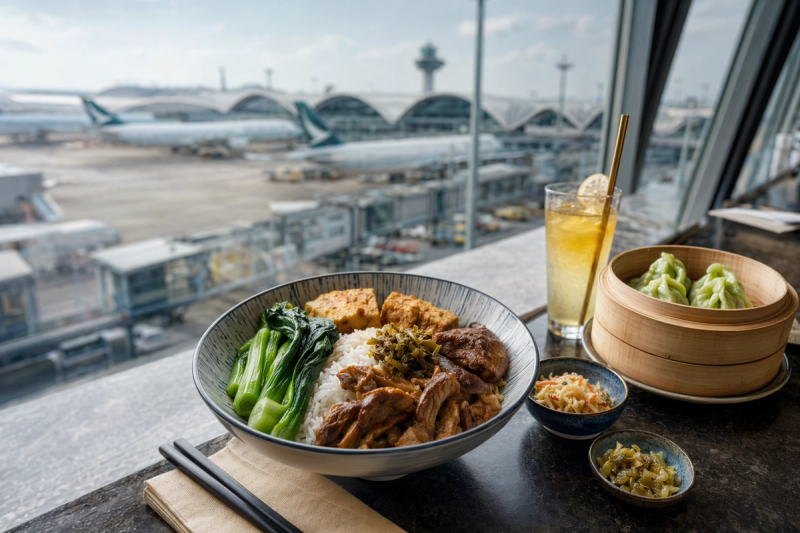
One of my better HKIA meals was a simple plate of rice with vegetables and a mild curry sauce from a food court style counter. Was it the best curry of my life? No. My mother’s aloo tamatar would destroy it in one spoon. But after 11 hours of flight food where my “Asian vegetarian meal” had somehow become two bread rolls and a sad cutlet, that airport curry tasted like home had sent me a WhatsApp voice note. Another time, I ordered a cheese-and-tomato bakery thing and a hot milk tea, sat near the windows, watched Cathay planes roll past, and honestly it was perfect. Sometimes the vibe seasons the food.
| Food option | Vegetarian confidence | What to check |
|---|---|---|
| Fruit cups, bananas, packaged nuts | High | Still check flavouring on masala nuts or trail mixes |
| Cheese sandwich or veggie wrap | Medium to high | Gelatin, egg mayo, meat contamination, hidden sauces |
| Vegetable noodles | Medium | Broth, oyster sauce, fish sauce, egg |
| Vegetable fried rice | Medium | Egg, meat oil, oyster sauce, shared wok concerns |
| Bakery items | Medium | Egg, gelatin, lard, meat fillings, whether yeast bothers you personally |
| Indian-style veg curry and rice | Medium to high if confirmed | Stock base, ghee, onion-garlic, whether vegetarian curry is actually available |
Backup snacks: the Indian traveller’s unofficial religion
#Every Indian vegetarian I know has a backup snack system. Some are thepla people. Some are khakhra people. Some carry Haldiram packets with the seriousness of carrying medical documents. I am personally a roasted makhana and protein bar person, with one emergency packet of chivda that gets crushed into powder by the time I reach my destination. Hong Kong airport has convenience stores and cafés, yes, but if you have dietary restrictions, don’t arrive empty-handed. Especially if your layover is late night or early morning, because not every outlet runs 24 hours and even when something is open, your nearest gate area may not have the thing you want.
This is the same rule I follow in high-footfall travel spots in Japan too, where labels and ingredient checks become half the trip. If you’re planning more vegetarian travel beyond Hong Kong, my notes in Japan Theme Park Vegetarian Food Guide for Indians are weirdly relevant here too: carry snacks, don’t assume fries are safe, and ask about stock. Same with convenience-store breakfasts abroad. The habit of reading labels, spotting gelatin, and keeping a backup banana is something I wrote about in Japan Konbini Breakfast Guide for Indian Travelers, and honestly airports are just konbinis with boarding gates and more expensive coffee.
Bakery counters, bread, and the yeast question that always comes up
#Indian vegetarian conversations can get very detailed very fast. Someone says “pizza,” and suddenly the group chat is debating enzymes, rennet, yeast, egg wash, and whether the oven also baked pepperoni. At HKIA, bakery items are tempting because they’re quick and they smell amazing when you’re hungry. Pineapple buns, croissants, muffins, cheese breads, custard things, little cakes in plastic boxes, all calling your name like sirens. But if you’re strict, check for egg, gelatin, lard, meat floss, sausage fillings, and sometimes cheese sources if that matters to you.
Yeast itself confuses a lot of Indian vegetarians, especially when buying bread abroad. In most Indian vegetarian practice, yeast is generally accepted because it’s a fungus, not an animal ingredient, but families and religious interpretations can differ. If this topic makes your brain hurt during a layover, read this before your trip: Is Yeast Veg or Non-Veg? Indian Vegetarian Answer. My personal approach is that I’m okay with yeast, but I still check for egg and lard, because those are much more likely to be the issue in airport bakery food.
If you have time to leave the airport: should you?
#This is where my travel brain and food brain start fighting. Hong Kong city is one of the best eating cities in the world, and the Airport Express can get you from the airport toward Central in around 24 minutes once you’re on the train. Tung Chung is even closer and connected by public transport, with malls and casual food options. If your layover is long, immigration is smooth, and you don’t need to collect bags, leaving the airport can be tempting. I’ve done short Hong Kong exits before, and walking into the humid air after airport AC feels like being revived.
But please don’t romanticise it too much. If you have a 5-hour layover, that does not mean 5 hours of city time. You need to count immigration, walking, train waiting, security on return, gate distance, and the mental fog of travel. For vegetarian Indian food specifically, the city has many more options than the airport, including Indian restaurants, vegetarian Chinese places, and Buddhist vegetarian spots, but a rushed meal outside can become stressful. I’d only leave for food if I had at least 7 to 8 hours, no visa/entry complications for my passport situation, and enough energy to not make bad decisions.
- With 2 hours: stay near your gate, eat simple, don’t be heroic.
- With 4 hours: explore airside dining zones, maybe sit down for a proper meal, but keep checking gate info.
- With 6 hours: you can consider a more relaxed airport meal and shopping, but city exit still depends on immigration and comfort.
- With 8 hours or more: Tung Chung or the city becomes realistic, if you’ve checked entry rules and return timing.
How I ask questions without making it awkward
#I used to feel embarrassed asking too many food questions abroad. Like I was being difficult. Then I got older, hungrier, and less interested in pretending. Now I ask politely, smile, and keep it short. “I’m vegetarian. No meat, no fish, no chicken stock. Is this okay?” If they hesitate, I don’t order it. Hesitation is information. Sometimes staff will say, “Vegetable, but soup has chicken.” That honesty is gold. Thank them and move on. Airport workers deal with thousands of tired travellers, so being clear and kind gets you further than launching into a lecture on Indian dietary categories.
One trick that works well is showing written text on your phone. I keep a note that says: “I am vegetarian. I do not eat meat, chicken, fish, seafood, pork, beef, or meat stock. No oyster sauce or fish sauce please.” If you avoid egg, add “no egg.” If you’re Jain, add “no onion, no garlic, no root vegetables,” but also be prepared for the answer to be no. Not because people don’t care, but because airport kitchens are built for speed, not customised spiritual alignment. Sad but true.
My honest Hong Kong Airport food philosophy: ask clearly, eat simply, carry snacks, and don’t let one unavailable veg meal ruin a whole journey.
Little things Indian vegetarians should watch at HKIA
#The first little thing is sauces. Sauces are where vegetarian certainty goes to die. A plain vegetable dish can become non-veg because of one spoon of oyster sauce. The second is broth. Noodle shops often build flavour from stock, and vegetable toppings don’t mean vegetable broth. The third is breakfast. If your flight lands early, you may be surrounded by egg sandwiches, ham croissants, and coffee, while your soul wants poha. This is when packaged fruit, yoghurt, plain bread, or your own snacks help.
The fourth thing is airline meals. Always request your vegetarian meal with the airline in advance, usually at least 24 to 48 hours before departure depending on airline rules, but don’t assume it will be perfect. I’ve had excellent AVML meals with paneer and rice, and I’ve had meals that looked like someone gave up halfway. If you’re transiting through Hong Kong after a long flight, your airport meal may become your real meal, so plan for that. Also, if you’re travelling with kids or elders, don’t gamble. Carry familiar snacks. A hungry uncle in transit is not a peaceful creature.
What I’d pack for a Hong Kong vegetarian layover
#- Two dry snacks that don’t leak: thepla, khakhra, roasted chana, makhana, or energy bars.
- One sweet thing, because airport fatigue is real and sometimes a small chocolate fixes your personality.
- A refillable water bottle, emptied before security and refilled airside where allowed.
- A note on your phone with your dietary restrictions written clearly.
- Patience. I hate that this is necessary, but it is.
So, is Hong Kong Airport good for Indian vegetarians?
#Yes, but with conditions. It’s not like some Indian airports where you can stumble into idli, dosa, pav bhaji, chole, veg sandwich, and chai without thinking too much. HKIA is more international, more Cantonese-influenced, and more ingredient-check dependent. But it’s also clean, well-organized, full of cafés and global food counters, and generally manageable if you aren’t expecting a full Gujarati thali at Gate 22. The food scene reflects Hong Kong itself: fast, layered, practical, and full of hidden complexity. I kind of love that, even when it annoys me.
My final advice? Check the HKIA dining directory close to your travel date, don’t rely on one specific restaurant being there forever, ask about broth and sauces, keep snacks like your grandmother told you to, and give yourself enough time to actually enjoy the food instead of inhaling it while boarding starts. Hong Kong Airport can be a surprisingly decent vegetarian layover if you treat it like a mini food mission, not a guaranteed buffet. And if you’re into these slightly obsessive food-travel notes for Indian travellers, you’ll probably enjoy browsing AllBlogs.in before your next trip too.