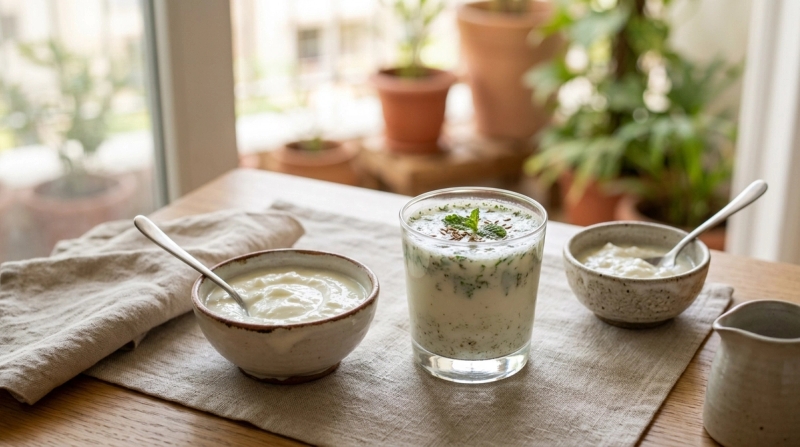
In many Indian homes, summer lunch feels incomplete without dahi.
A little curd with dal-chawal, curd rice on a hot afternoon, boondi raita with pulao, or a glass of chaas after a spicy meal — these are simple comforts. They cool the plate, balance the food, and somehow make the meal feel more satisfying.
But summer also changes curd very quickly.
Milk sets faster. Dahi turns sour faster. A bowl that tasted fresh in the morning can become quite khatta by evening if it has been sitting outside for too long.
So the common question is: in summer, is fresh curd better or sour curd? And if curd has become sour, is it still okay to eat?
Quick answer
#For everyday summer meals, fresh curd is usually the better choice.
Fresh dahi is milder, less acidic, and generally feels lighter on the stomach. If you often struggle with acidity, bloating, reflux, heaviness, or sensitive digestion, a small bowl of fresh curd with lunch is usually safer than eating a big serving of sharp, sour curd.
That said, sour curd is not automatically unsafe.
If it is only mildly sour, has been stored in the fridge, and looks and smells normal, many people can eat it without any problem. But very sour curd can feel heavy and may trigger acidity, gas, or bloating in some people, especially in hot weather or when eaten at night.
If you want something lighter, make chaas from fresh curd. Add water, roasted jeera, black salt, mint, coriander, or whatever suits your taste. Chaas is thinner than dahi, easier to sip, and often feels better with lunch in summer.
A simple rule to remember:
Fresh curd for daily eating. Mildly sour curd only if it looks and smells normal. Very sour, slimy, moldy, discoloured, spoiled, or bad-smelling curd should be thrown away.
Fresh curd vs sour curd
#Curd keeps changing after it sets. The longer it ferments, the more sour it becomes. In summer, this happens much faster because the warm weather speeds up fermentation.
Here’s an easy comparison.
Fresh curd is dahi that has just set properly. It is not too runny, not too sharp, and not strongly tangy. This is the kind most people enjoy with lunch.
Sour curd, or khatta dahi, is curd that has fermented for longer. The sour taste comes mainly from lactic acid formed during fermentation. A little tang is normal. But when curd becomes very sour, it may not suit everyone as a raw side dish.
In many traditional Indian food habits, curd is eaten more during the daytime and less at night. You may have also heard people say that dahi can feel “heavy” even though it tastes cooling. Whether or not you follow these ideas strictly, it is worth observing your own body. If curd at night makes you feel heavy, acidic, or congested, shifting it to lunch may help.
When sour curd may trigger acidity
#A little tang in curd is usually fine for many people. But very sour curd is different.
Because sour curd is more acidic, it may trigger discomfort in people who are already prone to acidity, reflux, gas, or bloating.
Sour curd may cause acidity or heaviness when:
- You eat it raw in a large quantity.
- You eat it late at night or close to bedtime.
- You eat it with oily, fried, spicy, or very heavy food.
- You already have reflux, heartburn, or sensitive digestion.
- The curd has been kept outside in summer heat for too long.
- You are lactose intolerant or dairy does not suit you well.
The discomfort can feel like burning, burping, gas, bloating, sour belching, nausea, or a heavy feeling after eating.
This does not mean curd is bad for everyone. It simply means the curd may be too sour, the quantity may be too much, or the timing may not suit you.
If you repeatedly get reflux, chest burning, severe stomach pain, vomiting, diarrhoea, or symptoms after eating dairy, speak to a doctor. Food timing can help some people, but it should not replace medical advice when symptoms are frequent or severe.
Also be extra careful with older or sour curd if you are pregnant, elderly, immunocompromised, or serving it to young children. In these cases, freshly set and properly refrigerated curd is the safer choice.
Best time to eat dahi in summer
#The best time to eat curd in summer is usually with lunch or in the early afternoon.
That is when dahi naturally fits into the meal. It can balance spicy food, add some protein and calcium, and make rice, dal, khichdi, roti-sabzi, or pulao feel more complete.
A small bowl of fresh curd at lunch is usually easier on digestion than a large bowl of thick, sour curd late at night.
A few simple tips:
- Prefer curd with lunch. Fresh dahi at lunchtime usually suits people better than sour curd at dinner.
- Avoid curd just before sleeping. It may feel heavy, especially if it is thick, sour, or eaten in a large amount.
- Keep the portion moderate. A small katori is enough for most meals.
- Choose chaas when appetite is low. It is lighter than plain thick curd and easier to drink in summer.
- Do not leave curd outside for hours. Once it sets, refrigerate it so it does not keep turning sour.
If you eat curd at dinner and feel perfectly fine, there is no need to panic. Everyone’s digestion is different.
But if you often wake up with heaviness, mucus, sour burps, bloating, or reflux after eating curd at night, try having it at lunch instead for a few days and notice the difference.
Safer ways to eat curd in summer
#Curd feels much better when paired properly. You do not need to make it complicated. Just keep it light, fresh, and suitable for your digestion.
1. Turn dahi into chaas
#Chaas is one of the easiest summer swaps.
Whisk curd with water until it becomes thin. Add roasted cumin powder, black salt, mint, coriander, or a little black pepper.
This makes it lighter than thick curd and easier to sip with lunch.
If plain dahi feels heavy, chaas may suit you better. You still get the flavour of curd, but without the same dense feeling.
2. Add roasted jeera and black salt
#Roasted jeera and black salt are classic additions for a reason. They improve the taste and many people feel curd sits better in the stomach this way.
You can try:
- Fresh curd with roasted jeera
- Chaas with black salt and mint
- Curd rice with mild tempering and coriander
- Cucumber raita or lauki raita, if these suit you
Keep the spices gentle. The idea is to make the curd easier to digest, not turn it into something too spicy.
3. Avoid very heavy combinations
#In summer, thick sour curd with oily parathas, fried snacks, heavy gravies, or very spicy food may feel uncomfortable.
This does not mean you can never eat these combinations. But if you often feel bloated or acidic after such meals, change one thing at a time.
Try fresh curd instead of sour curd. Take a smaller portion. Or have chaas instead of thick dahi.
4. Do not force fruit and curd if it does not suit you
#Some people enjoy fruit and curd bowls. Others feel gassy or heavy after eating them.
If fruit with dahi does not suit your stomach, it is completely okay to avoid that combination. Curd with regular meals may work better for you.
5. Use sour curd carefully
#If curd is only mildly sour and has no spoilage signs, you can use it in cooked dishes like kadhi or in marinades.
But if it is very sour, smells odd, has changed colour, or feels slimy, do not try to “save” it with spices.
When in doubt, throw it out.
When to throw curd away
#There is a clear difference between sour curd and spoiled curd.
Sour curd smells tangy and acidic. Spoiled curd smells wrong. Most of the time, you can tell immediately.
Throw curd away if you notice:
- Mold: Any fuzzy green, black, grey, or white spots.
- Strange colour patches: Pink, orange, or unusual yellow patches are not normal.
- Bad smell: Rotten, stale, yeasty, or unpleasant smell.
- Slimy texture: Stringy, sticky, or slippery curd is not safe.
- Bitter or strange taste: Do not keep tasting it to check.
- Curd left outside too long in summer: Especially if it smells too strong or looks oddly separated.
Do not scrape off mold and eat the rest. Do not boil spoiled curd to make it safe. Do not add masala to hide a bad smell.
Spoiled dairy can cause food poisoning. Watch for symptoms like repeated vomiting, diarrhoea, fever, severe stomach cramps, weakness, or dehydration. Seek medical help, especially for children, pregnant women, older adults, and people with weak immunity.