If you dry clothes indoors all the time, you’ve probably had this exact problem: the laundry is technically “drying”, but the room feels damp, the windows mist up, and towels somehow smell stale even after hours on the rack.
So, what should you actually buy?
Here’s the honest answer:
- Buy a drying rack if your home has decent airflow and you want the cheapest option.
- Buy a heated airer if you mainly want clothes to dry faster, especially lighter clothes.
- Buy a dehumidifier if dampness, condensation, or musty laundry is the real problem.
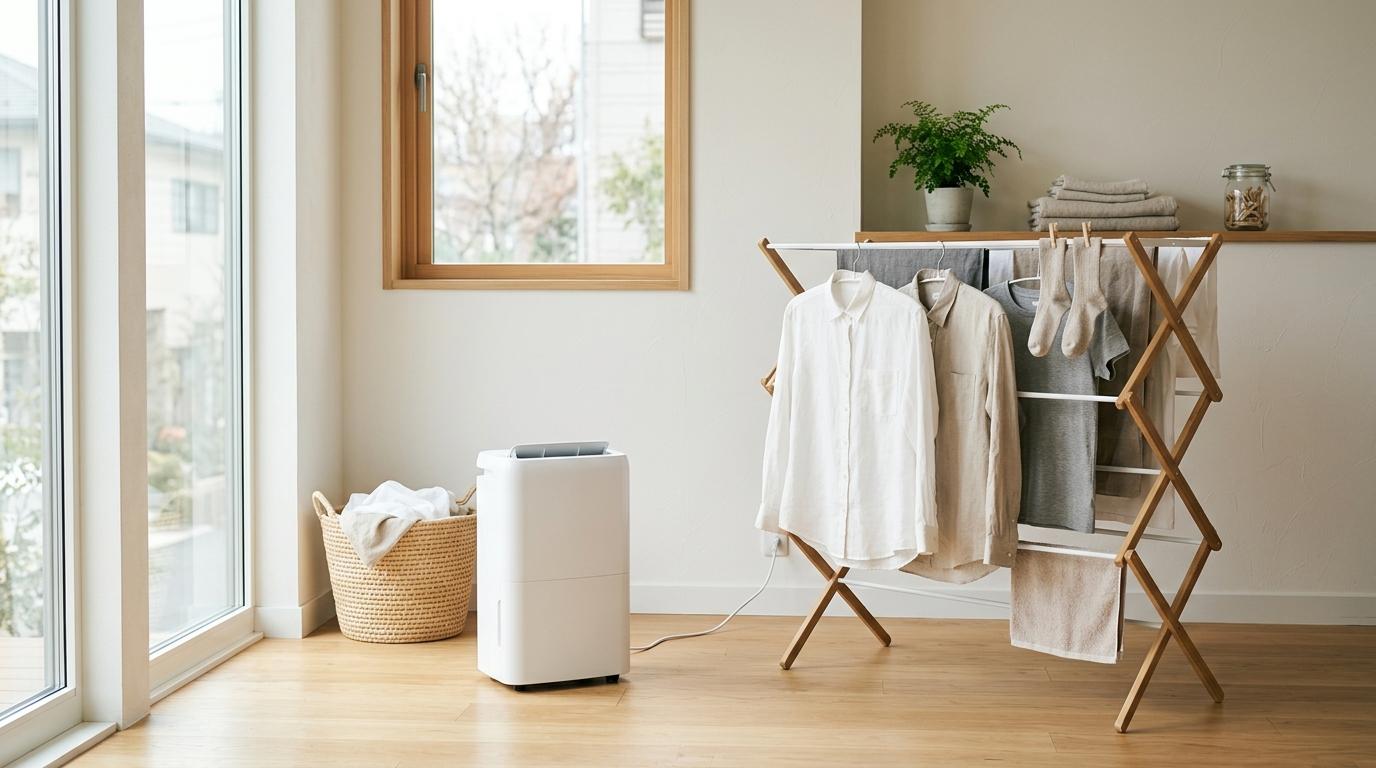
For many small flats and humid homes, the best setup is not a heated airer on its own. It’s a normal drying rack with a dehumidifier running nearby in a closed room.
That sounds less exciting than a new heated gadget, but it often works better because it deals with the thing that causes most indoor laundry problems: moisture trapped in the air.
Quick answer
#If you just want the short version, here it is.
- Choose a drying rack if your room is airy, sunny, or well ventilated.
- Choose a heated airer if you need faster drying for T-shirts, uniforms, baby clothes, socks, or daily basics.
- Choose a dehumidifier if your windows get condensation, your room feels clammy, or clothes smell musty after drying indoors.
- Best setup for many small homes: a drying rack plus a dehumidifier.
- Best budget setup: a sturdy drying rack, good spacing, and as much airflow as you can safely get.
One thing to keep in mind: running costs and drying times vary a lot. The room size, weather, electricity rate, washing machine spin speed, fabric type, and exact appliance model all make a difference. So treat any “cost per load” claim as a rough guide, not a guarantee.
Why drying clothes indoors becomes such a pain
#Drying laundry indoors sounds simple enough. Hang the clothes, wait a few hours, put them away.
But if you live in a small apartment, shared flat, hostel room, basement unit, or home without a balcony, it can quickly become annoying.
Wet laundry releases a lot of moisture into the room. If that moisture has nowhere to go, you get:
- clothes that stay damp for ages
- towels that smell stale
- foggy windows
- damp corners
- mould risk around walls, wardrobes, or curtains
- that heavy, humid feeling in the room
That’s why the choice between a drying rack, heated airer, and dehumidifier is not just about speed. It’s about what happens to the water after it leaves your clothes.
Heated airer vs dehumidifier vs drying rack: the real difference
#There isn’t one perfect answer for every home. These three options solve slightly different problems.
A drying rack gives clothes space to air-dry.
A heated airer adds warmth, so some clothes dry faster.
A dehumidifier removes moisture from the room, which helps clothes dry and stops the room from becoming damp.
Let’s look at each one properly.
1. Standard drying rack: cheap, simple, but slow
#A standard drying rack, clothes horse, or clothes airer is the simplest option. No plug, no settings, no electricity. You unfold it, hang the clothes, and let air movement do the work.
Best for
#A drying rack is best if you have:
- good ventilation
- a sunny window
- a balcony or utility area
- smaller laundry loads
- time to let clothes dry naturally
What it does well
#A normal drying rack is hard to beat for basic indoor drying because it:
- costs nothing to run
- is cheap to buy
- folds away easily
- is gentle on delicate fabrics
- works well in airy rooms
- gives you flexible hanging space
Where it struggles
#The problem is that a rack does not remove moisture. It simply lets the water evaporate into the room.
That can be fine in a breezy, dry space. But in a closed room, it can lead to:
- slow drying
- musty smells
- condensation on windows
- damp bedding or curtains nearby
- mould risk in corners or wardrobes
A drying rack is not a bad choice at all. In fact, it’s the best starting point for many people. But it depends heavily on the room.
In a warm, airy home, it may be all you need. In a small sealed flat during rainy weather, it can turn laundry day into a two-day damp-smelling waiting game.
If your main issue is laundry smell during humid weather, you may find this useful: how to dry clothes in monsoon without smell or fungus.
2. Heated airer: faster than a rack, but it still adds moisture to the room
#A heated airer looks like a normal drying rack, but the bars warm up when plugged in. The heat helps clothes dry faster than they would on a basic rack.
It feels like an easy upgrade because you still dry clothes in the same way. You just get a bit of extra help from the heated bars.
Best for
#A heated airer is useful if you:
- dry clothes indoors regularly
- need faster drying than a normal rack
- mostly dry light or medium fabrics
- want something smaller than a tumble dryer
- need quick turnaround for school uniforms, innerwear, baby clothes, or work clothes
What it does well
#A heated airer can be genuinely handy. It can:
- speed up drying for lighter clothes
- use less space than many larger drying appliances
- be gentler than tumble drying for many fabrics
- fold away, depending on the design
- help with small daily laundry loads
Where it struggles
#The main thing people misunderstand is this:
A heated airer dries clothes, but it does not remove moisture from the room.
The water from your clothes still evaporates into the air. If the room is already damp or poorly ventilated, that moisture can end up on windows, walls, wardrobes, bedding, or curtains.
Other common issues:
- clothes dry fastest where they touch the heated bars
- thick items may dry unevenly
- you may need to rotate clothes
- overloading slows everything down
- towels, jeans, and hoodies can still take a long time
A cover can help by trapping warmth around the clothes, and it may improve drying speed. But even with a cover, the moisture still needs somewhere to go.
So a heated airer is best when your main issue is speed, not dampness.
If your windows fog up every time you dry laundry, a heated airer alone probably won’t fix the real problem.
3. Dehumidifier: best for damp rooms, condensation, and musty laundry
#A dehumidifier works differently. It does not heat the clothes directly like a heated airer. Instead, it pulls moisture out of the air.
When you place a dehumidifier near a drying rack in a closed room, it lowers the humidity around the clothes. Drier air helps moisture leave the fabric faster.
That’s why a dehumidifier can be such a good indoor laundry tool, especially in small flats and humid homes.
Best for
#A dehumidifier is the better choice if you have:
- frequent indoor laundry
- window condensation
- damp corners
- musty-smelling clothes
- poor ventilation
- humid weather
- a small room where moisture gets trapped
What it does well
#A dehumidifier helps because it:
- removes moisture from the room
- helps clothes dry without making the room clammy
- reduces condensation when used properly
- can make laundry smell fresher
- is useful beyond laundry day
- works well with a normal drying rack
For many people, that last point is important. You don’t always need a heated airer if you already have a good rack. Pairing that rack with a dehumidifier can be more effective than adding heat alone.
Where it struggles
#A dehumidifier is not perfect either. It:
- costs more upfront than a drying rack
- uses electricity
- works best in a closed room
- needs the water tank emptied
- can be noisy, depending on the model
- performs differently depending on room temperature and humidity
But if damp is already part of the problem, a dehumidifier is usually the smarter long-term buy. It tackles the moisture instead of just warming the laundry.
If you’re unsure whether your home needs moisture control or air cleaning, read this: air purifier vs dehumidifier for Indian monsoon homes.
The easiest way to choose
#Before buying anything, ask yourself what the actual problem is.
If clothes dry slowly but the room feels fresh
#A better drying rack or heated airer may be enough.
If clothes dry slowly and the room feels damp
#A dehumidifier is probably the better upgrade.
If windows fog up when laundry is drying
#You have a moisture problem. A heated airer alone will not solve that.
If you dry clothes indoors several times a week
#A dehumidifier becomes much more worth considering.
If you only dry small loads indoors occasionally
#A simple drying rack is probably fine.
The real question is not “Which one dries clothes fastest?”
It’s: where is all that moisture going?
Who should buy a drying rack?
#Buy a standard drying rack if:
- you have a balcony, sunny window, or airy corner
- your laundry loads are small
- you can wait longer for clothes to dry
- you want the cheapest option
- you mostly dry lightweight clothes
- you do not have condensation or damp problems
Avoid relying only on a drying rack if:
- clothes smell musty after drying
- your room already feels damp
- windows collect water droplets
- you dry thick towels, jeans, or bedsheets often
- there is very little airflow in the drying area
A drying rack is the best budget option. But if it leaves your room damp and your clothes smelling stale, it may not feel so cheap in the long run.
Who should buy a heated airer?
#Buy a heated airer if:
- you want faster drying than a normal rack
- your home is not especially damp
- you need quick drying for daily basics
- you dry smaller loads indoors
- you want something foldable and easy to store
- you are not ready to buy a dehumidifier
Avoid a heated airer if:
- your room already has condensation
- laundry often smells damp
- you plan to overload it with heavy clothes
- you expect thick towels and jeans to dry evenly without rotating
- you need moisture control for the room itself
A heated airer is useful, but it is not a damp-control appliance. It warms fabric. It does not remove water from your home.
Who should buy a dehumidifier?
#Buy a dehumidifier if:
- you dry laundry indoors several times a week
- your windows mist up
- clothes smell musty even after drying
- your home is small, humid, or poorly ventilated
- you want to reduce moisture in the room
- you want one appliance that helps with laundry and general dampness
Avoid a dehumidifier if:
- you only dry clothes indoors once in a while
- your home is very drafty and cannot be closed off
- you do not want to empty a water tank
- you have nowhere safe to place it
- your issue is only lack of hanging space, not humidity
A dehumidifier makes the most sense when your laundry problem is also a room humidity problem.
What to check before buying
#1. Look at the room first
#Before comparing appliances, look at where you actually dry clothes.
Ask yourself:
- Is there a window?
- Is there cross-ventilation?
- Does the room smell damp?
- Do windows fog up overnight?
- Is there space around the rack?
- Can you close the door if using a dehumidifier?
A good appliance in the wrong room can still perform badly. This is where a lot of people go wrong.
2. Think about how much laundry you dry
#A student drying a few T-shirts has a very different problem from a family drying towels, uniforms, bedsheets, and baby clothes.
For small loads, a rack or heated airer may be enough.
For frequent indoor family laundry, moisture buildup becomes a bigger issue. That’s where a dehumidifier can make a noticeable difference.
3. Think about the fabrics
#Light clothes dry quickly. Heavy fabrics hold water for much longer.
A heated airer can work well for:
- T-shirts
- socks
- innerwear
- light shirts
- children’s clothes
- thin sleepwear
A drying rack plus dehumidifier is often better for:
- towels
- jeans
- sweatshirts
- bedsheets
- hoodies
- mixed laundry loads
Heavy clothes need airflow around the whole fabric, not just heat on one part of it.
4. Check spacing and capacity
#Do not judge a rack or heated airer only by the claimed capacity.
If clothes are packed too tightly, damp air gets trapped between them and drying slows down.
Look for:
- enough space between bars
- a stable frame
- height for longer clothes
- a folded size that suits your home
- safe weight handling
- enough room for airflow between garments
With indoor drying, spacing matters more than people think. Sometimes it matters more than heat.
5. Think about safety and placement
#For heated airers, check:
- stable feet
- cable length
- plug location
- whether a cover is allowed
- manufacturer guidance on unattended use
- distance from bedding, curtains, and clutter
For dehumidifiers, check:
- tank size
- easy emptying
- drainage option
- noise level
- room size suitability
- filter cleaning
- laundry or continuous mode, if available
Also think about real-life space. An appliance may look compact online, but once it is loaded with wet clothes, it can take up much more room than expected.
6. Don’t rely only on wattage
#Wattage matters, but it is not the whole story.
A lower-watt appliance running for many hours may not always cost less than a higher-watt appliance running for a shorter time.
Actual running cost depends on:
- appliance wattage
- drying time
- electricity rate
- load size
- washing machine spin speed
- room temperature
- humidity
- spacing between clothes
That’s why online running-cost comparisons are useful as rough guidance, but they may not match your home exactly.
Common mistakes to avoid
#Mistake 1: Drying clothes in a closed room with no moisture plan
#If you shut wet laundry in a room with no airflow and no dehumidifier, the moisture has nowhere useful to go.
The clothes may stay damp, and the room may start to smell stale.
If you use a normal rack or heated airer, you usually need some ventilation. If you use a dehumidifier, close the room so the machine can work properly.
Mistake 2: Overloading the rack
#More clothes on the rack does not always mean more efficient drying. Usually, it just means slower drying.
Leave gaps between items. Put thicker fabrics on outer bars. Turn towels, jeans, and hoodies partway through if needed.
Mistake 3: Ignoring the washing machine spin cycle
#The less water clothes hold before you hang them, the easier they are to dry.
Use a suitable spin setting for the fabric. Don’t spin delicate items aggressively if the care label says not to, but don’t hang clothes wetter than they need to be either.
Mistake 4: Thinking a heated airer removes damp
#A heated airer warms clothes. The moisture still goes into the room air.
If your windows mist up while using a heated airer, your problem is not just drying speed. It is humidity.
Mistake 5: Running a dehumidifier beside an open window
#A dehumidifier works best in a closed room.
If the window is open, the machine keeps dealing with fresh incoming air instead of focusing on the moisture from your laundry.
Set up the rack, place the dehumidifier nearby with space around it, close the door, and let it work.
Mistake 6: Drying laundry too close to walls or wardrobes
#Wet laundry needs air around it.
If you push a loaded rack against a wall, wardrobe, mattress, or curtain, moisture can collect there. This is especially risky in humid weather.
For more on laundry smell and wardrobe mould, see: monsoon laundry smell, drying clothes, and wardrobe mold.
Best setup by living situation
#For students in one room
#Start with a foldable drying rack. If clothes often smell damp, add a small dehumidifier if your budget allows.
A heated airer can help if you need faster drying, but avoid relying on it in a room that already traps moisture.
Best setup: drying rack plus ventilation, or drying rack plus dehumidifier in damp rooms.
For apartment renters
#If you have a balcony or good window airflow, a drying rack may be enough.
If you dry clothes in the bedroom or living room, a dehumidifier is often more useful than a heated airer alone.
Best setup: drying rack plus dehumidifier, especially in humid or cold seasons.
For families
#Families usually need more capacity. A single heated airer may not handle large mixed loads well unless you dry in batches.
A larger clothes airer with a dehumidifier is usually more flexible.
Best setup: large drying rack plus dehumidifier in a closed room.
For humid climates or rainy seasons
#When the air is already full of moisture, a basic rack can struggle. A heated airer may help with speed, but the room can still become damp.
A dehumidifier is usually the stronger option when humidity is the main issue.
Best setup: drying rack plus dehumidifier, with clothes spaced well.
For occasional indoor drying
#If you only dry indoors during bad weather, keep it simple.
You probably do not need to buy a powered appliance for a problem that happens rarely.
Best setup: standard drying rack.
So, which one should you buy?
#Buy a drying rack if your home has good airflow and you want the lowest-cost option.
Buy a heated airer if your main problem is drying speed and your room is not already damp.
Buy a dehumidifier if you dry clothes indoors often, see condensation, or deal with musty laundry.
For small apartments, humid homes, and poorly ventilated rooms, the most balanced setup is usually a drying rack plus a dehumidifier. It gives clothes space to dry while removing the moisture from the air.
Final verdict
#In the heated airer vs dehumidifier debate, the better buy depends on your actual problem.
If the issue is speed, a heated airer can help.
If the issue is damp, a dehumidifier is the better choice.
If the issue is budget, start with a good drying rack and improve your drying habits first.
For many small homes, the best long-term solution is not a heated airer on its own. It is a well-spaced drying rack with a dehumidifier running in a closed room.
That setup tackles the real enemy of indoor clothes drying: trapped moisture.