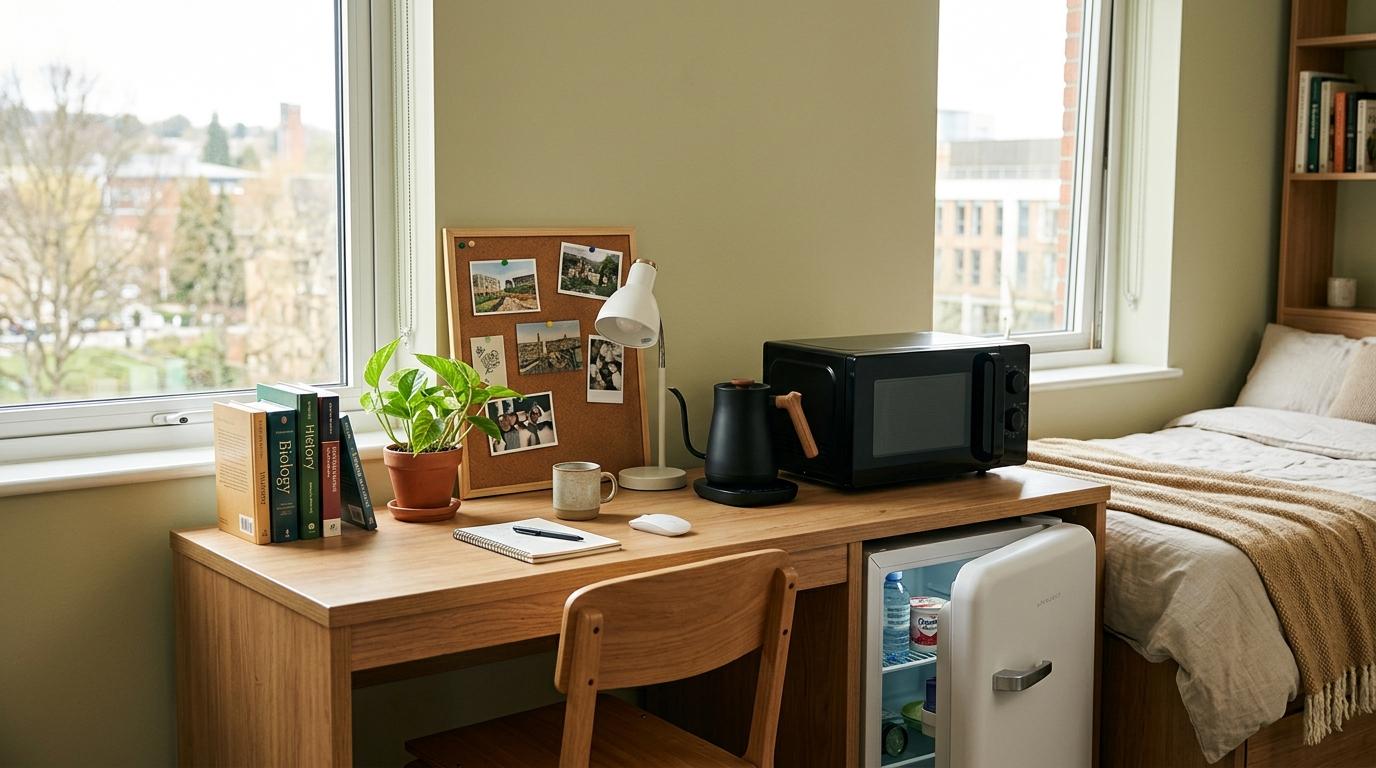
If you’re trying to choose between a mini fridge, microwave, and electric kettle, my honest answer is: start with the electric kettle.
For most hostel, dorm, PG, or small student-room setups, it’s the one appliance you’ll probably use the most. It doesn’t take up much space, it’s easier to manage, and in many places, it causes fewer rule-related problems than a microwave or fridge.
You can use it for tea, coffee, hot water, instant oats, noodles, soups, hot chocolate, and quick breakfasts when you’re running late for class. Basically, it handles a lot of those small daily “I need food or caffeine right now” moments.
A microwave is great too, especially if you reheat leftovers often. A mini fridge can be useful, but only if you actually need cold storage every day.
The mistake many students make is buying everything at once because it looks like the “complete dorm setup.” But once you move in, reality hits: one awkward plug point, barely any counter space, hostel rules, roommate opinions, and a budget that is already crying.
So instead of buying what looks nice online, here’s a practical guide to help you decide what to buy first, what to buy later, and what you may not need at all.
Who This Guide Is For
#This guide is for students living in:
- College dorms
- Hostels
- PG accommodations
- Shared student rooms
- Small rented rooms with limited cooking space
It will be especially useful if:
- Your room is tiny
- You don’t have access to a proper kitchen
- Open flames or gas stoves are not allowed
- You depend on a mess, canteen, dining hall, or outside food
- You want a simple food corner without overcrowding your room
- You’re looking for practical hostel room appliances
- You want easy no-fridge breakfast or snack ideas
This is not about building a full kitchen inside your room. It’s more of a realistic student room appliance buying guide: buy one useful thing first, then upgrade only if your routine actually needs it.
What to Check Before Buying Anything
#Before you order an appliance, check the rules.
Yes, it’s boring. No, it’s not optional.
The last thing you want is to spend money on a microwave or fridge and then find out your hostel doesn’t allow it.
1. Hostel or dorm appliance rules
#Every place has different rules.
Some hostels allow electric kettles but ban microwaves. Some allow microwaves only in common areas. Some PGs don’t care much. Some college dorms are very strict and allow only approved appliances.
Before buying, check:
- Hostel handbook
- Dorm website
- PG agreement
- Warden or resident assistant instructions
- Move-in guidelines
- Appliance wattage limits
- Approved appliance lists, if any
Also, ask seniors. They usually know the real situation better than the official rulebook.
2. Wattage limits
#Wattage matters because hostel rooms often share electrical circuits. If too many high-power appliances run at once, the power can trip.
Microwaves are often around 700W or more. Kettles can also be high-wattage, depending on the model.
If your hostel has a wattage limit, follow it properly. Don’t assume “it’ll be fine.” Sometimes it won’t be fine, and sometimes the whole floor will know it was you.
3. Safety certification
#Look for safety certification marks like UL or ETL, where applicable. If your country or hostel follows another standard, follow that instead.
The point is simple: avoid unknown, no-label appliances just because they’re cheap. In a small room full of books, clothes, bedding, chargers, and bags, appliance safety matters.
4. Auto shut-off
#For heating appliances, auto shut-off is a big deal.
Students forget things. Everyone does. You put water to boil, someone calls you, your roommate starts talking, you leave for five minutes, and suddenly it’s been twenty.
For an electric kettle, look for:
- Auto shut-off
- Boil-dry protection
- Stable base
- Covered or concealed heating element
- Comfortable handle
- Secure lid
For a microwave, check for:
- Proper door seal
- Clear safety labeling
- Approved wattage
- Good ventilation space
- Stable placement
5. Space and plug points
#Product photos are lies in a very polite form. Everything looks cute and compact in a clean, well-lit room with perfect shelves.
Your actual room may have one usable plug point behind the bed.
Before buying, ask yourself:
- Where will this appliance sit?
- Is there a safe plug point nearby?
- Will it block the walkway?
- Is it too close to bedding, curtains, papers, or clothes?
- Does it need ventilation?
- Can I clean around it easily?
- Will my roommate hate it?
A mini fridge for dorm room use may look small online, but it still takes up real floor space. A microwave needs a stable, heat-safe surface. Even a kettle needs a dry, steady spot.
6. Roommate comfort
#If you share your room, talk before buying.
A mini fridge can hum at night. A microwave can leave smells. A kettle can become a shared appliance that nobody cleans properly.
In a small room, even small annoyances become big very quickly. Decide where the appliance will go, who can use it, and who is responsible for cleaning it.
Quick Comparison: Mini Fridge vs Microwave vs Electric Kettle
#Here’s the simple version without overcomplicating the decision.
Electric kettle
#- Best for: Tea, coffee, hot water, instant oats, noodles, soups and quick breakfasts.
- Space needed: Low.
- Rule risk: Usually lower than larger appliances, but still check your hostel or dorm rules.
- Daily usefulness: Very high for most students.
- Best first buy? Yes, for most hostel and dorm rooms.
Microwave
#- Best for: Reheating leftovers, warming ready meals and making simple mug snacks.
- Space needed: Medium.
- Rule risk: Medium to high, depending on wattage and building policy.
- Daily usefulness: High if you regularly reheat food.
- Best first buy? Usually second, after a kettle.
Mini fridge
#- Best for: Milk, curd, yogurt, leftovers, medication and fresh food that needs cold storage.
- Space needed: High for a small student room.
- Rule risk: Medium, especially if size or power limits apply.
- Daily usefulness: High only if you truly need cold storage.
- Best first buy? Usually third, unless refrigeration is medically or practically necessary.
In plain words: a kettle helps almost everyone. A microwave helps if you reheat food often. A mini fridge helps if you genuinely store perishable food or medicine.
1. Electric Kettle for Hostel Room: The Best First Buy
#If you can buy only one appliance, buy an electric kettle for hostel room use.
It’s small, quick, and useful from day one. You can make tea, coffee, hot water, instant oats, instant noodles, soup mixes, hot chocolate, and simple breakfast options.
For most students looking for dorm kitchen essentials, this is the appliance that earns its place fastest.
What to look for in an electric kettle
#Choose a kettle with:
- 1 litre to 1.5 litre capacity
- Auto shut-off
- Boil-dry protection
- Stable base
- Easy-to-clean opening
- Concealed heating element
- Safe, durable materials
- Wattage that fits your hostel rules
A wide-mouth kettle is easier to clean, especially if you use it for anything other than plain water. But read the manual first. Some kettles are meant only for boiling water, not cooking food directly inside them.
If your hostel rules say “water only,” follow that.
Who should buy an electric kettle first?
#Buy a kettle first if you:
- Drink tea, coffee, or hot water daily
- Need quick breakfast options
- Often miss breakfast because of class timings
- Want simple snacks without a fridge
- Have very little room space
- Want a low-effort, practical appliance
- Are not ready to buy bigger appliances yet
For most students, this is the easiest yes.
Who can skip the kettle?
#You may not need one if:
- Your floor already has a reliable 24/7 hot water dispenser
- Your hostel bans all personal heating appliances
- You never drink tea, coffee, soups, oats, noodles, or hot drinks
Otherwise, a kettle is usually the safest first purchase.
2. Microwave: The Best Second Upgrade If Rules Allow
#A microwave is genuinely useful, but it’s not always allowed. That’s why it usually makes sense as your second appliance, not your first.
Microwaves are great for:
- Reheating leftovers
- Warming packed food
- Heating ready-to-eat meals
- Making simple mug snacks
- Reviving food that got cold by the time you reached your room
If you often bring food back from the dining hall, order takeout, or save leftovers, a microwave can make hostel life much easier.
But check the rules before buying one. Dorm microwave rules can be strict.
What to look for in a microwave
#Choose a microwave that matches your housing policy. Check for:
- Compact size, often around 0.7 cubic feet
- Wattage that fits the rulebook, commonly 700W or less where required
- Safety certification such as UL, ETL, or the required local standard
- Good ventilation space
- Simple controls
- Stable placement
Don’t buy a huge microwave for a tiny student room. Bigger is not better if it takes over your desk, blocks ventilation, or breaks hostel rules.
Who should buy a microwave?
#Buy a microwave if:
- Your hostel or dorm clearly allows it
- You regularly reheat leftovers
- You eat ready-to-heat meals
- You have a safe shelf or counter for it
- You and your roommate can share the cost and space
- You’ll use it several times a week
Who should avoid a microwave?
#Avoid it if:
- Your college, hostel, or PG bans personal microwaves
- Your room has no safe counter space
- You mostly eat fresh meals outside your room
- Your building has strict electrical load limits
- Microwaves are only allowed in common areas
Some colleges don’t allow personal microwaves at all. Some allow only approved rentals or combo units. It’s better to check first than to carry a microwave back home awkwardly.
3. Mini Fridge for Dorm Room: Useful, But Easy to Overbuy
#A mini fridge for dorm room use sounds like a must-have. It feels like the classic student-room appliance.
But honestly, it’s also the easiest one to overbuy.
If you don’t regularly keep milk, curd, yogurt, fruit, leftovers, fresh food, or medicine that needs refrigeration, your mini fridge may become an expensive storage box for water bottles and forgotten takeout.
That doesn’t mean it’s useless. For the right student, a mini fridge can be very important. But it should be based on your actual habits, not just the idea of having one.
What to look for in a mini fridge
#Choose a mini fridge with:
- Size approved by your hostel or dorm
- Safety certification
- Energy-efficient operation
- Reversible door, if your room layout is tight
- Enough capacity for your real needs
- Stable placement
- Proper ventilation space
A mini fridge around 3.2 cubic feet is common in dorm-style setups, but your hostel may have a different allowed size. Always follow your building’s rules.
Who should buy a mini fridge?
#Buy a mini fridge if:
- You need to refrigerate medication
- You drink milk daily
- You eat cereal, curd, yogurt, or chilled foods often
- You store leftovers safely
- You meal-prep fresh foods
- You have enough floor space
- Your housing rules allow it
Who should skip the mini fridge?
#Skip it if:
- You mostly eat at the mess, dining hall, canteen, or outside
- You want a simple no-fridge hostel breakfast setup
- Your room has very little floor space
- You are on a tight budget
- You rarely finish perishable food before it spoils
- Your roommate already has one and is willing to share
For many students, a mini fridge is better as a later purchase. Live in your room for a bit first. You’ll quickly know whether you actually need cold storage.
What About a Microfridge?
#Some colleges and dorms allow or recommend a Microfridge, which combines a microwave and mini fridge in one unit.
The useful part is that these units are often designed to work through a single plug system. In many setups, the microwave temporarily cuts power to the fridge while running, which helps reduce electrical overload.
A Microfridge may be a good option if:
- Your dorm bans separate personal microwaves
- Your housing office offers approved rentals
- You want both a fridge and microwave
- You prefer one approved unit instead of two separate appliances
But don’t assume any random microwave-fridge combo will be accepted. If your dorm has a specific rental or approval system, follow that. It may feel annoying, but it saves you trouble later.
Best Buying Order for Most Students
#If your rules allow all three appliances, the best buying order is usually:
1. Electric kettle
#Start here. It’s compact, useful, and perfect for quick breakfasts, hot drinks, instant food, and late-night hunger.
2. Microwave
#Add this if you reheat food often and your hostel or dorm allows it.
3. Mini fridge
#Buy this only if you need cold storage regularly.
This order helps you avoid wasting money and crowding your room. Many students think they’ll cook, meal-prep, and live like organized adults from day one. Then classes start, assignments pile up, and the dining hall becomes the main food plan.
If possible, live in your room for one or two weeks before buying everything. Your real routine will become obvious.
Common Mistakes to Avoid
#Buying all three on day one
#It feels efficient, but it often creates clutter.
Start with what you’ll use daily. For most students, that’s the kettle. Add more only when your routine proves you need more.
Ignoring the rulebook
#This is the biggest mistake.
A great appliance is useless if your hostel doesn’t allow it. Check the wattage, size, certification, and appliance category before buying.
Buying a high-wattage appliance because it looks faster
#Faster is not helpful if it trips the circuit or gets you in trouble.
In shared buildings, approved wattage matters more than speed.
Forgetting ventilation
#Microwaves and mini fridges need space around them. Don’t push them tightly between bags, bedding, books, or clothes.
Poor ventilation can affect performance and create safety issues.
Using a kettle like a full cooking pot
#A kettle is great for hot water. Some students use wide-mouth kettles for simple foods, but you should follow both the appliance manual and hostel rules.
If you do make food inside it, clean it immediately. Food residue can smell, stick, and damage the kettle. Also, your roommate will complain, and honestly, they’ll have a point.
Buying a mini fridge without a food plan
#A fridge only makes sense if you use it properly.
If your usual breakfast is instant oats, bananas, peanut butter, bread, dry snacks, or protein bars, you may not need a fridge at all.
Not coordinating with roommates
#Two kettles, two mini fridges, and one tiny room is a bad setup.
Talk first. Share if possible. Decide cleaning rules early. It prevents a lot of unnecessary arguments.
Simple No-Fridge Food Setup With Just a Kettle
#You don’t need a mini fridge to make a useful food corner.
With just a kettle, you can keep:
- Instant oats
- Tea or coffee
- Instant soup packets
- Instant noodles
- Peanut butter
- Bread or crackers
- Bananas or apples
- Dry snacks
- Protein bars
- Hot chocolate mix
This is why a kettle works so well as the first appliance. It supports quick breakfasts, late-night snacks, and basic comfort food without needing cold storage.
If you’re looking for no-fridge hostel breakfast ideas, this is the easiest place to start.
Final Takeaway
#When comparing mini fridge vs microwave vs electric kettle, the best first buy for most hostel and dorm students is the electric kettle.
It’s small, practical, and fits real student life: quick breakfast, hot drinks, instant meals, late-night snacks, and emergency caffeine.
A microwave is a good second appliance if your rules allow it and you reheat food often. A mini fridge should come later, unless you truly need cold storage for food or medication.
Start small. Check the rules. Buy what you’ll actually use every day, not what looks perfect in a staged dorm-room photo.