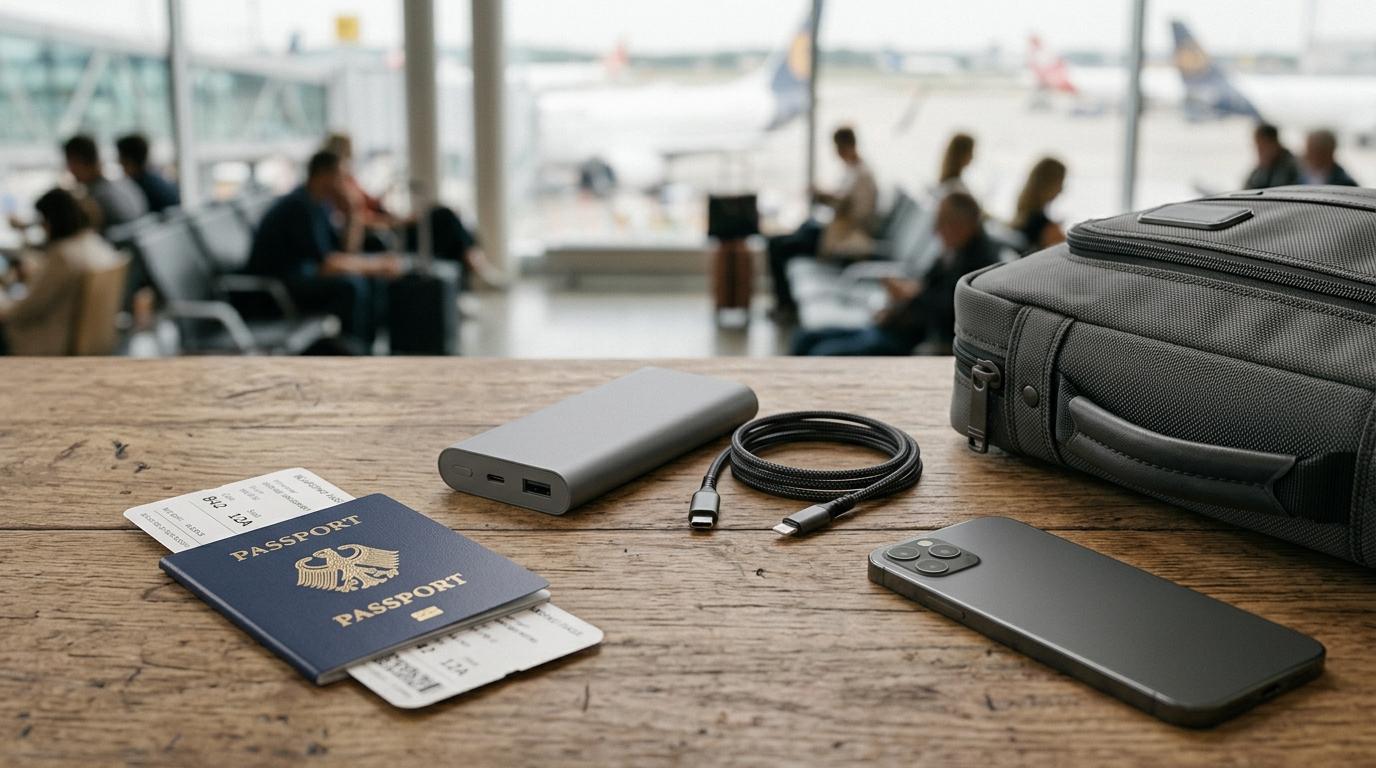
Buying a power bank for travel seems easy until you start thinking about airline battery rules. Then suddenly, all those big mAh numbers and “airline approved” claims get a little confusing.
Here’s the simple version: for most travelers, the safest choice is a power bank under 100Wh, with the battery rating clearly printed on the case, packed in your carry-on or personal item. Do not put it in your checked bag.
If you just want a reliable charger for flights, airports, hotels, and long travel days, look for a 10,000mAh to 20,000mAh USB-C Power Delivery power bank. That range is practical, easy to carry, and usually well below airline limits.
If you need to charge a laptop, you may want something larger, but you still need to check the watt-hour rating, output wattage, and printed label before flying.
Quick Answer: Flight-Safe Power Bank Checklist
#If you are buying a power bank right now, use this checklist:
- Capacity: stay under 100Wh for the easiest airline approval.
- mAh range: 10,000mAh to 20,000mAh is enough for most travelers.
- Label: Wh rating or full battery specs should be printed on the power bank.
- Where to pack it: keep it in your carry-on or personal item, not checked luggage.
- USB-C: choose USB-C Power Delivery, also called USB-C PD.
- Laptop charging: look for higher output, usually 60W or more.
- Very large power banks: be careful with 30,000mAh+ models, as they may exceed flight limits.
A good rule of thumb: if the power bank does not have a readable battery rating printed on it, do not buy it for flights.
Why Flights Make Power Bank Shopping Different
#For normal everyday use, most people shop by battery size. A bigger mAh number sounds better, and sometimes it is.
But air travel changes things.
Airlines and airport security care about lithium battery safety. For flights, the important number is usually the watt-hour rating, written as Wh. Power banks are treated as spare lithium batteries, which is why they normally need to travel in the cabin, not in checked luggage.
That way, if there is ever a battery issue, crew can deal with it quickly.
So when you buy a power bank for flying, you are not just asking, “How many times can this charge my phone?”
You also need to ask:
- Is it under the common 100Wh limit?
- Is the rating printed clearly on the case?
- Can airport staff quickly identify the battery size?
- Does it charge my phone, tablet, or laptop fast enough?
- Is it from a reliable brand with basic safety protections?
- Is it easy to carry, pack, and inspect?
The best travel power bank is not always the biggest one. It is the one that gets through security without drama and actually works for the devices you carry.
Who Should Buy a Travel Power Bank
#Frequent flyers
#If you spend a lot of time in airports, a power bank is one of those things you only forget once.
Your boarding pass, ride app, hotel booking, maps, messages, camera, translation app, and payment wallet all depend on your phone staying alive.
For most frequent flyers, a 10,000mAh to 20,000mAh power bank is the sweet spot. It gives you real backup power without turning your bag into a brick.
Remote workers
#If you work from lounges, cafes, trains, airport gates, or hotel lobbies, pay close attention to output wattage.
A small phone-focused power bank may be fine for your phone, but it might barely help your laptop. In some cases, it may only slow down the battery drain instead of actually charging the laptop.
For laptop travel, check two things:
- Capacity, shown in Wh or mAh
- Output wattage, shown in W
A larger USB-C PD power bank that stays under 100Wh can make sense for remote workers. Just make sure the Wh rating is printed clearly on the device itself, not only shown on the online product page.
Students
#Students usually carry a mix of devices: phone, earbuds, tablet, maybe a laptop, and sometimes a handheld gaming device.
Tiny novelty chargers can be cute, but they are not always useful when you have a full day of classes, commuting, studying, and travel.
A 20,000mAh class USB-C power bank is usually a practical choice for students, as long as it stays under 100Wh and has clear battery markings.
Families
#Families often need to charge several devices at once: phones, tablets, headphones, kids’ gaming devices, e-readers, and more.
A power bank with multiple ports can be helpful, but one huge power bank is not always the best answer.
In many cases, two smaller power banks are easier than one giant one. They are easier to share, easier to pack, and less likely to create confusion around airline battery limits.
Everyday travelers
#If you mostly need backup for your phone, maps, messages, photos, and ride apps, do not overbuy.
A reliable 10,000mAh USB-C power bank is often enough. It is lighter, easier to carry, and usually well under airline battery limits.
Who Should Avoid a Large Power Bank for Flights
#The “biggest battery wins” shopper
#A 30,000mAh power bank looks tempting. More power sounds better.
But for flights, that size can get close to the airline limit or go over it, depending on the voltage and actual Wh rating.
In general:
- Under 100Wh is the easiest range for air travel
- 100Wh to 160Wh may require airline approval
- Over 160Wh is generally not allowed on passenger flights
If you want the lowest-stress option, skip oversized power banks for flying.
The bargain-bin buyer
#Very cheap, no-name power banks can be risky. The problem is not only slow charging. The bigger issue is that the labeling, battery quality, and safety protections may be poor.
Avoid power banks that:
- Do not show Wh or full battery specs
- Have unclear, fake-looking, or missing labels
- Feel poorly built
- Have loose or damaged ports
- Have swollen, cracked, or warped casing
- Claim huge capacity without proper markings
If airport staff cannot verify the battery rating, they may refuse it, even if the battery is technically within the allowed limit.
The checked-bag packer
#If you want something you can throw into any suitcase and forget about, a power bank is not that thing.
Power banks should go in your carry-on or personal item, not your checked luggage.
Before you leave for the airport, it is worth checking every pocket of your checked bag. Power banks are easy to forget in side compartments.
What to Check Before Buying a Power Bank for Flights
#1. Check Wh first, not just mAh
#Most power banks are advertised by mAh, such as 10,000mAh, 20,000mAh, or 26,800mAh.
That number is useful, but airline rules usually care about Wh, which means watt-hours.
So mAh alone is not enough. A good travel power bank should show its Wh rating, or at least show enough battery information for you to calculate it.
The basic formula is:
(mAh × volts) ÷ 1000 = Wh
Most power banks use internal lithium cells around 3.7V.
Approximate examples at 3.7V:
- 10,000mAh: about 37Wh, usually fine for flights.
- 20,000mAh: about 74Wh, usually fine for flights.
- 26,800mAh: about 99.16Wh, very close to 100Wh.
- 30,000mAh: about 111Wh, may need approval or may not be accepted.
This is why you often see people mention a rough flight-friendly ceiling around 27,000mAh. At 3.7V, that lands close to 100Wh.
Still, do not rely only on rough math. Check the actual printed rating on the power bank.
2. Make sure the rating is printed on the power bank
#This is one of the easiest details to overlook.
A travel-friendly power bank should have its battery information printed on the body. Ideally, it should show:
- Capacity in mAh
- Voltage
- Wh rating
- Input rating
- Output rating
- Brand and model information
If the Wh rating is missing, airport staff may not care that you found it on a product page. They may not have time to check a listing or verify your calculation.
Before buying online, zoom in on the product photos. Before packing for a trip, check the actual power bank in your hand.
If the label has rubbed off or become unreadable, it may be time to replace it before flying.
3. Choose the right mAh size for your trip
#Do not buy more capacity than you actually need.
Bigger power banks cost more, weigh more, take longer to recharge, and may attract more attention during checks. For most trips, a moderate size is easier to live with.
A simple way to choose:
- Light phone user: 5,000mAh to 10,000mAh, useful as a small phone backup.
- Regular traveler: 10,000mAh to 20,000mAh, the best balance of size and usefulness.
- Long-haul traveler: 20,000mAh class, better for long airport days.
- Laptop user: higher-capacity USB-C PD model under 100Wh, useful only if the output is strong enough.
- Camping or emergency backup: 30,000mAh+ or a power station, better for non-flight use.
For most people flying with phones, earbuds, tablets, and small devices, 10,000mAh to 20,000mAh is the best range.
4. Understand real-world capacity
#A 10,000mAh power bank will not deliver exactly 10,000mAh into your phone.
Some energy is lost through voltage conversion, heat, and normal charging inefficiency. That is completely normal.
So if your phone has a 5,000mAh battery, a 10,000mAh power bank probably will not give you two perfect full charges from zero to 100%.
It can still be plenty for travel. Just do not expect the math to work perfectly in real life.
This is one reason heavy phone users, content creators, and remote workers often prefer the 20,000mAh class.
5. Check USB-C Power Delivery
#A USB-C power bank is usually the better buy today, especially if your phone, tablet, earbuds, or laptop already use USB-C.
Look for USB-C Power Delivery, often written as USB-C PD.
USB-C PD matters because it can give you:
- Faster phone charging
- Better tablet support
- Possible laptop charging
- Fewer cables if your devices are already USB-C
- More flexibility across modern devices
For phones and smaller devices, 20W to 30W output is often enough.
For laptops, check the charging requirements. Many laptops need around 45W, 60W, 65W, or more. If the power bank output is too low, it may charge painfully slowly or only slow down battery drain.
6. Check input speed too
#Output tells you how fast the power bank charges your devices.
Input tells you how fast the power bank itself recharges.
This matters more than people think. A large power bank with slow input can take a very long time to refill. That gets annoying if you only have a short hotel stop, a quick layover, or one available outlet at a crowded gate.
For travel, look for USB-C input and output, preferably with fast recharging through USB-C PD.
7. Check ports and cable needs
#Before buying, think about what you actually carry.
Ask yourself:
- Do I need USB-C only?
- Do I still need USB-A?
- Will I charge two devices at once?
- Does my laptop need USB-C to USB-C?
- Is the included cable good enough for fast charging?
- Do I need to bring a separate high-wattage cable?
A power bank might advertise high wattage, but you may not get that speed if your cable cannot handle it.
This is especially important for laptop charging. A weak or old cable can turn a good power bank into a slow one.
8. Look for basic safety features
#Do not buy a power bank only because it looks nice in the photos.
Battery safety matters, especially when flying. Look for basic protections such as:
- Overcharge protection
- Over-discharge protection
- Short-circuit protection
- Temperature protection
- Clear brand and model labeling
Also, do not travel with a damaged power bank.
If it is swollen, cracked, leaking, overheating, or damaged around the ports, replace it. It is not worth taking a chance with a questionable lithium battery.
Which Power Bank Size Should You Buy for Flights?
#No fake “best overall” claims here. No made-up rankings. Just a practical breakdown by size.
1. Pocket power bank, around 10,000mAh
#Approximate Wh: Around 37WhBest for: Phones, earbuds, smartwatches, e-readersGood for flights: Yes, usually well under 100WhBest buyer: Everyday travelers, students, light packers
This is the easiest size to recommend for most people.
A 10,000mAh power bank is small enough for a backpack pocket, sling bag, purse, or jacket pocket, but still useful enough for a long travel day.
Choose this size if your main goal is keeping your phone alive for boarding passes, maps, messages, photos, and ride apps.
Watch out for: Some smaller models have weak output. If fast charging matters to you, make sure it supports USB-C PD.
2. Mid-size power bank, around 20,000mAh
#Approximate Wh: Around 74WhBest for: Heavy phone users, tablets, long-haul flights, shared family useGood for flights: Yes, usually under 100WhBest buyer: Frequent flyers, students, families, content creators
This is the practical middle ground.
You get much more breathing room than a 10,000mAh power bank, but you are usually still comfortably below the 100Wh limit.
If you take lots of photos, use maps all day, stream video, work from your phone, travel with a tablet, or charge more than one device, this size makes sense.
Watch out for: It will be heavier. Also check recharge speed, because some larger power banks take a long time to fill back up.
3. Laptop-friendly power bank, roughly 24,000mAh to 26,800mAh
#Approximate Wh: Around 88Wh to just under 100Wh, depending on voltageBest for: USB-C laptops, tablets, multi-device work setupsGood for flights: Usually yes, if clearly under 100Wh and properly labeledBest buyer: Remote workers and business travelers
This is near the upper end of what many travelers should consider for flights.
A power bank in this range can be extremely useful if you need laptop backup in airports, during delays, at conferences, or between meetings.
But this size deserves more attention. Check:
- Exact Wh rating
- Printed battery label
- USB-C PD output
- Laptop wattage requirements
- Airline rules, especially if it is close to 100Wh
Watch out for: A power bank near 100Wh may be allowed, but only if the rating is clear. If the label is missing, faded, or hard to read, it can become a problem at security.
4. Oversized power bank, 30,000mAh and above
#Approximate Wh: Often above 100Wh, depending on voltageBest for: Road trips, camping, home backup, non-flight useGood for flights: Not idealBest buyer: People who need backup power away from airline restrictions
This is the category to be careful with.
Some 30,000mAh power banks exceed 100Wh, which can move them into the approval-required range or make them unsuitable for passenger flights.
For air travel, this size is usually more hassle than it is worth.
Watch out for: Do not assume 30,000mAh is allowed. Calculate Wh and check the printed rating before buying or packing it.
Carry-On Power Bank Rules: What Travelers Should Know
#Power bank rules can vary by airline and country, so always check your airline before flying. This is especially important for international trips.
The common pattern is:
- Power banks go in cabin baggage, not checked baggage
- Power banks under 100Wh are generally accepted without special approval
- Power banks between 100Wh and 160Wh may require airline approval
- Power banks above 160Wh are generally not allowed on passenger flights
- The battery rating should be clearly visible
Some airlines may also restrict using or charging power banks during the flight. Rules can change, and crew instructions always come first.
The safest habit is simple: charge your devices before boarding, keep the power bank in your personal item, and follow the airline’s instructions.
Related AllBlogs Guides
#If you want to go deeper before buying or packing, these guides are useful next reads:
- Power Bank Rules for International Flights from India
- Portable Fan & Power Bank Rules for Indian Flights
- GaN Charger Buying Guide: 30W vs 65W vs 100W
- USB-C Cable Buying Guide India: Fast Charging, Data Speed and Safety Checks
“Airline Approved” and “TSA Approved” Claims: Be Careful
#Product listings love phrases like:
- Airline approved
- Flight approved
- TSA approved
- Travel certified
Do not rely on those words by themselves.
What matters is the actual battery information:
- Wh rating
- mAh rating
- Voltage
- Battery type
- USB-C PD support
- Output wattage
- Safety protections
- Clear printed label
A marketing phrase does not replace airline battery rules.
If the specs are missing, vague, or hard to confirm, choose another model.
Mistakes to Avoid When Buying or Flying With a Power Bank
#Mistake 1: Packing it in checked luggage
#This is the big one.
Power banks should travel in your carry-on bag or personal item. Do not pack them in checked suitcases.
Lithium battery issues are safer to handle in the cabin than in the cargo hold. That is why airlines care so much about where spare batteries are packed.
Before leaving for the airport, check your checked bag for power banks, spare batteries, and battery cases. It is easy to forget one in a side pocket.
Mistake 2: Buying a power bank with no readable Wh rating
#A power bank without a visible rating can cause problems at security.
Even if it is actually under 100Wh, airport staff may not have time to verify a product listing, search the model number, or check your calculation.
A clear printed label makes everything easier.
Mistake 3: Confusing mAh with Wh
#mAh is useful when comparing power banks, but Wh is what matters for flight limits.
A 20,000mAh power bank is usually fine. A 30,000mAh power bank may not be. The difference becomes clear when you calculate or read the Wh rating.
Use the formula:
(mAh × volts) ÷ 1000 = Wh
Mistake 4: Ignoring output wattage
#A big battery with weak output can still be frustrating.
If you only charge a phone overnight, it may not matter much. But if you charge a tablet or laptop, output wattage matters a lot.
For laptops, make sure the power bank can deliver enough watts through USB-C PD. Otherwise, it may charge too slowly to be useful.
Mistake 5: Buying one huge power bank for everyone
#Families and groups often think one giant charger will be convenient.
For flights, that can backfire.
A couple of smaller, compliant, clearly labeled power banks may be easier to pack, share, and manage than one oversized power bank close to the limit.
It also means that if one power bank dies or gets rejected, everyone is not stuck.
Mistake 6: Traveling with a damaged power bank
#Do not fly with a power bank that is swollen, cracked, unusually hot, leaking, or damaged around the ports.
That is not a “maybe it will be fine” situation.
Replace it before your trip.
Quick Buying Checklist
#Before you buy a portable charger for flights, confirm these points:
- Capacity is under 100Wh
- Wh rating or full battery specs are printed on the power bank
- Size matches your actual travel needs
- USB-C PD is included if you want fast charging
- Output wattage matches your phone, tablet, or laptop
- Input speed is fast enough for travel
- Ports match your cables
- Brand and model details are clear
- Safety protections are listed
- Battery claims are realistic and easy to verify
If a listing hides the Wh rating, move on. There are plenty of better options.
Final Takeaway
#The best power bank for flights is not the biggest one. It is the one that stays under 100Wh, has a clear printed rating, fits in your carry-on, and charges your actual devices at the speed you need.
For most travelers, a 10,000mAh to 20,000mAh USB-C PD power bank is the safest and most practical choice.
Remote workers may need a larger laptop-friendly model, but it should still stay clearly under the airline limit and have readable battery specs printed on the case.
Buy for the trip you actually take, not the biggest number on the box.