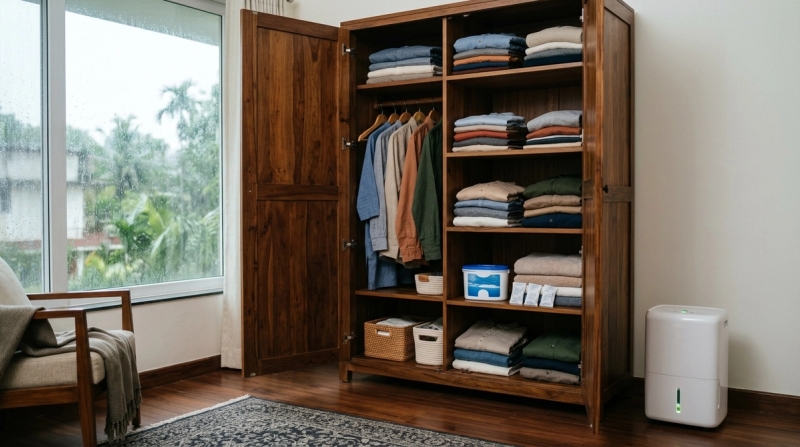
If the dampness is limited to a wardrobe, drawer, shoe rack, or storage box, start with moisture absorber tubs or hanging sachets. They are simple, affordable, and made for small closed spaces.
For very tiny sealed spaces like shoe boxes, camera bags, document pouches, jewellery boxes, and electronics storage, silica gel is usually a better fit.
Charcoal packs are useful mainly for smell. They can make a cupboard or shoe rack feel fresher, but they are not the best solution for serious moisture.
Buy an electric dehumidifier only when the dampness is not just inside the cupboard. If the whole room feels humid, clothes take ages to dry indoors, walls or windows sweat, or mould keeps coming back even after cleaning, then a dehumidifier makes sense.
Quick Answer: What Should You Use Where?
#- Wardrobe or cupboard: use a moisture absorber tub or hanging sachet because it works in small closed spaces and needs no electricity.
- Drawers and storage boxes: use a small moisture absorber or silica gel because compact spaces need compact moisture control.
- Shoe boxes, camera bags and electronics: use reusable silica gel because it suits tiny sealed spaces.
- Smelly shoe rack or closed cabinet: use charcoal for odour support, but pair it with moisture control if the area is damp.
- Damp bedroom, laundry room or sweating walls: use an electric dehumidifier because the problem is room-level humidity.
- Slight cupboard smell in monsoon: clean, dry and ventilate first, then add an absorber.
For most Indian homes during monsoon, the practical first choice is a moisture absorber. A dehumidifier is worth buying when the problem is bigger than one cupboard.
Why This Choice Matters During Indian Monsoon
#Monsoon dampness is not just about a little bad smell. In many Indian homes, especially rented flats, older buildings, hostels, ground-floor homes, and coastal cities, moisture gets trapped inside closed storage spaces.
You may notice:
- Clothes feeling slightly damp even after drying
- A musty smell when you open the wardrobe
- White or green fungus on leather bags, belts, shoes, or wallets
- Books becoming wavy or smelling old
- Sarees, uniforms, blazers, and formal shirts smelling odd
- Shoe racks feeling sticky and unpleasant
- Wooden cupboards swelling or smelling musty
Shops sell moisture absorber tubs, silica gel packets, charcoal bags, and electric dehumidifiers, and all of them sound similar. They are not. They are meant for different spaces and different levels of dampness.
1. Moisture Absorber Tubs and Hanging Sachets
#Best for: wardrobes, cupboards, drawers, shoe racks, under-sink cabinets, hostel cupboards, and other small enclosed spaces.
Moisture absorbers are non-electric products. Most common wardrobe absorbers use a salt-based material, usually calcium chloride. It pulls moisture from the air, and over time, the crystals turn into liquid that collects in the tub or pouch.
There is no wiring, charging, filter cleaning, or floor space needed. You simply place or hang it inside the cupboard and replace it when it is full.
Who should buy moisture absorbers?
#Buy them if:
- Your main problem is a damp or smelly wardrobe
- You live in a rented flat and cannot make major changes
- You are a hostel student with one small cupboard
- You want to protect sarees, uniforms, formal clothes, bags, belts, and shoes
- One or two cupboards smell musty, but the rest of the room feels fine
- You want a low-effort wardrobe moisture absorber in India
Who should not rely only on moisture absorbers?
#Do not expect them to solve the problem if:
- Your bedroom walls are damp or sweating
- The whole room smells musty
- Clothes take days to dry indoors
- Mould keeps returning on walls, mattresses, curtains, or furniture
- You are trying to dry a full room with one small tub
Moisture absorber tubs work best inside closed spaces. They are not room dehumidifiers.
2. Silica Gel for Wardrobes, Shoes, Books, and Electronics
#Best for: very small, sealed spaces.
Silica gel works well when the space is tiny and mostly closed. That is why you find those little packets inside new shoe boxes, handbags, medicine bottles, and electronics packaging.
Use silica gel for:
- Shoe boxes
- Camera bags
- Lens cases
- Small electronics storage
- Jewellery boxes
- Document pouches
- Small airtight containers
- Storage boxes for rarely used items
Reusable silica gel packs are especially handy because you can dry and use them again. Some also change colour when they are full of moisture, so you know when to recharge or replace them.
For a full wardrobe, small silica gel packets are usually not enough. Use silica gel inside drawers, boxes, compartments, shoe containers, or pouches. For the main wardrobe space, a moisture absorber tub or hanging sachet is usually more practical.
3. Charcoal Packs
#Best for: smell control, not serious moisture removal.
Charcoal packs can help reduce stale smells and closed-space odour. But charcoal is not the same as a moisture absorber.
Buy charcoal packs if:
- Your cupboard smells closed or stale
- Your shoe rack smells bad
- You already use a moisture absorber and want extra odour control
- You do not like artificial fragrance pouches or sprays
Do not use charcoal alone if:
- Clothes feel damp
- Fungus is visible
- Books are bending or warping
- Leather items have white patches
- The cupboard has a strong musty smell
Charcoal can support your monsoon setup, but it should not replace a proper moisture absorber.
4. Electric Dehumidifiers
#Best for: whole rooms, severe dampness, laundry drying areas, and recurring mould.
An electric dehumidifier pulls damp air in, removes water from it, and releases drier air back into the room. Unlike passive moisture absorbers, it works actively and can remove much more moisture.
Consider one if:
- Your whole bedroom feels damp during monsoon
- Walls or windows sweat
- Clothes take too long to dry indoors
- The room smells musty even after cleaning
- Mould returns on walls, curtains, mattresses, or furniture
- You live in a very humid city or a poorly ventilated flat
- You want to reduce humidity around wardrobes too
Skip it if:
- Only one wardrobe smells slightly musty
- You do not have floor space
- You do not want to empty water tanks or clean filters
- You need a simple hostel cupboard solution
- Your budget is better spent on cleaning, ventilation, and cupboard absorbers
Also, do not run a regular electric dehumidifier inside a closed wardrobe unless the product is specifically designed for that. Most dehumidifiers are made for room air, not cramped cupboard spaces.
Moisture Absorber vs Dehumidifier: Practical Comparison
#- Moisture absorber tub or sachet: best for wardrobes, cupboards, drawers and shoe racks. It needs no electricity, removes moderate moisture in small closed spaces, and should be replaced when full. Main risk: liquid can spill if the tub is knocked over.
- Silica gel: best for shoe boxes, camera bags, sealed boxes, documents and electronics. It needs no electricity and works well in tiny sealed spaces. Main risk: it stops working when saturated.
- Charcoal pack: best for odour in cupboards, shoe racks and cars. It needs no electricity and can make closed spaces smell fresher. Main risk: it may create a false sense of dryness because it is not a serious moisture solution.
- Electric dehumidifier: best for bedrooms, laundry areas and damp rooms. It actively removes room humidity but needs electricity, floor space, tank emptying and filter cleaning. Main risk: overbuying for a small cupboard problem.
What to Check Before Buying
#1. Match the product to the space
#- Wardrobe, cupboard, shoe rack: use a moisture absorber
- Shoe box, camera bag, document pouch: use silica gel
- Smelly closed cabinet: use charcoal plus moisture control
- Damp room or laundry area: use an electric dehumidifier
Do not buy a room dehumidifier for one mildly smelly cupboard. And do not expect one small absorber tub to fix a damp bedroom.
2. Check whether the space is closed or open
#Moisture absorbers and silica gel work best in enclosed spaces. If your wardrobe doors are always open, or the cupboard has large gaps, the absorber will have to work harder and may fill faster. For open rooms, passive absorbers are usually too weak.
3. Look for spill protection
#Before buying, check:
- Is the tub stable?
- Does it have a spill-resistant design?
- Can it sit safely on a flat shelf?
- Can children or pets knock it over?
- Would a hanging sachet be safer for your wardrobe?
For crowded wardrobes, hanging absorbers are often easier and safer than tubs.
4. Check replacement or recharge method
#Some products are disposable. Some silica gel packs are reusable. Some charcoal packs need sun-drying. Electric dehumidifiers need tank emptying and filter cleaning. Buy the option you will actually maintain.
5. For electric dehumidifiers, check room suitability
#If you are buying an electric dehumidifier, check:
- Recommended room size
- Tank capacity
- Continuous drainage option
- Noise level
- Filter cleaning needs
- Power consumption
- Warranty and service availability
Very small thermoelectric models are usually meant for compact spaces and mild dampness. For serious monsoon humidity in a room, a larger room dehumidifier is usually more suitable.
6. Do not buy only for fragrance
#Fragrance does not remove dampness. Room fresheners, scented pouches and perfume sprays may hide monsoon wardrobe smell for a while, but if the moisture remains, the smell will come back.
Who Should Buy What?
#Buy moisture absorber tubs or hanging sachets if you are:
#- A renter dealing with one or two damp cupboards
- A hostel student with a small wardrobe
- A family storing school uniforms, sarees, blazers, or winter clothes
- An office worker tired of musty shirts and formal shoes
- Someone with a damp shoe rack during monsoon
- Looking for a simple, non-electric wardrobe moisture absorber in India
Buy reusable silica gel if you are:
#- Storing shoes in boxes
- Protecting camera gear
- Keeping documents in sealed pouches
- Storing watches, jewellery, or electronics
- Managing small airtight containers
Buy charcoal packs if you are:
#- Fighting shoe odour
- Reducing stale cupboard smell
- Avoiding artificial fragrances
- Using it along with a moisture absorber, not instead of one
Buy an electric dehumidifier if you are:
#- Drying clothes indoors often
- Living in a room that stays damp for days
- Seeing mould return on walls or furniture
- Noticing condensation or sweating walls
- Managing a large wardrobe in a damp bedroom
- Trying to reduce humidity in the whole room
Step-by-Step Monsoon Wardrobe Checklist
#Step 1: Empty the wardrobe
#Take everything out: clothes, bags, shoes, files, boxes, old newspapers, plastic covers. This helps you spot hidden damp patches, fungus, and items that already smell musty.
Step 2: Clean shelves and corners
#Wipe the wardrobe properly. Dust, lint and old fabric fibres can hold smell and encourage fungus. If you use a damp cloth, let the wardrobe dry completely before putting anything back.
Step 3: Dry the wardrobe fully
#Keep the doors open. Switch on the fan. If the day is less humid, let fresh air come in. Putting clothes back into a half-damp cupboard is one of the fastest ways to bring the smell back.
Step 4: Sort clothes before storing
#Do not store clothes that are slightly damp, recently steam-ironed and still warm, already smelling musty, worn once, or packed inside plastic dry-cleaning covers.
Step 5: Place absorbers properly
#For wardrobes, hang moisture absorber sachets from the rod or place tubs on a stable, low shelf. Keep tubs away from clothes that may brush against them. For shoes, dry them fully first, then use silica gel inside boxes and a moisture absorber or charcoal pack in the shoe cabinet.
Step 6: Avoid trapping moisture with plastic
#Plastic covers can trap moisture around clothes, especially silk, leather, woollens, blazers, and special occasion wear. Use breathable storage when possible.
Step 7: Ventilate once a week
#On a relatively dry day, open the wardrobe doors for some time. Switch on the ceiling fan and let air move around.
Step 8: Check absorbers regularly
#During peak monsoon, moisture absorbers can fill faster than expected. Replace or recharge them when saturated. Do not leave a full tub sitting in the cupboard for too long.
Mistakes to Avoid
#- Putting “almost dry” clothes inside the wardrobe.
- Using only room freshener instead of reducing moisture.
- Expecting charcoal to remove serious dampness.
- Using tiny silica gel packets for a full wardrobe.
- Overstuffing the cupboard so air cannot move.
- Forgetting leather shoes, belts, wallets, bags and jackets.
- Keeping absorber tubs where they can spill.
- Buying a dehumidifier when only one small cupboard smells.
Final Buying Advice
#For most Indian monsoon wardrobes, start simple.
Buy moisture absorber tubs or hanging sachets for cupboards, wardrobes, shoe racks, and drawers. Add silica gel for sealed shoe boxes, electronics, documents, camera bags, and small containers. Use charcoal packs if smell is also a problem, but do not treat them like a moisture solution.
Choose an electric dehumidifier only if dampness is affecting the whole room, not just one cupboard.
The easiest rule is this: small enclosed space, use a moisture absorber. Tiny sealed space, use silica gel. Smelly space, add charcoal. Damp room, buy a dehumidifier.