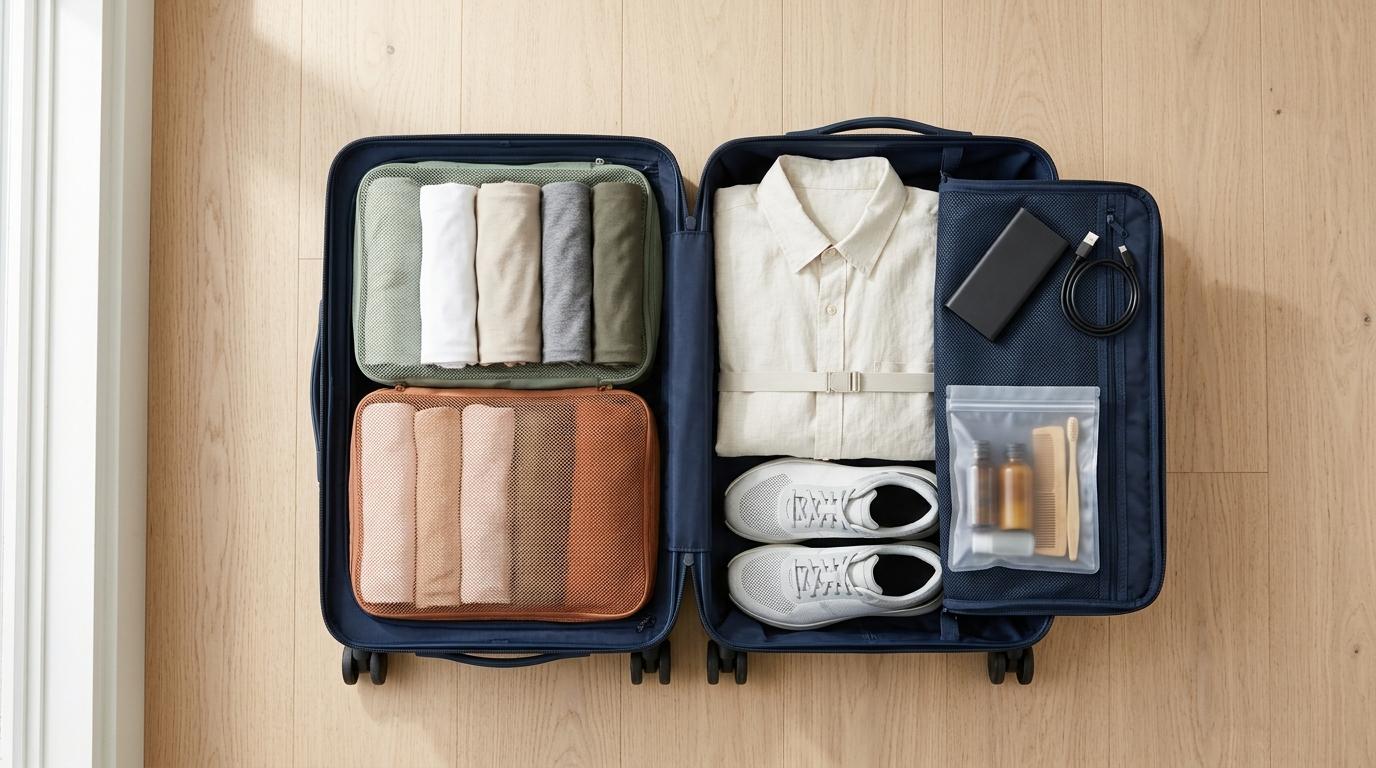
The fastest way to pack a suitcase efficiently is to stop using one folding trick on everything and match the method to the item: roll soft T-shirts and knits inside compression cubes, flat-fold blazers and crisp shirts on top, fill the handle channels first so your base stays level, and place heavy shoes and toiletry bags right over the wheels.
Most bags turn messy halfway through a trip because clothes are stacked by guesswork instead of bag shape and fabric behavior. You end up squeezing zippers shut, hunting for socks at the bottom, watching your trolley tip forward every time you let go of the handle, or unpacking a power bank in the boarding line.
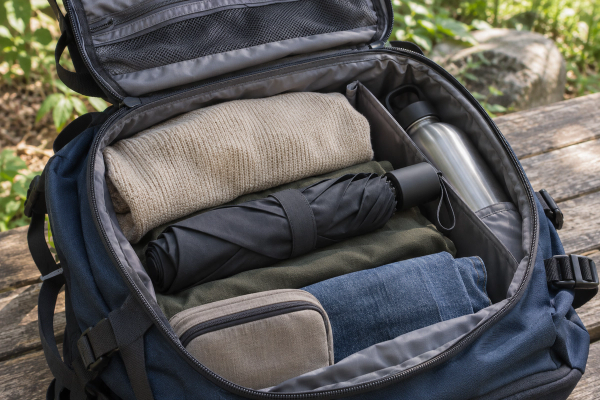
Before you touch your closet, make sure a wheeled case actually fits your route. If your trip mixes stairs, gravel lanes, ferries, or multiple quick stops, choosing between a backpack and a suitcase can save more effort than any folding trick inside the bag.
Start With an Empty Bag and Capsule Outfit Math
#Start with a completely empty suitcase and check every zippered pocket before a single shirt goes in. Transportation Security Administration (TSA) screening guidance specifically advises starting with an empty bag so forgotten pocket knives, old aerosol cans, or stray liquids from your last trip do not follow you to the security line.
Next, stop packing individual outfits day by day. Packing seven complete looks for a seven-day trip leaves you hauling double the bottoms, extra shoes, and backup tops you never touch.
Use simple capsule math instead. Aim for two to three tops for every bottom, stick to one neutral color family where every shirt matches every pair of trousers or shorts, and count on re-wearing pants or jeans two or three times unless the weather is brutally humid.
For an illustrative seven-day city trip in mild weather, a practical load looks like this:
- Four to five versatile tops or shirts (one worn on travel day)
- Two to three bottoms (one worn on travel day)
- One light jacket, cardigan, or rain layer (worn or carried in hand on transit day)
- Seven pairs of underwear and socks, plus one sleepwear set
- Two pairs of shoes total: wear your heaviest pair (sneakers or boots) to the airport and pack one lighter pair inside the suitcase
Shoes eat more volume and add more dead weight than almost anything else in luggage. Cap packed footwear at one or two extra pairs unless a formal event or trail hike genuinely forces a third.
Rolling vs. Folding vs. Bundle Wrapping: Match the Fabric
#Single-method packing guides miss the obvious physical difference between a jersey T-shirt and a lined blazer. Soft fabrics hold tight cylinders without creasing, while stiff collars and structured seams collapse when rolled.
Rolling for Soft Knits and Everyday Layers
#Rolling works best for T-shirts, polo shirts, leggings, workout gear, knit sweaters, casual shorts, sleepwear, underwear, and socks. Smooth the garment flat on the bed, fold sleeves inward so the sides form a straight rectangle, and roll tightly from the bottom hem up.
Tight rolling pushes out trapped air and creates compact cylinders you can stand side by side inside a packing cube like files in a drawer. You see every top at once instead of digging down through a stack.
Skip rolling for stiff dress shirts, structured blazers, starched cotton trousers, and thick denim. Thick jeans turn into awkward baseball bats when rolled, wasting corner room around them, while stiff woven shirts pick up twisted creases along the collar and placket.
Flat Folding for Structured Clothes
#Flat folding keeps collars crisp and seams aligned on button-down shirts, blazers, dress slacks, pleated skirts, and heavy denim. Button every second button on dress shirts, lay them face down, fold the sleeves straight down the back with gentle bends, and fold in half once or twice at a soft angle rather than creasing hard with your fingernail.
Layer tissue paper or a dry-cleaning plastic bag between folded formal pieces if you have extra-wrinkly linen or thin cotton. The slippery layer reduces fabric-on-fabric friction when the bag gets tossed onto a baggage belt.
Save these flat-folded items for last so they sit near the top of the suitcase on top of your packing cubes. A flat cube platform acts like a mini shelf and prevents sharp collapse creases.
Bundle Wrapping for Wrinkle-Sensitive Outfits
#Bundle wrapping drapes several structured garments around one soft central core, such as a small cube of socks and underwear or a flat toiletry pouch. Instead of folding a blazer or trouser leg sharply in half, the large curve of the central pouch keeps fabric bends wide and rounded.
Lay a blazer open face-up, place a buttoned shirt across it in the opposite direction, lay trousers perpendicular across the stack, place the soft pouch in the center, and wrap each pant leg, sleeve, and tail neatly over the core one by one.
The upside is clear: fewer hard creases when you arrive for a wedding or work trip with no iron in sight. The downside is just as real: pulling one shirt out in the middle of the week unwraps the whole bundle. Only use bundle wrapping if you plan to unpack into a hotel closet on day one.
| Method | Best For | Skip For | Main Advantage | Main Tradeoff |
|---|---|---|---|---|
| Tight Rolling | T-shirts, knits, activewear, underwear | Blazers, stiff shirts, thick jeans | Saves space and shows every item upright | Can crease structured collars if loose |
| Flat Folding | Button-downs, trousers, jackets, denim | Soft thin tees and small basics | Protects collars, pleats, and garment shape | Traps air and shifts without a top shelf |
| Bundle Wrapping | Multi-piece formal or work outfits | Frequent hotel changes mid-trip | Eliminates sharp fold lines around a soft core | Must unwrap entire bundle to reach inner layers |
How Packing Cubes Actually Save Space (and When They Backfire)
#Packing cubes do not shrink fabric by magic. Standard zippered mesh cubes organize your bag into neat rectangular bricks so rolled tees never come undone and socks never vanish into dark corners.
When you open your suitcase in a small hotel room, you lift out two or three cubes like portable dresser drawers instead of exploding clothes across the bed. Grouping by function works cleanly for most travelers:
- One medium cube for rolled casual tops and knitwear
- One medium or large cube for folded trousers, shorts, or mid-layers (or a slim garment folder for dress shirts)
- One small cube for underwear, socks, belts, and swimsuits
- One empty foldable nylon laundry bag tucked flat against the liner so worn clothes stay separate from clean cubes
Double-zipper compression cubes go one step further. After closing the main zipper, a second perimeter zipper pulls the gusset tight and pushes trapped air out of puffy shirts, fleeces, and cotton knits.
Watch out for two traps with compression cubes. First, compressing clothes makes them smaller, not lighter. Packing dense compressed bricks makes it painfully easy to blow past a strict carry-on weight cap or a checked-bag allowance.
Second, never stuff a compression cube until the middle bulges like a pillow. A rounded cube leaves empty triangles all along the suitcase edges and stresses the zipper teeth. Keep the corners square and flat. Avoid vacuum-seal bags unless you know your return hotel has a vacuum hose—manual roll-up vacuum bags often leak air mid-trip and expand faster than your suitcase can close.
Suitcase Geometry: Level Handle Ruts and Balance the Weight
#Two suitcases with identical liter ratings can pack completely differently depending on what sits inside the back wall. Before loading your main cubes, look closely at the interior floor of your rolling bag.
Level the Telescoping Handle Ruts First
#Almost every wheeled suitcase has two metal telescoping handle tubes running down the back interior panel, leaving deep narrow trenches beside and between the rails. Laying a flat blazer or wide packing cube straight over those ridges wastes space underneath and forces clothes to buckle over the metal bars.
Fix the floor first. Pack soft, squishable items directly into the channels between and beside the handle tubes until the surface feels flat to your hand:
- Rolled socks and underwear in thin pouches
- Soft knitwear or base thermals
- Rolled belts tucked along the rail edges
- Soft-sided charging cord pouches or lightweight flip-flops
Once the handle ruts sit level with the top of the metal rails, every cube and folded layer above sits flat instead of sliding sideways every time the bag goes upright.
Clamshell vs. Soft-Side Weight Balance
#A hard-shell clamshell suitcase opens down the middle into two roughly equal halves, usually separated by a zippered mesh divider on the lid side. A soft-side suitcase puts almost all depth into one deep main tub with a flat fabric lid on top.
In a clamshell suitcase, treat the deeper or hinged back half (the side with the telescoping handle frame and wheel housings) as your heavy cargo side. Put shoes, dense toiletry kits, heavy jeans, and thick sweaters there.
Keep the zippered lid half strictly for lighter items: rolled T-shirts, underwear cubes, folded shirts, or a light jacket. If you load heavy toiletries or extra shoes into the lid side, two things happen: closing the two halves together becomes an awkward wrestling match, and the suitcase pulls backward or sideways toward the heavy lid when upright.
In a soft-side suitcase, build from back-bottom to front-top. Lay heavy items flush against the rear rigid wheel wall, stack lighter cubes in front of them, and leave the front exterior lid pocket for flat paper documents, light scarves, or a flat windbreaker—never heavy bottles that swing the bag forward.
Put Heavy Items Over the Wheels to Stop Tipping
#Nothing annoys travelers faster than a carry-on spinner that tips face-down on the terminal floor the second you let go of the handle. That happens when heavy shoes, hair dryers, or glass toiletry bottles sit near the top grab handle or against the front lid.
Place your heaviest, densest items right at the bottom wheel end of the suitcase, between or right above the wheel wells:
- Bagged shoes placed heel-to-toe along the bottom wheel wall (stuff socks inside the shoe openings to keep the uppers from crushing and save gap space)
- Heavy toiletry pouches cushioned just above the wheel end in the center—never pressed right up against a thin outer corner
- Dense denim or heavy sweaters sitting low over the axle rather than near the top zipper
Once packed, stand the suitcase upright on a hard floor and give the top handle a light tap forward and sideways. If it stays planted, your center of gravity is low and balanced. If it rocks onto its front wheels, shift one heavy pouch down toward the rear wheel wall.
Leave Room for Airline Size, Weight, and Return Shopping
#Packing tight is useful only if the bag passes the check-in desk and overhead sizer without last-minute repacking in public. International Air Transport Association (IATA) passenger guidance notes a common carry-on reference box of 56 x 45 x 25 cm (22 x 18 x 10 in) including wheels and handles, with cabin weight caps starting as low as 5 kg (11 lb) on some carriers and commonly 7 to 10 kg depending on fare and route.
For checked luggage, IATA cites 23 kg (50 lb) as the standard occupational health guideline for a single bag, with 32 kg (70 lb) serving as the common upper safety ceiling in markets like the U.S. and EU, and 158 cm (62 in) total linear dimensions (length plus width plus height) as a typical piece-concept limit. Always confirm your exact ticket allowance, and aim to leave 10 to 15 percent space and a 1 to 2 kg weight buffer for damp clothes, thicker re-packing, or gifts on the flight home.
Airport Security Rules: Liquids, Powders, Batteries, and Locks
#A beautifully packed bag still fails if security pulls it off the belt or gate agents force you to dump items at boarding. Build airport compliance straight into how you zone your suitcase.
Liquids, Gels, and the Powder Screening Caveat
#For carry-on bags, the TSA 3-1-1 rule—and the nearly identical 100 mL cabin limit used across most international airports—is strict on container size, not how much liquid remains inside:
- Each liquid, aerosol, gel, cream, or paste container must be 3.4 oz (100 mL) or smaller. A half-empty 150 mL shampoo bottle does not pass.
- All containers must fit comfortably inside one clear, plastic, resealable quart-sized (roughly 1-liter) bag, limited to one bag per passenger.
- Keep that clear zip bag near the top of your carry-on or in an outer sleeve so you can pull it into a bin fast if the checkpoint uses older X-ray lanes.
Remember that TSA treats anything you can spill, spread, spray, pump, or pour as a liquid or gel—including toothpaste, sunscreen, liquid foundation, peanut butter, soft cheese spreads, jams, and snow globes. Put bottles larger than 100 mL inside your checked bag instead, sealed inside leak-proof zip bags and cushioned near the middle of your clothing.
Medical liquids, prescription medications, and infant milk or formula are exempt from the 3.4 oz / 100 mL limit in reasonable flight quantities, though you must declare medically required liquids over 100 mL at screening. Duty-free liquids over 100 mL can also ride in carry-on on connecting flights if sealed inside a transparent Secure Tamper-Evident Bag (STEB) with the original receipt showing purchase within 48 hours, though packing non-exempt over-limit liquids in checked bags avoids connection surprises.
One rule catches travelers off guard: powders. Under TSA policy (with similar checks adopted at several international checkpoints per IATA), powder-like substances larger than 350 mL or 12 oz—roughly the volume of a standard soda can—must go into a separate screening bin in carry-on bags.
On international flights inbound to the U.S., powders over 350 mL / 12 oz that cannot be cleared at the central checkpoint are confiscated and disposed of. Unless you have a medical or infant-formula reason, pack large jars of protein powder, ground coffee, bath salts, or dry spices in checked baggage.
Lithium-Ion Power Banks and Batteries (Carry-On Only)
#This is a strict aviation safety rule, not a packing preference: never put spare lithium batteries or power banks in checked luggage.
Both the Federal Aviation Administration (FAA) and IATA ban spare (uninstalled) lithium-ion and lithium-metal batteries, power banks, battery charging cases, and e-cigarettes from checked hold baggage. Lithium-ion cells can overheat and enter thermal runaway—a fast, self-sustaining chemical fire triggered by impact damage, short circuits, water, overcharging, or cell defects. In the cabin, flight crews are trained and equipped to extinguish or cool a smoking device quickly. Inside an unstaffed cargo hold, a battery fire is far harder to detect and control.
Follow these exact battery rules when packing:
- Under 100 Wh: Spare lithium-ion batteries and power banks rated at 100 Watt-hours (Wh) or less are allowed in carry-on baggage without prior airline approval (individual airlines can still cap quantity, and IATA guidance notes many carriers limit spare power banks to two per passenger).
- 101 Wh to 160 Wh: Allowed in carry-on only with explicit prior airline approval, capped at a maximum of two spare batteries per person.
- Over 160 Wh: Completely prohibited on passenger flights.
- How to check mAh-only labels: If your power bank only prints milliamp-hours (mAh) instead of Wh, calculate Watt-hours using the battery's nominal cell voltage (usually 3.7 V for standard lithium-ion power banks, not the 5 V USB port output): (mAh / 1000) x 3.7 V = Wh. A 10,000 mAh bank at 3.7 V equals 37 Wh. A 20,000 mAh bank equals 74 Wh (safe). A 27,000 mAh bank hits 99.9 Wh (right at the 100 Wh threshold), whereas a 30,000 mAh bank reaches 111 Wh and requires airline approval before you fly.
- Protect terminals from short circuits: Never toss loose batteries or power banks directly against keys, coins, or metal adapters. Keep them in original packaging, a dedicated sleeve, individual zip pouches, or cover exposed metal terminals with tape.
- Devices with installed batteries: Keep laptops, tablets, cameras, and phones in carry-on when possible. If you ever pack a laptop or camera in checked luggage, power it completely off (not sleep or hibernation mode) and cushion it so the power button cannot press accidentally.
- Smart luggage with built-in batteries: If your suitcase includes an integrated charging bank, the battery must be removable so you can pull it into the cabin whenever the bag is checked. Non-removable smart-bag batteries above tiny thresholds (0.3 g lithium metal / 2.7 Wh) are banned from flights entirely.
Also keep your power bank accessible under the seat or in your personal bag rather than buried in an overhead bin; IATA and airline safety rules frequently prohibit charging power banks from seat power or using them during taxi, takeoff, and landing.
TSA-Recognized Locks vs. Standard Padlocks
#Locking a checked suitcase with an ordinary hardware-store padlock often ends with a ruined lock. TSA screens all checked luggage and must physically open any bag that triggers an inspection alarm. If officers cannot open a non-compatible lock, they may cut it off—and TSA states clearly that it is not liable for damage caused to locked bags opened for screening.
Use a TSA-recognized lock marked with the Travel Sentry red diamond or Safe Skies symbol on checked bags instead. Screening officers carry universal master tools to open, inspect, leave a Notice of Baggage Inspection inside, and relock the bag intact.
When picking a TSA lock, prefer a flush built-in zipper combination lock or a flexible braided-cable TSA shackle over a stiff hanging metal padlock. TSA notes that rigid protruding padlocks regularly shear off on airport conveyor belt junctions even without a security search.
| Item Category | Carry-On Bag Rule | Checked Bag Rule | Key Limit or Action |
|---|---|---|---|
| Liquids, gels, pastes | Allowed in 100 mL / 3.4 oz or smaller containers | Allowed in larger volumes; double-bag to stop leaks | Fit all carry-on liquids in one clear 1-liter / quart zip bag |
| Powders | Allowed; extra bin screening over 350 mL / 12 oz | Allowed in full containers | Pack non-essential powders over 350 mL in checked bags |
| Power banks and spare batteries | Mandatory carry-on only; protect terminals | Strictly prohibited in checked hold | Up to 100 Wh without approval; 101 to 160 Wh needs airline approval |
| Installed-battery electronics | Recommended in carry-on | Allowed if completely powered off | Protect switches against accidental wake-up; never sleep mode |
| Suitcase locks | Optional (bag stays with you) | Use TSA-recognized locks only | Non-TSA locks may be cut without liability during inspection |
Pack a Gate-Check Emergency Kit Before Zipping Up
#Even when your carry-on matches airline size rules perfectly, full regional jets and late boarding groups run out of overhead bin space fast. Gate agents will tag your roller bag for the cargo hold right at the aircraft door with almost no waiting time.
IATA baggage tracking figures also show that while 99.5% of checked bags arrive alongside the passenger, roughly 0.5% are delayed or mishandled—with most returned within 48 hours. Preparing one grab-and-go pouch inside the top pocket of your carry-on or in your under-seat personal item turns both situations from a crisis into a five-second transfer:
- Every spare power bank and loose lithium battery: Pull these out immediately before handing your roller bag to gate staff (FAA and IATA rules prohibit spare lithium batteries in gate-checked bags too).
- Prescription and daily medications: Keep solid pills and liquid prescriptions with you in the cabin.
- Passports, keys, wallet, and fragile electronics: Laptops, tablets, and camera lenses stay in your personal item, never the cargo hold.
- A 24-hour survival swap: One clean T-shirt, fresh underwear, a pair of socks, phone charging cable, and mini toothbrush/deodorant so a delayed bag never ruins your first morning.
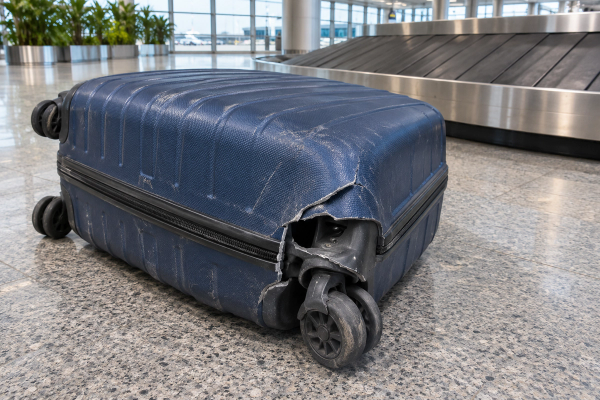
Before locking or dropping a checked suitcase, slip a piece of paper with your name, phone number, and email inside the main compartment (IATA recommends both external and internal ID tags in case an outer paper tag tears off). Snap one quick photo of the packed exterior at the check-in counter too—if a wheel or hard shell ever arrives cracked, read what to do if an airline damages your suitcase before leaving the baggage hall.
Final 5-Minute Check Before You Leave
#Run through five fast checks once your suitcase looks finished:
- The upright tip check: Stand the bag on a flat floor and tap the top handle forward. If it leans or tips onto its front face, move shoes or toiletries down to the rear wheel end.
- The smooth zipper check: Zip the bag closed without sitting on the lid or yanking the pull with two hands. Forcing an overstuffed zipper bursts the teeth halfway through a trip.
- The luggage scale check: Weigh the bag lifted off the floor, including your packed cubes and shoes, and confirm you still sit safely below your ticket limit.
- The battery sweep: Touch-check your checked bag's outer pockets and toiletry pouch to be sure zero power banks, charging cases, or e-cigarettes snuck into checked luggage.
- The top-access check: Confirm your 3-1-1 clear liquids bag, travel documents, meds, and gate-check kit sit within two seconds' reach at the top of your carry-on or under-seat bag.