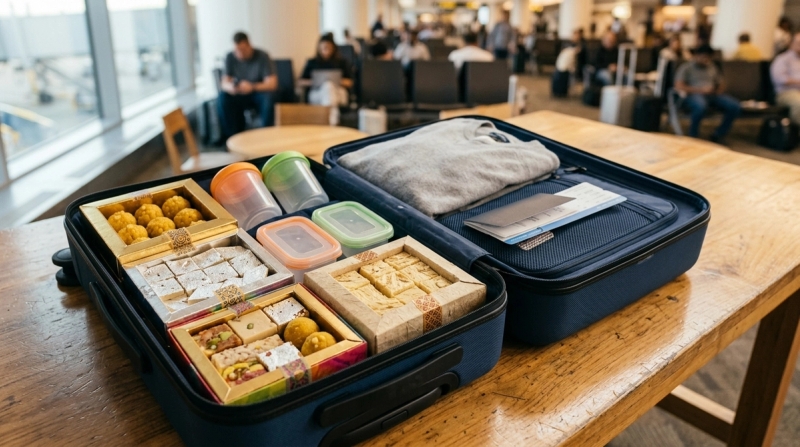
Packing mithai for a flight feels simple… until you reach airport security and suddenly start wondering, “Wait, will they allow this kaju katli?” or “Does rasgulla count as a liquid because of the syrup?”
If you are Indian, or travelling to visit Indian family, sweets are rarely just “snacks.” They are gifts, festival leftovers, wedding boxes, prasad, something for your child studying abroad, or that one thing your mother insisted you take because “wahan kaun banayega?”
But airport security does not look at mithai with emotion. They look at the practical stuff: is it solid, wet, leaky, creamy, perishable, or likely to behave like a liquid or gel?
So, can you carry Indian sweets in cabin baggage?
Usually, yes — if the sweets are dry, solid, and packed properly. Dry mithai is generally much easier to carry. Syrupy, creamy, dairy-heavy, or very soft sweets need more caution, especially on international flights.
This guide keeps things realistic. Rules can change, security officers have the final say, and customs rules vary by country. So use this as practical guidance, but always check your airline and your destination country’s official food import rules before flying.
Quick answer
#Yes, you can usually carry Indian sweets in cabin baggage if they are dry, solid, and neatly packed.
Good cabin baggage options usually include:
- Kaju katli
- Besan ladoo
- Atta ladoo
- Dry fruit ladoo
- Soan papdi
- Dry barfi
- Mysore pak
- Dry peda
Be more careful with sweets that contain syrup, cream, liquid dairy, or lots of moisture, such as:
- Gulab jamun
- Rasgulla
- Rasmalai
- Rabri
- Very soft kalakand
- Any mithai packed in sugar syrup
A simple way to think about it:
If it can leak, ooze, spill, melt badly, or look like a gel, paste, cream, or liquid, do not assume it will be allowed in cabin baggage.
For international flights, remember that airport security is only one step. Once you land, customs and food import rules also matter. In some countries, you may need to declare the sweets.
Dry sweets vs syrupy sweets
#This is the main difference that matters.
To us, kaju katli and rasgulla are both mithai. To airport security, they may be completely different items because one is dry and solid, while the other is sitting in liquid syrup.
Dry sweets are usually easier
#Dry sweets are generally easier to carry in cabin baggage because they are solid and do not contain free-flowing liquid.
Common examples include:
- Kaju katli
- Besan ladoo
- Atta ladoo
- Dry fruit ladoo
- Soan papdi
- Mysore pak
- Dry peda
- Dry barfi
These are usually better choices for dry sweets in hand luggage, especially if you are carrying sweets as gifts.
That said, “dry” should actually mean dry. If the mithai is very soft, sticky, wet, creamy, freshly made, or has a lot of moisture, it may still raise questions at security or spoil during travel.
Syrupy sweets are risky in cabin bags
#Syrupy sweets are where things get complicated.
Examples include:
- Gulab jamun in syrup
- Rasgulla in syrup
- Cham cham with syrup
- Rasmalai
- Rabri
- Any mithai packed in liquid sugar syrup
Cabin baggage rules commonly restrict liquids, aerosols, and gels. Syrup, thick cream, and liquid dairy can fall into that grey area. A large box of rasgulla or gulab jamun in syrup is not the same as a box of dry ladoos.
Even if the sweet itself is solid, the syrup around it can become the problem.
Think of it like this:
- Dry kaju katli: usually cabin-friendly
- Gulab jamun without syrup: still soft and perishable, so be careful
- Gulab jamun floating in syrup: not a good cabin baggage item
For similar dry vs wet packing logic, see the AllBlogs guide on chutney in cabin baggage from India.
Cabin vs check-in baggage
#Where you pack the sweets matters. The best choice depends on the type of mithai, quantity, packaging, and journey time.
When cabin baggage makes sense
#Cabin baggage is usually better for dry, delicate sweets that you do not want crushed.
Carry sweets in cabin baggage when:
- The mithai is solid and dry
- The box fits within your cabin baggage allowance
- The sweets are fragile, like soan papdi
- You are carrying premium sweets as gifts
- You want to avoid rough handling in checked luggage
Cabin baggage also lets you control how the sweets are handled. A box of kaju katli, soan papdi, or dry barfi may arrive in much better condition if it stays with you.
But remember, cabin bags go through security screening. If an officer feels something looks like liquid, paste, gel, cream, or syrup, they may stop it. At the airport, their decision matters.
When check-in baggage is safer
#Check-in baggage is usually better for sweets that are wet, syrupy, heavy, or packed in larger quantities.
Use check-in baggage when:
- The sweet contains syrup
- The container could leak
- You are carrying several boxes
- The sweets are heavy
- The item may not fit cabin liquid restrictions
- You want to avoid delays at security
But checked baggage has its own risks. Suitcases are moved, stacked, tilted, and sometimes handled roughly. If a syrupy sweet leaks, it can ruin clothes, documents, gifts, and the rest of your bag.
So if you are packing syrupy sweets in checked luggage, pack them as if you already expect some leakage.
Domestic vs international flights
#The answer also depends on whether you are flying within India or travelling abroad.
Domestic flights within India
#For domestic flights, mithai allowed in flight India is usually not a major issue, especially when the sweets are dry and properly packed.
Passengers commonly carry sweets like:
- Ladoos
- Kaju katli
- Soan papdi
- Mysore pak
- Barfi
- Peda
The main things to watch are:
- Cabin baggage weight limits
- Airport security screening
- Leakage from syrupy sweets
- Smell or mess from poor packaging
- Airline baggage instructions
For wet sweets, checked baggage is usually the safer option. Even then, pack carefully. A loose box of rasgulla inside a suitcase is basically inviting disaster.
International flights from India
#International flights need more planning.
When you fly abroad, you are dealing with:
- Airport security in India
- Airline baggage rules
- Transit airport rules, if you have a layover
- Customs rules at your destination
- Food import restrictions in the country you are entering
This is where many travellers get confused. A sweet may pass airport security in India, but that does not automatically mean it is allowed into the country where you land.
Some countries are strict about food items, especially:
- Homemade food
- Dairy-based items
- Fresh foods
- Seeds or nuts
- Meat products
- Items without clear labels
Indian sweets made with khoya, milk solids, ghee, cream, or other dairy ingredients may get extra attention depending on the destination country’s rules.
Commercially packed sweets with labels are usually easier for customs officers to inspect than loose homemade sweets. It does not guarantee they will be allowed, but it makes things clearer.
For broader food rules on international travel from India, see the AllBlogs guide on carrying homemade food on international flights from India.
Best Indian sweets to carry
#If you want low-stress mithai for travel, choose sweets that are dry, firm, non-leaky, and easy to pack.
Kaju katli
#Kaju katli is one of the easiest Indian sweets to carry. It is flat, compact, dry, and gift-friendly. It also fits neatly into boxes and does not usually create leakage issues.
Avoid versions that are unusually soft, wet, cream-filled, or heavily decorated with toppings that may melt.
Besan ladoo
#Besan ladoos usually travel well because they are dry and fairly sturdy. They can break if pressed hard, so use a firm container for longer journeys.
Atta ladoo and dry fruit ladoo
#These are practical choices for students, families, and long-haul travellers. They are usually dry, filling, and much less messy than syrupy sweets.
Soan papdi
#Soan papdi is dry and usually cabin-friendly, but it crushes very easily. Keep it in a hard box.
Do not put it in a soft backpack and then act surprised when it turns into sweet flakes. That is just soan papdi being soan papdi.
Dry barfi
#Dry barfi can be a good travel option if it is firm and not too moist. Avoid very soft, creamy, or freshly made varieties for long journeys.
Mysore pak
#Mysore pak, especially the firmer type, can travel well. Pack it in a tight container so the pieces do not crumble all over the box.
Dry peda
#Peda can work if it is dry and firm. Very soft or moist peda may spoil faster and may not be ideal for long international routes.
Sweets to be careful with
#Some sweets are wonderful at home but annoying in baggage. The issue is not only airport rules. It is also leakage, smell, spoilage, and customs uncertainty.
Gulab jamun
#Gulab jamun is risky because of the syrup. A box of gulab jamun in cabin baggage may be treated as a liquid or syrup item.
In checked baggage, the problem is leakage. If the container cracks, opens, or gets pressed, the syrup can spread through your suitcase.
If you really must carry gulab jamun, sealed commercial packaging is better. Pack it very carefully in checked luggage. For long international flights, dry sweets are a much smarter choice.
Rasgulla
#Rasgulla has the same issue as gulab jamun, sometimes even more because it usually sits in a lot of syrup. It is not a good cabin baggage choice.
Rasmalai
#Rasmalai is dairy-heavy and full of moisture. It is not practical for long flights. It can leak, spoil, smell, and raise customs questions depending on where you are travelling.
Rabri
#Rabri is creamy, perishable, and not cabin-friendly. Honestly, this is one of those things you should enjoy before leaving rather than try to carry on a flight.
Kalakand
#Kalakand can be soft, moist, and milk-heavy. Fresh kalakand may spoil quickly outside refrigeration, especially during long airport waits, layovers, and international journeys.
Cream-filled or fusion sweets
#Many modern mithai boxes now include cream layers, mousse fillings, liquid centres, chocolate spreads, or gel-like textures.
These may look solid from the outside but behave like creams, pastes, or gels during screening. Treat them with caution.
Packing checklist
#Good packing can save your sweets, your suitcase, and your mood.
Use this checklist before you leave for the airport.
Choose the right type of sweet
#Pick dry sweets whenever possible, especially for cabin baggage and international flights.
Better choices:
- Kaju katli
- Dry ladoos
- Soan papdi in a hard box
- Dry barfi
- Mysore pak
- Dry peda
Riskier choices:
- Syrupy sweets
- Creamy sweets
- Fresh milk sweets
- Very soft mithai
- Unlabelled homemade sweets for international travel
Keep original packaging if possible
#For international travel, commercial packaging with ingredients and labels can help. It makes the sweets easier to identify during customs checks.
If you move the sweets into another container, keep the original label if possible, especially for branded sweets.
Use a hard container
#Sweet shop boxes look nice, but they are not always strong enough for travel.
Use:
- A firm plastic container
- A sturdy food-safe box
- A tight-lid container
- A hard outer box for fragile sweets
Avoid packing delicate mithai loosely inside backpacks, handbags, or soft cloth bags.
Seal against leaks
#For wet or syrupy sweets in checked baggage:
- Use a tight container.
- Wrap the lid area with cling film.
- Put the container in a zip-lock bag.
- Put that bag inside another bag.
- Place it in the middle of the suitcase.
- Surround it with clothes for cushioning.
This still does not make syrupy sweets risk-free. It only reduces the chances of a full suitcase tragedy.
Separate layers
#For dry sweets like kaju katli or barfi, place butter paper or parchment paper between layers. This helps prevent sticking and keeps the pieces looking presentable when you open the box.
Do not overpack cabin baggage
#Even if the sweets are allowed, your cabin bag still has airline size and weight limits.
A few gift boxes may be fine. Several kilos of mithai may be better in checked baggage.
Think about journey time
#A short domestic flight is very different from a 20-hour international journey with layovers.
For longer trips, avoid sweets that need refrigeration or have a short shelf life. Choose drier, sturdier sweets.
Customs and declaration cautions
#This is the part people often ignore, but it matters a lot.
For international flights, carrying sweets is not only about clearing security in India. Once you land, your destination country’s customs and food rules apply.
Declare food when required
#If your arrival form or customs process asks whether you are carrying food, answer honestly.
A simple explanation is enough:
“I am carrying Indian sweets.”
If asked, explain whether they are commercially packed or homemade.
Declaring food does not mean your sweets will automatically be taken away. It means you are being transparent. If something is not allowed, officers may ask you to discard it. But if you do not declare food when required and they find it, the consequences can be more serious.
Homemade sweets need extra caution
#Homemade sweets are special. No question about that. But they are harder for customs officers to assess.
There may be:
- No ingredient label
- No expiry date
- No manufacturer information
- No sealed packaging
Be extra careful with homemade:
- Milk sweets
- Khoya sweets
- Ghee-heavy sweets
- Cream-based sweets
- Unsealed or loosely packed sweets
This does not mean every homemade sweet is banned everywhere. It simply means rules depend on the country, and officers may use their judgement during inspection.
Commercial packaging helps
#Commercially packed sweets with clear labels are usually easier to explain. Keep them sealed if possible.
Helpful packaging details include:
- Brand name
- Ingredients
- Manufacturing or packing date
- Best before date
- Vegetarian marking, if present
Packaging does not guarantee customs approval, but it reduces confusion.