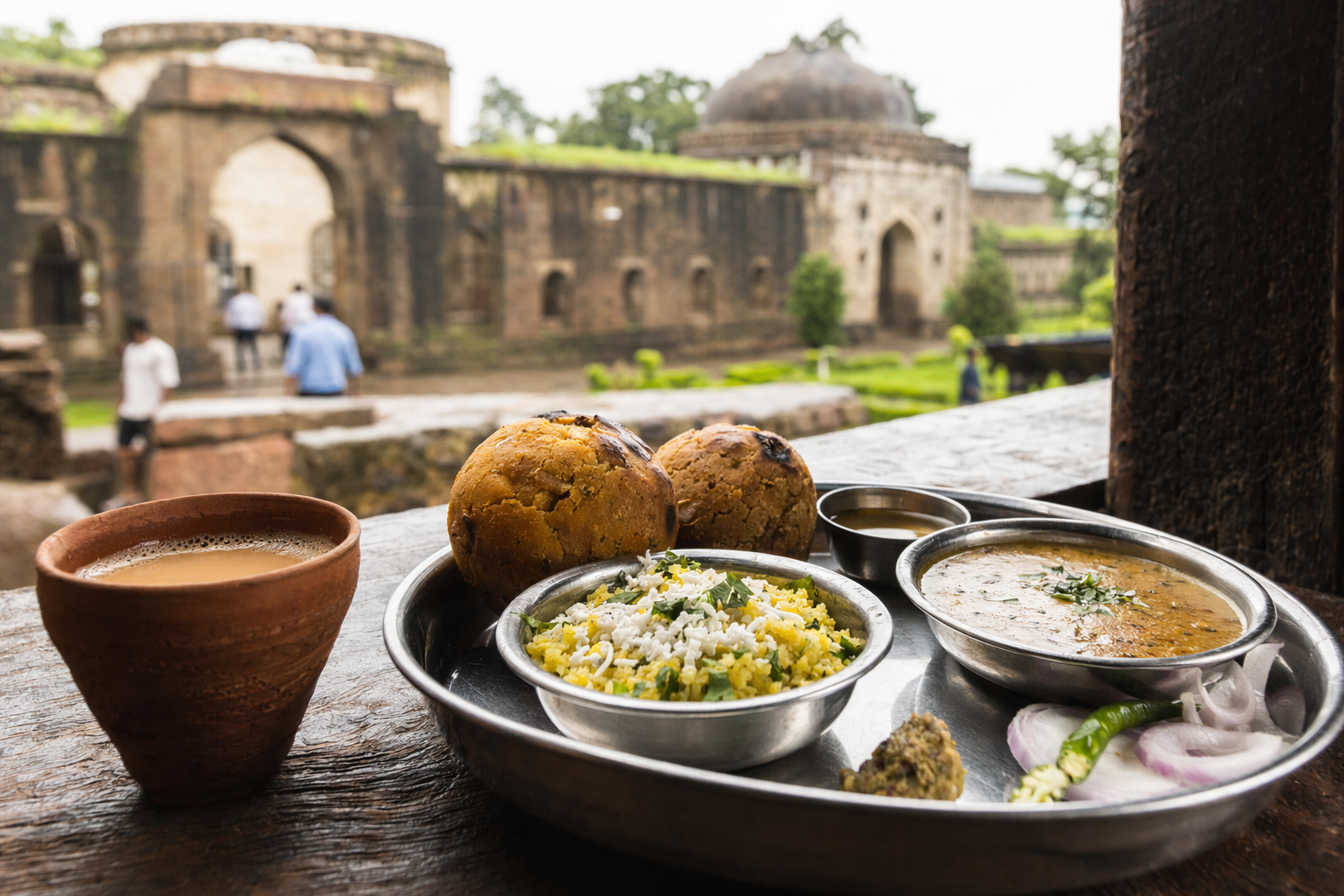
Rain on the ramparts, ghee on my fingers
#The thing about Mandu in the monsoon is that it doesn’t arrive quietly. It rolls in like a green wave. One minute you’re on the road from Indore or Dhar watching dry-looking hills, and then suddenly everything is mossy, damp, and dramatic, like somebody turned up the saturation on Madhya Pradesh. I went for the palaces, obviously. Jahaz Mahal in the rain? Come on. But if I’m being fully honest, I also went chasing that very specific Malwa comfort-food mood: dal bafla, bhutte ka kees, and hot tea in steel glasses while your shoes are slowly giving up on life.
Most travelers reach Mandu through Indore, and that’s not a bad problem to have because Indore is basically breakfast temptation disguised as a city. If you’re starting early, I’d genuinely plan the stomach before the sightseeing. Poha-jalebi at dawn, then the road, then Mandu by late morning is a very happy sequence, though maybe don’t overdo the sev unless you enjoy feeling like a packed suitcase. I’ve written before about that route and timing in this Indore Poha-Jalebi Breakfast Guide for Travelers, and it fits nicely if Mandu is your next stop.
Mandu is not just a fort town, it’s a rainy appetite
#Mandu, or Mandav as many locals say, sits in Dhar district and has that old fortified-city feel where history isn’t neatly kept behind museum ropes. It’s spread out. You move between gateways, ruins, viewpoints, water bodies, and little clusters of shops. In monsoon, the whole plateau changes character. The stone walls sweat, the grasses climb everywhere, clouds sit low over Roopmati’s Pavilion, and every few minutes you get that smell of wet earth that makes even plain chai taste like an event.
And food matters more in this weather. I know that sounds dramatic, but rainy travel is physical in a weird way. You’re walking on slippery stone, hopping over puddles, wiping your phone camera, removing and wearing your rain jacket twenty times. So when you finally sit down somewhere simple, maybe a roadside place near the market area or a little dhaba with plastic chairs, the first hot thing that lands on the table feels personal. Like the town is saying, okay, you got wet enough, now eat.
Dal bafla, the meal that needs no apology
#Dal bafla is one of those dishes that looks humble until it knocks you sideways. If you know Rajasthan’s dal baati, you’ll recognise the family resemblance, but bafla has its own Malwa personality. The wheat dough balls are boiled first and then baked or roasted, which gives them a softer bite inside. Then comes the ghee. Not a polite drizzle. A serious, fragrant, golden commitment. You break the bafla, drown it a little, add dal, maybe chutney, maybe onion, and suddenly the rain outside becomes background music.
My first proper Mandu dal bafla plate was at a no-frills eatery where the menu was more of a suggestion than a document. The owner looked at us, looked at the rain, and said something like, “Bafla kha lo.” Not a question. An instruction. He brought the dal in a steel bowl, thick and yellowish with that home-style tempering smell, and the baflas came cracked open like they were waiting for ghee to happen. I remember burning my fingers because I was too impatient. Worth it, naturally.
Now, small warning from someone who has made this mistake more than once: dal bafla is not a light snack. It is a sit-down-and-respect-it meal. If you have acidity issues or you’re doing a long fort-walking day, pace yourself. Ghee-heavy travel food is glorious, but it can also make you want to nap under a tree instead of climbing another viewpoint. The tips in this Dal Baati Churma Travel Guide: Ghee & Acidity Tips are for a cousin dish, but honestly, the buttermilk, portion, and timing advice applies beautifully to dal bafla too.
The bafla ritual, or why you should not rush lunch
#There’s a little ritual to eating it properly, and I’m sure different families will argue with me here, which is fair. Some people crush the bafla completely into the dal. Some keep bigger chunks. Some want loads of ghee first, some add it after. I like breaking it unevenly, because the small pieces soak up dal and the larger pieces stay a bit chewy. Then I add green chutney if it’s around. Raw onion on the side is excellent, especially with rain-cooled air and that slightly smoky roasted wheat taste.
What I love most is how un-fussy it is. Nobody is plating dal bafla with tweezers. Nobody is explaining it like a tasting menu. It arrives hot, it fills the table, and you eat with your hands because that’s the correct technology for the job. A spoon is fine for dal, sure, but the actual pleasure is in tearing the bafla, feeling the steam escape, and deciding exactly how much ghee is too much. Usually the answer is: a little less than what the server thinks, and a little more than what your doctor would prefer.
Bhutte ka kees: sweet corn, spice, and monsoon logic
#If dal bafla is the big, slow lunch, bhutte ka kees is the snack I start craving the second the sky goes grey. Kees basically means grated, and bhutte ka kees is made with grated corn cooked with milk or a little creaminess, spices, green chilli, mustard seeds, cumin, turmeric, sometimes ginger, and finished with coconut, coriander, lime, or sev depending where you get it. It is especially associated with Indore and the Malwa region, but you’ll find versions around Mandu too, particularly when corn is in season.
I had my favourite plate from a small stall not far from the main movement of tourists, the kind of place you notice because steam is rising and people are standing around pretending they only came for tea. The kees was soft but not mushy, sweet from the corn, sharp from lime, and just spicy enough to make me sniffle. I ate it from a paper plate with a wooden spoon that was nearly useless, but somehow that made it better. Rain was tapping on the tin shade above us, one scooter kept refusing to start, and everyone was just waiting, eating, laughing a bit. Perfect.
There’s something clever about kees in monsoon. Corn already belongs to rainy weather in this part of India. Roasted bhutta with salt and lemon is the classic, of course, but kees feels like the indoor cousin, warmer and softer. It doesn’t demand a huge appetite. It just slides into the afternoon between one monument and another. And when the corn is fresh, you don’t need fancy tricks. The sweetness does half the work.
Tea stops are the real sightseeing breaks
#I have a theory that every monsoon itinerary should be built around tea stops, not the other way around. In Mandu, this is easy because the distances between places look manageable on a map, but rain changes time. You linger. You wait for a cloud to pass. You sit at a viewpoint longer than planned because the valley suddenly appears, then disappears again. Chai becomes your punctuation mark.
The tea I liked best was not special in any Instagrammable way. It was strong, sweet, milky, and served too hot. There was ginger in one cup, cardamom in another, and once a version so sugary I could feel my ancestors judging me. But after walking around Hindola Mahal with damp socks, that glass of chai tasted like rescue. The stall had biscuits in plastic jars, namkeen packets hanging like decorations, and a kettle that looked older than some monuments. I mean that with affection.
- If the chai stall is busy with local drivers, guides, and shopkeepers, I usually take that as a good sign.
- Ask for less sugar if you need to, because default rainy-day chai can be very sweet. Delicious, but yeah, sweet.
- Carry cash in small notes. Some places may accept digital payment, but don’t build your whole snack plan around network confidence in rainy weather.
A loose Mandu monsoon food trail I’d actually repeat
#I don’t like over-planned food travel. It kills the appetite somehow. But Mandu does reward a bit of loose structure, especially in the rains when you don’t want to backtrack too much. My ideal day starts early from Indore or Dhar, reaches Mandu before the tourist rush gets thick, and keeps food breaks close to where the day naturally bends. Nothing complicated. Just enough planning so you’re not hangry in a downpour.
- Start with a light breakfast before the drive. If you’re coming from Indore, poha is sensible, jalebi is emotional, and both together is the classic trap I happily fall into.
- Do Jahaz Mahal and nearby monuments before lunch if the rain is gentle. The reflections in water, the stone, the green patches, all of it feels almost theatrical.
- Eat dal bafla for lunch, not at 5 pm unless you’re planning to sleep early. Find a place where the bafla is hot and the dal is moving fast from kitchen to tables.
- Keep bhutte ka kees or roasted corn for the afternoon. This is when the weather gets snacky, if that makes sense.
- End with chai near a viewpoint or market area before heading back, because driving away from Mandu without tea feels wrong.
Markets, stalls, and the joy of not chasing fancy
#Mandu’s food scene, at least the part I enjoyed most, is not about famous destination restaurants. It’s more about small eateries, seasonal stalls, tea shops, and the kind of local lunch places where the chairs scrape loudly and the food comes faster than expected. Around the main market and tourist movement zones, you’ll find basic meals, snacks, chai, bottled water, and rainy-day fried things. Some places are more polished than others, but don’t expect a big-city cafe culture to carry your trip. That’s not the point here.
I say this because sometimes travelers arrive in historic towns looking for “the best restaurant” as if there is one golden answer. In Mandu, I’d ask instead: what’s hot right now, what’s fresh, where are people actually eating, and does the kitchen look like it’s turning over food quickly? I’ve had memorable meals in places with zero decor and disappointing tea in places with the best view. Travel keeps humbling us like that.
Monsoon stomach rules, learned the slightly annoying way
#Rainy travel and street food are a romance, but it’s not a romance without boundaries. I’m not trying to scare anyone, because Mandu’s simple hot food is one of the big pleasures of going in monsoon. Just use common sense. Eat things that are cooked fresh and served hot. Be careful with cut fruit sitting out. Check water seals. Don’t experiment with five rich snacks in two hours and then blame the destination for your bad decisions. I have absolutely done this, by the way.
The same rainy-weather food safety habits that help in hill stations help here too: hot snacks, safe water, clean hands, and avoiding food that has been waiting around in damp air. If you want a practical companion read, this Saputara Monsoon Food Guide: Eat Safely covers that monsoon-snacking mindset well. Different place, same basic stomach wisdom.
What the monuments do to your appetite
#One of my favourite Mandu memories is standing near Roopmati’s Pavilion while clouds moved across the valley so fast it felt like weather was being dragged by invisible ropes. I’d eaten kees maybe an hour earlier, and I still had chilli and lime on my fingers. That’s the kind of detail that sticks. Not just the view, but the taste you carried into the view. Food does that when you travel. It anchors a place in your body, not just your camera roll.
Jahaz Mahal, with its long ship-like shape between water bodies, is probably the image most people keep from Mandu. In monsoon it can look almost unreal, especially when the tanks fill and the sky is heavy. But I also liked the quieter pauses: a tea stall after the rain, a dog sleeping under a bench, a vendor shaking water off a plastic sheet, a family sharing roasted corn and arguing about photos. The famous monuments give Mandu scale. The food gives it warmth.
Small things I’d pack next time
#This is not a glamorous packing list, sorry. Mandu in monsoon rewards practical people. Wear shoes with grip because old stone plus algae plus excitement is a silly way to fall. Carry a light rain jacket, not just an umbrella, because wind has opinions. Keep tissues or a small towel for wet hands before eating. And bring a small container of antacid or whatever your body usually needs when you introduce it to ghee, chilli, fried snacks, and travel enthusiasm in the same afternoon.
- A reusable water bottle, filled from a safe source, saves you from buying water every hour.
- A small packet of wet wipes is useful, but don’t be that person who leaves trash around. Mandu is too beautiful for that nonsense.
- If you’re photographing food, do it fast. Hot dal bafla does not wait for your perfect angle.
The best Mandu meal is not necessarily the most famous one. It’s the one you eat while rain drums on the roof, your fingers smell of ghee, and the next ruin is waiting somewhere in the mist.
Would I go back just to eat? Honestly, yes
#Mandu is one of those places where the travel and food don’t sit in separate boxes. The landscape makes you hungry in a particular way. The rain asks for tea. The old stones ask for slow walking. Dal bafla asks you to stop pretending you’re only having a “small lunch.” Bhutte ka kees sneaks into the day like a warm little secret. It’s not luxury travel, and it’s better because of that. It feels lived in, seasonal, and very human.
If you go, don’t rush it as a quick tick-mark from Indore. Give Mandu a rainy day, maybe two if you like slow places. Eat where food is hot, ask people what’s good that day, accept that your clothes may get damp, and leave room for one more chai than planned. That’s usually where the best travel memory hides. And if you’re collecting more food-travel ideas around India, poke around AllBlogs.in sometime, it’s a nice rabbit hole for hungry travellers.