The honest answer: compression bags shrink more, packing cubes save more headache
#If you’re asking only one thing, like pure space space, then compression bags win. Simple. They squeeze sweaters, jackets, jeans, towels, all those fat items into a thinner slab. But if you’re asking what actually works better when you’re travelling from India with a 7 kg cabin bag, one laptop bag, one tiffin-type snack pouch from home, and maybe your mother has added achar bottle last minute... then it gets slightly complicated, boss.
I learnt this the hard way on a winter trip to Himachal. I was so proud of myself because my compression bag made two hoodies, thermals and a puffer jacket look like one neat paratha. I closed my suitcase like a hero. Then at the airport counter the bag was overweight. Not by a little. By that annoying amount where you start removing things in front of strangers and pretending it’s normal. That day I understood: compression saves volume, not weight. Packing cubes don’t create magic space either, but they stop your bag from becoming a sabzi mandi after two days.
Packing cubes vs compression bags: what’s the actual difference?
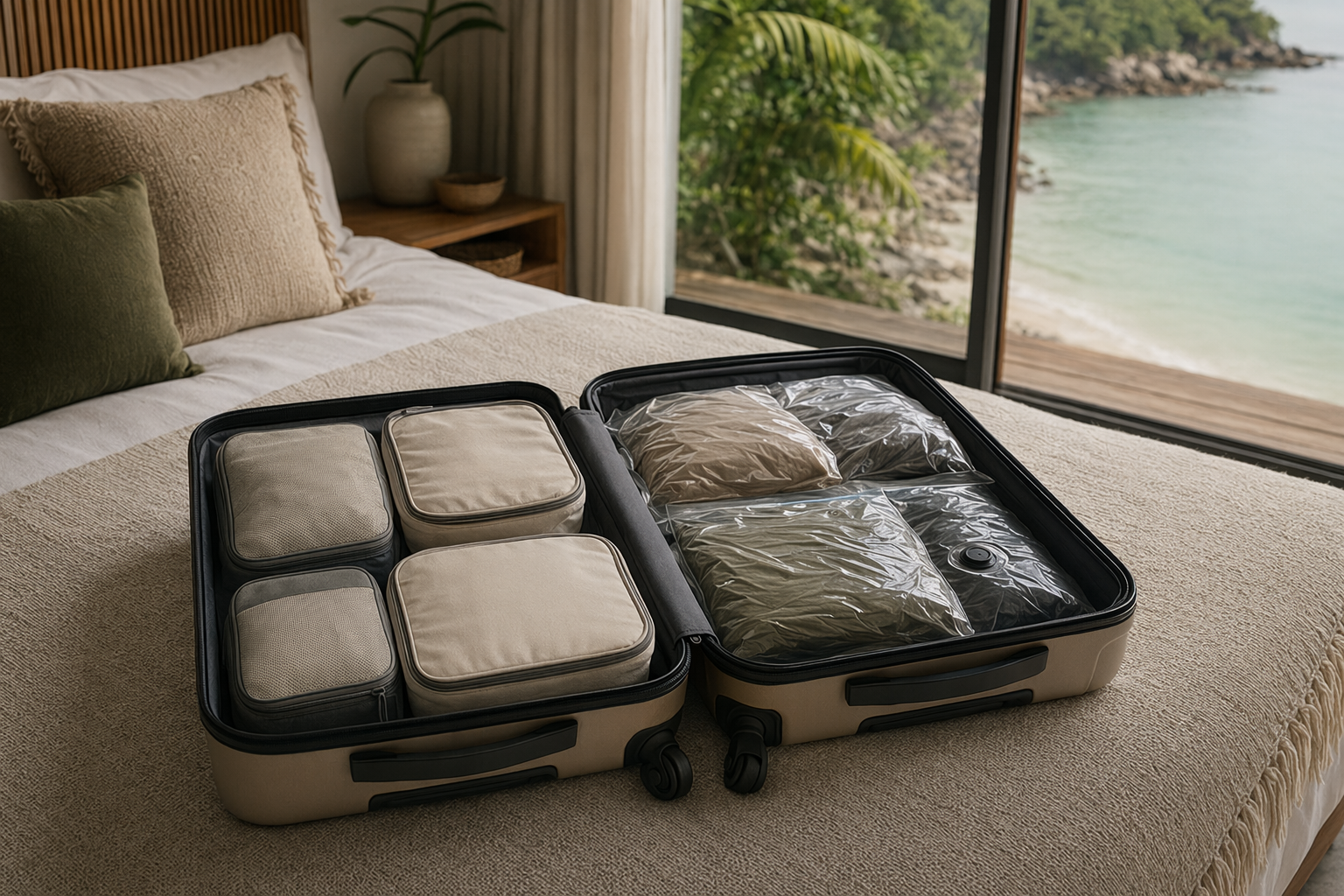
#Packing cubes are basically soft fabric boxes with zips. You fold or roll clothes and put them inside. Some have mesh tops so you can see what’s inside, some are opaque, some are fancy with double compartments for dirty laundry. They don’t always reduce the size of your clothes a lot. Their main job is organisation. T-shirts in one cube, underwear in one small cube, ethnic wear in another, gym clothes seperate. That type of thing.
Compression bags are made to remove air or squeeze clothing tighter. There are two common types: zip-style bags where you roll out the air, and cube-style compression organisers with an extra zip that tightens everything down. Vacuum bags are also there, but honestly I don’t like them for normal travel because who is carrying a vacuum cleaner to a homestay in Manali or a beach shack in Gokarna? Some hotels might help, but depending on that is a bit risky. Roll-up compression bags are more practical for Indian travellers.
| Feature | Packing cubes | Compression bags |
|---|---|---|
| Best for | Keeping clothes sorted and easy to find | Reducing volume of soft bulky clothes |
| Space saving | Mild to moderate | High, especially for winter wear |
| Wrinkles | Usually less if packed nicely | Can wrinkle clothes badly |
| Weight impact | No reduction | No reduction, only volume reduces |
| Daily access | Very convenient | Annoying if you keep opening and re-compressing |
| Good for | Family trips, work trips, backpacking, trains | Winter trips, long trips, one-bag packing |
| Risk | You may overpack because it looks neat | You may overpack because it looks smaller |
My first packing cube trip was not aesthetic, but it worked
#I bought my first set of packing cubes from a random online sale. Nothing Instagram-worthy. The stitching was okay-ish, one zip was slightly crooked, and the colour was that dull grey which looks like office carpet. I took them on a Kerala trip where we were doing Kochi, Munnar and Alleppey in one week. Different weather, different clothes, constant unpacking. That trip converted me.
In Kochi I needed light cotton clothes because it was humid and sticky. In Munnar, suddenly it was cool in the evening and I wanted my sweatshirt. On the houseboat I needed nightwear and one decent outfit because everyone takes photos even when they say they won’t. Earlier I would just dig through everything and create a small landslide inside the suitcase. With cubes, I could pull out only the “daily clothes” cube. My socks weren’t hiding inside my jeans. My kurta didn’t smell like sunscreen. Small victory, but when you’re travelling, these small things feel big.
Then compression bags saved my life in winter, kind of
#Compression bags became useful for me later, mostly for winter trips. North India winter packing is no joke. A single sweater eats half your cabin bag. Add thermals, monkey cap, muffler, thick socks, and suddenly you’re travelling like you’re shifting house. For trips to Himachal, Kashmir, Uttarakhand, Ladakh shoulder season, or even Europe in cold weather, compression bags are genuinely helpful.
But there is a catch which people don’t tell in those neat packing videos. Once you compress everything, your bag may still become heavy. Airlines don’t care that your sweater is now thin. Domestic flights in India often have cabin baggage limits around 7 kg and checked baggage allowances commonly around 15 kg in economy, but it varies by airline and fare type, so you really have to check before flying. International routes can be totally different, sometimes by weight and sometimes by number of pieces. Compression bag or not, the weighing scale is the final boss.
My rule now is simple: if I need to reduce bulk, I use compression. If I need to reduce confusion, I use cubes. If I need to reduce weight, I remove clothes. Painful, but true.
Which saves more space in real travel situations?
#For pure volume, compression bags usually save more space than regular packing cubes. Especially with soft, airy items. Fleece jackets, sweaters, cotton T-shirts, kids’ clothes, towels, shawls, leggings, nightwear. These items have air trapped between layers, so when you squeeze them, they flatten nicely. I’ve seen one medium compression bag take what would normally fill almost half a cabin suitcase and reduce it to one thick packet.
But for clothes like jeans, heavy lehenga blouse pieces, formal trousers, denim jackets, shoes, toiletries, books, and chargers, compression doesn’t do much. Jeans are already dense. You can press them, sit on them, emotionally threaten them, nothing much happens. Same with shoes. Packing cubes are better here because they help divide and protect things. I also never put cables, chargers, adapters or power banks loose inside a cube with clothes. For that, a proper tech pouch is much better, and this Travel Electronics Organizer Buying Guide for Indian Flyers is actually useful if your bag has become a jungle of Type-C cables, laptop charger and random earphones.
The Indian traveller problem: we don’t pack like minimalists
#A lot of packing advice online is like “just carry two outfits and wash them”. Very cute. But Indian travel is different, na. We carry one outfit for temple visit, one for dinner, one extra because weather may change, one Indian wear option because family might insist, slippers, sports shoes, snacks, medicines, sometimes bedsheet if we’re staying in a budget place, and at least one plastic bag full of “just in case” items. If travelling with parents or kids, multiply this by three.
For family trips, packing cubes are honestly more useful than compression bags. Give each person a different colour cube. Or label them, if you are that organised type. I’m not, but I try. When we did a Rajasthan road trip, cubes helped because we were changing hotels every two nights. Jaipur, Jodhpur, Jaisalmer, Udaipur. Instead of opening all bags in every room, each person pulled out their cube. In budget hotels and homestays where cupboard space is limited, this is a blessing.
Also, Indian trains. Packing cubes are very underrated for train travel. When you’re on an overnight train and your bag is under the berth, you don’t want to open the full suitcase to find one pair of socks. Pulling a small cube out is easier. Compression bags, not so much. They are slippery, noisy sometimes, and if you open one fully in a train, good luck packing it again while uncle on side-lower is staring.
When packing cubes are better than compression bags
#Packing cubes are better when you need access often. City hopping, hostel stays, work trips, destination weddings, train travel, backpacking, family holidays. Basically any trip where your luggage gets opened daily. If you’re staying in a hostel dorm in Goa or Rishikesh, cubes help you avoid spreading your clothes everywhere like a crime scene. If you’re in a business hotel in Bengaluru for two nights, one formal cube and one casual cube keeps life easy.
- Use one small cube for underwear and socks. Don’t mix it with fresh shirts, please.
- Use one medium cube for daily wear like T-shirts, tops, shorts or leggings.
- Use one cube or pouch for dirty laundry. Even a cloth bag works, no need to buy fancy everything.
- Use a flat folder or separate cover for shirts, kurtas and clothes that wrinkle quickly.
Packing cubes also help with hotel rooms where you don’t fully trust the cupboards. I know this sounds fussy, but many Indian travellers will understand. Sometimes I don’t want to place clothes directly in a drawer, especially in budget stays near bus stands or old hill-station hotels. I just keep the cube open in my suitcase and use it like a mini drawer. Done.
When compression bags are actually worth carrying
#Compression bags are worth it when your clothes are bulky, your bag is small, or you’re trying to manage one-bag travel. Winter trips are the obvious one. If you’re going to Kashmir, Spiti, Sikkim, Auli, Europe in winter, or even a December wedding where you need shawls and heavy outfits, compression bags can save serious space. They’re also good for return trips when your dirty clothes are bulkier and you have shopped more than planned. Which is always.
I also use compression bags for beach trips, but not in the way people think. I pack clean clothes in cubes, and keep one roll-up compression bag for used clothes or damp-ish swimwear after drying as much as possible. Not wet clothes, please. Wet clothes locked in plastic for long can smell horrible. On Goa trips during monsoon or shoulder season, when nothing dries properly, I keep a thin laundry bag and use compression only on the final day. Otherwise your suitcase will smell like sadness and sea water.
For treks, compression sacks are popular, especially for sleeping bags and jackets. But if you’re doing guided treks in India, check what the operator recommends. Some give duffel bags and strict weight limits. Over-compressing can make packing neat, yes, but the porter or mule weight limit still matters. And in mountains, safety layers are not optional. Don’t remove warm clothes just because your bag looks too full. Remove the third photo outfit instead. Harsh but fair.
Wrinkles, fabrics and the whole “looking decent in photos” issue
#Compression bags can wrinkle clothes badly. If you’re packing cotton kurtas, linen shirts, formal wear, saree blouses or dresses for a wedding, be careful. The tighter you squeeze, the more creases you get. I once compressed a linen shirt for a Pondicherry trip and it came out looking like it had fought with a buffalo. The hotel iron saved me, but still. Not ideal.
Packing cubes are gentler if you fold properly. Rolling T-shirts works nicely. For shirts and kurtas, I prefer folding flat and placing them in a cube that is not overstuffed. If it’s a wedding trip, I don’t compress the main outfit. I pack it in a garment cover or keep it on top. Sarees, lehengas, sherwanis, formal blazers... these deserve respect. Compression bags are for inner layers, sweaters and casual clothes, not your main wedding look.
What about backpacks, trolley bags and duffels?
#In a hard-shell trolley, both cubes and compression bags work well. Cubes stack like tiffin boxes and make everything visible. Compression bags fit better if you use rectangular ones. In soft backpacks, cubes are excellent because they stop clothes from becoming one big lump at the bottom. Compression bags can create hard blocks that don’t always sit comfortably against your back, especially if you’re carrying the bag for long.
For duffel bags, I like packing cubes more. Duffels are basically black holes. You put one thing in and it vanishes. Cubes give structure. Compression bags can help too, but they slide around unless packed tightly. If you’re doing road trips, bike trips, or bus travel where bags get thrown around, cubes make it easier to find things without emptying the whole bag on a dhaba chair. Not that I’ve done that. Okay, I have.
Costs in India: what you should actually spend
#You don’t need to buy the most expensive set. Basic packing cubes in India usually start around ₹400 to ₹800 for a simple set, while better quality ones with stronger zips, mesh panels and nicer fabric can go from ₹1,000 to ₹2,500 or more. Compression packing cubes are generally pricier. Roll-up compression bags are often available around ₹250 to ₹1,500 depending on size and number of pieces. Prices keep changing online, especially during sales, so treat this as a rough range, not final rate.
My suggestion: start with one decent packing cube set and one or two compression bags. Don’t buy a 10-piece travel organiser combo just because it looks satisfying in photos. Half of those pouches will sit at home. Check the zips before the trip. Cheap zips fail at the worst moment, usually when you’re already late for checkout and your cab driver is calling for the third time.
A practical packing system that works for most Indian trips
#After many messy trips, this is the system I use now. Not perfect, but it works. For a 4 to 7 day trip, I use two packing cubes, one small pouch, one laundry bag and sometimes one compression bag. Clothes I need daily go in cubes. Bulky or emergency layers go in compression. Toiletries stay separate. Electronics stay separate. Documents stay separate, always.
- First, pack clothes by use, not by type. Daily wear together, nightwear together, warm layers together.
- Second, keep first-night items on top. After a late arrival, nobody wants to dig for pyjamas.
- Third, compress only what you won’t need immediately. Otherwise you’ll keep opening and closing the same bag and get irritated.
- Fourth, weigh the bag after packing. This is boring advice, but it saves airport drama.
For passports, tickets, visa papers, forex cards, hotel printouts, ID proofs and kids’ documents, don’t rely on packing cubes. That stuff needs its own place. I’ve seen families at immigration counters searching for one child’s passport like it’s a missing TV remote. If you travel with family, this Travel Document Organizer Buying Guide for Indian Families: Passport Holder, Travel Wallet or Folder? fits nicely with the whole organised-luggage idea.
Seasonal tips: monsoon, winter, summer and wedding travel
#For monsoon trips, packing cubes are fine but use waterproof pouches for wet items. In places like Goa, Kerala, Coorg, Meghalaya and the Western Ghats, humidity is the real villain. Clothes don’t dry fast. Compression bags can trap smell if you pack damp clothing, so use them only when needed and open them as soon as you reach home. A small laundry line or extra plastic-free wet bag is more useful than one more cube.
For summer travel, cubes are usually enough because cotton clothes are light. Rajasthan in summer, Tamil Nadu temple trips, Mumbai weekends, Hyderabad work trips, all these don’t need heavy compression unless you overpack like me. For winter, carry compression for bulky layers but keep one jacket outside or easily accessible. If you land in Delhi late night in December and your jacket is compressed at the bottom of the suitcase, you will regret your life choices.
For destination weddings, I mix both. Cubes for daily clothes, a garment cover for main outfits, compression bag for extra shawls or casual clothes. If the wedding is in Jaipur, Udaipur, Goa, Alibaug or Kerala, you may also have jewellery, footwear, makeup, gifts and return favours. Space becomes politics. Keep fragile items in the cabin bag. And please don’t compress anything with embroidery, sequins or delicate work. It can snag and then full mood off.
Luggage safety and the small accessories people forget
#When your bag is neatly packed, you also notice how valuable it has become. Clothes, camera, shoes, medicines, documents, gifts. For checked bags on international trips or long domestic connections, a luggage tracker is becoming more common among Indian travellers. Not mandatory, but useful if you’re anxious like me. If you’re comparing these small add-ons, this Bluetooth Luggage Tracker Buying Guide for Indian Travelers: AirTag, Android Tags or GPS? explains the options without making it too techy.
Safety-wise, don’t pack power banks in checked luggage. Keep them in cabin baggage as airlines require. Liquids, sharp items, batteries, medicines, all have their own rules. Always check your airline and airport instructions before flying because policies can change. Packing cubes and compression bags organise your stuff, but they don’t protect you from security rules. I wish they did, truly.
So, which one should you buy?
#If you travel mostly for short domestic trips, office trips, family holidays, train journeys, or weekend getaways, buy packing cubes first. They make your luggage cleaner, faster and less stressful. If you travel in winter, carry bulky clothes, or want to fit more into a small suitcase, add compression bags. If you’re a backpacker, use cubes for daily access and one compression bag for warm layers or laundry. If you’re travelling with kids, cubes are almost non-negotiable. Kids’ clothes are tiny but somehow multiply inside bags.
My personal ranking is this: packing cubes for 80 percent of trips, compression bags for special situations. I know that sounds like a boring answer, but travel gear should solve real problems, not just look cute in a reel. Compression bags give that wow feeling when your clothes shrink. Packing cubes give quiet satisfaction every single day when you find your clean socks in 5 seconds. And honestly, that second one matters more when you’re tired, hungry and your hotel room has only one working plug point.
Final verdict from my messy suitcase life
#Compression bags save more physical space. Packing cubes save more mental space. The best setup is usually a mix of both. Use compression for bulky soft clothes, especially winter wear. Use packing cubes for everyday clothes, family organisation and easy access. Don’t compress delicate outfits. Don’t forget weight limits. Don’t put wet clothes in sealed bags for too long. And don’t buy every organiser online just because someone with a perfect beige suitcase told you to.
If you’re still confused, start small. One medium cube, one small cube, one compression bag. Take them on your next trip, whether it’s a train to Varanasi, a flight to Kochi, a bus to Manali or a wedding in Jaipur. You’ll understand your own packing style very quickly. Mine is still not perfect. There is always one extra kurta I don’t wear and one charger I almost forget. But my suitcase no longer explodes every time I open it, and that feels like progress. For more such practical, slightly real-world travel tips, I keep browsing AllBlogs.in as well, especially when I want advice that doesn’t sound too fancy for normal Indian trips.