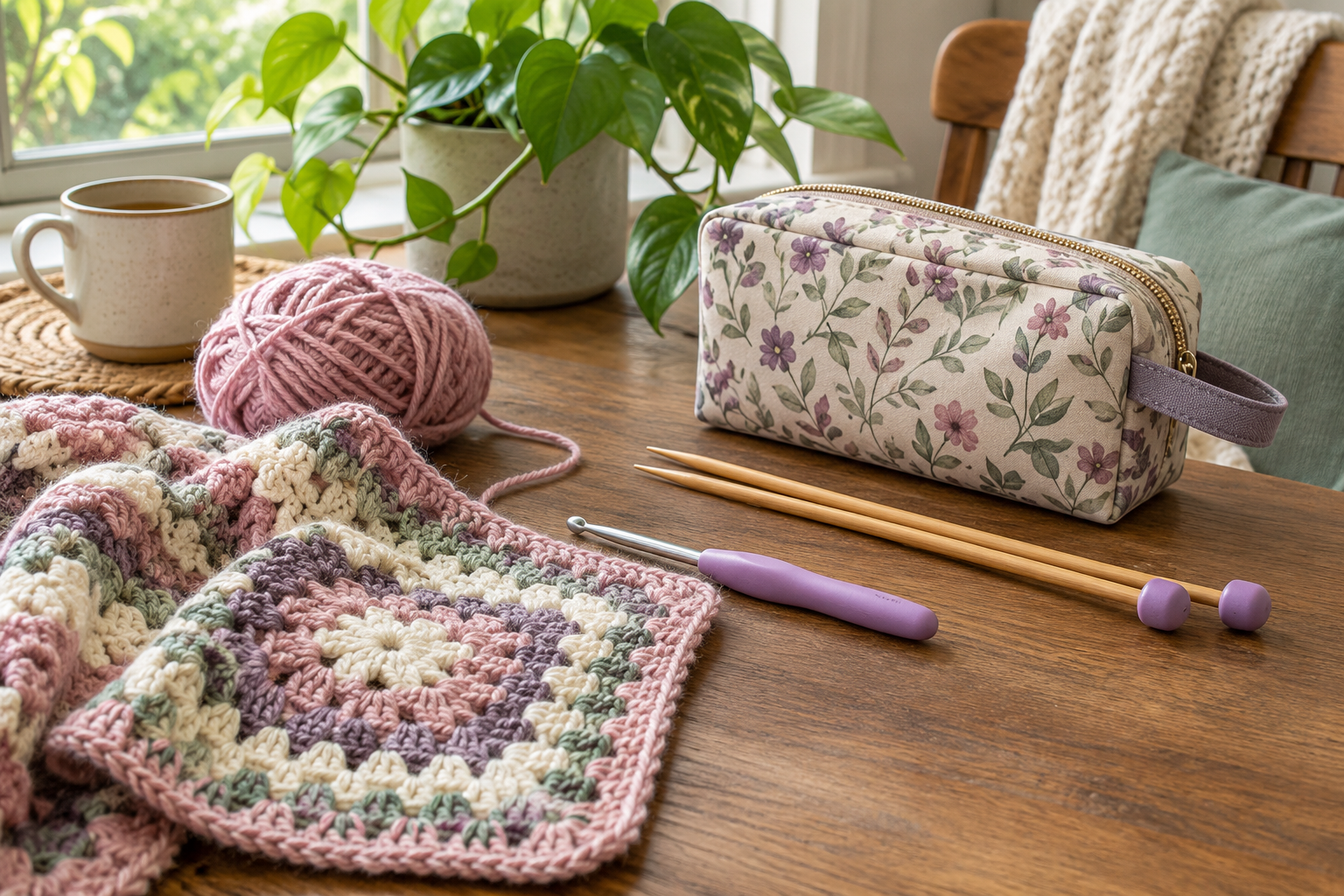
I’d check the crochet hook, knitting needles and yarn cutter separately before taking a craft project on a flight. Permission for a hook or needle doesn’t settle whether a separate cutting tool can go in the cabin. Check the screening rules for your departure and connection airports and the airline’s own baggage rules.
Imagine you’ve picked a scarf to work on during a long flight. The yarn and pattern are ready, and there’s a little tool pouch at the bottom of the bag. Open that pouch at home. A pair of scissors or a cutting pendant can be easy to overlook when all you’re thinking about is the project.
Make an inventory of the project bag
#Put everything on the table so you can see the items on their own. A crochet hook has a hooked end and a knitting needle has a point. A yarn cutter has a cutting edge, even when it’s built into a pendant. Attached tools and combination tools deserve their own check.
| Item | What I’d check |
|---|---|
| Crochet hook | Airport screening and airline rules for crochet hooks. |
| Knitting needles | Whether needles are allowed on that route and carrier. |
| Scissors | The specific blade measurement and permitted baggage under the checkpoint rules. |
| Pendant or blade-style cutter | The restriction for the cutter itself. |
| Stitch markers and yarn | Whether the pouch also contains a blade or another tool you forgot about. |
I’d write down the exact item name and material before searching a carrier’s list. If the wording doesn’t match your tool, describe it to the airline and the departure airport before packing. A clear question about a capped circular knitting needle is more useful than asking whether all craft supplies are allowed.
Pick a project that can survive a change of plan
#For a cabin bag only, choose the project after you’ve checked the rules. I’d leave a valuable or hard-to-replace tool at home if its status were unclear. You can carry the pattern and yarn and buy an appropriate tool after you arrive. Another option is to take a different activity for the flight and keep the craft for your hotel.
With a checked bag, put tools that must go in the hold into that bag before you leave. Protect points and cutting edges for safe handling. Keep the parts of the project you want in the cabin separate so you don’t pull the whole kit apart at check-in.
If a tool is necessary to keep work from unravelling, plan for that before choosing the bag. Secure the project in the way your pattern calls for. If you’re still unsure what can go through, take an unfinished piece that can travel separately from its tools.
Keep the pouch simple
#Pack tools you have confirmed are permitted in a small pouch. Cap or cover points where practical and keep the pouch accessible so you can show it if asked. Avoid bringing every shape and size you own for a single project. A spare stitch marker is a different decision from a second pair of scissors or a second set of needles.
If a security officer asks about the pouch, explain what the tools are for and follow their instructions. The person at the checkpoint makes the screening decision. If an item can’t go through, ask what options the airport has. With a flight close to boarding, you may have little time to leave the checkpoint and rearrange your bags.
On the flight, keep yarn and tools within your seat space and put the project away when the crew asks. A loose ball of yarn under a seat can be hard to retrieve while others are boarding. I’d keep the yarn in the project bag with just enough coming out to work, and stop somewhere easy to recognise before descent.
Check the UK and US rules one item at a time
#For a UK departure, look up what the government says about knitting needles and which scissors it accepts, then check the operating carrier for hooks and any further limits. The UK government lists small scissors with blades no longer than 6 cm in hand luggage. That is a specific rule for scissors under that guidance. It doesn’t tell you that every other tool with a blade of that length is permitted.
For a US departure, look up crochet hooks in the current item guide before packing, since published listings can change. Its knitting needles entry also distinguishes separate blade-style cutters. Check how its scissors entry measures the blade before you decide which bag it can go in. I’d check the tool I actually own against the description while it’s still on the table.
An airline can have a separate restriction. Before packing, look up the operating carrier on each boarding pass, including a short connection or a flight booked under somebody else’s flight number. If the carrier won’t take the tool in the cabin, the airport’s general permission doesn’t settle the whole trip. Scoot’s checked-baggage rule for knitting needles is a concrete example.
| Suppose you’re flying | Decision to make at home |
|---|---|
| Direct with cabin baggage only | Check departure screening and the carrier before choosing which project to take. |
| With a connection that requires new screening | Check the departure and connection checkpoints for each tool that stays in the cabin. |
| On a carrier with a hold-baggage rule for needles | Put the needles in your checked bag, or choose a different activity. |
| Out with one airline and back with another | Check both directions while you can still change the kit. |
A simple project choice when you have one bag
#Suppose you have two projects. One needs a single hook plus yarn. The other needs a few hooks, a stitch holder and scissors. If the first hook is confirmed for each leg, I’d take that project and leave the extra tools at home. Put in enough yarn for the time you’ll have and mark the row you’re on before you leave. You’ll be able to pick it up without spreading the whole pattern and kit across the tray table.
If the only suitable project depends on a tool that you haven’t confirmed, treat that as a packing decision to make before departure. Check whether you could buy the tool after you land, or bring a different activity for the flight. I’d put more value on keeping a favourite set of needles than on finishing a few rows in the air.
For checked baggage, put protected tools where they won’t get squashed by shoes or snag on clothes. Check that the working yarn can travel without the tools you need to keep in the hold. If you take the yarn in the cabin and the project in the hold, remember to move the pattern with whichever part you’ll use first.
Make a plan for the last ten minutes
#If I worked on a project in my seat, I’d leave time to put it away before descent. Finish a small section you can identify later, secure the stitches and put the hook or needles back in the pouch. If a stitch marker falls, wait until it’s safe to reach for it and follow crew instructions. A bright marker is easier to spot than a dark one on a dark seat cover.
A tray table is enough room for yarn, a small project and one tool. A longer needle can get awkward when the person next to you moves. Keep the project close and adjust if you have less room than you expected. If you can’t use it without getting into someone else’s space, put it away and pick it up after landing.
Before the return, empty the pouch once. A holiday project can acquire a new pair of scissors or a spare cutter you didn’t bring on the outward flight. Check the new item on its own. Save the notes for the rule that applies where you’ll be screened next.