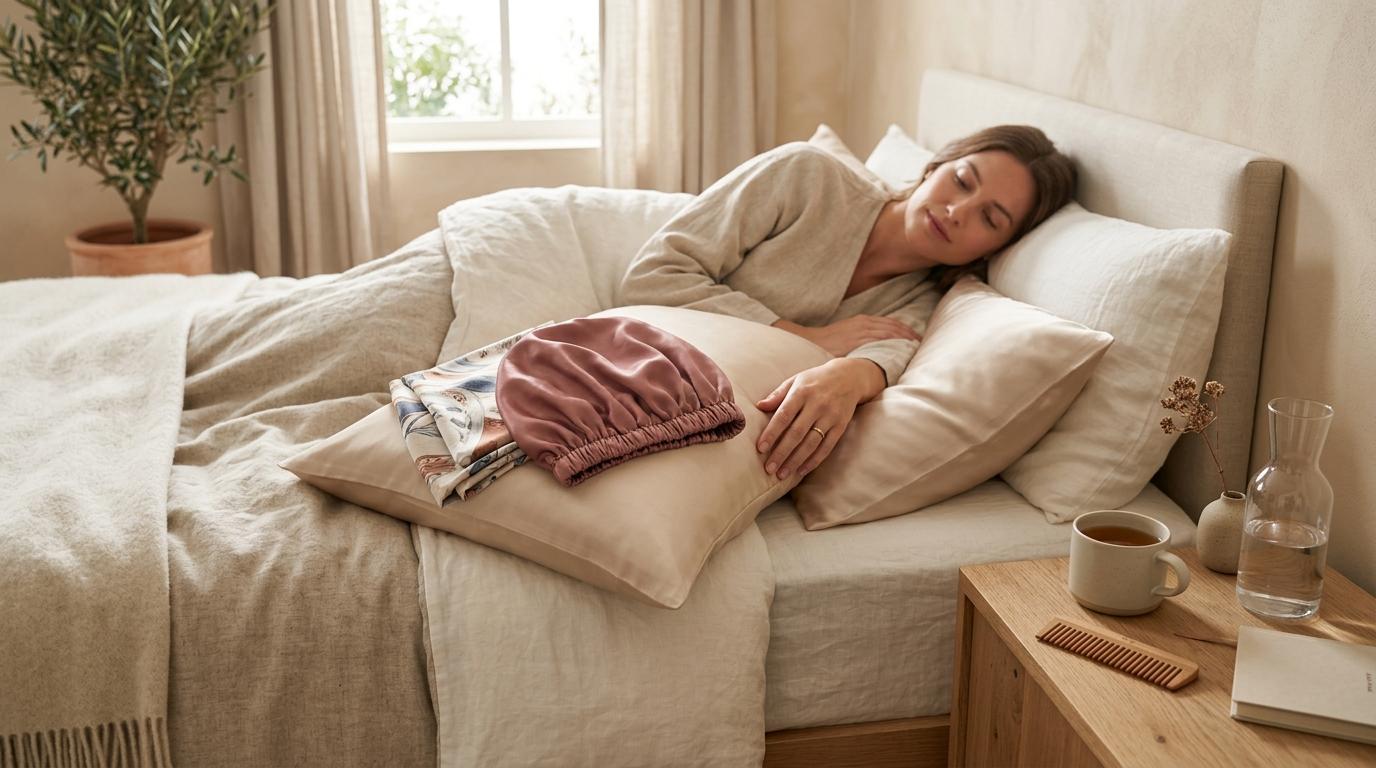
If you’re choosing between a satin bonnet vs silk pillowcase, use a bonnet if your hair is curly, wavy, long, thick, braided, or gets tangled while you sleep. Use a silk pillowcase if you dislike headwear, have short or fine hair, sleep hot, or want the easiest low-effort upgrade. A hair wrap is best for preserving sleek styles and blowouts.
Waking up with frizz is frustrating because your hair may look good at bedtime, then turn fuzzy by morning. A lot of that comes down to friction. While you sleep, hair rubs against your pillowcase, sheets, shoulders, and itself. If your pillowcase is rough or absorbent, your ends can feel drier and your curls or waves can lose shape.
A smoother sleep surface or a soft covering will not repair existing damage, but it can help reduce overnight friction, tangles and morning puffiness. The best choice depends on your hair type, sleep habits and comfort.
Satin Bonnet vs Silk Pillowcase vs Hair Wrap: Quick Comparison
#Why Frizz Gets Worse While You Sleep
#Frizz is not only a rainy-day or humidity problem. It can happen overnight too. When hair rubs against a rough surface, strands can look puffier, duller and less smooth in the morning. If you have curls or waves, friction can separate curl clumps, so instead of defined curls you wake up with a fuzzy shape.
That is why sleep protection helps. Your products do the work during the day. Your bonnet, pillowcase or scarf helps protect that work while you sleep.
When a Satin Bonnet Makes the Most Sense
#A bonnet is usually the best choice if your main problem is frizz plus tangles. It covers your hair, so your strands are not loose and rubbing everywhere while you move at night.
Choose a satin bonnet for frizzy hair if:
- You have curly, coily or wavy hair that loses shape overnight.
- Your hair is long enough to tangle around your neck or shoulders.
- You have thick hair, braids, extensions or protective styles.
- Your ends feel rough or dry when you wake up.
- You want your wash-day style to last longer.
Fit matters. A bonnet should stay on without squeezing your hairline. If the elastic leaves marks, gives you a headache or pulls at your edges, it is too tight. Look for a soft wide band, adjustable tie or drawstring style.
Fabric matters too. Polyester satin is usually affordable and smooth enough to reduce friction, but it can feel warmer. Silk usually feels more breathable, but it costs more.
When a Silk Pillowcase Is Better
#A silk pillowcase for hair is the easiest option because you do not have to wear anything. You just put it on your pillow and go to sleep.
Choose a silk pillowcase if:
- You dislike bonnets, scarves or caps.
- Headbands and elastic give you headaches.
- You have short hair that does not need much containment.
- You have fine or thin hair that gets flattened inside a bonnet.
- You toss and turn a lot.
- You want something gentle on your face too.
A silk pillowcase is not as protective as a bonnet for long, curly, thick or textured hair because your hair is still loose. But it is smoother than a regular cotton pillowcase, so it can still help reduce frizz while sleeping.
When a Hair Wrap or Scarf Is Enough
#A hair wrap for sleeping can be useful when your goal is to keep a style in place.
Choose a hair wrap or scarf if:
- You want to preserve a blowout.
- You have straightened hair and want it to stay sleek.
- You want extra control around your hairline.
- You already own a satin or silk scarf.
- You prefer a flatter, more secure wrap instead of a roomy bonnet.
A wrap sits closer to the scalp than a bonnet. That can be great for sleek styles, but not always great for curls. If you want your curls to stay fluffy and defined, a bonnet is usually better. If you want your hair smooth and controlled, a scarf may be the better choice.
Silk vs Satin, in Plain English
#Silk is a fiber. It is a natural material, often sold as mulberry silk. It is usually soft, smooth, breathable and more expensive.
Satin is a weave. It describes the way fabric is made, giving it a smooth glossy surface. Satin can be made from silk, polyester or other fibers.
So yes, something can be silk satin. But many affordable satin bonnets and pillowcases are polyester satin.
If your budget is tight, a polyester satin bonnet can still be a smart first buy. If you sleep hot, live somewhere humid, or want something touching your face all night, silk may feel nicer and more breathable.
Humid Weather and Monsoon Sleep Tips
#Frizz can get worse in humid weather, especially during monsoon season or in coastal cities. Moisture in the air can make hair swell, especially if your hair is dry, curly, porous, chemically treated or heat-styled.
Try these simple humid weather haircare sleep tips:
- Do not sleep with wet hair under a bonnet or wrap. Damp hair is more fragile, and covering it all night can make your scalp feel sweaty, itchy or uncomfortable.
- Dry your roots properly before bed. Your ends can be slightly damp if your hair tolerates it, but your scalp should not be wet before covering your hair.
- Use less product at night. Heavy oils, creams and leave-ins can feel sticky in humidity. A tiny amount on the ends is usually enough.
- Choose breathable fabric if you sweat. If polyester satin feels too warm, try silk or use a silk pillowcase instead of covering your hair.
- Wash sleep accessories often. Sweat, oil and product buildup can irritate your scalp or forehead, especially in hot weather.
- Keep styles loose. Tight styles get uncomfortable faster in humidity. Loose braids, soft scrunchies and roomy bonnets are usually easier to sleep in.
A Simple 5-Minute Sleep Routine for Frizzy Hair
#1. Detangle gently
#Use your fingers, a wide-tooth comb or a brush that works for your hair type. Start at the ends and work upward. If you have curls, finger detangling may help keep your curl pattern together better than brushing dry hair.
2. Add a tiny amount of product
#If your hair feels dry, use a small amount of serum, oil or leave-in on the mid-lengths and ends. Avoid overloading your scalp before bed, especially if you get oily or sweaty overnight.
3. Put your hair in a loose shape
#For curls and waves, try a loose pineapple with a soft scrunchie. For straight or long hair, a loose braid can help. For a blowout, wrap your hair around your head and secure it gently with a scarf.
4. Pick your sleep protection
#Use a bonnet if your hair needs to be contained. Use a silk pillowcase if you want the easiest option. Use a scarf if you want to preserve a sleek style.
5. Fix only what needs fixing in the morning
#You do not need to restart your whole routine. Smooth the frizzy bits, refresh curls with a little water or product if needed, and leave the rest alone.
Beginner Buying Checklist
#- Pick your main issue: frizz, tangles, flattened curls, dry ends or style preservation.
- Think about hair length: long and thick hair usually does better with a bonnet, while short hair may only need a pillowcase.
- Check the band: bonnets should have soft, wide or adjustable bands that do not dig into your hairline.
- Check the size: long hair, braids or extensions may need an extra-large or long bonnet.
- Look at the fabric: silk is breathable and pricier, while satin is smooth and usually cheaper.
- For silk pillowcases, check momme: 19 to 25 momme is a common shopping range.
- Check the closure: envelope closures or hidden zippers help keep the pillow in place.
- Buy one thing first and test it for two weeks before adding anything else.
Safety First: Hair Loss, Rash and Scalp Warning Signs
#Bonnets, pillowcases and wraps are usually low-risk. But a bad fit, tight tying or not washing them often enough can cause problems.
Watch out for hairline pain, pulling, breakage around the front hairline, headaches, pressure marks, scalp itching, bumps, rash or soreness. If you notice sudden shedding, patchy hair loss, flaking, redness, burning or ongoing scalp irritation, pause tight covered styles and speak to a qualified dermatologist or healthcare professional.
Also avoid sleeping in tight clips, rough hair ties or pins under a bonnet or scarf. The point is to reduce friction and tension, not add more.
So, Which One Should You Use?
#Choose a satin bonnet if your hair is curly, wavy, long, thick, braided, dry or tangles easily.
Choose a silk pillowcase if you want something effortless, have short or fine hair, sleep hot in head coverings, or move around a lot at night.
Choose a hair wrap or scarf if you want to maintain a blowout, straightened style or smooth hairline.
You only need a combination if there is a clear reason. For example, a bonnet plus a silk pillowcase can help if your bonnet slips off a lot. But for most people, one good item is enough.
Start with the thing you complain about most in the morning. If you wake up with tangles, you probably need containment. If your fine hair gets flat easily, you probably need freedom. If your blowout turns frizzy overnight, you probably need a wrap.