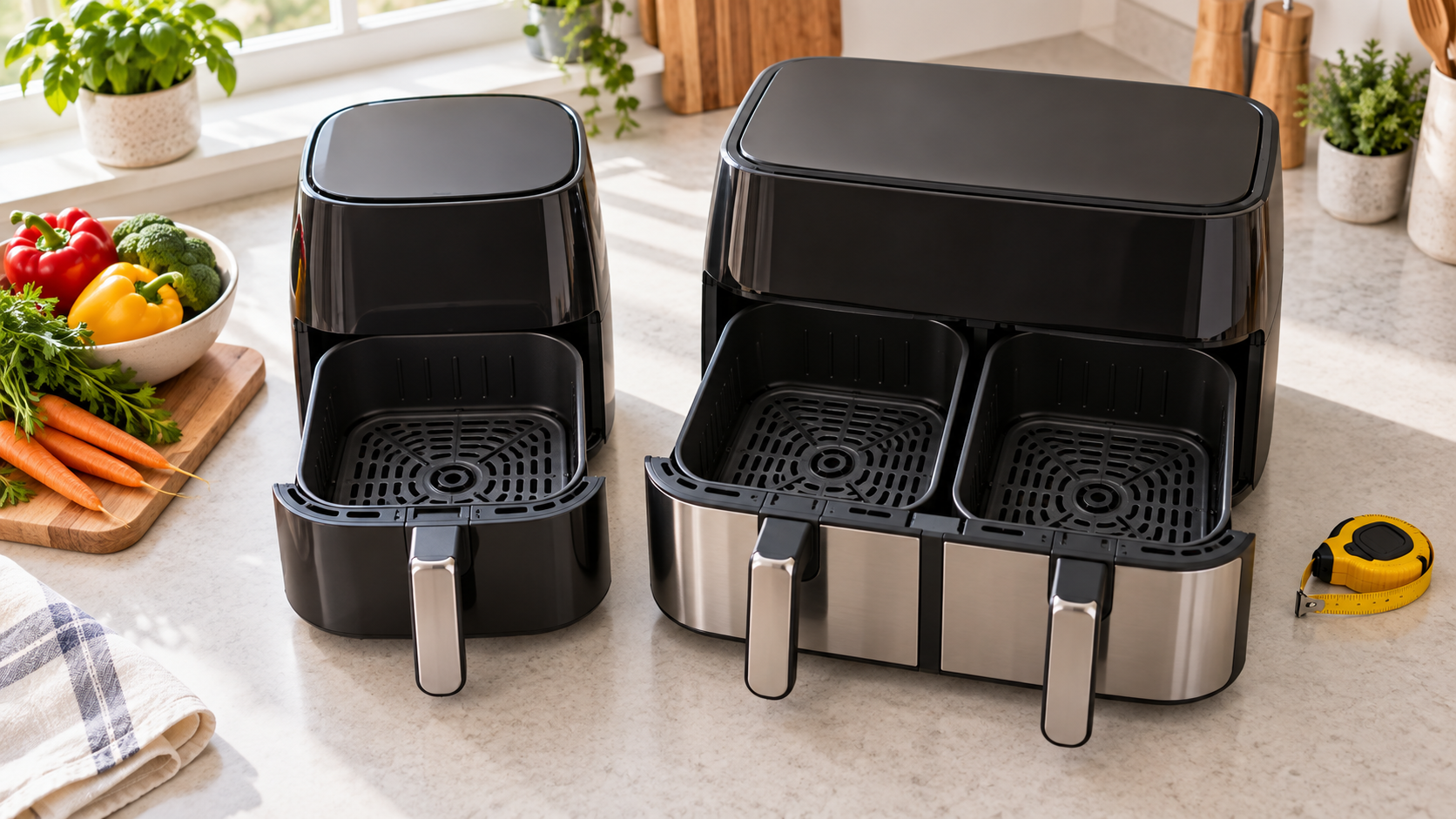
Choose an air fryer by the food you want to fit in one cooking round, then check whether the appliance fits your kitchen. The litre or quart label helps you shortlist models. Basket width, usable cooking area and the way the compartments divide often decide whether the purchase works for your meals.
For one person reheating a side dish, a compact basket may be enough. For two people cooking a main and vegetables together, the same basket can feel small. A family may prefer a large single drawer for one wide batch or separate drawers for foods with different cooking settings.
So first write down your normal meal. Include everything you expect the air fryer to cook. You will get a more useful answer than choosing from a simple “litres per person” rule.
Start with the job you expect it to do
#There is a big difference between buying an air fryer for snacks and expecting it to make most of dinner. Four people sharing a small side of fries need a different setup from four people each waiting for a main, potatoes and vegetables.
Think about your last few ordinary dinners. Which parts would go in the basket? Which would still cook on the hob? Would you cook food in separate rounds, or would that defeat the reason you want the appliance?
Use that routine as the starting point. An occasional dinner party should not decide the size of something that takes up your counter every day. Equally, a small price saving is less useful if you will run three rounds most evenings.
| Your regular use | Capacity detail to check first |
|---|---|
| Reheating one portion or making a small side | Smallest practical basket area and access for turning food |
| Cooking a main for two, with sides made elsewhere | Whether both portions fit with the spacing the recipe requires |
| Cooking a main and side together | Separate zones or an approved arrangement that suits both foods |
| Making a large batch of the same food | Uninterrupted basket area, supported load and shaking access |
| Cooking a whole item or using a baking dish | Internal width, depth and usable height, including clearance |
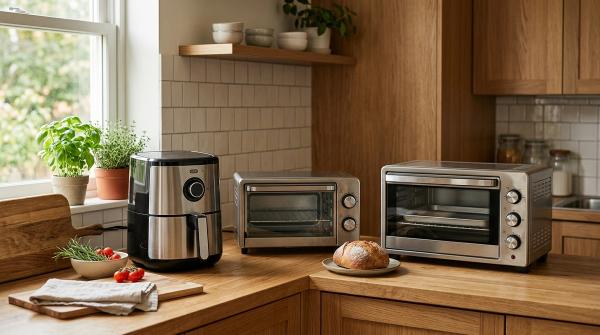
If you are still deciding between appliance types, start with the air fryer, toaster oven and convection oven comparison. Here, the decision is narrower: you want an air fryer and need to choose a workable size and layout.
Read the volume label, then look inside
#Litres and quarts describe volume. They do not directly describe how many food pieces you can lay across the bottom. A tall, narrow basket and a shallow, wide basket can have similar volume while handling flat foods differently.
This matters for a fillet, cutlet, sandwich or stuffed vegetable that you want to keep in one piece. Extra space above it may not help you fit another portion beside it. For other foods, depth can be useful, provided the model's cooking instructions support the load and mixing method.
Also check which part the advertised capacity describes. Read the exact product specification for the basket, pot or total cooking compartments. Avoid comparing two headline numbers until you understand what each includes.
When a listing gives US liquid quarts, one quart is about 0.946 litres. That makes 4 US quarts about 3.8 litres, 6 about 5.7 litres and 8 about 7.6 litres. These conversions help compare labels; they do not convert an appliance's volume into a guaranteed number of portions.
Use size ranges as a starting shortlist
#A shopping guide can point you towards a range, but your meal still needs to fit. Broad capacity bands overlap because people use the appliance in different ways. A household cooking a side dish can manage with less space than the same household cooking a full meal.
| Advertised range | Reason to consider it | Check before choosing |
|---|---|---|
| Below roughly 4 litres | Small portions, snacks, limited storage | Will your usual food fit without an extra round? |
| Around 4–6 litres | A practical starting comparison for individuals and couples | Usable basket dimensions and whether sides share the space |
| Around 6–8 litres | Larger portions or more food in one compartment | A wide basket versus a tall chamber, and the external footprint |
| Around 8–10 litres and above | Larger batches or several cooking zones | How the total splits, and whether each zone is large enough |
Treat this table as a search filter, not a serving chart. A model at the lower end could suit your side dishes; a bigger one could still disappoint if its compartments have the wrong shape.
Retailers often add a “serves up to” description. Read what food and load that claim uses. A maximum batch of snacks is not a complete meal for the same number of people. Look for a cooking chart or manual that names the food you expect to make.
Measure usable basket space
#Before buying, look for the internal dimensions of the basket with its normal crisper plate in place. External width tells you whether the appliance fits the counter. Internal width tells you whether your food fits the cooking space. You need both.
If you can inspect a display model, compare the flat area you can use rather than the opening alone. Rounded corners, sloping sides and handles can reduce the space available for a dish. Never put paper templates or other measuring materials into an appliance during use.
A simple example shows why this matters. Imagine one basket has a usable rectangular floor of 20 by 20 cm, and another has 24 by 22 cm. Their approximate floor areas would be 400 and 528 square centimetres. That is 32% more area in the second example, even before comparing height. These are invented dimensions for illustration, not specifications of a named product.
Area is still only a screening tool. Food shapes leave gaps, and cooking instructions may require space around pieces. A dish that fits tightly against every side is not necessarily suitable for use. Check approved accessory dimensions and airflow guidance in the manual.
Decide how much batching you will accept
#Cooking in rounds is not a failure. It can be a sensible way to use a compact appliance when you have limited counter space. The useful question is whether those rounds fit your evening.
Imagine you want to cook six pieces of food and a basket comfortably holds three under the recipe's spacing instructions. You are planning two rounds. If the recipe says a round takes 15 minutes, that is about 30 minutes of cooking before allowing for loading, checking and any required preheating. This is arithmetic using a hypothetical recipe, not a cooking-time recommendation.
Now think about serving. Do you want everyone to start eating together? Can the first round wait in a suitable way while you cook the second? Would you rather make the main elsewhere and use the basket only for the side?
Write down that compromise before spending more. A larger basket can be worth it when it removes a repeated cooking round. If you use the extra area only once a month, the smaller model may still fit your life better.
One large drawer and two small drawers solve different problems
#A large single drawer gives you an uninterrupted space. That can suit a wide item, several portions of the same food or a dish that needs more width. It does not automatically let you cook foods with incompatible settings together.
A dual-basket air fryer gives you separate compartments. Depending on the model, you can use different cooking times and settings and a feature that coordinates when they finish. You still need enough room in each basket for its own food.
For example, Ninja lists one current model with two 4-quart containers, giving 8 quarts in total. The useful comparison is two spaces of about 3.8 litres each, not one uninterrupted 7.6-litre basket. That manufacturer specification illustrates the split; it does not establish which model performs best.
Some designs use unequal drawers or a divider that can be removed for a larger zone. Check the exact configurations the manufacturer permits. Do not assume that two zones become one just because they sit inside a wide appliance.
Work through three household examples
#One person, mainly leftovers and vegetables
#Suppose you usually reheat a portion of food or roast vegetables while another part of dinner cooks on the hob. You do not need to fit an entire meal in the basket.
Start by checking compact models and the lower part of the mid-size range. Compare your typical portion with the usable floor, and make sure you can turn or remove the food without a struggle. Then check where the basket will go for washing and drying.
Moving up one size could be useful if you regularly make tomorrow's lunch at the same time. Moving up several sizes just because guests sometimes visit may leave you storing more appliance than you need. Keep the ordinary meal as the reference point.
Two people who want the main and side together
#Now suppose dinner is two portions of a main plus a side of vegetables. A basket that fits the main alone has solved only half the job. Adding the vegetables may crowd it or require a different setting.
Compare a wider single basket against a dual-zone design. With one basket, check a supported recipe that combines the foods or plan separate rounds. With two, check whether the main fits one compartment and the vegetables fit the other. Total capacity alone cannot answer either question.
If you already prefer making vegetables on the hob, you might not need a second zone. If coordinating both dishes is the whole point of the purchase, it deserves more weight in the comparison than an extra preset button.
A family making the same food for everyone
#For a family sharing one main dish, start with the required batch rather than the family-size label. Check how many pieces fit under the manual's recommended arrangement and whether the manufacturer's load example resembles your meal.
A large single drawer may give you the shape you need. A dual model may let you split the batch, but you must check each compartment and the operating instructions for using both. An oven-style air fryer may offer shelves, with its own rules for spacing, turning or rotating trays.
If the meal still needs multiple rounds, compare that routine with the oven you already own. You can decide that an air fryer is useful for weekday sides without asking it to replace every family dinner.
Capacity depends on the food
#A maximum load is not a target you need to reach. Follow the food-specific cooking chart and the maximum mark for the actual appliance. Manufacturers can recommend a smaller load for a particular result than the largest amount the container holds.
Philips' support guidance, for example, distinguishes fries from meat and fragile foods, and gives model-dependent load limits. For delicate or stuffed pieces, spacing also helps you remove the food without breaking it. Check the equivalent instructions for the model you buy rather than transferring another brand's rule.
Do not assume a rack doubles useful capacity. Use only supported accessories, with the arrangement and cooking method specified for them. Nor should a baking dish fill the basket so tightly that you ignore the manufacturer's required airflow or height clearance.
For food safety, capacity planning does not replace checking doneness. Use the relevant recipe, appliance instructions and appropriate food-safety checks. A browned outside does not establish that a crowded batch has cooked through.
Check the space it needs while operating
#Measure the counter where you will actually use the air fryer. Include width, depth and height, then add the clearances in the manual. Different models have different requirements; a general kitchen rule cannot replace those instructions.
Also allow room to pull the drawer out. Picture yourself lifting a loaded basket, setting it down on a suitable heat-resistant surface and turning the food. If another appliance or a wall blocks that movement, the listed footprint has understated the space you need.
Check the position of nearby cabinets, sockets and anything that could be affected by heat. Use the specified electrical supply and follow the manufacturer's placement instructions. A model that only fits when pushed into a tight storage gap may not have a suitable operating position there.
Consider the full routine: bring it out, cook, let it cool as directed, clean it and put it away. Compare the weight and grip with what you can comfortably manage. If moving it is awkward, you may prefer a model you can leave in a safe permanent spot.
Include cleaning and ownership costs
#A bigger basket also needs somewhere to be washed and dried. Check whether it fits your sink, whether the removable parts are dishwasher-safe under the manufacturer's instructions and whether the handle makes storage awkward.
Replacement baskets and crisper plates are useful to investigate before purchase. Check availability for the exact model in your country. Similar-looking parts from another version may not fit or be approved. Warranty and service coverage matter more than an extra capacity label if you cannot replace a worn part later.
Avoid a guaranteed electricity-saving claim based only on size or wattage. Rated power, cooking time, preheating, load and the number of rounds all affect energy use. Two smaller rounds may change a comparison you made using one cooking cycle. Use actual measured consumption if that saving is central to your buying decision.
Keep a short comparison sheet
#Compare two or three real candidates using the same meal. Copy the figures from the manufacturer's listing and manual, and mark anything you still need the seller to confirm.
| Detail | What to record |
|---|---|
| Your regular meal | Main, sides and portions expected from the appliance |
| Cooking space | Usable internal dimensions with the normal plate or approved accessory |
| Compartment split | One zone, two equal zones, unequal zones or a supported removable divider |
| Expected rounds | Based on a suitable cooking chart, not the largest promotional food photo |
| Kitchen fit | External dimensions, drawer-open space and manual clearances |
| Ongoing use | Cleaning, weight, storage, spare parts and local service |
Choose the smallest model that comfortably handles your repeated meal in the number of rounds you accept, while meeting the placement instructions. If two models both do that, compare controls, cleaning and ownership cost. The extra volume deserves your money when you can name the job it will do.