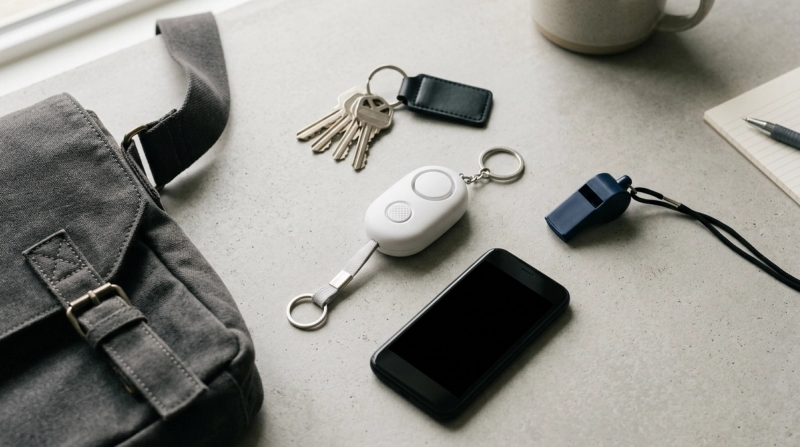
If you’re trying to choose between a personal safety alarm vs a safety whistle, the most honest answer is: you probably shouldn’t choose just one.
They’re good at different things.
A personal safety alarm is usually better for quick, in-the-moment attention in a city or on campus. A safety whistle is better outdoors, in bad weather, or as a no-battery backup. And your phone’s SOS features are worth setting up no matter what else you carry.
For most students, commuters, solo travelers, runners, and people who are often out alone, the simplest setup is this:
- Phone SOS turned on and tested
- Personal safety alarm clipped somewhere easy to reach
- Small safety whistle for hiking, travel, or backup use
None of this has to feel dramatic. You’re not building a survival bunker. You’re just giving yourself a few extra options if something feels wrong.
The goal is simple: make noise, get attention, create a moment to move away, and make it easier to call for help when your brain is under stress.
Quick Summary
#- Personal safety alarm: Best for commuters, students, and city travelers who need a loud, fast tool that can be triggered without speaking. Main weakness: it needs battery or charging and is not useful if buried in a bag.
- Safety whistle: Best for hikers, runners, campers, and backup use. Main strength: no battery, lightweight, dependable in wet weather. Main weakness: it needs breath and quick access to your mouth.
- Phone SOS safety setup: Best for everyone. Main strength: it can call emergency services and may share location depending on your device and settings. Main weakness: it depends on battery, signal, phone access, and setup.
- Safety apps: Best for families, groups, and shared travel plans. Main strength: they can add check-ins, tracking, and alerts. Main weakness: they may require location access and ongoing data sharing.
Short answer: If you only buy one physical item for everyday use, get a personal safety alarm. If you spend time outdoors, add a safety whistle. And no matter what else you carry, set up your phone SOS features now.
Personal Safety Alarm vs Safety Whistle: What’s the Difference?
#A personal safety alarm is a small electronic device that makes a very loud siren when you pull a pin or press a button. Many are advertised around 120 to 130 decibels. Some also include a small LED light.
The point is not to “fight back” with it. The point is to create a sudden, unpleasant burst of sound that draws attention and gives you a chance to move away.
A safety whistle is much simpler. You blow into it, and it makes a sharp sound that can carry well, especially outdoors. It doesn’t need batteries, charging, signal, or an app update. That’s why it has stayed useful for hikers, campers, runners, and travelers for so long.
A phone SOS setup is different again. It’s not really a deterrent. It’s a communication tool. Built-in emergency features on your phone can help you contact emergency services and, depending on your device and settings, share your location with emergency contacts.
So each one helps in a slightly different moment:
A personal alarm helps when something is happening near you right now.A whistle helps when you need to signal without relying on electronics.Phone SOS helps when you need emergency contact, location sharing, or official help.
Most people don’t need a complicated safety setup. They need one they’ll actually carry and remember how to use.
1. Personal Safety Alarm: Best for Fast Urban Deterrence
#A personal safety alarm is usually the easiest tool to activate quickly in everyday places: a parking lot, campus path, stairwell, bus stop, train station, rideshare pickup spot, lift lobby, or quiet street.
You can clip it to your keys, bag strap, belt loop, jacket zipper, or lanyard. If it has a pull-pin design, you can trigger it without unlocking your phone, opening an app, typing anything, or trying to explain what’s happening.
That matters more than people think.
In a scary moment, your hands may shake. You may freeze. You may forget your passcode. You may not be able to shout clearly.
A loud alarm is simple.
It says: look here.
Who should buy a personal safety alarm?
#A personal safety alarm makes sense if you are:
- A student walking across campus at night
- A solo traveler arriving somewhere unfamiliar
- A commuter using buses, trains, parking lots, or quiet streets
- Someone who wants a physical backup to phone SOS
- A person who may freeze or struggle to shout under stress
- A night-shift worker or early morning walker
It’s especially useful in places where other people may be nearby, but not really paying attention.
Who shouldn’t rely only on a personal alarm?
#A personal alarm may not be enough if you are:
- Going deep into remote wilderness
- Often in very cold weather where battery performance can drop
- Likely to keep it buried in the bottom of your backpack
- Expecting it to contact police or family automatically
- Looking for something that works with no battery at all
A personal alarm is an attention tool. It is not a tracker, not a phone, and not a guarantee.
What to watch for
#The biggest issue is access.
If it takes ten seconds to dig your alarm out of your bag, it’s not really available when you need it.
The second issue is power. Battery-operated alarms need checking. Rechargeable alarms need charging. Replaceable-battery models need fresh batteries from time to time. Cold weather can also reduce battery performance, so don’t make an electronic alarm your only backup in freezing conditions.
2. Safety Whistle: Best Low-Tech Backup for Outdoors
#A safety whistle isn’t fancy, and that’s exactly why it works.
It’s small, light, cheap, and dependable. It doesn’t need a phone signal, charging cable, screen, app permission, or battery check. For hikers, campers, trail runners, and solo travelers who spend time outdoors, it’s still one of the most practical safety items you can carry.
If you’re lost, injured, separated from a group, or trying to get attention over distance, a whistle can be better than shouting. Shouting uses up energy quickly. A whistle creates a sharper sound with less effort.
Who should buy a safety whistle?
#A safety whistle is a good choice if you are:
- Hiking or camping
- Trail running alone
- Traveling in remote or low-signal areas
- Carrying a daypack or emergency kit
- Looking for a no-battery backup
- Building a simple travel safety setup
It can also work well as a backup for commuters who want something that never needs charging.
Who shouldn’t rely only on a whistle?
#A whistle may not be ideal as your only tool if you are:
- Mostly worried about sudden close-contact situations in a city
- Unable to blow strongly because of asthma, panic, injury, or illness
- Wearing scarves, face coverings, helmets, or gear that blocks quick access
- In a packed crowd where getting it to your mouth may be hard
The whistle is reliable, but it still needs your breath and your mouth. That sounds obvious, but under stress, obvious things matter.
What to watch for
#In cold weather, avoid putting a metal whistle directly against your lips. A plastic pealess whistle is usually more practical in freezing conditions.
“Pealess” means the whistle doesn’t rely on a little ball inside. That’s helpful because the ball in some whistles can jam, freeze, or perform badly when wet or dirty.
3. Phone SOS Safety: Essential, But Not Enough by Itself
#Your phone is probably the most powerful safety tool you already carry.
Built-in emergency features can help you call emergency services quickly. Some phones can also notify selected emergency contacts and share your location, depending on your region, device, and settings.
That’s why everyone should set up phone SOS safety features.
But your phone isn’t magic.
In a sudden situation, it may be in your bag, locked, low on battery, dropped, or out of reach. You may not have signal. You may not have time to open the right screen or remember the right steps.
That doesn’t make phone SOS useless. It just means it shouldn’t be your whole plan.
Who should set up phone SOS?
#Everyone.
If your phone has emergency SOS, medical ID, emergency contacts, location sharing, crash detection, or similar features, take a few minutes to set them up.
This applies to solo travelers, students, commuters, parents, older adults, runners, night-shift workers, and anyone who is often out alone.
Who shouldn’t rely only on phone SOS?
#Don’t rely only on your phone if you:
- Often leave home with low battery
- Keep your phone buried in a bag
- Walk in poor-signal areas
- Travel internationally and may not have reliable service
- Want something that draws instant public attention
- Need a tool you can use without unlocking a screen
A phone can call for help. A personal alarm or whistle can get attention right where you are.
Both jobs matter.
Safety Apps vs Built-In Phone SOS
#Third-party safety apps can be useful. Some offer group check-ins, shared routes, timed alerts, location tracking, or automatic notifications. For families, friend groups, and organized travel, those features can be genuinely helpful.
But they also add friction.
You may need to allow constant location access, background activity, notifications, contact access, and data sharing. You also need to trust the company behind the app. Some apps can drain your battery too.
Built-in phone SOS features are usually the best starting point because they’re already on your device. You don’t have to install another service, create another account, or share data with another company.
If you need advanced group features, compare safety apps carefully. If you want to keep things simple and share less data, start with your phone’s native emergency settings and carry a physical safety tool.
Head-to-Head Comparison: Which Should You Carry?
#Best for city commuting
#Winner: Personal safety alarm
A personal alarm is easy to trigger in a parking lot, subway station, bus stop, lift lobby, stairwell, or quiet road. You don’t need to unlock your phone or bring a whistle to your mouth.
For commuters, the best setup is usually:
- Personal alarm clipped where your hand naturally reaches
- Phone SOS configured
- Emergency contacts updated
Best for students
#Winner: Personal safety alarm plus phone SOS
Students move between classrooms, libraries, hostels, dorms, parking areas, and public transport. A personal alarm is useful because it’s immediate. Phone SOS adds the emergency contact layer.
Keep the alarm on your keychain, ID lanyard, or outer bag strap. Not inside the tiny pocket you never open.
Best for hiking and outdoor use
#Winner: Safety whistle
A whistle is hard to beat outdoors because it doesn’t need a battery. It’s also useful if your phone has no signal or your personal alarm battery dies.
For hiking, carry:
- Plastic pealess safety whistle
- Charged phone with SOS settings checked
- Personal alarm only if it makes sense for your route and weather
Best for international solo travel
#Winner: Layered approach
For solo travel, one item is rarely enough. Different places create different problems. Your phone may lose service. Your alarm may run out of battery. Your whistle may not be ideal in a crowded city street.
A practical solo traveler safety setup looks like this:
- Phone SOS enabled before the trip
- Personal alarm clipped to your day bag or keys
- Safety whistle in your backpack or jacket pocket
- Emergency contacts saved somewhere easy to find
- Local emergency numbers noted down if needed
Best in cold or wet conditions
#Winner: Safety whistle, with one caution
Wet conditions are usually fine for a simple plastic whistle. Cold conditions can reduce battery performance in electronic devices. If you use a personal alarm in winter, check it often and keep it somewhere accessible.
For freezing weather, choose a plastic whistle instead of a metal one.
Buying Checklist: What to Look for in a Personal Safety Alarm
#Use this personal alarm buying checklist before you buy.
1. Loudness rating
#Look for a clearly stated sound rating. Many personal alarms are marketed around 120 to 130 dB.
Treat that number as a guide, not a perfect promise. Distance, traffic, walls, crowds, and indoor spaces all affect how sound carries.
2. Activation method
#Common options include:
- Pull-pin activation
- Button activation
- Double-button activation
- Keychain-style triggers
Pull-pin alarms are popular because they’re simple to use under stress. Button alarms can work well too, but poor designs may trigger accidentally in a bag.
Choose the one you can operate quickly without looking.
3. Size and grip
#A tiny alarm is convenient until you can’t hold it properly.
Ask yourself:
Can you grab it with wet hands?Can you trigger it while wearing winter gloves?Can you find it by touch in the dark?
If not, it may be too small or awkward for real use.
4. Battery or charging type
#Check whether the alarm uses replaceable batteries or USB charging.
Rechargeable models are convenient for travel, but only if you actually remember to charge them. Replaceable-battery models can be practical if you keep spare batteries and check them regularly.
Either way, test it on a schedule.
5. Attachment style
#This matters more than people think.
Look for an alarm that can attach securely to:
- Keys
- Bag strap
- Belt loop
- Jacket zipper
- Lanyard
- Backpack exterior loop
If it falls off easily, it’s not dependable. If it lives at the bottom of your bag, it’s mostly decoration.
6. Extra light
#Some personal alarms include a small LED light. This can help with finding a keyhole, walking through dim areas, or adding a little visibility.
Don’t buy one only because of the light, but it’s a useful bonus.
7. Ease of resetting
#Some alarms keep sounding until you replace the pin. Others use a button or different reset method.
Make sure you know how to stop it before you carry it every day. You really don’t want to figure that out for the first time on a crowded train.
Safety Whistle Buying Checklist
#A whistle is simple, but a few details still matter.
Look for:
- Plastic body, especially for cold weather
- Pealess design
- Bright color so it’s easy to find
- Strong clip, cord, or keyring
- Comfortable mouthpiece
- Compact size, but not so tiny that it’s hard to use
Avoid novelty whistles that look cute but are weak, fragile, or difficult to blow.
Common Buying Mistakes
#Mistake 1: Buying the loudest-looking alarm without checking usability
#A loud alarm is only useful if you can activate it fast. Grip, trigger design, and placement matter just as much as the decibel rating.
Mistake 2: Keeping the device buried
#This is probably the most common mistake.
A safety tool at the bottom of your backpack may feel reassuring, but it isn’t very useful in a fast situation. Clip it where your hand can reach it naturally.
Mistake 3: Never testing it
#Test your alarm according to the product instructions. Know how it sounds, how it activates, and how it stops.
If you carry a whistle, try it outdoors once so you know how much breath it takes.
Be considerate when testing loud alarms. Warn people nearby and avoid enclosed public spaces.
Mistake 4: Assuming phone SOS is already set up
#A lot of people think their phone is ready for emergencies, but they’ve never checked the settings.
Add emergency contacts. Learn the button sequence. Check whether location sharing is enabled. Do it before your next trip, not when something is already happening.
Mistake 5: Treating any device as a complete safety plan
#A personal alarm, whistle, or phone SOS feature is a backup layer. It doesn’t replace paying attention, planning your route, keeping your phone charged, trusting your instincts, or leaving a situation early.
Privacy and Safety Cautions
#Personal safety tools can help, but they have limits.
A personal alarm may attract attention, but it doesn’t guarantee that someone will step in. A whistle can signal distress, but someone still needs to hear it. Phone SOS can be powerful, but it depends on battery, signal, device access, and local emergency systems.
Be careful with safety apps too. If an app asks for constant location access, contact access, background activity, or lots of personal data, pause before accepting.
Ask yourself:
- Do I trust this app?
- Do I really need these features?
- Can I use built-in phone SOS instead?
- How easy is it to stop sharing my location?
- Who can see my location, and when?
For travelers, privacy is part of safety. Share your location only with people you trust. Avoid posting real-time routes publicly. And don’t let a tracker give you a false sense of security.
The safest setup is usually simple, accessible, and practiced.
Practical Carry Setups
#Everyday commuter setup
#Carry:
- Personal safety alarm on keys or bag strap
- Phone SOS configured
- Emergency contacts updated
Best for buses, metros, office commutes, late walks, and parking areas.
Student setup
#Carry:
- Personal alarm on ID lanyard, keys, or backpack strap
- Phone SOS enabled
- Campus or local emergency numbers saved if relevant
Best for libraries, dorms, hostels, campuses, evening classes, and public transport.
Solo traveler setup
#Carry:
- Personal alarm on your day bag
- Safety whistle in your backpack
- Phone SOS and location sharing configured
- Charger or power bank if you already carry one
Best for unfamiliar cities, transit hubs, short walks, and mixed urban travel.
Hiking or outdoor setup
#Carry:
- Plastic pealess whistle
- Charged phone with SOS settings checked
- Personal alarm only if useful for your route
Best for trails, parks, camping, and low-signal areas.
Final Takeaway
#You don’t have to choose one tool forever.
For most people comparing personal safety alarm vs safety whistle, the practical answer is simple: carry a personal safety alarm for daily urban use, carry a safety whistle for hiking or backup, and set up your phone SOS safety features today.
A good safety tool isn’t the one with the scariest packaging or the biggest promise. It’s the one you can reach, activate, and trust when you’re stressed.
Keep it simple. Keep it accessible. Practice once before you need it.