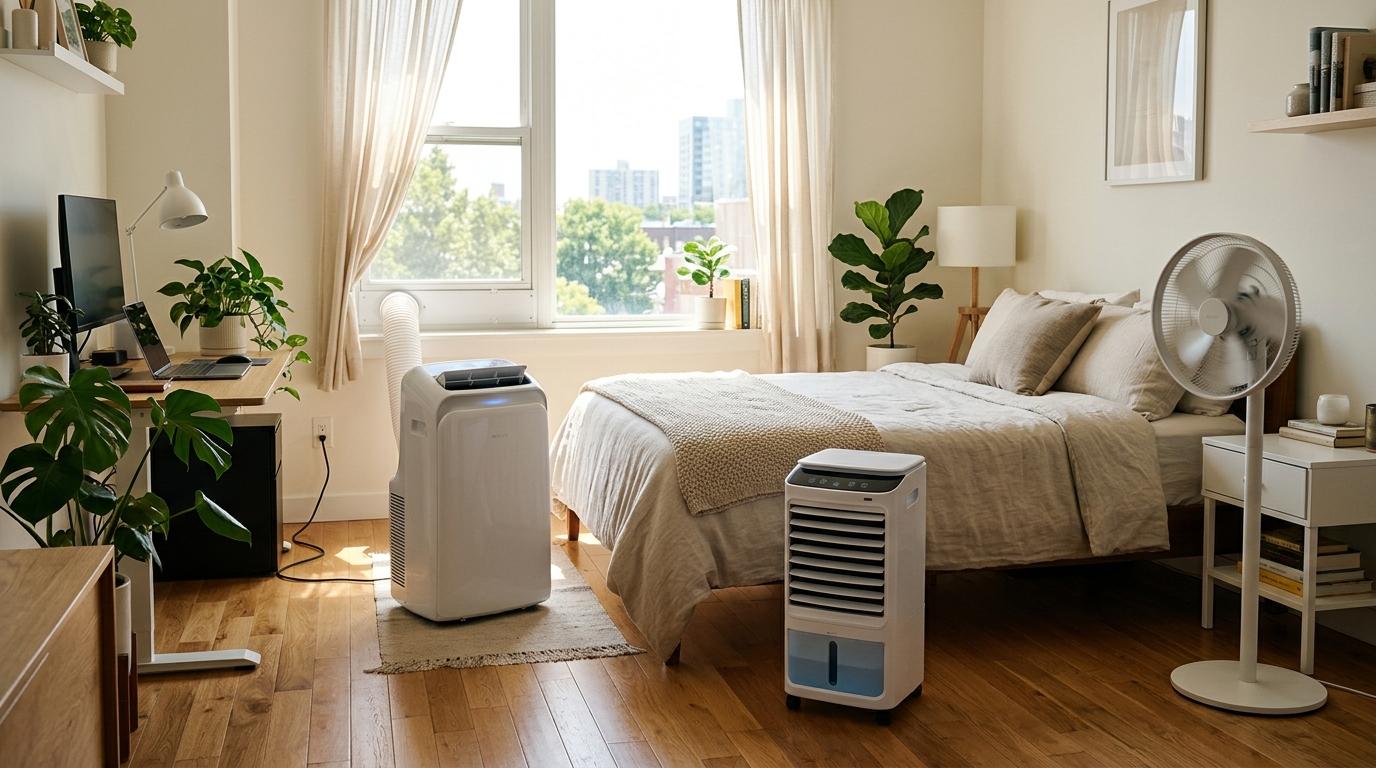
If you’re trying to choose between a portable AC, an evaporative cooler, and a fan, here’s the easiest way to think about it:
- Buy a fan if you just want to feel cooler while you’re sitting nearby.
- Buy an evaporative cooler if you live somewhere dry and want cooler, slightly moist airflow.
- Buy a portable AC if you need the room itself to actually cool down.
They might all look like “cooling” products, but they work in very different ways. A fan moves air. An evaporative cooler uses water to cool air. A portable AC removes heat from the room and sends it outside. That last part is the big difference.
The Short Version
#- Choose a fan when you want cheap, simple cooling at a desk, bed, or sofa. Avoid it if you expect it to lower the actual room temperature.
- Choose an evaporative cooler when you live in a dry climate and do not mind added moisture. Avoid it if your room or climate is already humid.
- Choose a portable AC when you need real room cooling. Avoid it if you do not have a window, balcony door, sliding door, or safe exhaust path for the hose.
So the question isn’t just “Which one is cheapest?” or “Which one blows the coldest air?”
The real question is: Are you trying to cool your body, or cool the room? That one answer will save you a lot of frustration.
Who This Guide Is For
#This guide is for anyone trying to cool one hot room without installing a permanent air conditioner.
Maybe you rent and can’t install a split AC. Maybe your bedroom traps heat all night. Maybe your home office gets blasted by afternoon sun. Maybe you’re a student trying to survive a heatwave without spending too much.
Whatever the situation, it’s easy to get confused because fans, air coolers, and portable ACs are often marketed like they do the same thing.
They don’t.
A fan helps you feel cooler. An evaporative cooler can cool the air, but only in the right climate. A portable AC actually removes heat from the room, but it needs proper venting.
So before you buy anything, it’s worth figuring out what problem you’re really trying to solve.
What to Check Before Buying
#Before you spend money, look at the room itself. A cooling product that works beautifully in one home can feel useless in another.
Use this as a quick portable AC buying checklist, even if you’re also considering a fan or evaporative cooler.
1. Do you have a window or another exhaust path?
#A portable AC needs to vent hot air outside through an exhaust hose.
Usually, that means using:
- A standard window
- A sliding window
- A balcony door
- A sliding door
- Another safe outdoor venting route
If you can’t send the hot air outside, don’t buy a portable AC. Running one with the hose sitting loose in the room is basically pointless because the heat stays inside.
Fans and evaporative coolers don’t need exhaust hoses.
2. Is your climate dry or humid?
#This is the make-or-break question for evaporative coolers.
Evaporative coolers work by pulling air through water or a wet cooling pad. As the water evaporates, it cools the air. That works best when the air is dry.
But if the air is already humid, evaporation slows down. Instead of getting cool, fresh airflow, you can end up with air that feels heavy, damp, and sticky.
So if you live somewhere dry, inland, or desert-like, an evaporative cooler may be a good option.
If you live somewhere coastal, tropical, muggy, or monsoon-prone, be careful. Evaporative cooler humidity is not a small detail. It’s the whole point.
3. Do you need to cool yourself or the room?
#This sounds obvious, but it’s where a lot of people buy the wrong thing.
If you mostly sit in one spot — at a desk, on a sofa, in bed, or while gaming — a fan might be enough.
But if the room itself is too hot, a fan won’t fix that. It can make you feel better while it’s blowing on you, but it won’t lower the room temperature.
If you need the actual room to cool down, you’re really choosing between an evaporative cooler and a portable AC. That choice mostly depends on humidity and whether you can vent a portable AC properly.
4. How much noise can you live with?
#All three make noise, but they don’t sound the same.
Fans are usually the easiest to tolerate. You mostly hear moving air. Evaporative coolers add fan noise plus some water movement. Portable ACs are usually louder because the compressor is inside the room.
This matters a lot if you’re using the room for:
- Sleeping
- Work calls
- Studying
- Recording audio
- Quiet home-office work
Also think about placement. A unit two feet from your bed will feel very different from one across the room.
5. How much setup and maintenance do you want?
#A fan is simple. You plug it in and turn it on.
An evaporative cooler needs a little more attention. You’ll need to fill it with water, clean it, and make sure it doesn’t sit around with stale water inside.
A portable AC takes the most setup. You need to attach the exhaust hose, fit the window kit, and seal the window area as well as possible. If hot outdoor air leaks right back in, the unit has to work harder and may not cool as well.
Portable AC vs Evaporative Cooler vs Fan: How They Actually Work
#Let’s break down what each one really does.
1. Fan: Best for Cooling You, Not the Room
#A fan does not lower the room temperature.
What it does is move air across your skin. That helps sweat evaporate, which makes your body feel cooler.
That’s why a fan can feel amazing when it’s pointed right at you, but useless the moment you walk away. It’s not removing heat from the room. It’s just helping your body handle the heat better.
Best for
#- Desk work
- Bedside airflow
- Studying
- Gaming
- Sitting on the sofa
- Mildly warm rooms
- People who want the cheapest and simplest option
Avoid if
#- You expect the room temperature to drop
- The air is so hot that moving it around doesn’t help
- You need humidity control
- You want to cool the room before you enter it
The honest takeaway
#A fan is not useless. It’s just often misunderstood.
If you need personal cooling, a fan is the easiest and cheapest choice. But if your whole room is overheating, a fan won’t solve the real problem.
2. Evaporative Cooler: Best for Dry Heat
#An evaporative cooler, sometimes called an air cooler or swamp cooler, uses water to cool the air.
Inside the unit, a fan pulls warm air through a wet pad or water-fed material. As the water evaporates, it absorbs heat. The cooler then blows that cooler, moisture-rich air back into the room.
In dry climates, this can feel really nice. In humid climates, it can feel awful.
That’s the part many people miss. An evaporative cooler is not a portable AC without a hose. It’s a completely different kind of cooling product.
Best for
#- Dry climates
- Rooms where extra moisture is welcome
- People who want something stronger than a fan
- Hot, dry spaces with decent airflow
- Areas where the air feels dry, harsh, or dusty
Avoid if
#- Your room already feels damp or sticky
- You live somewhere humid
- You need dehumidification
- You expect it to perform like an air conditioner
- You don’t want to deal with water filling and cleaning
The honest takeaway
#An evaporative cooler can be a smart buy in the right place.
But in the wrong climate, it can make your room feel worse. Before buying one, check your local humidity — not just the temperature.
3. Portable AC: Best for Actually Cooling the Room
#A portable AC works more like a traditional air conditioner.
It uses refrigerant and a compressor to remove heat from indoor air. It blows cooled air back into the room and pushes the extracted heat outside through an exhaust hose.
That’s why venting matters so much.
A portable AC doesn’t just move air over your skin like a fan. It also doesn’t depend on dry air the way an evaporative cooler does. It actively removes heat from the room.
It can also help reduce humidity, which is one reason it often feels much better during muggy weather.
But it has tradeoffs. A portable AC needs a window or outdoor venting path. It takes up floor space. It usually costs more to run than a fan or evaporative cooler. And it’s usually louder because the compressor is inside the room with you.
Best for
#- Humid climates
- Bedrooms that stay hot at night
- Home offices with afternoon sun
- Renters who can’t install permanent AC
- Rooms that need real temperature reduction
- People who want cooling plus some moisture removal
Avoid if
#- You can’t vent the exhaust hose outside
- You’re very sensitive to mechanical noise
- Your window setup can’t be sealed reasonably well
- You only need a light breeze nearby
The honest takeaway
#A portable AC is the strongest option for cooling one hot room.
But only buy one if you can vent it properly. Without outdoor venting, it’s the wrong tool.
Quick Comparison Section
#- Room temperature: A fan does not lower room temperature. An evaporative cooler may help in dry air. A portable AC is the strongest option for actual room cooling.
- Humidity: A fan does not add moisture. An evaporative cooler adds moisture. A portable AC usually helps reduce moisture when vented properly.
- Setup: A fan is plug-and-play. An evaporative cooler needs water and cleaning. A portable AC needs hose setup, window sealing, and filter/drainage checks.
- Best use case: Fan for personal airflow, evaporative cooler for dry-climate cooling, portable AC for real hot-room cooling.
- Main caution: Do not buy a portable AC without a venting path, and do not buy an evaporative cooler expecting AC-like cooling in humid weather.
Best For / Avoid If
#Fan
#Best for: You want quick, affordable relief while sitting, sleeping, working, or studying.
Avoid if: You need the room itself to cool down, want humidity control, or expect it to work like an air conditioner.
Evaporative Cooler
#Best for: You live in a dry climate and want cooler-feeling airflow without using a compressor-based AC.
Avoid if: Your climate is humid, your room feels damp, or you don’t want extra moisture in the air.
Portable AC
#Best for: You need real hot room cooling, especially in humid weather, and you have a window or another place to vent the exhaust hose.
Avoid if: You can’t vent it outdoors, can’t tolerate compressor noise, or only need airflow in one spot.
Common Buying Mistakes to Avoid
#Mistake 1: Buying a fan and expecting it to cool the room
#A fan can make you feel cooler, but it does not remove heat from the room.
If you leave a fan running and come back later, the room will not be cooler because of the fan. It may even feel the same or slightly warmer if the room is closed up and the motor has been running.
Use a fan when you’re in the airflow. Don’t treat it like an air conditioner.
Mistake 2: Buying an evaporative cooler in a humid climate
#Evaporative coolers need dry air to work well. In humid air, the water doesn’t evaporate as effectively. Instead of cool, pleasant airflow, you may get damp air that makes the room feel heavier.
If your summers are muggy, an evaporative cooler is risky.
Mistake 3: Ignoring the portable AC exhaust hose
#The exhaust hose is not optional.
A portable AC has to send hot air outside. If the hose isn’t attached correctly, or if the window gap is poorly sealed, cooling performance drops quickly.
The hose is the part that removes the heat from your room. Without it, the unit can’t do its job.
Mistake 4: Thinking “cool air” means “air conditioning”
#Some small cooling gadgets blow air that feels cool up close, especially if they use water or ice.
That does not mean they can cool a whole room.
If you want actual room cooling, look at how the product works. Marketing words like “cooling,” “ice breeze,” or “personal AC” can be misleading.
Mistake 5: Forgetting about maintenance
#Every cooling product needs some upkeep.
Fans collect dust. Evaporative coolers need fresh water and cleaning. Portable ACs may need filter cleaning, drainage checks, proper hose placement, and window sealing.
The best option is not just the one that works on the first day. It’s the one you can realistically live with all summer.
So, What Should You Buy?
#Here’s the simple answer.
Buy a fan if you only need personal cooling and you’ll be sitting or sleeping near it.
Buy an evaporative cooler if your climate is dry and you want cooler airflow without a full air conditioner setup.
Buy a portable AC if the room itself needs to cool down, especially if your weather is humid, and you have a proper place to vent the exhaust hose.
For most renters, students, and apartment dwellers, it comes down to three questions:
- Is your climate dry or humid?
- Do you have a window or venting path?
- Do you need personal comfort or actual room cooling?
Once you answer those, the choice becomes much easier.