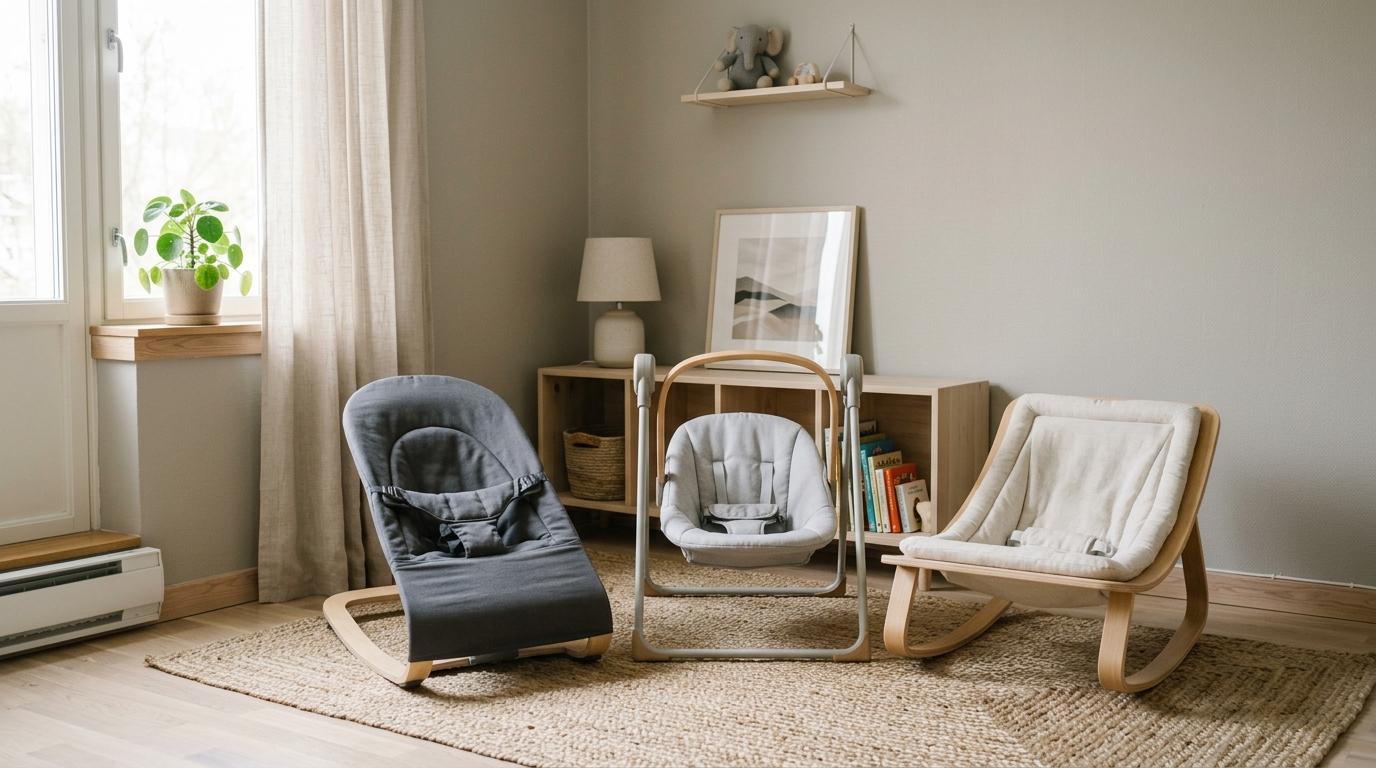
If you’re trying to choose between a baby bouncer vs swing vs rocker, the practical answer for most new parents is: start with a bouncer if you need one at all. It is usually lighter, easier to move, easier to store, and better suited to apartments than a bulky swing. A swing can help if your baby likes motorized motion and you have floor space. A rocker sits in the middle. None of them should be used for sleep.
Bouncers, swings, and rockers all promise the same basic thing: a safe place for short supervised awake time while you sit nearby, fold laundry, eat a meal, or take a brief breather. But they differ a lot in space, cleaning, portability, and how quickly they become annoying to manage.
Most importantly: bouncers, swings, and rockers are convenience products, not sleep products. If your baby falls asleep in one, move them to a firm, flat crib or bassinet.
Baby Bouncer vs Swing vs Rocker: Quick Difference
#A baby bouncer is a lightweight seat on a flexible frame. It moves when your baby kicks, wriggles, or when you gently tap it.
A baby swing is a larger seat that moves automatically with a motor. Some move side to side, some move front to back, and many include timers, music, vibration, or toy bars.
A baby rocker sits on a curved base and rocks manually. Some models lock into a still position or convert for longer use, depending on the manufacturer’s limit.
Which One Is Best for Small Homes and Apartments?
#For most small homes, the bouncer wins.
In an apartment, every baby product has to justify the space it takes. A swing may look useful online, but once it arrives, it can take over a corner of the living room, block walking space, and become hard to move during cleaning.
A bouncer is usually easier to live with. You can place it near you while you sit, eat, fold clothes, or talk with family. You can also move it from bedroom to living room without treating it like furniture.
A rocker is a middle option. It is often smaller than a swing but larger than a basic bouncer. If you like the idea of gently rocking the baby with your hand or foot while sitting nearby, it can work well. Just measure the base before buying.
Choose a swing only if you have a fixed safe spot for it. If you will need to fold, drag, or shift it daily, it may become more effort than help.
India-Aware Checks: Heat, Monsoon, Family Visits and Apartment Life
#Many baby gear ads show large nurseries with lots of empty floor space. Real homes are often different. Many families share rooms, live in apartments, welcome grandparents and relatives often, and manage heat, dust, and monsoon dampness.
Check the full footprint
#Do not check only the seat width. Check the full footprint of the frame. Swings often need wide bases for stability. That is useful for safety but awkward in compact rooms.
Avoid overly plush seats in hot weather
#Very padded seats can make babies sweaty. In hot or humid homes, breathable fabric and washable covers are more useful than thick cushioning.
Think about monsoon drying time
#During monsoon, thick fabric can take a long time to dry. Choose removable, machine-washable covers that dry quickly. Check whether the frame has hidden corners where dust, milk, spit-up, or dampness can collect.
Plan for family visits
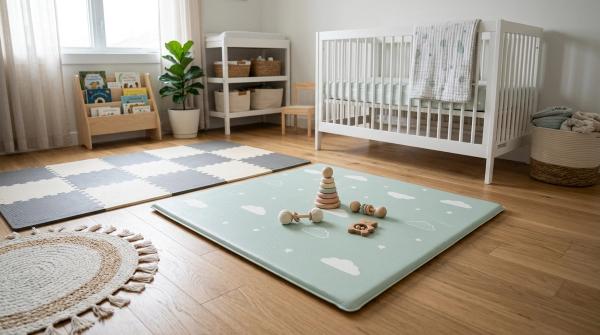
#If you visit grandparents often, a lightweight bouncer is easier to carry than a swing. For short visits, you may not need gear at all. A clean mat in the same room can work if the area is away from wires, pets, stairs, sharp corners, and small objects.
Safety Checklist: Awake, Supervised, Buckled, on the Floor
#Use this checklist every time:
- Use bouncers, swings, and rockers only for supervised awake time.
- Keep your baby in sight and stay close.
- Always use the harness correctly.
- Place the product only on the floor, never on a bed, sofa, table, or counter.
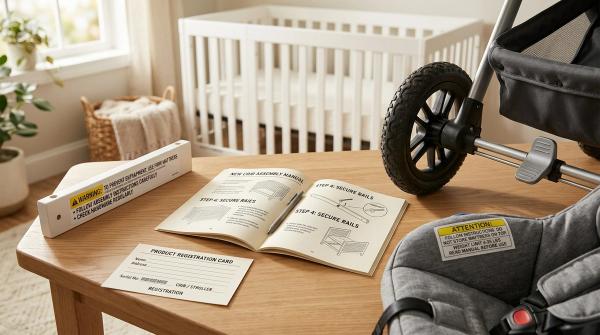
- Follow the age, weight, and movement limits in the manual.
- Stop using the seat when your baby reaches the limit or starts moving in a way the manual says is unsafe.
- Do not add loose blankets, pillows, inserts, or extra padding unless the manufacturer specifically includes them.
- If your baby falls asleep, move them to a firm, flat crib or bassinet.
The simplest safety rule is: awake, supervised, buckled, and on the floor.
Newborn Bouncer Safety: What to Check First
#Newborns need proper head and neck support. Before using any bouncer, swing, or rocker for a newborn, confirm that the product is suitable from birth and that the recline supports the baby without letting the chin slump forward.
Check:
- Age and weight guidance.
- Recline position for newborn use.
- Harness fit.
- Head and body support.
- Session length.
- Whether the baby can stay visible and supervised.
If the seat looks too upright, wait. A product that is useful later may not be right for the earliest weeks.
Buying Checklist Before You Pay
#Harness
#Look for a secure, adjustable harness. It should hold the baby snugly without digging into the skin.
Stable base
#The base should feel steady and should not wobble during normal use. Anti-skid grips are useful on tile floors.
Cleaning
#Choose a removable, washable cover. If removing the cover feels complicated, you may regret it after spit-up, sweat, drool, or diaper leaks.
Storage
#Check whether it folds, how flat it becomes, and where you will actually keep it.
Limits and manual
#Read the age, weight, and movement limits before buying. Do not rely only on product photos or online reviews.
Portability
#If you want to move the product between rooms or carry it to family homes, choose something lightweight.
Power source for swings
#If buying a swing, check whether it uses batteries, plug-in power, or both. Keep cords away from babies and walking paths.
Who Should Buy a Bouncer?
#Buy a bouncer if you want:
- A compact option for a small apartment.
- A lightweight product you can move easily.
- A more budget-friendly first baby gear item.
- A short-use supervised awake-time seat.
- Something easier to store than a swing.
A bouncer is often the most practical first choice because it is simple and easy to live with.
Who Should Buy a Swing?
#Buy a swing if you want:
- Motorized movement.
- A fixed setup in one room.
- Extra features like music, vibration, or toy bars.
- A soothing option for a baby who enjoys repeated motion.
- Enough clear floor space to use it safely.
A swing can be useful, but it is bulky. Some babies love swings and some reject them completely, so do not assume it will solve every fussy moment.
Who Should Buy a Rocker?
#Buy a rocker if you want:
- Manual rocking instead of motorized motion.
- A middle option between a bouncer and a swing.
- Fewer batteries, wires, and settings.
- A seat that may have a longer use window, depending on the model.
A rocker can be a good choice if you like simple gear and have enough room for the base.
Who Should Skip All Three?
#Skip all three if:
- Your space is very limited.
- Your budget is tight.
- You prefer fewer baby products.
- You are happy using a clean floor mat or play gym.
- You do not want another washable cover, frame, and storage problem.
Floor time is useful for babies because it lets them stretch, kick, turn, and build strength. A bouncer, swing, or rocker can help for short periods, but it should not replace regular floor time.
Baby Swing vs Rocker: Which Is More Useful?
#A swing is more useful if you specifically want motorized movement and have enough floor space. A rocker is more useful if you want something simpler, quieter, and easier to manage without plugs or battery changes.
For small apartments, a rocker may be easier than a swing, but a bouncer is usually easiest of all.
Baby Rocker vs Bouncer: Which Should You Choose?
#Choose a bouncer if your priorities are portability, storage, budget, and small-space use.
Choose a rocker if you prefer manual rocking, a sturdier feel, and a model that may last longer depending on the manufacturer’s instructions.
For many first-time parents, the decision comes down to space. If you need something you can fold, carry, and tuck away, a bouncer usually makes more sense.
Final Recommendation
#If you are buying only one item, start with a baby bouncer.
Choose a swing only if you have enough floor space and want motorized soothing. Choose a rocker if you prefer manual movement and want something simpler than a swing.
And if you skip all three, that is completely reasonable. A clean floor mat, supervised awake time, and safe sleep in a crib or bassinet are enough for many families.