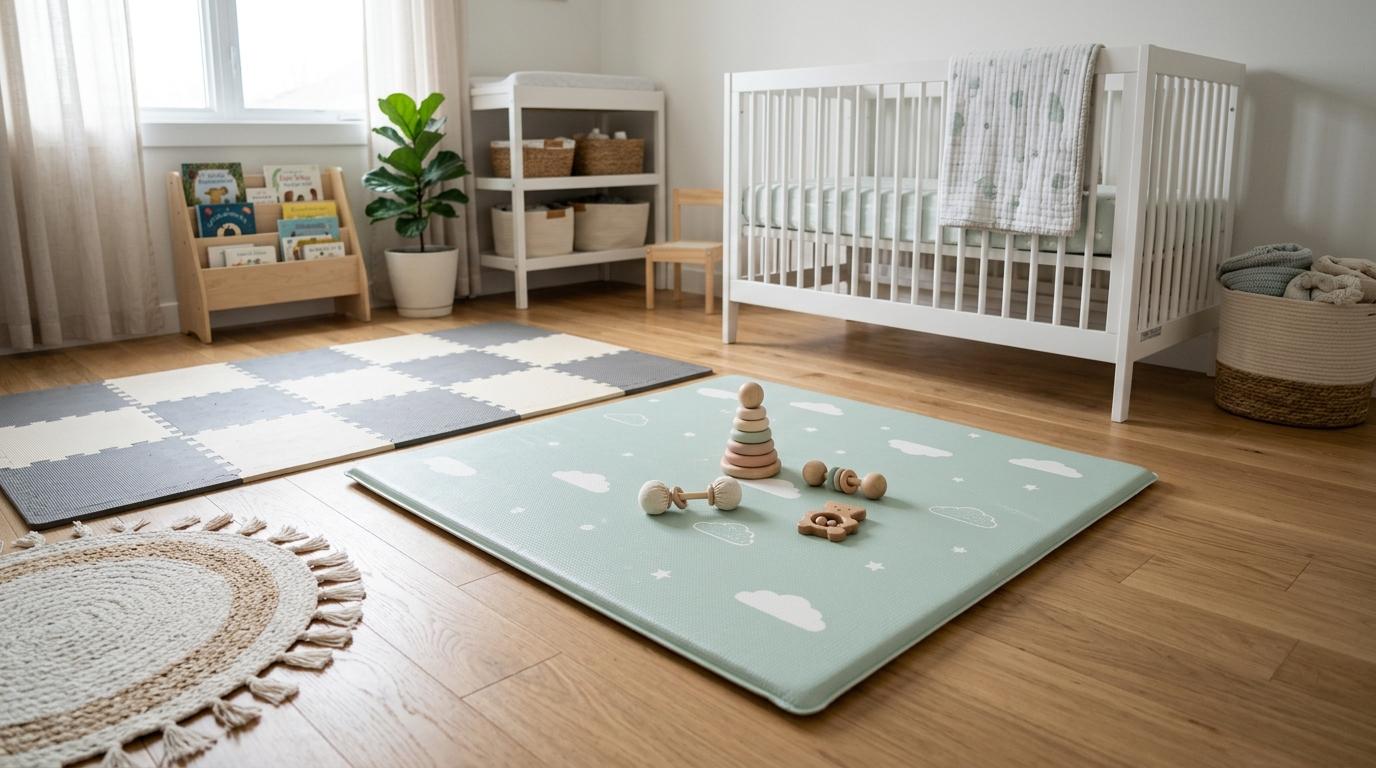
If you’re a new parent and you just want the short answer: a good baby play mat is usually the easiest choice for everyday floor play.
It gives your baby a clean, cushioned, wipeable spot for tummy time, rolling, sitting, crawling, and all the little “almost there” movements that happen before they suddenly start moving everywhere.
Foam tiles can also work, especially if you want to cover a bigger area. Rugs look nicer in a living room, but they can be a pain to clean after spit-up, drool, diaper leaks, or snack crumbs. A floor blanket is useful in a pinch, but it can slide around, bunch up, and may not offer enough cushioning on hard floors.
The truth is, babies spend a lot more time on the floor than most of us expect. First it’s tummy time. Then rolling. Then crawling. Then pulling up. And before you know it, they’re trying to reach the one thing you thought was safely out of reach.
You don’t need to turn your whole house into a padded play zone. You just need one safe, clean, supervised space where your baby can move freely.
Here’s a practical comparison.
Quick Comparison: Baby Play Mat vs Foam Tiles vs Rug vs Floor Blanket
#1. Baby Play Mat: The Easiest Everyday Choice for Most Families
#A single-piece baby play mat is usually the most practical option for daily use.
It creates a clear play area without taking over the entire room. You can place it in the living room, nursery, or bedroom, and your baby has a familiar spot for tummy time, toys, and early movement practice.
The biggest benefit is cleaning.
Babies are adorable, but they are also very messy. They drool. They spit up. Diapers leak. Toys fall on the floor and somehow go straight back into their mouths. A wipeable baby floor mat makes all of this easier to manage.
Because a single-piece mat has fewer gaps and seams, there are fewer places for milk, crumbs, dust, or moisture to hide.
A good tummy time mat should feel cushioned but firm. You don’t want something soft like a pillow. Babies need a supportive surface so they can push up on their arms, lift their head, turn, roll, and learn to move.
If the mat is too soft or plush, your baby may sink into it and find movement harder.
Good for:
- Supervised tummy time while baby is awake
- Rolling practice
- Crawling practice
- Homes with tile, marble, granite, wood, or laminate flooring
- Parents who want one easy-to-clean play space
Watch for:
- Clear age label
- Safety testing or certification details
- Non-slip base
- Firmness and thickness
- Waterproof or water-resistant surface
- Peeling, cracking, or torn foam
A baby play mat is for play, not sleep. If your baby falls asleep on it, move them to a safe infant sleep surface.
2. Foam Tiles for Babies: Flexible, But You’ll Need to Check Them Often
#Foam tiles, often called puzzle mats, are popular because you can build the play area however you like.
You can make a small corner, cover a large part of the room, or fit the tiles around furniture. That flexibility is helpful, especially in apartments or shared living spaces.
They’re also easy to take apart and store. If you need to pack the play area away at night, foam tiles can feel like a smart solution.
But they do come with a few extra jobs.
The biggest issue is the seams. Milk, water, dust, hair, crumbs, and tiny bits of food can get stuck between the interlocking pieces. To clean them properly, you may need to pull the tiles apart, wipe underneath, and let everything dry fully.
There’s also the small-parts concern.
The U.S. Consumer Product Safety Commission, or CPSC, warns about small parts for children under 3. With foam tiles, loose puzzle edges, detachable border strips, or bitten-off foam pieces can become choking hazards.
This becomes especially important once babies start pulling, biting, crawling, and putting everything in their mouth — which they absolutely will.
Good for:
- Larger play areas
- Temporary setups
- Odd-shaped rooms
- Families who want a modular layout
Watch for:
- Loose puzzle edges
- Detachable border pieces
- Torn or bitten foam
- Dirt trapped in seams
- Tiles slipping on smooth floors
- Whether the product is suitable for babies
If you use foam tiles, inspect them often. Remove any damaged tile immediately.
3. Rug: Lovely to Look At, Not Always Easy With a Baby
#A rug can make a room feel warm, soft, and finished. It looks more like home and less like a nursery setup, which many parents appreciate.
Depending on the rug and backing, it may also reduce slipping compared with bare tile or marble.
But rugs are not always the easiest choice for babies.
Spit-up, drool, diaper leaks, and snack messes are harder to clean from fabric. And when babies are learning to crawl, their hands, knees, cheeks, and toys are constantly touching that surface.
So cleaning really matters.
Some rugs also slide around unless they have a proper non-slip backing or rug pad. Others are too thin to cushion little bumps on hard floors. Some textures may also feel rough on a baby’s skin.
Good for:
- Decor-friendly living rooms
- Older babies and toddlers
- Spaces where adults also sit and play
- Families who already have a washable rug
Watch for:
- Slipping or curling corners
- Fabric that is hard to clean
- Dust buildup
- Rough texture
- Whether it gives enough cushioning over tile or marble
If you’re choosing between a play mat and a rug for a baby who is still learning to roll, sit, or crawl, the play mat is usually easier to clean and more predictable.
4. Floor Blanket: Handy, But Best for Short Supervised Play
#A floor blanket is the simplest option. Most parents already have one at home.
It folds easily, travels well, and can usually go into the washing machine. For short, supervised newborn tummy time, a blanket can work if it’s placed on a clean, flat, non-slip surface.
But once babies start kicking, rolling, pivoting, or crawling, blankets often bunch up. That can make movement frustrating and may create loose folds near the baby’s face.
On smooth tile or marble, a blanket can also slide around. And if the floor underneath is hard, it doesn’t offer much impact protection.
Good for:
- Short supervised awake play
- Travel
- A quick clean layer over another safe surface
- Newborn tummy time when closely watched
Watch for:
- Bunching fabric
- Slipping on tile
- Loose folds near the face
- Thin cushioning over hard floors
- Baby rolling off the blanket
A floor blanket is not a sleep surface either. If your baby gets sleepy, move them to a safe place to sleep.
India-Aware Notes: Tile Floors, Monsoon Cleaning, Heat, and Storage
#Many Indian homes have vitrified tiles, marble, granite, or other hard flooring. These floors are easy to sweep and mop, but they can feel cold, slippery, and very hard when a baby is learning to sit or crawl.
So if you’re buying a baby play mat in India, a few things matter even more.
Tile, Marble, and Granite Floors
#If your home has smooth tile, marble, or granite, check the bottom of the mat carefully.
A non-slip base is important. If the mat slides when your baby pushes with their feet, crawls, or later runs across it as a toddler, it’s not ideal.
Also check thickness and firmness. You want enough cushioning for small bumps, but not a soft surface that your baby sinks into.
Monsoon Cleaning
#During monsoon, thick rugs, quilts, and fabric mats can take a long time to dry. If they stay damp, they may start smelling musty.
A wipeable baby play mat or baby crawling mat is often easier to manage in humid weather.
If you use foam tiles, don’t just clean the top. Moisture can get trapped between the tiles and the floor, especially around the seams. Lift them regularly and let the floor dry properly.
Heat and Ventilation
#In hot weather, avoid leaving mats in direct sunlight for long periods unless the brand says it is safe to do so. Heat can affect some materials.
If a mat has a strong smell when you open it, air it out as directed by the brand before regular use. Check the material and safety information on the label instead of relying only on product photos or marketing claims.
Apartment Storage
#For smaller apartments, storage matters.
A foldable or rollable single-piece baby floor mat can be easier than a large rug. Foam tiles can be stacked, but you’ll need to keep track of loose edges and border pieces, especially once your baby starts grabbing everything.
Choose the option you can realistically clean, dry, store, and use every day. Not just the one that looks best online.
Safety Checks Every Parent Should Make
#No mat, rug, tile, or blanket replaces supervision. A play surface can make floor time more comfortable, but it cannot make a baby area completely risk-free.
1. Supervise Tummy Time
#The American Academy of Pediatrics supports tummy time while babies are awake and supervised.
That’s the key part: awake and supervised.
Stay nearby. Watch your baby’s position, breathing, and comfort. If your baby gets tired, fussy, or sleepy, pause and pick them up.
2. Do Not Use Any Mat as a Sleep Surface
#A baby play mat, foam tile mat, rug, or blanket is for play. It is not for naps or overnight sleep.
If your baby falls asleep during floor play, move them to a proper infant sleep space.
3. Check for Small Parts and Choking Hazards
#Babies explore with their mouths. Check the play area often for:
- Loose puzzle edges
- Detachable border strips
- Torn foam
- Peeling layers
- Broken toys
- Small parts from older siblings’ toys
The CPSC warns about small parts for children under 3, so this is especially important in shared play spaces.
4. Make Sure the Surface Does Not Slip
#A mat should stay in place.
This matters even more on tile, marble, granite, or polished floors.
Before regular use, press your hand into the mat and see if it shifts. Watch what happens when your baby kicks or pushes against it. If it moves around easily, it may not be stable enough for active play.
5. Check Recalls and Labels
#Before buying, check for recalls through relevant consumer safety sources in your country.
In India, look for BIS or ISI labels where applicable. Also read the product label for age recommendations, cleaning instructions, warnings, and material information.
Labels are not just packaging. They tell you how the product is meant to be used.
Do-Not-Use Warnings
#Avoid using a baby floor mat, foam tile setup, rug, or floor blanket in these situations:
- Do not use it for sleep. Floor play products are not infant sleep products.
- Do not use torn foam. Remove any tile or mat with bite marks, missing chunks, peeling, or cracks.
- Do not use loose puzzle edges. Border strips or small foam pieces can become choking hazards.
- Do not use a mat that slips. If it moves around on tile or marble, it is not stable enough.
- Do not use products without checking the age label. A product meant for older children may not be suitable for babies.
- Do not ignore trapped moisture. Clean under foam tiles and fabric rugs, especially in humid weather.
Buying Checklist: What to Check Before You Buy
#Use this checklist before choosing a tummy time mat, baby crawling mat, foam tile set, rug, or blanket.
1. Age Label
#Look for a clear age recommendation.
For a young baby, the product should say it is suitable for infants or 0+ months if that is the intended use.
Don’t guess based only on product photos.
2. Testing and Certification
#Check whether the product mentions relevant testing or certification.
In India, look for BIS or ISI labels where applicable. For global buyers, check your local safety standards and recall information.
Also read the material label. Many parents look for information on BPA, phthalates, and VOCs, but the important thing is to rely on the product’s stated testing and safety details, not just broad marketing words.
3. Seams and Gaps
#Fewer seams usually mean easier cleaning.
A single-piece baby play mat is simpler to wipe than foam tiles with many joins.
If you choose foam tiles, make sure the pieces fit tightly and inspect the seams often.
4. Thickness and Firmness
#A mat should cushion hard floors while still feeling firm enough for movement.
Very soft or plush surfaces can make it harder for babies to push up, roll and crawl. Check the product label and press the surface with your hand before use.
5. Cleaning Method
#Read the cleaning instructions before buying.
Ask yourself:
- Can I wipe it daily?
- Can I clean spit-up quickly?
- Does it need machine washing?
- Will it dry during monsoon or humid weather?
- Can moisture get trapped underneath?
- Are harsh cleaners prohibited by the label?
For babies, easy cleaning often matters more than appearance.
6. Non-Slip Base
#This is essential for tile floors and apartment homes.
Check both the top and bottom surfaces. The top should help your baby grip during movement, and the bottom should not slide across the floor.
7. Storage
#Think about where the mat will go when you’re not using it.
Rollable and foldable mats suit many apartments. Foam tiles can be stacked, but loose pieces need to be stored safely away from babies.
So, What Should New Parents Buy?
#If you want one simple recommendation, choose a good-quality, single-piece baby play mat with:
- A firm cushioned surface
- A non-slip base
- A clear age label
- Easy wipe-clean material
- Safety and material information from the brand
Choose foam tiles if you need a modular setup and you’re willing to clean the seams and check the edges often.
Choose a rug if your baby is older, your cleaning routine is strong, and the rug stays flat and stable.
Use a floor blanket for short, supervised awake play. It should not be your main crawling surface on hard floors.
The best setup is not always the most expensive one. It’s the one you can keep clean, inspect regularly, store easily, and use while actually supervising your baby.